Image source: wikiart.org
Introduction
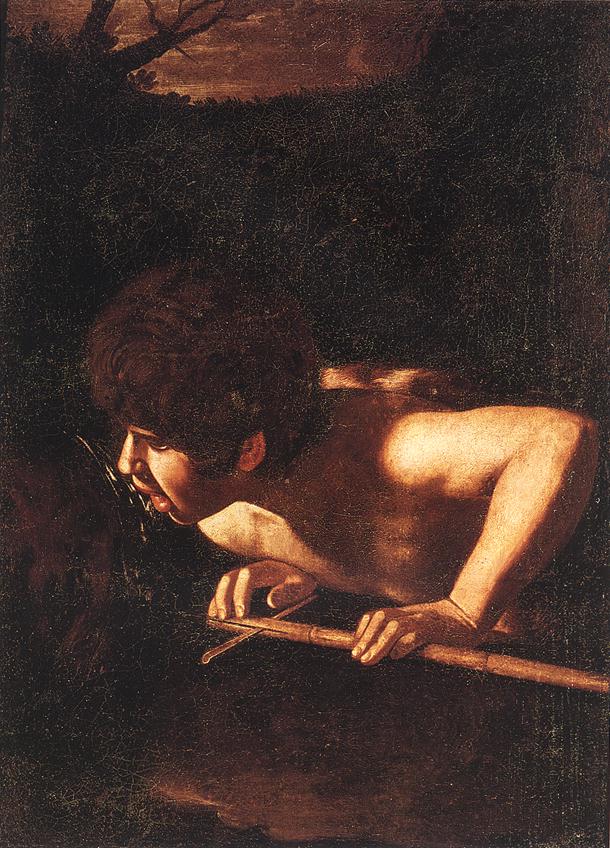
Caravaggio’s “John the Baptist” of 1608 is a compact, nocturnal meditation on prophecy, solitude, and the threshold moment before revelation. Unlike the celebrated full-length youths draped in glowing red cloaks that he painted earlier in Rome, this late vision crops tightly around a crouching adolescent who leans over dark water, his torso lit by a knife of light as if caught in an act—drinking, whispering, listening, or preparing to name the One who is to come. A slender reed runs diagonally beneath his hands, the barest signifier of the Forerunner’s identity and of the Crucifixion he will foretell. Everything else recedes into shadow. The scene reads less as a saint’s portrait than as a spiritual state: vigilance at the edge of wilderness, desire bending toward a reflective surface that both hides and reveals.
The Wilderness As Psychological Space
Caravaggio strips the wilderness to essentials: encroaching foliage, a suggestion of distant sky, and a pool of water that doubles as mirror and baptismal font. The obscurity is not a failure of detail but a moral choice. By drowning the background, he converts landscape into a mental zone—dark, uncertain, and resonant. John’s body becomes the only articulate text within this silence, a living line pitched against the thicket of darkness. The result is a wilderness experienced from the inside: not a scenic backdrop but a felt condition of exile, poverty, and alertness.
A New Kind Of Saintly Presence
Earlier treatments of John the Baptist present a poised, emblematic youth: a staff crowned with a cross, a lamb, a crimson mantle, the desert treated as a stage. Here Caravaggio relinquishes the props and theatrical distance. The boy is near, cropped at the shoulder and hip, his breath almost audible as he bends to the water. The proximity cancels the usual hagiographic remove. We meet not a type but a person surprised in meditation. It is a late-Caravaggio hallmark: the great narratives are condensed into a single gesture, and sanctity emerges from an unguarded interval rather than a public ceremony.
Gesture And The Diagonal Of Urgency
The composition runs on diagonals. The reed staff slices left-to-right; the spine tilts in the opposite direction; the thrust of the head into the dark space above the water completes a tense X. These crossed vectors give the small picture momentum, as if John were drawn forward by a force stronger than thirst. The hands—one bracing, the other negotiating the staff—anchor the figure while communicating a delicate urgency. Caravaggio’s diagonals are never mere design; they are carriers of emotion. Here they express the push and pull between caution and compulsion, between listening and proclaiming.
Chiaroscuro As Calling
The light is particular: narrowed, directional, and tactile. It grazes the boy’s shoulder, highlights the clavicle, and rides the curve of the forearm before catching the knuckles as they clutch the reed. The face is half-submerged in shadow, the eyes fixed on a point we cannot see. Such lighting dramatizes vocation. John is literally called out of darkness; his body is the path the light takes into the world. Because the illumination touches flesh rather than emblem, the painting implies that calling seizes the person first, not the office.
The Reed As Theology In A Line
The slender staff—likely a reed that will later become the Baptist’s cross-staff—is a masterstroke of compression. Fragile, common, and flexible, the reed suggests humility and instrumentality. In Scripture, reeds are shaken by the wind; in Passion imagery, a reed becomes the mock scepter of the derided Christ. Caravaggio fuses these meanings. John steadies himself upon a sign that prefigures both his own humility and the humiliation of the one he heralds. The staff’s diagonal places this theology quite literally under his hands, a line he must grasp before he can speak.
Water As Mirror, Threshold, And Test
Caravaggio’s pool is dark, almost opaque, yet it catches a faint glint where John’s face approaches it. The surface becomes a threshold between nature and the supernatural, body and voice. John may be drinking, but his posture also suggests scrutiny, as if he were searching the water for an answer. This ambiguity activates the sacramental dimension: the pool points to baptism, but before it washes others, it interrogates the Baptist himself. The water is a test—do you know who you are and what you will do?
Flesh That Knows Work And Hunger
The modeling of the body marries grace to toughness. Muscles pull across the back and shoulder with believable strain; the ribs whisper beneath the skin; the hand veins rise subtly under light. Caravaggio avoids the softened ideal of academic nudes. This youth looks capable of walking the desert, sleeping on stone, and living on locusts and wild honey. The corporeal truth grounds the spiritual theme. Prophecy, the painting insists, is not a vapor of visions but work undertaken by a body subject to fatigue, weather, and want.
Late Style: Reduction As Power
By 1608 Caravaggio’s painting had grown ever more severe. The grand Roman ensembles of a decade earlier gave way to reduced stages, sharper contrasts, and charged silences. “John the Baptist” is a paradigm of this severity. The brush turns economical; the palette tightens; the narrative is compressed into a single act. Where earlier versions display the saint like a banner, this one withdraws ornament to uncover experience. The late style does not simply darken the canvas; it clarifies purpose. The fewer the elements, the stronger the statement.
The Silence Between Prophecy And Speech
One of the picture’s quietest triumphs is its capture of the second before words. John is famed for his voice—“crying in the wilderness”—yet here he is mute. Caravaggio paints the inhale before proclamation, a sip of water, a closing of the throat, a focus of attention. The saint’s calling is audible by its suspension. This silence is dramatic because it is poised. We sense that something will be said; the reed, the wilderness, and the bent head all converge toward an utterance. By painting the vacuum before speech, Caravaggio makes the eventual cry more inevitable.
Theological Compression In A Human Interval
Caravaggio condenses the Baptist’s mission into human experience. Wilderness stands for the world’s estrangement; water for purification; reed for humility and the Passion; light for divine initiative; the youth’s body for the instrument chosen to carry the message. Yet the painting does not read as a diagram. The symbols are embedded in an unrepeatable moment: a young man leans toward water under a night sky. That union of doctrine and lived time is the artist’s singular gift—to make belief visible as a lived instant.
The Cropped Frame And The Viewer’s Involvement
The tight framing denies the viewer distance. We are placed almost at the boy’s side, close enough to feel the cool air along the water’s skin and to register the tension in his fingers. This proximity makes the scene participatory. We are not witnesses at a respectful remove but companions at the edge of the pool, enlisted into the hush. Caravaggio often uses this strategy to collapse devotional spectatorship into empathy. Here it urges us to taste the same thirst, to watch the surface for the same signal of time fulfilled.
Color As Moral Temperature
The palette is reduced to earths, warmed flesh, and the dark olive of the thicket—tones that feel sun-baked by day and cooled by night. The warmth is gathered almost exclusively in the body; the environment remains tonally austere. This asymmetry heightens the sense that life—and therefore hope—resides in the person, not the world. The minimal chroma also pushes texture and value to do the expressive work, producing a painting that communicates through temperature and weight rather than decorative hue.
Brushwork That Hides To Reveal
Much of the surface is deliberately indistinct, particularly in the foliage and sky, where the brush withdraws into dry, scumbled passages. Against this muffled ground, the modeling of flesh turns precise. Caravaggio wants the eye to rest not on leaves or clouds but on the body’s tense architecture and the hard, slick ridge of the reed. Even the reflection in the water is withheld; we see just enough to feel the interface between skin and surface. The painter’s discipline keeps our attention on the meaning-bearing forms.
Human Vulnerability As Sacred Material
Caravaggio’s saints are often young, their innocence verging on defenselessness. In this canvas the youth’s vulnerability—bare torso, exposed throat, unguarded position—is not erotic display; it is theological insistence that God chooses the weak things of the world. The body’s openness, stooped in concentration, becomes its strength. Nothing in the pose suggests triumph; everything suggests availability. The painting thereby reverses the logic of heroic display: sanctity is not a posture of dominance but of surrender to a task.
A Maltese-Sicilian Shadow Over The Image
The date invites biographical reading. In 1608 Caravaggio, embroiled in violence and flight, sought refuge among the Knights of Malta and then moved through Sicily. The sense of fugitivity saturates the image. The darkness is not only aesthetic but existential; the youth’s sidelong intentness carries the alertness of someone living in danger. Caravaggio’s own unrest may have sharpened his sympathy for figures on the brink—saints not yet enthroned but still in the act of becoming.
Dialogue With His Earlier Baptists
Comparing this painting to Caravaggio’s 1602 and 1604 versions clarifies what has changed. The earlier works stage John like a classical shepherd, centered, frontal, and illuminated in a way that celebrates youthful beauty. The 1608 canvas decentralizes him, bending the figure, dimming the color, and making light more surgical. The symbolic lamb disappears; the mantle is set aside; the desert presses closer. The figure is no less beautiful but far more intent. This evolution marks the artist’s move from emblematic declaration to existential encounter.
The Edge Between Nature And Grace
The painting lives on an edge—water’s lip, foliage’s fringe, light’s reach. John’s calling likewise inhabits a borderland between the natural and the graced. He touches water, a common element, yet the touch consecrates. He holds a reed, a simple plant, yet it carries the memory of the Passion. Caravaggio, a poet of thresholds, arranges these liminal things so that their ordinariness bears weight. Grace does not obliterate nature; it charges it with recognition. The dark clearing becomes a chapel; the boy’s breath, a prayer.
A Portrait Of Attention
Above all, the painting celebrates attention. John’s gaze is focused, his body organized around a single objective. In a world of scattered light and cluttered images, Caravaggio compels us to notice what it looks like when a person truly attends—to the water, the sign, the task. This is the moral of his late art: attention is the first act of love, and love is the only light strong enough to break a wilderness night.
Conclusion
“John the Baptist” (1608) distills a saint’s destiny into one lean, enigmatic action. By pressing the figure to the picture plane, extinguishing superfluous detail, and choreographing a network of charged diagonals, Caravaggio turns a crouched youth into an axis of meaning. The reed carries the future cross; the water holds the future rite; the light announces a future voice. Yet the picture is irreducibly present tense—now, a boy in the dark, steadying himself, learning how to listen. In that presentness lies the painting’s spiritual force. It does not flatter devotion with easy clarity; it grants us the truth that calling is born in silence, on the edge of night, when someone leans toward a surface that might be mirror, source, or both, and waits until light writes its answer on the skin.