Image source: wikiart.org
Introduction
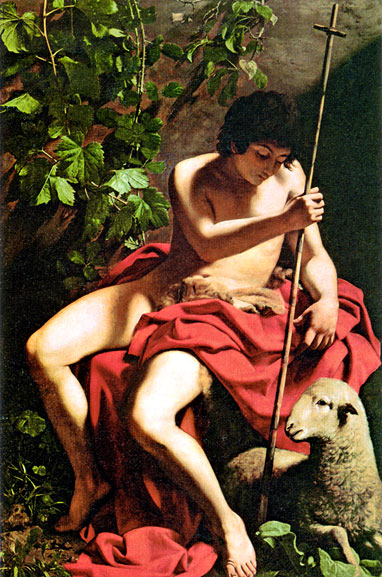
Caravaggio’s “John the Baptist,” painted in 1598, presents the forerunner of Christ as a solitary youth resting in a wild grotto. Draped in a vivid red mantle, the figure leans on a reed cross while a lamb nuzzles his knee. Rather than stage an ecstatic prophet, Caravaggio gives us a pause between tasks—a young body catching its breath, eyes lowered in inward attention. The painting condenses the saint’s identity into three essentials: the person, the wilderness, and the sign of mission. From these elements Caravaggio shapes a meditation on calling, preparing the viewer to meet not an emblem but a living presence.
Historical Context
In the final years of the sixteenth century, Rome demanded religious images that felt immediate and clear. Caravaggio answered with scenes set in recognizably human spaces and lit by believable light. “John the Baptist” belongs to this early Roman phase, when the artist explored sacred subjects through contemporary models and pared-down symbolism. The commission likely intended private devotion, which explains the intimacy of scale and the emphasis on the saint’s humanity. Instead of a heroic adult or an allegorical child, Caravaggio chooses a liminal figure—a late adolescent—whose body carries both innocence and strength. The choice suits a saint who lived between covenants and whose vocation was to prepare rather than complete.
Subject and Iconography
The essential attributes of John the Baptist are present but reduced to their most eloquent forms. The red mantle—traditionally the prophet’s garment—pooling across his lap signals the fervor of his mission. The reed cross, simple and tall, rests in his hand as both walking staff and heraldic sign, foretelling the Crucifixion he proclaims. The lamb, emblem of Christ, presses against the youth’s shin with farmyard familiarity rather than mystical glow. Wild grape leaves and coarse foliage climb the rock wall, fixing the scene in the wilderness. Caravaggio omits hair shirts, scrolls, and streams; he trusts that a few, well-seen things can carry the story without theatrical excess.
Composition and the Architecture of Stillness
The figure forms a compact pyramid anchored by the red mantle. The bent right leg projects forward; the left leg slides outward to the stone. The torso curves into a C that draws the head down toward the staff, creating a visual circuit between thought and vocation. The reed cross rises vertically, a counterpoint to the diagonal of the body, stabilizing the composition like a plumb line. The lamb’s rounded body completes a secondary triangle at the lower right, knitting the foreground. The background remains close, a wall of earth and leaves that pushes the figure toward the viewer. Everything in the design persuades the eye to move in slow, contemplative loops rather than in restless zigzags.
Chiaroscuro and the Direction of Meaning
Light enters from high left and falls across the saint’s shoulder, chest, and knees, leaving the far arm and flank in a warm darkness. This chiaroscuro is not merely dramatic; it allocates significance. The illuminated flesh declares the reality of the body chosen for prophetic work. The deep shadows behind the staff and lamb create a tonal cradle, so that those signs read with high clarity. The wilderness is darker than the youth, the world receiving the light he bears. Caravaggio avoids spotlit theatricality; the light behaves like afternoon sun filtering through leaves, yet it concentrates on what matters most—the person and the mission joined in a single posture.
Color, Fabric, and the Tactility of Calling
The palette is tuned to earth and blood. Greens and browns settle into the rock and vines; the mantle’s red pulses at the center like a heart. Caravaggio paints the cloth with weight and grain; it does not flutter like allegory but drapes like wool. The red carries multiple resonances: zeal, martyrdom foretold, and the warmth of life in a chill wilderness. Flesh tones soften where shadow kisses the skin and brighten where light skims the kneecap, rib, and shoulder. Such tactile fidelity anchors the painting’s spirituality in the feel of the world, insisting that vocation is lived through the body.
The Youthful John and the Psychology of Readiness
Caravaggio’s John is not the gaunt ascetic of later legends. He is a strong teenager, still growing into his limbs, with the relaxed exhaustion of someone who has walked far. The lowered gaze and half-turn of the head suggest thoughtfulness rather than melancholy. One hand grips the staff while the other rests lightly on the cloth—a balance between resolve and ease. The body language reads as readiness at rest, a pause rather than a retreat. The saint thinks because he has work to do; he rests because he will rise. This psychological credibility makes the picture persuasive across belief systems.
The Lamb as Companion and Prophecy
The lamb is rendered as a real animal—soft, curious, and grounded on splayed hooves. It nuzzles the saint’s shin with domestic trust, not ceremonial solemnity. In that natural behavior Caravaggio folds prophecy into affection: the lamb that signifies the future Christ is already at home with the forerunner. The calm connection between animal and human tempers the painting’s austerity; it suggests that calling, however stern, includes gentleness. The lamb’s pale fleece catches stray light and returns it to the saint’s shadowed leg, creating a visual exchange that echoes the theological one.
Wilderness and the Ecology of Grace
Caravaggio’s wilderness is not a schematic backdrop. Vines curl with botanical specificity; leaves thickly overlap, their veins and serrations catching tiny accents of light. The rock wall shows fissures and dampness. This attention to ecology matters because it relocates holiness from abstraction to habitat. John’s calling unfolds in a place with textures, smells, and temperatures. The saint does not transcend the world; he inhabits it. When the Gospel quotes him crying in the wilderness, this painting imagines the interval between cries, when the wilderness listens back.
Gesture, Anatomy, and the Body’s Grammar
The hands do much of the picture’s speaking. The left hand embraces the staff near the crossbar, thumb and fingers forming a firm ring. The right hand lies idle on the mantle, its relaxed fingers pointing toward the lamb. The shoulders slope asymmetrically, the right lifted slightly by the staff’s weight, the left released into rest. Muscles are described with the honesty of observed anatomy: the quadriceps bulge under skin; the ribs register under a thin layer of flesh; the neck cords tighten with the head’s angle. Caravaggio refuses idealized smoothness; he paints a working body, emphasizing that prophecy is carried by sinew and bone.
The Cross-Staff and the Logic of Symbol
The staff is plain reed, the crossbar lightly tied. Because its material is humble, its meaning reads with greater force. The vertical line climbs from the lamb’s nose past John’s hand to the top edge, binding the painting’s three symbolic nodes—lamb, prophet, cross—into one gesture. The cross does not dominate; it accompanies, waiting to be lifted again when the pause ends. Caravaggio’s modesty of symbol allows space for the viewer’s contemplation rather than dictating conclusions.
Time, Silence, and the Interval of Vocation
Many paintings depict John in action—preaching, pointing, baptizing. Caravaggio chooses an interval. The saint is between tasks: he has walked, he will walk; he has warned, he will warn. That interval gives the picture its emotional temperature. It is quiet but not empty, thoughtful but not withdrawn. The viewer shares in the rest and, by implication, in the readiness that follows. The red cloth suggests a cloak laid aside for a moment; the staff is not planted like a banner but held as a companion. In this grammar of in-between, Caravaggio suggests that vocation is sustained as much by pauses as by proclamations.
Comparisons and Innovation
Earlier and contemporary depictions often showed John as a boy with attributes arranged like a still-life lesson or as a gaunt ascetic bearing the full weight of prophecy. Caravaggio’s innovation lies in how he collapses symbol into person. The wilderness is not a stage set; the lamb is not a toy; the cross is not an ornament. This strategy aligns with the artist’s broader revolution—sacred subjects rendered as credible human beings in believable light. The result is a saint whose sanctity is inseparable from his body’s truth.
Technique and Paint Handling
Caravaggio constructs forms with large tonal masses and reserves crisp accents for edges where light meets shadow. The red mantle is laid in with dense body color, then enriched with glazes to achieve depth in the folds. Flesh passages are thin and translucent, allowing underpaint to warm the surface and create the bloom of living skin. Leaves and rock receive varied strokes: quick flicks for serrations, broader scrapes for stone. The lamb’s fleece is suggested rather than counted, a rhythm of short strokes that allows light to do most of the descriptive work. The staff is drawn with a single confident line, then slightly thickened to register roundness. The result is a surface that feels decisive, controlled, and responsive to light.
Theological Resonances Without Didacticism
The painting sustains rich theological meanings while avoiding didactic display. The red mantle hints at sacrifice; the lamb anticipates the Passion; the wilderness evokes purification; the cross-staff points toward the Gospel John announces. Yet these meanings arise through the scene’s naturalism rather than through an overlay of allegory. Grace appears as credibility. The viewer senses that this youth could rise, step into the light, and speak words that matter.
The Human Appeal of the Image
Even viewers unfamiliar with the saint’s story can read the painting as an image of a young person bearing responsibility. The pose of rest, the unguarded flesh, the loyal animal, the staff held like a promise—these elements speak to universal experiences of duty and pause. Caravaggio’s refusal to idealize invites empathy rather than distant reverence. The painting honors the weight of a calling by showing the cost in muscle and breath.
How to Look
Begin with the red mantle at the center and let its folds guide the eye to the hands. Follow the staff upward to the crossbar and feel how the straight reed calibrates the surrounding curves. Return along the staff to the lamb, noticing how its muzzle meets the saint’s shin and how the small glints on the eye and fleece echo the highlights on John’s knee. Move upward to the face, half shadowed, and hold there long enough to register the tilt of the head and the slight compression of the lips. Finally, step back to receive the whole as a single chord of red, flesh, green, and stone, bound by the vertical of the cross. The painting deepens with such slow reading.
Reception and Afterlife
From the seventeenth century onward, “John the Baptist” has been admired for its synthesis of contemplative mood and bodily truth. Its influence can be traced in later Baroque saints whose humanity is foregrounded and whose symbols are woven into their environment rather than displayed as trophies. Modern viewers continue to value the painting’s psychological candor and its refusal of spectacle. The image speaks across centuries because it treats sanctity as a way of being in the world rather than as a theatrical episode.
Conclusion
Caravaggio’s “John the Baptist” gathers a life into an interval of rest. A youth sits with a lamb and a staff under leaves that filter afternoon light. Nothing extraordinary happens, and yet the painting holds extraordinary force. Through composition, chiaroscuro, and tactile color, Caravaggio joins symbol to body, vocation to pause, prophecy to tenderness. The result is not a lesson pinned to a figure but a person whose presence teaches by example. In the quiet between proclamations, the saint’s readiness becomes visible, and the viewer is invited to share it.