Image source: wikiart.org
Joan of Arc in the imagination of Peter Paul Rubens
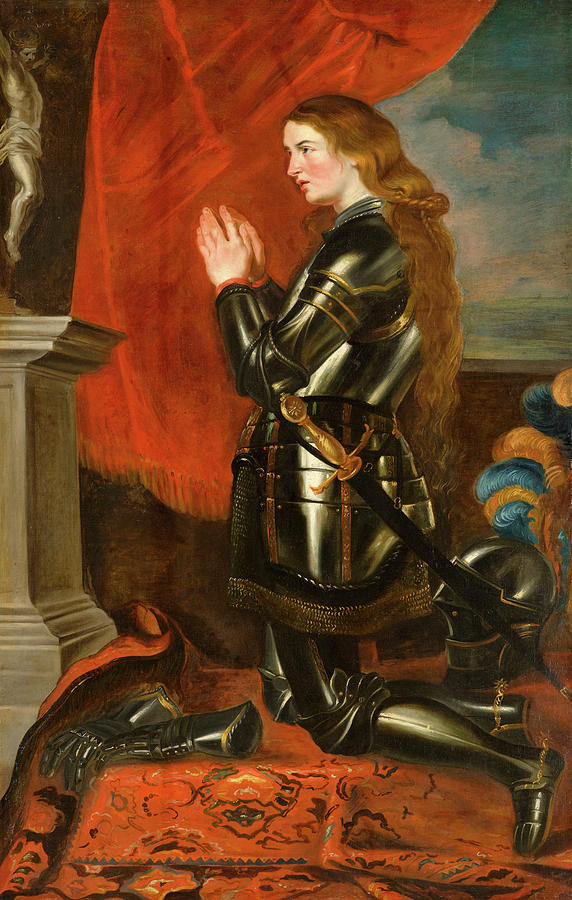
In “Joan of Arc” Peter Paul Rubens presents one of history’s most famous heroines at a moment of intense spiritual concentration. The young warrior kneels on a rich oriental carpet, clad in gleaming armor, hands joined in prayer before an altar on the left. Her flowing auburn hair cascades down her back, forming a vivid contrast with the hard reflections of steel. Behind her, a heavy red curtain sweeps across the scene, partially opening to reveal a calm blue sky.
Instead of showing Joan on the battlefield or at the stake, Rubens chooses the quiet but decisive instant when she aligns her courage with divine will. The painting reads as a meditation on faith, vocation, and the relationship between inner conviction and public action. It is both a portrait of a single woman and an emblem of Christian heroism as Rubens understood it in the Baroque age.
Composition and first impression
The composition is vertical and strongly structured. Joan occupies the center, yet slightly to the right, so that her gaze and folded hands lead toward the altar on the left. She kneels on one knee, her body in profile, facing the crucifix that stands atop a stone pedestal. The altar itself is cropped by the frame, which pulls the viewer’s attention more to Joan’s response than to the object of her devotion.
Rubens places the entire scene within a richly furnished interior. The carpet with its intricate pattern anchors the lower half of the canvas and provides a warm base of reds and oranges. The red curtain rises behind Joan like a wall of color, then curves inward toward the altar. The background opens at the right, where a patch of sky suggests the world outside that awaits Joan’s actions.
This architecture of color and form creates a sense of depth and drama. The eye travels from the crimson curtain to the shining armor, then to the pale oval of Joan’s face. From there it moves toward the pale Christ figure on the crucifix. The kneeling posture, the diagonal of the sword, and the placement of the discarded helmet and gauntlets all reinforce the idea that Joan has paused in the midst of warfare to pray.
Joan of Arc as warrior and saint
Rubens captures the dual nature of Joan’s identity. She is both a warrior who leads armies and a saintly figure guided by visions. The armor she wears signals her military role. It covers her torso, arms, and legs in dark steel with gold accents and leather straps. At the same time, her uncovered head, delicate features, and flowing hair identify her as a young woman rather than a generic soldier.
Her face is turned toward the altar with a serious, concentrated expression. There is no hysteria or ecstatic trance. Instead Rubens portrays a measured yet fervent devotion, suggesting that Joan’s legendary voices and visions have been integrated into a firmly grounded faith. This mixture of martial strength and spiritual purity embodies the ideal of a Christian knight who fights not for personal glory but for a divine mission.
The kneeling posture is crucial. It signals humility before God even as it shows the prowling strength of a body ready to rise and act. Joan’s straight back and firmly planted leg reveal an inner discipline. She has not collapsed in submission; she kneels deliberately, as if offering her abilities to a higher command. Through this pose Rubens communicates that true heroism for Joan involves both obedience and initiative.
The language of armor and weaponry
Rubens delights in the visual possibilities of armor. The steel plates reflect streaks of light, tracing the curves of joists and the ridges of gauntlets. Golden rivets and bands decorate the dark surface, while delicate fringe of chain mail lines the skirt and sleeves. The armor is not simply a costume; it is a sculptural form that defines Joan’s body as powerful and protected.
The open helmet and gauntlets placed on the carpet near her serve as important symbols. By removing these pieces she has literally put aside part of her defense in order to pray. Her head is uncovered, exposing her vulnerability before God. The gauntlets, which would grip weapons and reins, lie folded on the ground. This arrangement suggests that for a moment Joan has suspended her martial activity to engage in spiritual dialogue.
The sword strapped at her side, however, remains. Its presence indicates that she has not abandoned her mission. The blade is partially visible, the hilt richly ornamented. The diagonal line it forms across her body adds dynamism to the composition. It is as if the potential for action still hums beneath the stillness of prayer. The weapon becomes an extension of her vocation rather than an instrument of personal aggression.
Prayer, devotion, and the altar
At the left of the painting stands a stone altar topped by a crucifix. The figure of Christ is small yet distinct, with pale body and outstretched arms. The altar is carved with classical mouldings, suggesting the continuity of the Church through history. There may also be a cloth draped over it, though much of the surface lies in shadow.
Joan’s hands are folded in front of her chest, fingertips gently touching. The gesture is precise and controlled, with fingers elongated and palms slightly parted. This traditional posture of prayer conveys reverence and concentration. Rubens carefully aligns her hands with the vertical of the crucifix so that the two elements visually echo each other. Her devotion is thus directed and focused.
The red curtain behind the altar plays an important symbolic role. In many religious paintings such drapery evokes the veil of the temple that was torn at the moment of Christ’s death, opening access to the divine. Here the curtain also serves a theatrical purpose, framing the sacred space and separating it from the surrounding world. It creates a stage for Joan’s spiritual encounter, as if we are witnessing a private drama between soul and savior.
Color, light, and Baroque atmosphere
Rubens uses color to balance fervor with serenity. The dominant hue is the red of the curtain and carpet, which conveys passion, sacrifice, and royal dignity. These intense reds contrast with the cool blues and greys of the sky and the stone architecture, producing a rich harmony that is typical of Baroque painting.
Light enters the scene from the upper left, washing over Joan’s face and armor. The reflections on the steel are crisp and bright, giving the armor a polished, almost liquid quality. This play of light suggests both earthly illumination and spiritual grace. Joan appears literally enlightened, as if the divine presence she adores is also shining upon her.
The background is relatively subdued, which keeps the viewer’s attention on the kneeling figure. Rubens avoids clutter in the surrounding space, allowing the interplay of color and light around Joan to carry the emotional weight. The result is an atmosphere that feels both intimate and grand. The painting has the theatrical energy of the Baroque, yet the mood is contemplative rather than chaotic.
Drapery, textiles, and the staging of power
The red curtain and the patterned carpet are more than decorative details. They help define Joan’s social and spiritual status. In early modern Europe, oriental carpets and heavy drapery were associated with wealth and high rank. By placing Joan upon such an opulent surface and before such a curtain, Rubens aligns her with royal imagery. She may be a simple peasant girl by birth, but in this painting she carries the dignity of a princess or knight of high order.
The folds of the curtain swing diagonally, echoing the movement of Joan’s hair and reinforcing the vertical structure of her body. The fabric appears thick and heavy, yet it undulates as if moved by an unseen air. This subtle motion energizes the background, suggesting that the spiritual forces at work in Joan’s prayer extend beyond her private thoughts.
The carpet, with its complex geometric design, creates a stable horizontal foundation. It also provides a warm field of color that frames the discarded helmet and gauntlets. Their dark metal shapes stand out against the saturated reds and oranges, making sure that the viewer notices their symbolic significance. At the same time the carpet softens the hardness of the stone floor, giving Joan’s kneeling posture a sense of comfort and reverence rather than punishment.
Gesture, expression, and inner psychology
Rubens was renowned for his ability to communicate emotion through gesture and facial expression. In this painting he chooses a restrained yet eloquent approach. Joan’s face is calm, her lips slightly closed, her eyes directed toward the crucifix. There is no dramatic tear, no exaggerated ecstasy. Instead we see a look of steady concentration, as if she is listening attentively to an inner voice.
Her slender hands, held at chest level, express the intensity of her petition. The fingers are pressed together but not clenched. This suggests that her prayer is earnest but not desperate. She appears confident in the power of the one she addresses. The angle of her arms, forming a gentle triangle, guides the viewer’s gaze up from the armor toward the face, linking physical strength with spiritual focus.
Her body language reveals both reverence and readiness. The forward bend of her torso acknowledges the sacred presence on the altar, while the firmly planted rear leg keeps her balanced. She could rise at any moment, ready to return to the field with renewed purpose. Through such subtle cues Rubens visualizes the psychological tension between contemplation and action that defines Joan’s life.
Rubens, chivalry, and the heroic woman
Although Rubens painted many scenes of warriors, rulers, and saints, depictions of female knights are relatively rare in his work. His Joan of Arc therefore carries a special resonance. She embodies the ideal of chivalry yet remains distinctly feminine in appearance. Her long hair flows freely, and her features are soft. Rubens does not disguise her gender beneath the armor; he celebrates it.
This fusion of feminine beauty and martial strength reflects Baroque fascination with complex heroism. Joan is not a simple stereotype of a fragile maiden or a fierce amazon. She is a believer whose courage flows from her spiritual conviction. By presenting her in a moment of prayer rather than in combat, Rubens emphasizes that her victories are grounded in obedience to God rather than in raw force.
At the same time, the meticulous depiction of her armor and weaponry affirms her legitimacy as a military leader. Rubens avoids any hint of costume play. The equipment looks functional and weighty. He thereby honors the historical Joan’s achievements while aligning her image with broader early modern ideas of virtuous governance and divinely guided warfare.
Spiritual narrative and the viewer’s experience
For viewers of Rubens’s time, this painting would have offered both inspiration and instruction. The kneeling Joan serves as a model for how a Christian warrior should approach combat. Before taking up sword and helmet, she kneels before the crucifix, seeking direction from Christ’s sacrifice. The narrative implied by the composition is simple yet powerful: prayer first, action second.
The viewer is invited to kneel with her in imagination. The vertical format, the low placement of the altar, and Joan’s side profile all create space for the spectator to stand just behind her, sharing her line of sight toward the crucifix. In this way the painting functions like a visual guide to devotion. It suggests that any believer faced with difficult tasks can imitate Joan’s posture and attitude.
At the same time the painting reassures its audience about the compatibility of faith and political or military responsibility. Joan’s armor is not removed or cast aside. It remains on her body, polished and ready. The message is that one can serve God even in the realm of war and politics, provided that one submits all plans to divine judgment.
Legacy and contemporary relevance
Today, “Joan of Arc” by Peter Paul Rubens continues to fascinate viewers because it combines historical legend with timeless spiritual questions. The painting does not recount specific episodes from Joan’s campaigns. Instead it condenses her story into a single archetypal moment: the encounter between a called individual and the crucified Christ.
For modern audiences, the image invites reflection on vocation, conscience, and courage. Joan’s kneeling figure suggests that genuine strength arises from deep inner alignment with one’s beliefs. Her readiness to act after prayer can speak to anyone who wrestles with the challenge of living out convictions in a complex world.
Rubens’s artistry ensures that these themes are conveyed with visual richness. The glowing armor, the vibrant curtain, the crisp reflections, and the carefully staged gestures all contribute to a sense of living presence. Although centuries separate us from the artist and his subject, the painting still feels immediate. We can sense the quiet intensity of Joan’s prayer and the weight of the decisions that lie before her.
In this way, Rubens’s “Joan of Arc” stands not only as a Baroque masterpiece but also as a lasting image of faith under tension. It reminds viewers that heroic action often begins in a private moment of kneeling, where ambitions, fears, and hopes are laid before the crucifix, and where a solitary figure listens for the call that will send her back into the world.