Image source: wikiart.org
Introduction
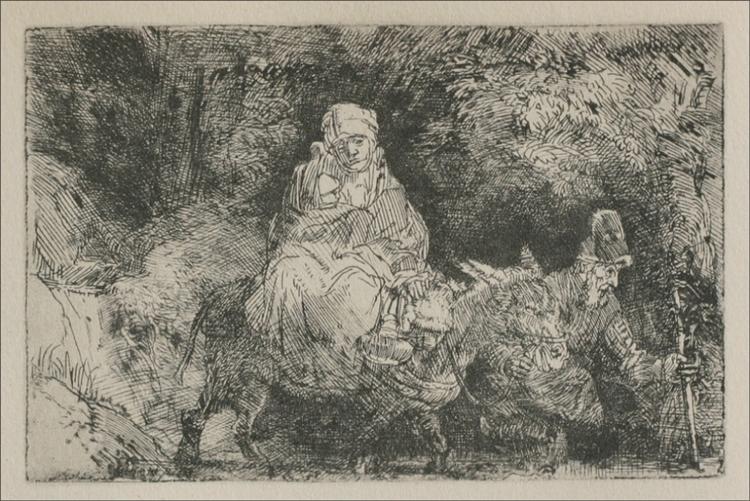
“Jesus and His Parents Returning from Jerusalem” (1654) is a compact etching in which Rembrandt distills tenderness, fatigue, and the slow dignity of ordinary travel into a few vibrating lines. Drawn from the Gospel narrative that follows the twelve-year-old Jesus’ encounter with the doctors in the Temple, this sheet shows the Holy Family after reunion, threading their way through a dark wood along the long road home. Mary rides a small donkey, the boy gathered close; Joseph, staff in hand, feels the ground ahead and shoulders the practical burden of the journey. Around them foliage thickens like a curtain, and the air seems to hum with the rustle of leaves and the muffled clop of hooves. It is a scene of return rather than spectacle, and in that choice Rembrandt reveals his lifelong preference for the human scale of sacred history.
The Gospel Context and Rembrandt’s Chosen Moment
Luke’s account tells of a Passover trip to Jerusalem during which Jesus stays behind, absorbed in conversation with teachers. After three days of searching, Mary and Joseph find him; he goes back with them to Nazareth. Rembrandt does not replay the moment of astonished discovery or the public disputation. He chooses the very next chapter of feeling: the quiet re-gathering of a family as they resume the road. The narrative has already shifted from public amazement to private care. Mary holds the child close in the saddle; Joseph leans forward, guiding and testing the path. The scene becomes a moral image of how understanding is carried into life: not with trumpets but with footsteps.
Composition and the Rhythm of Movement
The composition operates like a low, steady musical phrase. A broad dark mass of foliage fills the upper half of the plate, pressing downward; within that canopy the group slides from left to right along a shallow diagonal. Mary and Jesus form the central weight, an oval of softly hatched cloth atop the patient donkey. Joseph is a taut counter-shape at the right, crouched and forward-leaning, staff angled toward the ground. The animals’ legs and Joseph’s stride echo each other, establishing a synchronized rhythm of “step, step, feel.” Rembrandt keeps the ground plane near the lower edge, so the trio seems to skim along the base of the image, emphasizing continuity and pace over destination.
Light, Shadow, and the Shelter of the Trees
The etching’s tonal drama comes from the canopy of shadow that almost swallows the travelers. Yet Rembrandt opens pockets of light—on Mary’s headscarf, along the child’s profile, and on Joseph’s hat and knuckles—that breathe the group into visibility. The wood becomes more than background; it is shelter. Leaves knit into an upper vault, their stippled marks producing a muffled atmosphere, while the lower half of the sheet retains crisp line for figures and animal. That balance between soft, enveloping tone and etched clarity creates the sensation of moving within dappled shade, where perception focuses on the near and dear.
The Donkey as Partner in Care
Rembrandt’s donkey is small, sturdy, and essential. Its head dips, ears alert, legs planted in a practical beat that keeps the family steady. He etches the animal with affectionate economy—few strokes to catch the rough coat, a firm contour to set the shoulder and flank. The donkey’s patience becomes a visual metaphor for the road itself: not heroic, but faithful. In many Holy Family journeys the animal is a narrative convenience; here it is a participant, its tempo setting the family’s shared breath.
Mary’s Presence and the Work of Holding
Mary is wrapped and seated, the body of the boy gathered into her lap. Rembrandt draws her not as a distant icon but as a mother who has recovered a lost child and now refuses to let him slip from touch. Her head inclines slightly forward, and the tilt suggests both tiredness and inward prayer. The folds of her garment fall in long, steady hatches, a textile echo of the path’s longness. Her role in the composition is architectural: she is the stable central mass around which the motion arranges itself. The emotional register is quiet relief—relief that does not erase worry, but steadies it.
Joseph’s Vigilance and the Staff as Line of Duty
At the right margin Joseph bends into the step, a figure of guidance. The staff he grips is a piece of drawn geometry—a straight, vertical accent that interrupts the soft forest textures and affirms human intention within nature’s dimness. His hat’s brim casts a shadow across his face, so identity dissolves into function: protector, path-finder, bearer of pace. The crouch that Rembrandt gives him, almost a shepherd’s stoop, conveys two truths at once: the road is uneven and must be tested; the parent’s patience must lean into difficulty without complaint.
The Child Between Listening and Rest
Nestled into Mary’s arms, Jesus is small, almost a bundle of cloth and profile. Rembrandt understands that after the Temple’s public brightness, the boy now inhabits a different kind of light: the reflective hush of return. The child’s cheek, indicated by a few clean lines, is turned toward the path ahead; he is not asleep but sensing. That poised quiet—between rest and attention—aligns with Luke’s remark that he “grew in wisdom.” The etching makes growth visible as a shared rhythm rather than a solitary leap.
The Language of Line and the Feeling of Breath
This small plate is a study in Rembrandt’s late etching touch. The forest canopy is knit from short, broken strokes that print as a soft burr of darkness; the ground is articulated with longer parallel hatches that glide under hoof and foot; the figures are drawn with a mixture of clipped contours and scumbled interiors that conjure textile and flesh. There is a remarkable economy here. With a handful of marks the artist evokes the thud of steps, the creak of harness, the rustle of leaves pressing close. The entire scene feels made of breath—pressing in, letting out, pressing in again.
Space, Scale, and Intimacy
Rembrandt keeps the far distance largely out of view. There is no dramatic horizon, only a suggestion of thinning foliage at the right and an opening beyond the tree trunks. This spatial decision keeps the viewer close to the travelers. We are not placed as distant spectators; we are walking alongside. The print’s small size intensifies that intimacy, as if one held a travel diary page where a friend had sketched, mid-journey, the companions up ahead. Sacred art seldom feels this neighborly, and that is precisely the point: the holy passes within touching distance.
The Ethics of Smallness
The modest format and humble subject matter perform an ethic. There is no pageant, no architectural grandeur, no torrent of discourse. Instead we are given ordinary care in motion. The miracle, if one insists on finding it, is not in spectacle but in the steadfast work of returning together. By devoting exquisite attention to small gestures—Joseph’s testing staff, the donkey’s patient hoof, Mary’s enclosing arm—Rembrandt argues that fidelity is the form revelation takes once the crowd has dispersed.
A Dialogue with Other Holy Family Journeys
Rembrandt etched the Flight into Egypt in several moods—nocturnes with lantern light, broad daylit landscapes where the family is a tiny bundle against distance, and intimate scenes like this one where foreground texture becomes the world. Compared with those versions, “Jesus and His Parents Returning from Jerusalem” is warmer and more domestic. The threat is gone; what remains is the work of keeping together. The artistic language shifts accordingly: dramatic chiaroscuro gives way to a soft canopy; perilous cliffs are traded for close leaves and undergrowth. The difference clarifies the narrative: not every journey is a flight; some are the slow knitting of life after astonishment.
Dutch Eyes on a Biblical Road
The clothing, staff, and even the donkey carry northern flavor rather than archaeological accuracy. Rembrandt translates the episode into the visual vocabulary of his own time so that the story feels current. Seventeenth-century viewers would have recognized the types instantly: the laboring father, the wrapped mother balanced on a small mount, the family pushing through a wood at evening. Such translation is not historical indifference; it is a theological wager that the sacred can be recognized in the garments and trees one knows.
Time, Pace, and the Psychology of Return
There is a palpable sense of time here—long hours still to be walked. The repeated diagonals in foliage and ground create a sotto voce momentum; the figures’ compact clustering suggests the body’s wish to stay close after separation. The psychology of return is different from the psychology of departure: speech quiets, touch increases, pace steadies. Rembrandt’s composition reads that truth. The boy’s head is close to Mary’s shoulder; Joseph’s hand does not simply hold the staff, it tests with it. The scene teaches patience more than plot.
Plate Tone and the Weather of the Image
Many impressions of the print preserve a veil of plate tone in the upper half of the sheet. That translucent gray air makes the foliage feel thicker and the space feel humid, as if the family were passing through the breath of the trees. Against that weather, the lightly wiped faces and the glint along the staff register as small clarities—moments when vision sharpens. The technical choice doubles as narrative: travel is a sequence of such sharps within the overall blur of distance.
The Dog That Isn’t There and the Sense of Sound
Some of Rembrandt’s related travel scenes include a dog nosing along the path, an emblem of domestic continuity. Here there is no dog, but the ground is etched with such lively, tap-like strokes that one almost hears a little trotter beneath the donkey. The print’s power comes partly from these synesthetic cues. The dark canopy makes a soft hiss; the short marks at the donkey’s legs tick like steps; the angled staff clicks against stone in the imagination. We are not only seeing; we are hearing the road.
Theological Undercurrents Without Emblems
There is no halo, no Temple façade, no inscribed motto. The theological meaning is embodied rather than announced. The child who speaks wisdom in the public house now learns obedience in the private company of those who love him. The parents who feared loss embody care not through speech but through shared motion. The God who acts in history also inhabits the small, human scale of travel. Rembrandt’s refusal of overt emblem lets these truths arrive as experience rather than lesson.
A Contemporary Reading
Seen now, the image has durable relevance. It honors the moments after crisis when families simply keep going. It suggests that reconciliation finds its shape in ordinary tasks—testing a path, holding a child, keeping pace with a mount. It validates the quiet heroism of returning to routines after public drama, when fatigue and love must share the same step. In an age that prizes spectacle, this small etching defends the holiness of the unremarkable.
Conclusion
“Jesus and His Parents Returning from Jerusalem” is an exquisite exercise in restraint and empathy. With a canopy of softly murmuring foliage and a handful of decisive lines, Rembrandt gives us the moral music of a family’s walk: the press of closeness after fear, the forward lean of responsibility, the patient measure of an animal that carries more than weight. The print proves that sacred art can be at its most persuasive when it stops explaining and simply accompanies. We leave the scene feeling we have walked a little way with them, and that is precisely Rembrandt’s gift—turning viewers into companions on the road where understanding becomes life.