Image source: wikiart.org
Introduction
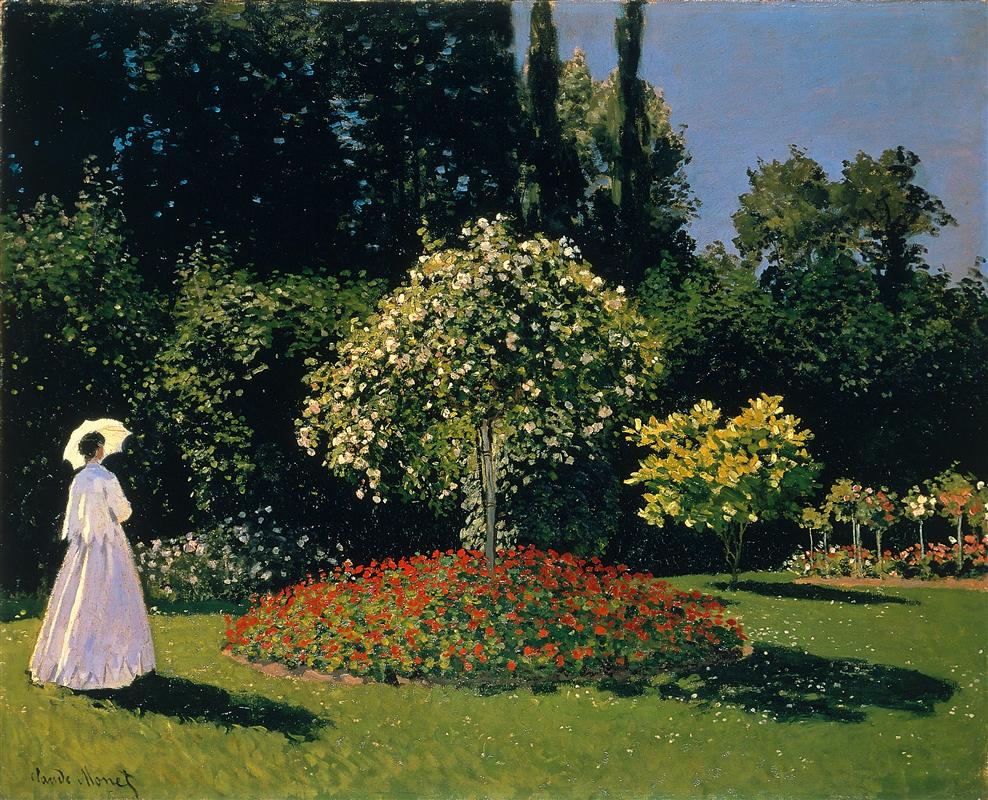
Claude Monet’s Jeanne-Marguerite Lecadre in the Garden from 1866 is a painting that reveals how much the artist could accomplish before Impressionism had fully taken shape as a named movement. At first glance, the work seems quiet and simple. A woman in a pale dress and hat stands at the left side of the composition, facing inward toward a sunlit garden. Around her, Monet arranges trimmed grass, flower beds, shrubs, and dense trees. The scene feels calm, domestic, and private. Yet within that apparent stillness, the painting already contains many of the qualities that would define Monet’s mature art: a sensitivity to natural light, a fascination with fleeting visual effects, a love of outdoor painting, and an ability to transform an ordinary moment into something radiant and memorable.
What makes this work especially compelling is the tension between order and sensation. The garden is cultivated and carefully arranged, but Monet does not paint it with cold precision. Instead, he lets light dissolve outlines and allows patches of color to build form through atmosphere rather than strict drawing. The figure is clear enough to anchor the scene, but she is also part of the garden’s visual rhythm, almost absorbed into the larger play of foliage, bloom, sunlight, and shadow. This is not simply a portrait placed outdoors. It is an exploration of how a person exists within an environment, and how the eye experiences that environment in real time.
The painting also gives us a glimpse of Monet at a transitional moment. He was still a young artist, still negotiating between established conventions and his own emerging vision. In this picture, he proves that he can organize space, render a recognizable figure, and create a carefully balanced composition. At the same time, he is already moving toward a freer, more optical kind of painting in which color, light, and direct observation matter more than academic finish. The result is a work that feels both rooted in mid nineteenth century painting and strikingly modern.
Monet in 1866
The year 1866 was important in Monet’s development. He was still early in his career, but he had already begun pushing against academic expectations. Rather than treating landscape as a background for grand stories or idealized scenes, he approached it as a living field of perception. Nature was not merely a setting. It was the subject itself. Even when a person appears in the composition, as in this painting, the landscape carries equal if not greater emotional and visual importance.
In the mid 1860s, Monet was increasingly interested in painting modern life outdoors. He wanted to capture actual light rather than studio formulas for light. He wanted air, season, weather, and time of day to register on the canvas. This desire set him apart from more conventional painters of the period, who often preferred carefully controlled studio finishes. Monet’s outdoor practice gave his work an immediacy that can already be felt here.
This painting belongs to a phase when Monet was still attentive to figure painting, costume, and social setting. The white dress and hat are not incidental details. They locate the sitter within contemporary bourgeois life and suggest leisure, refinement, and seasonal elegance. Yet Monet does not present Jeanne-Marguerite Lecadre in the stiff manner of a formal society portrait. He places her in a lived environment, not in an abstract or staged interior. The garden becomes the real subject of experience, while the woman becomes the human measure through which we enter that experience.
That balance is crucial. The work shows that Monet had not yet abandoned traditional concerns, but he was already bending them toward something more observational and atmospheric. He treats the scene not as a narrative event but as a visual encounter. We are not told a story. We are invited to look.
Composition and Spatial Design
One of the most impressive features of Jeanne-Marguerite Lecadre in the Garden is the intelligence of its composition. Monet builds the image through large zones of contrast and carefully placed accents. The figure stands on the left, near the edge of the canvas, leaving most of the pictorial space open to the garden itself. This decision immediately shifts the painting away from a conventional portrait arrangement. The woman is important, but she does not dominate the scene. Instead, she functions as a visual entry point.
From her white dress, the eye moves toward the central flowering tree, which rises above a circular bed of vivid red flowers. This central motif acts as the painting’s compositional core. It stabilizes the scene while also drawing attention to Monet’s interest in layered color and texture. The rounded red bed below the flowering tree provides a strong horizontal anchor, while the trunk and blossoms above introduce a vertical lift. Behind this, darker masses of foliage form a shadowed wall that frames the brighter middle ground and intensifies the luminous effect of the sunlit areas.
The composition is especially effective because Monet avoids symmetry while maintaining balance. The figure on the left is countered by the brighter shrubs and flower beds on the right. The dark trees in the background are broken by vertical forms that rise into the sky, creating variation and preventing the backdrop from becoming static. Small passages of open blue sky at the top right offer relief from the density of the foliage and help the entire scene breathe.
There is also a subtle play between openness and enclosure. The foreground lawn appears open and inviting, but the dense background trees create a sense of privacy and protection. The garden feels intimate, almost secluded. This gives the painting a contemplative mood. It is not a public park filled with activity. It is a private world of cultivated beauty and personal reflection.
The Figure as Presence Rather Than Narrative
Jeanne-Marguerite Lecadre is not shown in an expressive pose or dramatic action. She stands quietly, turned away from us, seemingly absorbed in the garden. That restraint is one of the painting’s greatest strengths. Monet does not ask the figure to perform. He allows her simply to be present. Because of this, the painting acquires a sense of authenticity and calm observation.
The fact that the figure is turned inward rather than outward matters a great deal. She is not engaging the viewer directly. She does not return our gaze. This means the painting avoids the confrontational or social dynamics of many portraits. Instead, we observe someone who is herself observing. That creates a reflective chain of looking: Monet looks at Jeanne-Marguerite in the garden, she looks into the garden, and we follow that direction of attention. The result is a gently meditative experience.
Her pale dress plays an important visual role. Against the surrounding greens and dark shadows, the white fabric becomes a luminous shape. It catches the light and immediately distinguishes the figure from the foliage, yet it also harmonizes with the flowering tree at center, whose pale blossoms echo the brightness of her clothing. This linking of figure and garden is central to the painting’s unity. Jeanne-Marguerite is not isolated from nature. She is visually woven into it.
There is also a modern quality in the way Monet handles her presence. He does not overdefine facial features or force psychological interpretation. The figure remains somewhat generalized, but not vague. This approach allows the painting to retain both specificity and openness. She is a particular person, yet she also becomes a type: the modern woman at leisure in a cultivated outdoor space, an embodiment of stillness within the moving life of light.
Light, Color, and the Garden’s Atmosphere
Light is the true protagonist of this painting. Monet uses it not merely to illuminate objects but to organize the entire emotional and visual structure of the scene. Sunlight strikes the lawn, catches the dress, touches the blossoms, and creates sharp passages of shadow that stretch across the ground. Instead of flattening the garden into decorative pattern, this light gives it atmosphere, depth, and time.
The color relationships are especially beautiful. Greens dominate, but they are never monotonous. Monet varies them constantly, moving from deep bluish greens in the shadowy trees to warmer yellow greens in the sunlit shrubs and grass. These variations suggest not only different plant species but also different intensities of light. The eye senses the temperature of the air through color alone.
The red flower bed at the center is one of the painting’s boldest decisions. It introduces a striking complementary contrast against the surrounding greens. Yet the red does not overwhelm the composition because Monet breaks it into many small touches. The flowers flicker rather than solidify. They create vibration on the surface, anticipating the broken color that would become even more prominent in later Impressionist painting.
The white blossoms of the central tree are equally important. They act like a bridge between the figure’s dress and the surrounding vegetation, and they also catch the light in a way that softens the scene’s darker passages. Monet is not just painting flowers as botanical details. He is painting how blossoms register in sunlight, how they scatter light across a leafy mass, how they seem to shimmer between form and atmosphere.
Even the sky is handled with restraint and intelligence. It appears only in limited passages, but those glimpses of cool blue are enough to prevent the background from becoming too closed. The sky also sharpens the silhouette of the tall trees, giving the upper part of the composition a vertical elegance that balances the horizontal calm of the lawn and flower beds.
Brushwork and the Material Life of the Surface
Although this painting still retains more structure than many of Monet’s later works, the brushwork already shows his movement toward a freer handling of paint. He does not labor over every leaf or petal in a polished academic way. Instead, he suggests forms through touches, dabs, and strokes that retain their individuality. The paint surface feels alive because it records the act of seeing as well as the act of making.
In the foliage, Monet uses clustered brushmarks to create density without rigidity. Leaves are implied through repeated touches of green, yellow, and dark blue rather than outlined one by one. This method allows the vegetation to feel organic and moving. It also keeps the eye active, since the viewer must participate in assembling the forms from color and texture.
The figure’s dress is treated differently but with equal sensitivity. The fabric is shaped through light and shadow, with folds indicated by fluid strokes rather than hard contours. The whiteness of the dress is not a blank flat tone. It contains subtle inflections of lavender, cream, gray, and pale blue, which help the garment respond to the surrounding light. Monet understood that white in nature is never simply white. It absorbs and reflects the colors around it.
On the lawn, scattered touches of paint create a sparkling surface effect. Small highlights suggest sunlight glancing off blades of grass or tiny blossoms scattered in the field. The shadows across the foreground are especially effective because they are not just dark patches. They are colored shadows, infused with blue and green, and they maintain a sense of transparency rather than heaviness.
This brushwork gives the painting a double identity. From a distance, the scene appears coherent and calm. Up close, it dissolves into energetic marks and chromatic decisions. That tension between unity and fragmentation is one of Monet’s great contributions to modern painting. He teaches the viewer that a painting can be both a convincing scene and a visible arrangement of paint.
Nature, Cultivation, and Modern Leisure
The setting of the painting is not wild nature. It is a garden, a shaped and maintained space where nature has been guided by human taste. This distinction matters because it places the work within the culture of nineteenth century leisure and domestic life. Gardens like this represented refinement, comfort, and controlled beauty. They were spaces where one could enjoy nature without confronting its harshness.
Monet seems fully aware of this cultural dimension, but he does not reduce the garden to a social symbol. Instead, he uses its cultivated order as a framework for sensory experience. The circular flower bed, trimmed lawn, and arranged shrubs all suggest design, yet Monet’s painting transforms that design into something atmospheric and living. The garden is ordered, but it is not static. Light changes it from moment to moment.
The woman’s presence reinforces this idea of modern leisure. She is not working in the garden. She is walking or standing within it, enjoying it. Her stillness suggests contemplation rather than activity. In that sense, the painting becomes a study of quiet privilege, but not in a harshly critical way. It is more interested in how modern life creates spaces for looking, pausing, and feeling the day.
There is a broader significance here as well. Monet and the artists who would become known as the Impressionists were deeply interested in the visual world of contemporary life, including gardens, promenades, riversides, train stations, and suburban retreats. These places reflected the changing rhythms of modern society. Jeanne-Marguerite Lecadre in the Garden belongs to that emerging sensibility. It shows that even a secluded family garden could become a site of modern vision.
The Mood of Silence and Intimacy
One of the most memorable aspects of the painting is its emotional restraint. Nothing dramatic happens. There is no overt storyline, no theatrical gesture, no symbolic excess. Instead, the work offers a feeling of silence. That silence is not empty. It is full of atmosphere, shade, fragrance, and suspended time.
The dark background foliage plays a major role in creating this mood. Those deep greens and near blacks form a protective screen behind the brighter parts of the scene. They make the garden feel sheltered from the outside world. Against that dark enclosure, the sunlight on the figure and flowers seems even more precious, as though it were a temporary gift.
The painting’s intimacy also comes from scale and attention. Monet is not trying to overwhelm us with spectacle. He asks us to notice the contrast between a white dress and a shaded hedge, between red flowers and green grass, between stillness and light movement. The emotional power of the painting lies in its concentration on modest things fully seen.
Because Jeanne-Marguerite turns away from us, the scene becomes inward rather than social. We do not interrupt her. We share her absorption. The painting becomes a visual equivalent of a quiet pause in the day, the kind of moment that might easily be forgotten in life but is preserved here through art. Monet shows how painting can dignify such moments without exaggerating them.
A Glimpse of the Future Impressionist
Although this painting predates the first Impressionist exhibition by several years, it already contains much of what would later define Monet’s mature style. The outdoor setting, the prioritizing of light, the broken touches of color, the interest in modern life, and the refusal of heavy narrative all point forward. At the same time, the work still holds onto a stronger compositional clarity and figure presence than some of Monet’s later canvases.
This combination makes the painting especially valuable. It allows us to see Monet in motion. He is not yet the painter of dissolving haystacks, water lilies, and cathedral facades, but the seeds of that vision are here. He is learning how to let the eye, rather than academic convention, guide the construction of the image. He is learning that color relationships can carry structure. He is learning that atmosphere can be more compelling than finish.
The painting also reminds us that Impressionism did not appear out of nowhere. It emerged gradually through works like this, where artists tested new ways of seeing while still negotiating older pictorial traditions. Jeanne-Marguerite Lecadre in the Garden stands at that fertile threshold. It is both accomplished in itself and historically revealing.
Why the Painting Still Matters
This painting still feels fresh because it captures something fundamental about perception and memory. Many people know the experience of standing in a garden on a bright day and feeling that the scene is somehow more vivid than words can explain. Monet translates that experience into paint. He does not record every detail equally. He selects, simplifies, and intensifies, allowing the viewer to feel the atmosphere rather than merely inspect the setting.
The work also remains moving because of its humanity. Jeanne-Marguerite Lecadre is not dramatized or idealized into abstraction. She is simply there, part of a world of light and growth. That simplicity gives the painting emotional durability. It speaks not through grand symbolism but through attentive observation.
For viewers interested in Monet’s development, the painting offers an essential early chapter. For viewers who love gardens, it offers beauty and serenity. For viewers interested in nineteenth century modernity, it offers an image of cultivated leisure shaped by contemporary fashion and private space. And for anyone drawn to painting itself, it offers a masterclass in how composition, light, and brushwork can turn an ordinary subject into a lasting work of art.
Conclusion
Jeanne-Marguerite Lecadre in the Garden is a remarkable early Monet because it joins intimacy with innovation. It presents a quiet garden scene, yet within that scene Monet explores some of the most important problems of modern painting: how to render light truthfully, how to build form through color, how to place a figure within an environment without reducing either one, and how to make a brief everyday moment feel enduring.
The painting’s beauty lies in its balance. It is controlled but not rigid, descriptive but not overworked, elegant but not artificial. The woman in white, the flowering tree, the red bed of blossoms, the sunlit grass, and the enveloping dark foliage all work together to create an image of extraordinary calm and visual richness. Monet does not force meaning on the scene. He allows meaning to emerge through looking.
In doing so, he reveals a truth that would guide much of his later career: the visible world is never static. It is shaped by light, weather, time, and attention. A garden is not just a garden. A figure is not just a figure. Everything is transformed by the act of perception. That insight gives Jeanne-Marguerite Lecadre in the Garden its lasting power. It is not only a beautiful painting of a woman outdoors. It is an early declaration of Monet’s lifelong belief that painting can make us see the living world more fully.
