Image source: wikiart.org
Claude Monet and the Significance of an Early Still Life
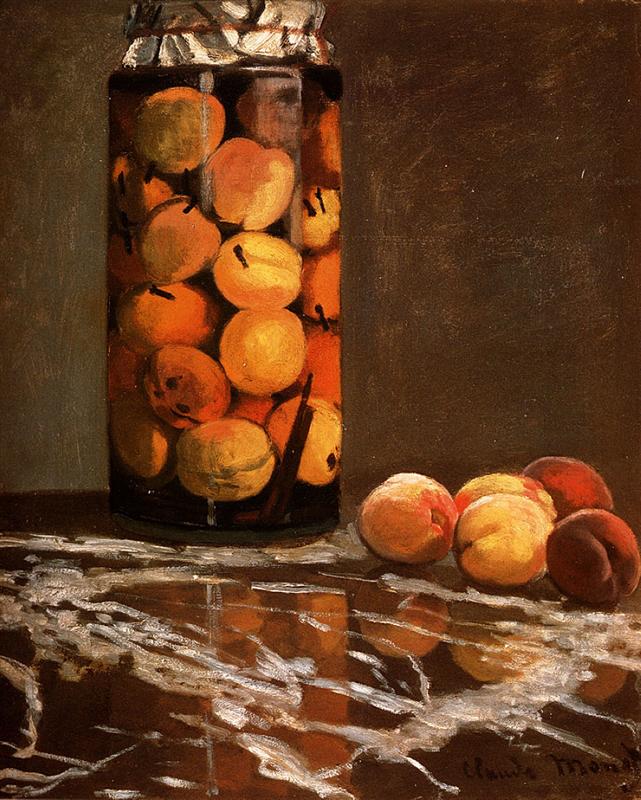
Claude Monet is usually associated with open air painting, broken color, fleeting light, and the landscapes that later helped define Impressionism. Because of that, a work like Jar Of Peaches can come as a surprise. Instead of a river, garden, train station, or sunlit field, this painting presents a quiet tabletop arrangement. A glass jar filled with peaches stands against a dark background, while a few more peaches rest beside it on a polished stone surface. The whole image feels concentrated, restrained, and inward. It is not trying to overwhelm the viewer with spectacle. It is asking for slower attention.
That is precisely what makes the painting so compelling. Made in 1866, Jar Of Peaches belongs to an important phase in Monet’s development, when he was still a young artist refining his command of composition, color, and paint handling. The work reveals a side of Monet that is sometimes overshadowed by his later fame. Here, he is not yet the painter of dissolving haystacks and shimmering water lilies. He is an artist carefully studying objects, reflections, textures, and tonal contrasts. The painting shows discipline as much as sensitivity.
What becomes clear very quickly is that this is not a casual study. Monet takes a simple arrangement and transforms it into something atmospheric and substantial. The jar is solid, dark, and vertical. The peaches are soft, rounded, and glowing. The stone tabletop catches light in streaks and reflections that animate the lower half of the composition. Even within a limited subject, Monet finds a rich visual drama. He turns preservation, ripeness, glass, fruit, and stone into a meditation on color and presence.
The painting also demonstrates how early Monet could work within older artistic traditions while already revealing a modern eye. Still life had a long history before him, especially in Dutch painting and in the French tradition of artists such as Chardin. Monet clearly understood the power of those precedents. At the same time, Jar Of Peaches does not feel like a mere imitation of the past. Its directness, looseness in certain passages, and fascination with reflected light suggest an artist beginning to think in ways that would later become central to modern painting.
First Impressions and Overall Visual Effect
At first glance, the painting seems simple, almost stark. A tall jar dominates the left side of the composition, while four peaches sit to the right. Behind them is a largely undefined brown background. Beneath them is a dark, veined stone surface that mirrors the fruit and catches glimmers of light. There are few distractions. Monet has stripped the scene down to essentials.
Yet the more one looks, the richer the painting becomes. The jar is not merely a container. It is a chamber of warm color. Inside it, the peaches appear suspended in liquid, their skins diffused by glass and shadow. They seem both tangible and slightly transformed, as though preserved not only in syrup but also in paint. This creates an intriguing contrast with the peaches outside the jar. Those external fruits look softer, more immediate, and more vulnerable. The jar contains, protects, and displays. The loose fruit rests freely, exposed to the surrounding air and light.
The visual balance between these two groups gives the composition its quiet tension. The vertical jar has a strong architectural presence. The loose peaches form a low cluster that softens the right side. Together they create a measured rhythm of upright and horizontal, enclosure and openness, structure and spill. The empty background to the right also matters. It gives the arrangement breathing room and prevents the scene from feeling crowded. It allows the peaches to glow more clearly against darkness.
The overall mood is warm, meditative, and slightly solemn. This is not a bright kitchen scene full of cheerful domestic detail. It is a still life with gravity. The darkness around the objects gives them weight and seriousness. At the same time, the peaches bring warmth and sensuality through their oranges, yellows, reds, and blush tones. The result is a painting that feels both modest and intense.
Composition and the Power of Restraint
One of the most impressive aspects of Jar Of Peaches is its compositional control. Monet arranges very few elements, but he positions them with remarkable intelligence. The tall jar sits slightly left of center, anchoring the painting with a firm vertical block. This prevents the composition from drifting. The peaches placed outside the jar are pushed toward the lower right, establishing a counterweight without challenging the dominance of the central object.
This arrangement creates asymmetry, but it is a stable asymmetry. The large dark form of the jar carries more visual mass than the smaller cluster of loose fruit, yet Monet compensates through spacing, reflection, and color. The open brown space on the right intensifies the visibility of the peaches and draws the eye toward them. The glossy tabletop below also helps connect left and right by reflecting the objects back into the surface. That reflection acts almost like a second composition beneath the first.
The tabletop itself is especially important. Its white veining cuts across the dark stone in energetic lines, introducing movement into an otherwise quiet scene. Without those diagonal and irregular marble veins, the lower portion might feel flat or overly heavy. Instead, Monet gives the painting a subtle internal animation. These streaks of pale paint create visual paths that lead the eye through the composition and echo the reflected light from the peaches and jar.
The restricted setting also strengthens the emotional tone. There is no visible room, no window, no decorative cloth, no floral accompaniment, no overflowing abundance. Everything unnecessary has been removed. This restraint allows each object to matter more. The jar feels monumental because there is nothing competing with it. The peaches feel luminous because the surrounding darkness is so controlled. The composition proves that richness does not require complexity. A few elements, when handled with conviction, can achieve great depth.
Color and Tonal Harmony
Color is one of the keys to the painting’s success, though Monet uses it with surprising economy. The palette is dominated by browns, deep blacks, amber tones, and warm peach colors. It is not the high key palette many people associate with Monet’s later work. Instead, it is built on tonal relationships. Light emerges out of shadow rather than dissolving it.
The peaches are the natural focal point because their oranges and yellows stand out against the darker setting. But Monet avoids making them garish. Their color is softened by brown undertones and by the subdued lighting of the scene. Even the ripest fruit remains integrated into the whole. Nothing feels disconnected from the surrounding atmosphere.
Inside the jar, the fruit takes on a darker, richer glow. The liquid and glass modify the colors, muting some passages and intensifying others. This creates wonderful variations within the same color family. Some peaches appear golden, others orange, others touched with reddish blush, and others sink into brownish shadow. The effect is subtle but highly sophisticated. Monet is not simply painting peaches as separate round objects. He is studying how color behaves when filtered through glass and immersed in liquid.
The background is equally important. Its brown field provides a stable tonal envelope that holds the painting together. It is not a flat, dead area. There are gentle shifts in warmth and darkness across it, enough to prevent monotony. This background allows the fruit to glow without isolating it too sharply. Instead of dramatic spotlighting, Monet opts for an enveloping darkness that feels organic.
The stone surface below introduces a cooler note through its grayish and whitish veins, but even there the overall harmony remains warm. Reflections of orange and gold tie the tabletop back to the fruit above. This careful orchestration of warm and cool, dark and light, gives the painting a deep internal coherence. Monet is already showing the eye of a great colorist, even within a comparatively narrow range.
Light, Reflection, and the Study of Surfaces
Although Jar Of Peaches is a still life, it is also a painting about light. Not theatrical light, but observed light. Monet studies how illumination touches fruit skins, penetrates glass, interacts with liquid, and bounces off polished stone. This interest in light on surfaces would become central to his later career, and here it already appears in concentrated form.
The glass jar is especially revealing. It is not rendered with rigid academic precision, yet it convincingly conveys transparency, thickness, and reflective density. The dark liquid inside gives the jar weight, while highlights along the edges and near the rim suggest its slick surface. Monet understands that glass is never visible by outline alone. It is perceived through distortions, reflections, and changes in tone. The fruit within the jar looks close enough to touch, but also slightly refracted, which makes the jar visually fascinating.
The peaches outside the jar are painted differently. Their surfaces are matte and velvety rather than glossy. Light falls on them softly, rounding their forms and emphasizing their fleshiness. Their skins are not polished. They absorb more than they reflect. This contrast between the hard clarity of glass and the tender opacity of fruit enriches the painting’s sensory appeal.
The marble or stone tabletop adds yet another surface quality. It is dense and reflective, but not mirror smooth. The reflections of the peaches are visible, though slightly blurred and broken by the veined texture of the stone. This is one of the most beautiful passages in the work. Monet captures the way reflections shimmer and fragment across a polished but imperfect material. These reflected forms are not exact copies. They are painterly echoes, translated into streaks and warm patches.
This interest in how objects appear under specific conditions links the painting to Monet’s larger artistic path. Even in a studio still life, he is less interested in idealized description than in visual experience. He watches what light does. He watches how matter receives it. He watches how one surface changes another. That habit of looking is the seed of much that would follow.
Brushwork and Material Presence
Another reason the painting feels so alive is Monet’s brushwork. He does not bury the surface under excessive smoothness. The paint remains present as paint. This is important because the subject itself concerns material transformation. Fruit preserved in liquid, light broken in reflection, stone animated by veining, and warm color emerging from shadow all depend on the painter’s touch.
In the peaches, Monet uses rounded strokes and soft transitions to suggest fullness. He does not overdefine every contour. Some edges dissolve gently into shadow, which helps the fruit feel natural rather than cut out. In the jar, darker passages are built with a denser handling, giving the object solidity. The background is comparatively broad and restrained, allowing the more active paint in the central forms to stand out.
The marble surface is perhaps where brushwork becomes most visibly expressive. The white veins are laid in with brisk, assertive strokes that cut across the darker brown plane. They energize the foreground and remind us of the painter’s hand. These marks are descriptive, but they are also abstract in their rhythm. They give the lower part of the painting a kind of calligraphic vitality.
This balance between representation and painterliness is one of the work’s strengths. Monet wants us to see peaches, glass, and stone, but he also wants the medium to remain active. The painting does not disappear into illusion. It exists as a crafted object. That quality places the work within the broader movement toward modern painting, where the surface itself becomes part of the experience.
It is tempting to read this brushwork as an early sign of the freedom Monet would later embrace. Even here, before the full flowering of Impressionism, there is an unwillingness to become rigid. Observation matters, but so does touch. Accuracy matters, but so does vitality. The result is a painting that feels studied without becoming stiff.
Jar Of Peaches and Monet’s Artistic Development
Because this work dates from 1866, it belongs to a formative moment in Monet’s career. He was still a young painter, but already ambitious and deeply engaged with questions of realism, light, and modern vision. This period includes some of his most impressive early achievements, and Jar Of Peaches contributes to that story by showing how broad his interests were.
It is easy to imagine Monet as a painter concerned only with landscape, but that would be too narrow. Early on, he explored portraiture, figure painting, marine subjects, urban views, and still life. What unites these varied subjects is his attention to immediate visual truth. In Jar Of Peaches, that truth is not atmospheric weather or moving water but the quiet drama of objects under light.
The painting also reveals his dialogue with tradition. Still life was a genre with deep roots, often used to display technical mastery, sensuous observation, and reflections on time or mortality. Monet does not turn the subject into elaborate allegory, yet he clearly embraces the genre’s demand for close looking. The peaches are ripe, preserved, and perishable all at once. The scene naturally suggests the passage from freshness to storage, from seasonality to containment. Without forcing symbolism, Monet allows the material facts of the subject to carry emotional weight.
At the same time, the painting already feels modern in its refusal of narrative. There is no anecdote here, no literary program, no overt moral message. The objects are enough. Their arrangement, color, and interaction produce meaning through visual experience rather than story. This is one of the qualities that would become increasingly important in modern art. Painting does not need a dramatic subject to be profound. A jar of fruit can sustain serious attention if seen with intensity.
Mood, Symbolic Possibilities, and Emotional Tone
Even though the painting is grounded in observation, it invites emotional and symbolic reflection. The preserved peaches inside the jar suggest time arrested, fruit held beyond its natural season. The peaches outside the jar suggest freshness, softness, and exposure. This contrast may not be overtly symbolic in a fixed sense, but it creates a gentle tension between preservation and transience.
The darkness surrounding the still life adds to this feeling. Rather than placing the fruit in bright daylight, Monet envelops it in a warm shadow. This makes the peaches seem more precious, almost hidden. The painting becomes less about abundance and more about concentration. It is as though the artist wants to distill the essence of the objects rather than merely display them.
There is also a faint sense of solitude in the work. The scene is silent and self contained. No human presence appears, yet traces of care remain in the arrangement itself. Someone has gathered the fruit, stored it, placed it on the stone surface. The still life carries that human implication without showing a figure. It becomes a record of attention, labor, and domestic order.
Emotionally, the painting feels calm but not empty. Its warmth prevents it from seeming cold or purely analytical. The peaches glow with a quiet sensuality. Their roundness, color, and softness are deeply appealing. Yet the austerity of the composition keeps sentiment in check. This combination of pleasure and restraint gives the painting its dignity.
Why Jar Of Peaches Still Matters
Jar Of Peaches remains significant because it reveals how much can be achieved through observation, tonal intelligence, and compositional simplicity. It reminds us that Monet’s greatness did not emerge suddenly in the fully developed language of Impressionism. It was built through works like this one, where he tested how objects occupy space, how color lives within shadow, and how light transforms matter.
The painting also matters because it broadens our understanding of Monet. It shows him as a painter of intimacy as well as atmosphere, of interior stillness as well as outdoor sensation. It proves that his gift for light was not limited to landscapes. Even in a dark still life, he finds radiance.
For viewers today, the appeal of the painting lies partly in that balance between familiarity and surprise. Peaches in a jar are ordinary enough. But Monet’s handling turns them into something memorable. He sees not just fruit, but a whole network of visual relationships: transparency and opacity, softness and hardness, reflection and absorption, enclosure and exposure. Through those relationships, the painting becomes larger than its subject.
In the end, Jar Of Peaches is a quiet masterwork of early Monet. Its power does not depend on scale or drama. It depends on attention. The artist looks carefully, arranges carefully, paints carefully, and allows ordinary things to reveal their beauty. That discipline gives the work lasting force. It asks us to slow down and notice how much visual richness can exist in a few humble objects placed before us in shadow and light.
