Image source: wikiart.org
Introduction
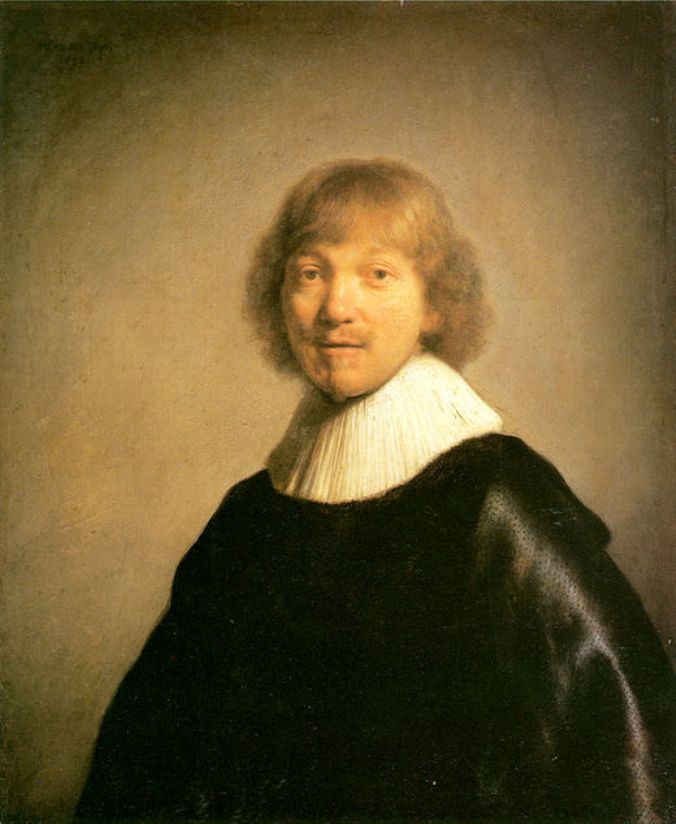
Rembrandt’s “Jacob III de Gheyn” (1632) captures a young Dutch gentleman at the threshold of distinction. The sitter meets us with a frank, level gaze, his head turned slightly over the right shoulder so that light grazes the face and gathers along the crisp pleats of a millstone ruff. The coat is an ample field of dark velvet that drinks the light, letting a few broad, oily highlights confirm its weight and sheen. The background is a soft, warm atmosphere with no intruding architecture or prop. In a year when Rembrandt was newly established in Amsterdam and flooding the city with portraits, this painting shows how he could make social presence and inner life arrive together, quietly and immediately.
Historical Moment And Patronage
The date 1632 marks Rembrandt’s first full year in Amsterdam after leaving Leiden. His reputation was expanding quickly through striking portraits and history scenes. In this milieu, the portrait of Jacob III de Gheyn announces a professional alignment between artist and sitter: a rising painter meeting a cultivated young man whose name already resonated in artistic circles through his family. The picture addresses Amsterdam’s taste for sober elegance—dark garments, brilliant white linen, restrained backgrounds—while infusing those conventions with a psychological freshness that set Rembrandt apart from his contemporaries.
Composition As A Device For Presence
The composition builds a compact triangle whose apex is the sitter’s forehead and whose base is the luminous ruff spread across the shoulders. The head turns just enough to animate the neck and to expose the planes of the face to a graded light that travels from brow to cheek to lips. The shoulders form a broad, stable pedestal; the right shoulder carries a soft, climbing highlight that slides into shadow and returns near the elbow. These few structural moves establish volume without fuss. Nothing distracts from the encounter between viewer and sitter; the whole architecture is tuned to the exact distance at which conversation begins.
Light That Thinks And Clarifies
Rembrandt’s light behaves like understanding. It arrives from the left, tempered and warm, seeking edges that will reward attention: the top of the forehead, the ridge of the nose, the slight hollow beneath the eye, the moist fullness of the lower lip, the filigreed pleats of the collar. It refuses the coat’s deeper blacks, where it would only glare, and instead offers a handful of long, subdued reflections that let us feel the garment’s pile without counting stitches. In the background the light thins into a breathable halo that keeps the head from reading as a cutout. The result is not theatrical spotlight but patient revelation, a light that seems to learn the face as we do.
The Rhetoric Of Dress And Linen
Dutch portraiture of the 1630s valued restraint, cleanliness, and legible rank. The millstone ruff in this portrait is a marvel of controlled bravura. Each pleat is suggested with small, decisive strokes and minute shadows; the collar’s geometry turns the head into a jewel set cleanly in white. The black coat, almost abstract in its breadth, is handled with broader passages—glazes that swallow light, rounded highlights laid wet-in-wet, and soft edges that keep the garment from breaking into incident. The pairing of severe black and brilliant white carries visual authority without ostentation. Rembrandt lets linen and velvet speak in their own voices while ensuring that they remain subordinate to the living face.
The Face And Its Unforced Psychology
What sets the canvas apart is the sitter’s expression: alert, intelligent, and slightly provisional, as if he has just settled into the pose and is still measuring the painter in return. The eyes are gently asymmetrical—one fractionally more open than the other—creating a pulse of life across the gaze. The mouth holds a small, relaxed courtesy rather than a rehearsed smile. The skin is modeled with a delicate network of warm and cool notes: warmer on cheek and ear, cooler along the jaw and temple, with the faintest violet shadow beneath the lower lip. These transitions resist the porcelain smoothness favored by some contemporaries and instead describe a face that breathes.
Hair, Edge, And The Art Of Transitions
Around the head, Rembrandt softens edges in different ways to match material and light. Where hair meets the bright side of the background, the boundary is feathered, a haze of small touches that allow air into the curls. Where hair slips into shadow, it becomes a more definite contour, anchoring the profile. At the top of the head, a pale rim-light threads through the hair and clarifies the skull’s form without resorting to outline. These modulations of edge quality—lost, found, and half-found—perform a quiet virtuosity that keeps the head alive in space.
The Background As A Chamber For Character
The ground is a warm, tonally graduated field that functions like an acoustic for the portrait. It is not a wall we can measure; it is a volume of air that receives and returns light. Its subtle oval brightening behind the head—Rembrandt’s “oval of attention”—draws the gaze inward without theatrics. A few nearly imperceptible brush swirls keep the surface from going inert, but the painter denies us any anecdote or setting. In Amsterdam’s civic culture, such restraint signaled confidence: the sitter’s identity rests in his person, not in borrowed emblems.
Touch And Paint Handling
Close looking reveals a highly economical surface. The face is woven from small, fused strokes that suppress brushwork while preserving epidermal vitality. The ruff turns brisker, with small flicks of thicker white that catch real light and glitter like starched linen. The coat is painted with long, elastic sweeps and soft scumbles; at the shoulder a thicker ridge of paint turns as if under a thumb, confirming the garment’s mass. These varied touches—quiet in the face, articulate in the collar, broad in the coat—grant each material its own syntax while keeping the whole coherent.
Color And Temperature Strategy
The chromatic design is purposeful and narrow. Warm flesh tones modulated with cool half-tones build the head; a disciplined black (more accurately a mix of umbers, blues, and bone black) constructs the garment; creamy lead white shaped with tiny gray shadows describes the ruff; the background gathers soft browns and muted ochres. Rembrandt’s key move is temperature counterpoint: a cool gray note under the jaw secures the head against the collar’s warmth; the coolness of the eye whites is balanced by a blush on the cheek; a cool highlight in the coat’s sheen echoes the cooler half-tones of the skin. This restrained palette reads neither dull nor decorative—it reads honest.
The Sitter, Social World, And Meaning Without Emblem
Even without props, the portrait says a great deal about the sitter’s world. The clean ruff and sober coat announce adherence to the civic ideals of the Dutch Republic. The lack of ostentatious jewelry or weaponry argues for substance over display. The open, forward-facing presentation suggests a man of letters or business rather than court spectacle. Rembrandt relies on the grammar of posture and light, not on heraldic shorthand, to communicate status and character. The effect is timeless precisely because it is so specific to ordinary human cues.
Comparison With Contemporary Portraits
Compared with Rembrandt’s more opulent likenesses from the same year—where gold chains or gleaming gorgets flash—the “Jacob III de Gheyn” portrait is measured and intimate. It belongs to a group in which the painter proves that grandeur can be distilled to the interplay of face and ruff. Against the polished surfaces of van Mierevelt or the elegant regularities of Frans Hals, Rembrandt’s approach feels warmer and more searching. He accepts the conventions of dress and pose but goes further, letting micro-variations in light and edge tell a subtler story of temperament.
The Ethics Of Looking
A distinctive tenderness pervades the work. The painter’s attention never hardens into scrutiny; it remains courteous, the way one looks at another person during conversation. There is no caricature of features and no cosmetic smoothing; there is simply patience. This ethical stance aligns with the Dutch ideal of civic equality: the sitter is neither flattered into grandeur nor reduced to type. He is granted the dignity of being seen exactly.
A Guide For Slow Looking
Begin at the forehead where the largest, softest light rests. Follow the gentle slope to the brow and tip of the nose; notice that the reflected light on the far cheek prevents the nose from severing the face in two. Move to the eye on our left; observe the tiny highlight that keeps it wet and alive. Drift to the upper lip and see how a cool shadow makes the lower lip feel round. Drop to the ruff and trace a single pleat from the shadowed innermost fold to the outermost ridge of white; repeat the gesture across a few pleats and feel the rhythm. Slide along the coat’s shoulder highlight as it lengthens and sinks into darkness. Step back and watch how these small observations recombine into poise.
The Role Of Scale And Distance
The portrait is scaled for a viewer at conversational range. Its intimacy depends on a balance between head size and ruff breadth; the latter acts like a platform that sets the head at a comfortable elevation. The absence of deep space keeps our attention hovering within arm’s length. This proximity is where Rembrandt excels. He makes paint behave like presence at the exact distance where we negotiate identity with another person.
Why The Painting Still Feels Modern
The picture’s modernity lies in its economy and trust in subtleties that the eye and mind complete. There is no crowded symbolism, no decorative frame, no enforced narrative. Profile and three-quarter view are blended into a simple, legible design governed by light. Contemporary portrait photographers and painters continue to borrow these strategies—neutral background, measured highlights, attention to edges—because they remain the most reliable way to translate personhood into image.
Legacy And Afterlife
As Rembrandt’s reputation grew, portraits like this became touchstones for connoisseurs and artists seeking to combine civic clarity with inner life. The balance struck here—between social code and living individuality—became a standard for Dutch portraiture and a resource for later portraitists who understood that the most memorable likenesses are constructed from light, not decoration. The painting’s quiet authority continues to instruct: a well-seen face and the clean geometry of a ruff can outlast fashionable rhetoric.
Conclusion
“Jacob III de Gheyn” is a meditation on poise. In a single, luminous head and an immaculate collar, Rembrandt offers the viewer the essentials of presence: clear light, stable composition, truthful color, and a gaze that admits us without performance. The painting’s restraint is its eloquence. It registers a person who belongs to a disciplined civic world and yet remains distinctly himself. Nearly four centuries later, that mixture of public dignity and private intelligence still greets the viewer with undiminished freshness.