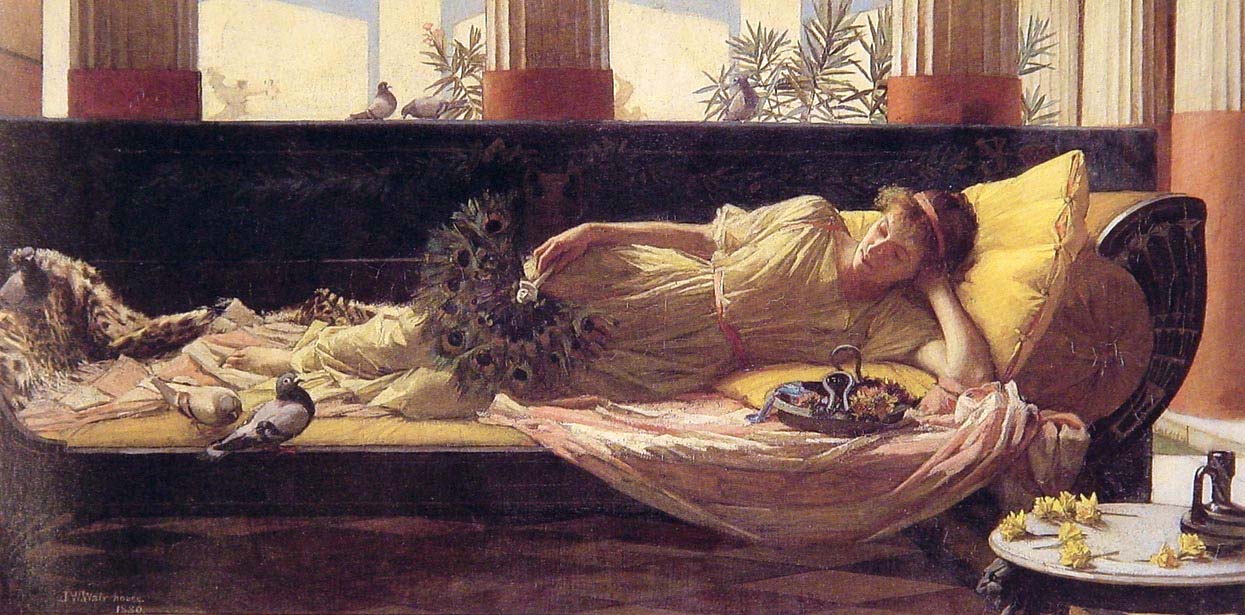
Image source: wikiart.org
Introduction to “Its Sweet Doing Nothing”
John William Waterhouse’s Its Sweet Doing Nothing (1880) is a painting that makes stillness feel like an event. At first glance, the subject appears simple: a young woman reclines on a couch in a bright, columned interior, attended not by people but by light, fabric, and a few birds that wander close. Yet the longer you look, the more the scene reveals itself as carefully composed, psychologically suggestive, and quietly theatrical. Waterhouse takes an everyday human impulse, the desire to rest, and elevates it into a poetic state, as if leisure itself were a form of beauty worthy of serious attention.
The title does a lot of the emotional work. It tells you how to read the figure’s inactivity, not as boredom or laziness, but as sweetness. That single word turns doing nothing into an experience of pleasure, a luxury that can be tasted. The painting becomes a meditation on the sensual value of pause: the body at ease, the mind drifting, the world softened by warmth and time.
Waterhouse in 1880 and the Appeal of Classical Reverie
Painted early in Waterhouse’s career, this work already shows his attraction to subjects that hover between narrative and mood. He is often associated with later, more overtly literary or mythological scenes, but here the story is minimal. Instead, Waterhouse explores a theme that had strong appeal in late nineteenth-century British art: a classical setting used as a dream-space for modern feeling.
The architecture and styling suggest an imagined antiquity. It is not a documentary reconstruction of a specific historical room, but an artistic invention that borrows the visual vocabulary of the ancient Mediterranean: columns, warm stone tones, open windows, and an air of sunlit quiet. Victorian viewers were familiar with this kind of classical fantasy, where antiquity becomes a stage for timeless emotions. In that context, repose reads as elegant and legitimate, as if the ancient world itself authorized leisure as a refined state rather than a guilty indulgence.
First Impressions and the Painting’s Emotional Temperature
The painting’s emotional temperature is warm, but not overheated. The background is flooded with daylight, yet the couch and the figure are sheltered in shade. That balance creates the sensation of midday outside and cool refuge inside. The entire scene feels slowed down, as if the hours have thickened. Nothing interrupts the calm. Even the birds seem to move cautiously, as though aware they are guests in a quiet room.
There is also a feeling of privacy. The woman does not look outward to engage the viewer. Her attention is turned inward and downward, suggesting either rest, daydream, or a soft kind of contemplative emptiness. The mood is not ecstatic, but content. It is the satisfaction of being temporarily unneeded, temporarily unhurried.
The Reclining Figure and the Art of Unforced Pose
The woman’s pose is central to how the painting communicates sweetness. She lies lengthwise along the couch, her body stretched into a relaxed line that emphasizes comfort over display. Her head rests against a large yellow cushion, and one arm bends to support it in a gesture familiar from real life. The other arm falls forward, loosely holding a cluster of peacock feathers, not tightly grasped, but carried almost absent-mindedly.
This matters because Waterhouse avoids turning the figure into a simple emblem of seduction. The pose could easily have been used for overt sensuality, but instead it reads as genuine rest. The body is not tense. The hands do not signal. The face is calm, soft, and withdrawn. The figure is present, but not performing for the viewer. That withdrawal creates a gentle psychological distance, a sense that we are witnessing a moment that would continue even if we were not there.
Composition and the Long Horizontal Stage
The painting’s composition reinforces its theme by stretching time across space. The couch forms a long, dark horizontal band, almost like a stage or a resting shoreline, on which the figure becomes the main presence. This extended horizontal format encourages slow looking. Your eye travels along the couch from left to right, noticing scattered fabric, birds, and shadow before arriving at the figure’s brighter face and pale dress.
Vertical elements in the background, especially the columns and window frames, counterbalance the couch’s horizontal pull. They stabilize the scene, giving it structure and classical dignity. The result is a composition that feels orderly but not rigid. The figure rests inside a framework that suggests permanence and calm, as if architecture itself were designed to protect leisure.
The drapery that spills over the couch and toward the floor introduces a soft diagonal, creating movement without disturbance. It is a visual echo of relaxation: a fabric that has been allowed to fall wherever it wants, uncorrected.
Light as Climate and the Sensation of Midday
Light in this painting is not merely illumination. It is atmosphere, climate, and mood. The background brightness suggests strong sun outside, turning distant surfaces pale and chalky. Inside, the couch’s dark mass absorbs light, creating a shadowed zone where the figure can recline without glare. That contrast makes the interior feel cool and habitable, a refuge from heat.
Waterhouse uses this light-shadow relationship to evoke a particular time of day and a particular feeling: the languor that comes when the day is at its brightest and the body prefers stillness. The woman’s repose feels appropriate, even inevitable, given the world’s brightness beyond the window. The sweetness is partly the sweetness of choosing shade.
Color Harmony and the Pleasure of Warm Tones
The palette is restrained, yet richly satisfying. Creams, pale golds, warm yellows, and soft pinks create a harmony of comfort. The woman’s dress sits between white and warm cream, making it feel sun-touched even in shadow. The yellow cushion behind her head reads as warmth and softness, a visual synonym for comfort. The pink drapery introduces a gentle romantic tone without turning the scene into overt sentimentality.
The couch’s deep darkness is essential. It sets off the pale figure like a pearl against velvet. Without that dark base, the scene would risk dissolving into sunlit softness. With it, the figure becomes the painting’s clear focal point, a luminous presence anchored in shadow. The background terracotta and stone hues keep the environment warm and classical, while the plants add muted green notes that suggest life without breaking the calm.
Fabric, Texture, and the Sensual Reality of Rest
A painting about doing nothing must persuade you that nothing can be felt. Waterhouse achieves this through texture. The fabrics are not just depicted, they are experienced through paint. The dress seems light and breathable, its folds soft rather than sharply pressed. The pink drapery looks thinner and more fluid, falling in graceful curves that imply weight and gravity. The cushion looks plush, receiving the head’s pressure, suggesting the comfort that makes idleness possible.
The couch appears heavy and substantial, likely upholstered or carved with a dark surface that holds shadow. It does not sparkle. It absorbs. That absorption increases the sense of quiet, as if the furniture itself muffles sound. Texture here becomes a language of mood. Softness equals permission. Weight equals safety. The sweetness of doing nothing is communicated as tactile reality.
Birds as Quiet Companions and Indicators of Safety
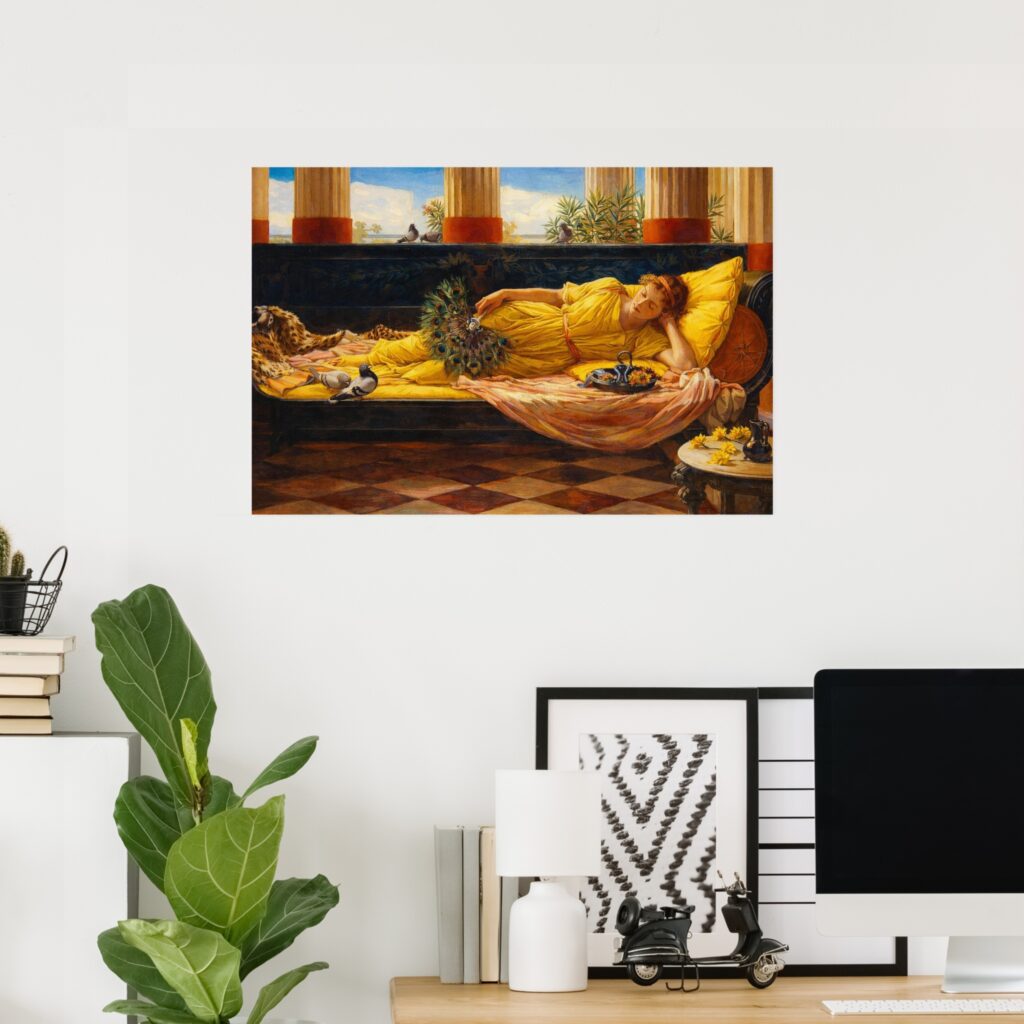
The birds are among the painting’s most charming and meaningful details. They gather near the figure, some on the couch, some on the fabrics. They do not read as threatening or intrusive. Their presence suggests that the space is calm enough for animals to wander without fear. In that sense, the birds become indicators of safety and stillness.
They also animate the scene with small movements that do not break the mood. A bird can peck, pause, tilt its head, and shift position. Those tiny actions give life to the silence. They provide a gentle contrast: the birds remain alert and mobile, while the human figure is surrendered to rest. Leisure, then, is not emptiness. It is a different rhythm of life, one that can coexist with quiet activity.
The birds also help guide the viewer’s eye along the couch and toward the figure. They punctuate the foreground with points of interest, making the long horizontal space feel inhabited.
The Peacock Feathers and the Idea of Beauty as Play
The peacock feathers held by the woman are more than decoration. Peacocks have long been associated with beauty, splendor, and display. Here, that display is reduced to an object in a resting hand. Instead of a peacock strutting in a garden, we have a cluster of feathers treated like a personal accessory, a toy for the senses.
This transforms beauty into play. The woman does not need the feathers for any function. She holds them because they are pleasing, because their colors and textures can be enjoyed without purpose. That aligns perfectly with the title. Doing nothing becomes a space where beauty can be appreciated for itself. The feathers also echo the painting’s broader theme: luxurious surfaces, gentle color, and the idea that pleasure can be quiet.
Still Life Elements and the Luxury of Being Unhurried
Near the reclining figure, Waterhouse includes objects that resemble a still life: vessels and food, possibly fruit. These details reinforce the sense of refined leisure. They suggest that the woman is not resting in deprivation but in comfort. Her environment provides small satisfactions, nourishment, and sensory variety.
These objects also deepen the painting’s realism. A person reclining in comfort often has nearby items, a tray, a dish, something left within reach. Such details imply that the moment has duration. She has been there long enough to settle in, long enough to let the room become slightly untidy. The sweetness comes partly from that sense of time extended beyond obligation.
Architecture and the Classical Dream of Idleness
The columned setting supports the painting’s mood by lending it a timeless dignity. Columns evoke temples, villas, and the visual authority of classical culture. In Victorian imagination, the ancient world often represented a realm of beauty, ritual, and a slower relationship to time. By placing the figure in a classical environment, Waterhouse frames her leisure as something elevated rather than trivial.
The background’s bright windows suggest a world beyond the interior, but it is a world of pale stone and sun, not of urban urgency. Even the exterior feels quiet. There are no crowds, no labor, no visible demand. This is antiquity as sanctuary, a place where doing nothing can be sweet because the world itself seems to allow it.
At the same time, the classical setting adds a faint theatricality. The couch becomes a stage, the figure a performer of repose, and the viewer a respectful observer. Yet because the figure remains psychologically withdrawn, the performance feels private, almost accidental.
The Viewer’s Position and the Ethics of Looking
A reclining figure can easily invite a complicated kind of viewing, especially in a painting with such careful attention to beauty. Waterhouse navigates this by controlling the woman’s gaze and the scene’s tone. She does not meet the viewer’s eyes, and her posture does not signal invitation. The mood is calm, not provocative. The viewer is allowed to look, but not to interrupt.
This creates an interesting ethical space. We are close enough to see details of fabric and skin tones, but we are kept at a respectful distance emotionally. The painting asks us to admire the sweetness of rest rather than consume the figure as spectacle. Leisure becomes the subject more than the body itself.
Psychological Stillness and the Suggestion of Daydream
The woman’s expression suggests a mind in transition, neither asleep nor fully alert. That in-between state is part of the painting’s charm. It captures a familiar psychological moment: when thoughts drift without direction, when the mind wanders through memory or fantasy, when time is not being used but experienced.
Waterhouse does not specify what she thinks. That openness invites the viewer to project. Is she tired? Content? Bored? Quietly joyful? The title nudges us toward pleasure, but the painting allows complexity. Sweetness can include melancholy, just as rest can include a faint sadness about time passing. The scene’s stillness makes room for those layered feelings.
Technique, Brushwork, and Controlled Softness
Waterhouse’s technique balances clarity with softness. The architecture is clean enough to feel stable, while fabrics and skin are modeled with gentle transitions. The brushwork does not call attention to itself in flashy gestures. Instead, it supports the painting’s theme by smoothing the world into calm. Edges are not aggressive. Shadows are deep but not harsh. Highlights are luminous but not sharp.
This controlled softness helps create the painting’s dreamlike quality. The scene feels real, but idealized. It is the kind of reality remembered after the fact, when the mind has edited out noise and discomfort. Paint becomes a tool not only for depiction but for emotional editing.
Waterhouse and the Broader Pre-Raphaelite Atmosphere
Waterhouse is often discussed alongside the Pre-Raphaelite tradition, especially in his interest in beauty, detail, and poetic mood. While Its Sweet Doing Nothing is not a dense literary narrative, it shares a related sensibility: the elevation of a moment into a kind of visual poem. The setting, the carefully chosen objects, and the emphasis on inwardness all align with a broader late nineteenth-century desire to create paintings that feel like cultivated experiences.
Yet Waterhouse also brings his own temperament. He is less interested here in moral drama and more interested in atmosphere. The painting does not argue. It invites. It suggests that beauty can be quiet, and that a life includes necessary pauses that can be honored rather than feared.
Themes of Time, Idleness, and the Modern Desire to Stop
One reason this painting still resonates is that it addresses a tension that remains familiar: the pressure to be productive versus the human need for rest. The title’s sweetness feels almost defiant. It asserts that doing nothing can be meaningful, not because it achieves a goal, but because it restores a person’s inner life.
The painting shows leisure not as excitement but as a gentle saturation of sensation. You notice fabric. You notice light. You notice the quiet companionship of birds. You notice the warmth of the day outside and the comfort of shade inside. These are small experiences, but they are the building blocks of a felt life.
There is also a subtle sense that this sweetness is temporary. Flowers fade. Daylight shifts. Birds move on. Rest is precious partly because it cannot be held indefinitely. The painting, by freezing the moment, turns fleeting leisure into lasting image, preserving a state that in reality would pass.
Conclusion: The Sweetness Waterhouse Preserves
In Its Sweet Doing Nothing, Waterhouse gives dignity to pause. He creates a world where classical architecture, warm light, soft fabrics, and small living creatures collaborate to make idleness feel not empty but full. The reclining figure becomes an emblem of permission, a reminder that rest can be a form of pleasure and a form of quiet self-possession.
The painting’s power lies in its restraint. It does not shout a message. It lets the viewer feel the scene’s tempo and understand sweetness through atmosphere. Waterhouse paints leisure as something cultivated and humane, a gentle state in which beauty is not chased but received.