Image source: wikiart.org
A Sovereign Seated: First Impressions
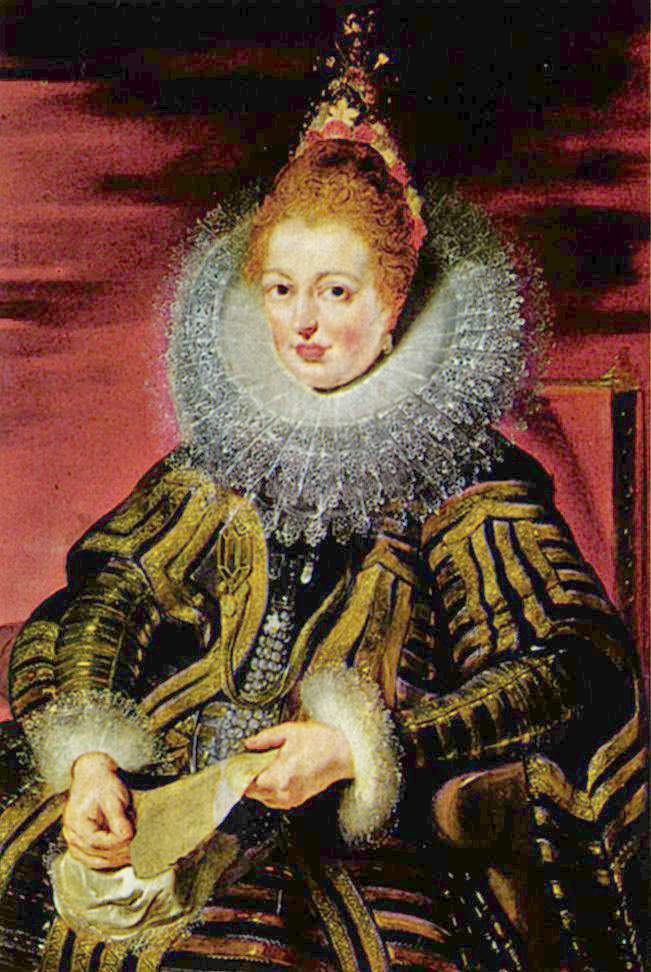
Peter Paul Rubens’s “Isabella, Regent of the Low Countries” (1609) presents one of Europe’s most powerful women at the very moment Rubens returned from Italy and stepped onto the political-artistic stage of the Habsburg Netherlands. The sitter, Isabella Clara Eugenia, faces us in a three-quarter pose, set against a warm crimson ground that behaves like a ceremonial curtain. Her presence is anchored by a monumental chair and an armor-dark gown veined with gold. A dazzling cartwheel ruff encircles her head like a frosted halo, and in her hands she holds a folded paper—the attribute of rule, counsel, and signature. The portrait’s balance of sumptuous display and disciplined restraint captures not only Isabella’s character but also the political message of 1609: authority tempered by piety, magnificence guided by prudence.
Portraiture At A Political Turning Point
The year 1609 marked the Twelve Years’ Truce, a pause in the long Dutch Revolt that stabilized Isabella and Archduke Albert’s governance in the Southern Netherlands. Rubens, newly appointed court painter, responds with an image that reads as statecraft. This is not a private likeness; it is a public face of legitimacy. The letter implies administrative action—the issuing of decrees, the reading of reports, the delicate diplomacy of truce. The backdrop’s theatrical red suggests ceremony without plunging into pomp. By fixing Isabella in a composed, frontal attitude, Rubens delivers the psychological steadiness expected of a regent charged with calming a war-torn land.
The Grammar Of Power In Fabric And Lace
Costume becomes language. The gown’s black is no mere absence of color; in Habsburg court culture, it signified gravity, chastity, and sovereign dignity. Rubens enriches the black with cords of gold that articulate the sleeve segments and bodice, making structure visible and authority tangible. The ruff—architectural, crystalline, nearly astronomical in its radiating loops—frames Isabella’s face with an aura of impersonal office even as it softens her features. Lace cuffs repeat the ruff’s rhythm at the wrists, echoing the delicate labor of governance: the biggest matters of state often hinge on the smallest signatures.
A Face That Balances Warmth And Reserve
Rubens’s handling of Isabella’s face is intimate without being familiar. The skin is modeled with pearl-like half-tones; the eyes are alert but not piercing; the mouth is closed in concentration rather than severity. He avoids flattery and caricature alike, allowing faint rosiness to play through the cheeks and a practical intelligence to settle in the gaze. We feel the cultivated piety of a woman raised at the Spanish court and the administrative competence of a regent seasoned by decades of rule. The result is a court portrait that seems to “think,” a rarity in dynastic image-making.
The Hands Tell The Story
Rubens stages the hands as a second face. One hand grips the document, the other steadies and unfolds it. The gesture is neither theatrical nor idle; it is the everyday movement of a ruler who reads, decides, and signs. By avoiding jewelry at the fingers, Rubens keeps attention on action rather than ornament. The fleshiness is rendered with a painter’s sympathy for lived work; even royal hands serve.
A Halo Of Needlework: The Ruff As Icon
The ruff’s shimmering geometry does more than flatter the sitter; it organizes the picture’s space. Its icy whites catch the room’s light and throw it onto Isabella’s face, amplifying the visibility of the sovereign’s features. Symbolically, it operates like a secular nimbus—light not of sanctity but of office, the aura of visibility that governance requires. Rubens paints the lace not as diagram but as material: threads bite into shadow, then leap into sparkle at the edges, the way real starch and linen do under candlelight.
Color That Negotiates Majesty And Mercy
The palette is restrained yet eloquent. Crimson behind the sitter, black and gold at the costume, milk whites at ruff and cuffs, and warm flesh tones for the face and hands. The red backdrop functions as a coloristic drumroll, intensifying the cool whites and ensuring that the face reads immediately at a distance. Gold not only asserts wealth; it warms the black and prevents severity from hardening into intimidation. These color choices echo the political posture of 1609: a regime strong enough to command yet desirous of reconciliation.
Italian Lessons, Flemish Tactility
Rubens had just returned from eight years in Italy, and the portrait shows it. The bold, clear silhouette and the orchestration of crimson curtain with dark garment nod to Titian and Veronese, while the porcelain modeling of the face recalls the Roman ideal. Yet the tactile truth of lace, the minute attention to couture, and the frankness of character are Flemish to the core. The synthesis announces the young court painter’s program: marry Venetian color and monumentality to Netherlandish detail and psychological veracity.
The Architecture Of Authority
Even in a bust-length portrait, Rubens hints at architecture. The throne-like arms of the chair, barely visible, supply a rectilinear counterpoint to the circular ruff. That opposition—square to ring, throne to halo—contains the sitter in an abstract frame befitting office. The background’s stage-like bands of red read as drapery, a portable architecture of the court that can be raised wherever sovereignty appears. Rubens thus sets Isabella inside a visual constitution: a seat, a backdrop, and a figure whose body anchors the state.
Isabella’s Image Within A Dynasty Of Images
Habsburg portraiture before Rubens, shaped by painters such as Alonso Sánchez Coello and Juan Pantoja de la Cruz, often emphasized immobility and impenetrable magnificence. Rubens preserves that grammar but adds suppleness. He grants the ruff breath, the fabric weight, the eyes moisture. The result is continuity without stiffness—an image that honors dynastic protocol while refreshing it for a new political context in the Low Countries.
The Letter As Program
The single sheet Isabella holds has been interpreted as a decree, diplomatic correspondence, or petition. Whatever its specific identity, it crystallizes the portrait’s theme: the transformation of language into power and of counsel into action. Rubens paints the sheet with quick, broken strokes that catch light along the fold, reminding us how fragile governance can be—paper thin—yet how decisive a page becomes when signed by the right hand.
Piety Without Ostentation
Isabella was renowned for devotion; later in life she would don the habit of a Franciscan tertiary. Rubens nods to that reputation without devotional props. Modest jewelry, tempered palette, and a face free of cosmetic excess signal a ruler who understands humility as an instrument of rule. The lace—though exquisite—is not jeweled to blindness; the gold bands are orderly rather than flamboyant. The painting offers an ethos, not an inventory.
Brushwork That Moves Between Court And Studio
Rubens modulates touch across the picture. In the face, strokes are softened and fused; in the ruff, he lets the brush skip and knit to evoke the physics of lace; in the black-and-gold gown, he sets down confident directional strokes that follow the garment’s construction. This choreography of handling mirrors the sitter’s life between ceremony and work—between the blended public face and the quick mind making decisions behind it.
The Human Behind The Protocol
Look long enough and the portrait yields small revelations: a slight parting of the lips suggesting breath drawn for speech; a tension at the corners of the eyes that could be fatigue or merely the weight of attention; a head held straight rather than tilted, implying a refusal to condescend. Rubens declines to turn Isabella into an allegory of Empire. He offers instead a woman who has learned power’s posture without abandoning personhood.
The Political Optics Of 1609
This portrait likely functioned as an ambassador even when the sitter could not be present. It could be dispatched to allied courts, hung in municipal halls, and placed in administrative chambers as the visible guarantor of policy. In that sense, the painting is part of the machinery of the Twelve Years’ Truce. Its calm frontal authority contradicts the noise of war; its rich yet sober textiles promise the prosperity peace can bring; its head-on gaze invites a new contract between ruler and ruled.
Comparisons And Influence
Rubens would paint Isabella again, and his studio would issue replicas and variants, attesting to demand for her image. The portrait type influenced later representations of archduchesses and queens across the Spanish sphere. Van Dyck—Rubens’s brilliant younger colleague—would inherit this lesson, creating elegant, psychologically tuned state portraits that owe a debt to Rubens’s Isabella: grandeur animated by life.
The Feminine Face Of Sovereignty
The painting has quietly shaped how Europe imagines female rule. There is no borrowed masculinity here, no sword or baton. Authority flows from presence, intelligence, and the serene control of ceremony. The fanfare is textile, the scepter is paper, the crown is a ruff. Rubens thereby articulates an alternative rhetoric of power—one rooted in prudence, eloquence, and governance as correspondence.
Material Culture As Memory
Every fold of lace, every stitched stripe of gold, has survived in the paint longer than the actual garment could. The portrait becomes a museum of early seventeenth-century material culture: the way starch holds a ruff’s wheel, how gold thread catches side-light, how velvet swallows shadow. Rubens does not copy; he interprets, translating feel into sight so persuasively that we almost hear the faint rustle when Isabella turns to speak.
The Portrait’s Modern Relevance
To modern eyes, the painting reads as a masterclass in leadership optics. It answers questions still asked of public figures: How do you project firmness without cruelty? How do you acknowledge wealth without boasting? How do you let personality breathe inside protocol? Rubens’s solution remains instructive—build a language of form (color, fabric, posture) that announces role, then allow the face and hands to tell the truth.
An Image That Appoints A Painter
Finally, this portrait does not only elevate its sitter; it also announces its maker. With it, Rubens declares that he can do everything the court requires—state theater, textile magic, psychological presence—while refreshing the whole with a painter’s joy. The picture is thus both an instrument of government and a contract for a career. In presenting Isabella to her subjects and allies, Rubens presents himself as the preeminent interpreter of power in paint.