Image source: wikiart.org
Introduction
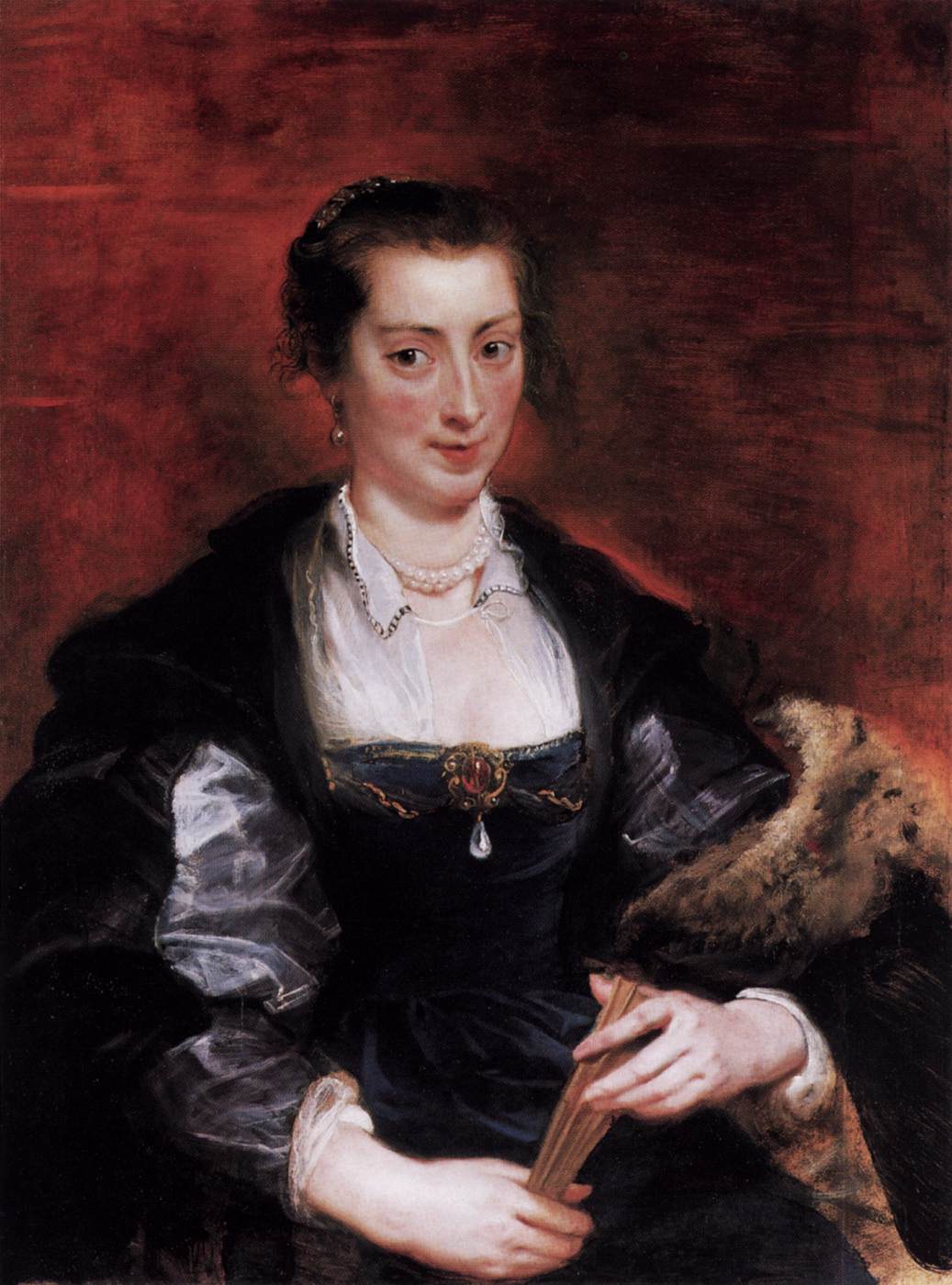
Peter Paul Rubens’s “Isabella Brandt, First Wife” (1610) is a portrait that glows with nearness. Painted soon after Rubens returned to Antwerp from Italy and the year he celebrated his marriage, it captures Isabella not as a distant emblem of status but as a quick, living presence. The red ground breathes behind her like warm air; pearls catch the light at her throat; a delicate fan rests between thoughtful hands. Rubens compresses courtly grandeur and private affection into a single, lucid image, and in doing so defines a new, humane direction for early Baroque portraiture.
A Marriage and a City at a Turning Point
The date matters. In 1609 Antwerp entered the Twelve Years’ Truce, a fragile peace that allowed civic life and patronage to flourish again. Rubens, newly home after a decade in Italy, married Isabella Brandt—daughter of a learned Antwerp family—and immediately began to shape the city’s visual culture. This portrait belongs to that opening chapter. It is proudly domestic and quietly triumphant: a painter declaring his new life, a household announcing itself with cultivated restraint, a city remembering how to be elegant after years of turmoil.
Composition and the Theater of Nearness
The composition is a three-quarter-length half-turn that tilts the sitter toward us, inviting conversation rather than ceremonial inspection. The figure fills the frame without crowding it, shoulders carried by a dark mantle that behaves like a soft stage curtain against the warm ground. Rubens places the head just off center and allows the gaze to meet ours with frank curiosity. The hands, placed low and slightly to the right, hold a folded fan that acts like a quiet metronome for the portrait’s rhythm. Everything is arranged to feel proximate: there is no deep architectural setting, only the person, the air, and the tokens that define her presence.
The Red Ground and the Temperature of Feeling
The red background is neither neutral cloth nor arbitrary color; it sets the portrait’s emotional key. Rubens brushes it broadly, leaving tonal variations that suggest velvet or damask without pinning it down. Red warms the flesh and pearls, pulls the black costume into rich depth, and connects the picture to both domestic interiors and court ceremonial. It makes the encounter feel intimate and alive, as if a conversation were happening in a room gently lit by afternoon.
Light, Flesh, and the Venetian Lesson
Rubens learned in Venice how to build faces with light that seems to originate within the skin. Isabella’s complexion is a weave of warm glazes and cooler half-tones: rose across the cheeks, honey at the temples, a delicate transparency at the throat. The modelling is firm but never brittle. Small specular notes on the lower lip and pearls bring the head forward, while a soft fall of shadow along the right cheek adds depth and modesty. The result is a likeness that breathes; paint has been coaxed into becoming skin.
Eyes, Mouth, and the Psychology of Poise
Isabella’s expression is an exquisite balance of reserve and humor. The eyes, luminous and steady, register attentive intelligence; the slight lift of the left eyebrow and the not-quite-smile at the corner of the mouth hint at playfulness. Rubens avoids flattery while refusing severity. He paints a person capable of wit, administration, and warmth—the emotional center of a household that was also a workshop and salon. The portrait’s power lies in this psychological credibility: the viewer feels that conversation would be easy.
Costume as Character
The dress is sumptuous without ostentation. A midnight-blue bodice closes with a jeweled brooch, from which a single pear-shaped pendant falls; translucent sleeves of white linen gather beneath a black mantle whose broad folds provide a dark echo to the red ground. The pearls—double strand at the throat, single drops at the ears—supply a cool counterpoint to the warm skin and background. Rubens sketches fur along the right forearm with brisk, broken strokes; it reads as touch rather than taxonomy, a suggestion of texture that contradicts the crisp sheen of satin. The costume describes a woman of means, yet its most eloquent function is psychological: softness and structure, sheen and matte, ceremony and ease.
The Hands and the Language of Gesture
Rubens’s hands are never idle. Isabella’s are delicately active, the left hand’s thumb and forefinger circling the fan, the right hand supporting it with relaxed assurance. The fingers are long and articulate, nails subtly pink, joints lightly modelled. These hands imply capability—writing letters, holding keys, turning pages, teaching children—and they also tell us how the sitter carries herself. The gesture neither flaunts nor hides; it mediates. In Baroque portraiture, gesture is character, and here the character is thoughtful poise.
Brushwork, Surface, and the Pleasure of Paint
Look closely and the surface discloses Rubens’s method: soft scumbles to suggest rambling hair; swift, opaque highlights that lace the edge of a cuff; translucent veils over the linen that keep it breathable; and broader, oily sweeps across the dark mantle that let it fall with convincing weight. Skin transitions are fused wet-into-wet, while the jewel is stated with a few decisive touches that refuse pedantry. This variety of touch is more than craft display; it conducts the viewer’s eye from hard to soft, from glitter to hush, so that the picture feels animated by breath and fabric.
The Fan, Small Stage of Modernity
The folded fan is a quiet marvel. It is modern, intimate, and socially coded; it occupies the territory between ornament and instrument. Rubens paints it simply—a pale wedge between warm hands—yet it acts like a hinge in the composition, turning the sitter toward the viewer and cueing the modest play of wrists and fingers. As an object, it softens the portrait’s rhetoric: this is no court pageant; it is a seated conversation on a temperate day.
A Dialogue with “The Honeysuckle Bower”
Compared with the formal garden double-portrait Rubens painted of himself and Isabella the same year, this canvas is more interior, less emblematic. In the bower, joined hands and honeysuckle dramatize marital concord; here, likeness does the rhetorical work. Yet the two images speak to one another: the same red tonality, the same delight in translucent fabrics over dark grounds, the same sense that affection and dignity are not opposites. Together they chart a range—from public celebration to private nearness—that defines Rubens’s portrait language.
The Early Baroque Ideal of Presence
This portrait exemplifies an early Baroque ideal: the sitter appears as if newly arrived, present to the viewer’s time rather than a frozen emblem from the past. Rubens achieves that immediacy through the frank gaze, the softly moving brushwork, and the avoidance of heavy allegory. Nothing in the picture insists on a moral program beyond ordinary virtues—grace, intelligence, composure—so the viewer meets a person first and a symbol only second. That human priority is the quiet revolution Rubens brings to northern portraiture.
Marriage, Workshop, and the Fabric of Daily Life
Isabella was more than a muse. She presided over a household that functioned as workshop, academy, and diplomatic launching point for her husband’s career. The portrait’s serenity whispers of that competence. Pearls sit easily on the throat of someone who understood both hospitality and accounts; the fur warms the arm of someone who moved through Antwerp’s winters with children and visitors under her care. By painting her with such gentle authority, Rubens acknowledges the mutuality of their partnership.
Color Harmony and Breathable Space
The chromatic structure is elegantly simple: reds and warm browns in the ground; blacks and deep blues in the garments; whites and pearls as cooling agents; flesh notes to tie everything together. Because the red is handled with transparent layers, it feels like air rather than wall; because the blacks carry blue, the dress does not collapse into a dead mass; because the whites are thin, the linen looks worn, not new. The space around Isabella is breathable—no architectural scaffolding, just atmosphere—and that openness invites the viewer to step near.
Comparison to Spanish and Dutch Portrait Modes
Set beside contemporary Spanish portraits, this painting is less hieratic; set beside Dutch bourgeois likenesses, it is more sensuous. Rubens finds a median path: courtly polish without stiffness, domestic intimacy without banality. His Venetian inheritance—glowing skin, saturated background, sensual fabrics—melds with Flemish attention to character and texture. The result is a portrait grammar that would shape Van Dyck and travel across Europe.
Time Etched Lightly on the Face
Rubens does not idealize his wife into porcelain perfection. A hint of redness edges the eyelids; the cheeks carry the bloom of living circulation; faint shadows at the corners of the mouth suggest speech recently ended. These tiny admissions of time keep the likeness alive and loveable. They are acts of fidelity—fidelity to seeing and to the person seen.
The Viewer’s Place and the Ethics of Looking
The sitter neither petitions nor deflects; she acknowledges. That acknowledgment gives viewers a role: not judges at a court but guests in a room. The portrait teaches a way of looking that is courteous and proximate. You are invited to notice lace and pearls, yes, but also to attend to the thought behind the eyes and the slight torque of the wrist. Such looking honors the person rather than consuming the spectacle.
Legacy and the Afterlife of an Image
Isabella Brandt would die young, and Rubens would later marry again. Yet this portrait retains the freshness of a beginning. It continues to shape how later viewers imagine the painter’s domestic life and, more broadly, what a loving, serious portrait can be. Its influence threads through the Baroque fascination with lived presence: portraits that breathe, fabrics that carry light, faces that confess interior life without theatrical excess.
Conclusion
“Isabella Brandt, First Wife” is a portrait of affection disciplined by style. In a few square feet of warm air Rubens composes a world: a woman poised between ceremony and ease, pearls stitched to a living throat, hands resting on a modest fan, a red ground that glows like memory. It is an image of marriage at the scale of a gaze. The bravura of paint serves tenderness; the rhetoric of costume serves character. Stand before it and you encounter not only an artist’s spouse but the early Baroque ideal of presence—human, dignified, and near.