Image source: wikiart.org
A Room Where Color Thinks
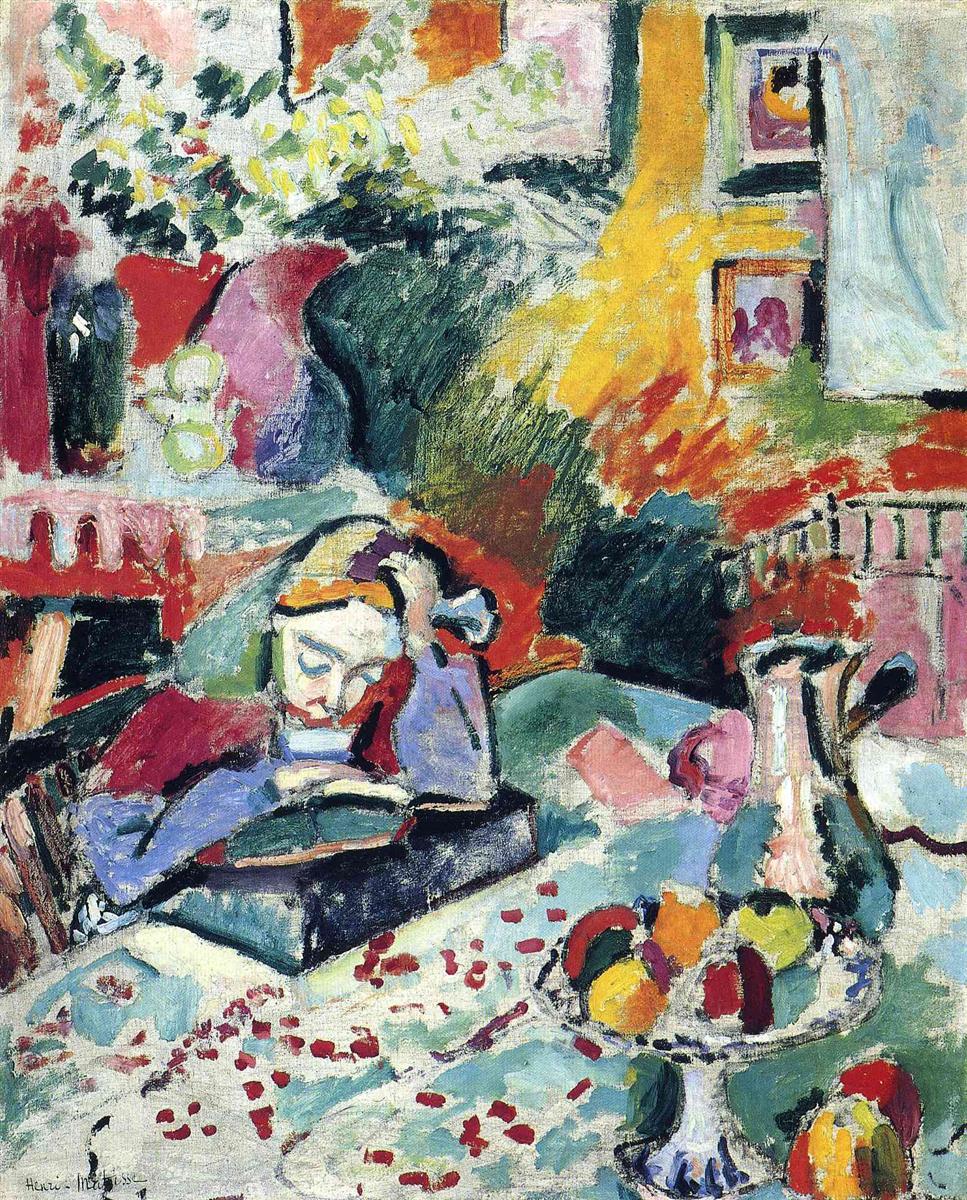
“Interior with a Girl Reading” shows Henri Matisse at the turning point of 1905, when color ceased to be an accessory and became thought itself. The subject is humble: a girl absorbed in a book at a table, a fruit dish and metal pitcher nearby, flowers, a window, walls patched with pictures and patterned cloths. Yet nothing is described with careful shading or academic perspective. The room is constructed out of saturated chords—acid yellows, emerald greens, deep reds, cool violets, and milky blues—laid as independent, confident blocks. Black is used like a brace to hold the bright planes in tension. The result is an interior that feels simultaneously intimate and expansive, a domestic scene that becomes a manifesto for modern painting.
Collioure 1905 And The Birth Of A Language
The painting belongs to the incandescent summer Matisse spent in Collioure, working shoulder to shoulder with André Derain. In those months he moved decisively beyond Neo-Impressionism’s measured dots toward a freer facture that kept the clarity of pure pigment but discarded optical rules. This interior keeps the idea of separate strokes, yet the dots have grown into tiles and arcs that change size according to the form’s needs. Instead of treating color as a skin on top of drawing, Matisse lets color do the drawing. The painting reads as a field experiment conducted in full daylight: how little descriptive information can be given while preserving the reality of a room and its occupation by a thinking person.
The Subject And The Quiet Drama Of Attention
At the lower left sits the girl, head tipped into her hand, eyes dropped to the page. Her body is suggested by broad planes—lavender sleeve, pale face, a dark triangle of tabletop shadow—and by a few black accents that state the curve of brow and the contour of her cheek. Around her, the tabletop spreads like a small landscape: sprinkled red petals, a folded pink note, a gleam of metal in the pitcher, a compote piled with citrus and apples. The narrative is minimal yet potent. Reading is not a side gesture; it is the organizing act. Everything in the room seems to echo the slow arc of concentration, from the curve of the flowers to the fan of light that moves across the wall.
Composition As An Engine Of Movement
The canvas is a theater of diagonals and arcs. The table slants from lower left to mid-right, carrying the viewer’s eye past the girl toward the fruit and jug. Behind, a powerful yellow diagonal descends across the wall like a shaft of sunlight, turning the green sofa or hanging textile into a dark counter-form. At the upper right, stacked window openings repeat as small rectangles, their internal color patches—violet, orange, green—acting like secondary paintings inside the painting. The left half of the composition is busier and denser; the right opens into larger, calmer zones. That imbalance is deliberate: attention pools around the reader and then disperses across the room, matching the mental rhythm of reading and drifting thought.
Color As Structure, Not Ornament
Warm–cool contrasts are the architecture of the space. Warm colors—ochre, cadmium orange, and the crimson of textiles—advance and provide mass; cool colors—emerald, viridian, blue, and violet—recede and create breathing room. The tabletop’s cool turquoise establishes a plane on which warm objects can sit without sinking. The fruit dish is a chord of lemon, tangerine, and red bound by blue shadows; the pitcher reads as metal through a sequence of cool flashes set against a warm outline. The wall to the right is literally built out of temperature: a wedge of hot yellow presses against a slab of cooler green, and the seam between them functions as a drawn edge. Nearly every boundary is a color meeting another color rather than a graphite or ink contour.
The Productive Power Of Black
Black in this painting is not shadow; it is a structural element. Matisse uses it to lock bright planes together and to give the composition ballast. A black band underlines the tabletop, preventing the cool surface from floating. Black seams articulate the girl’s face and hair, her book, and the table’s far edge. Thin black lines punctuate the fruit dish and pitcher to declare their profiles. This is black as the lead in stained glass: it intensifies, clarifies, and prevents the high key from dissolving into a glare of unrelated hues.
Brushwork, Impasto, And The Speed Of Perception
The surface is built from strokes that preserve the painter’s pace. In the flowers and foliage the marks are short, thick, and tilted, creating a tremor of life. On the table and walls the paint is broader, sometimes thinly dragged to allow the ground to sparkle through, which reads as glare. The fruit dish carries small ridges that catch real light; the pitcher’s bright notes are single decisive touches. This variety of handling allows Matisse to move from object to atmosphere without changing his basic vocabulary: the same brush that deposits a leaf can state a page or a slice of sunlight.
Light And Interior Weather
Everything in the room registers an afternoon brightness that simplifies and clarifies. The wall’s yellow diagonal behaves like a band of sun; it does not cast realistic shadows so much as reorganize the room’s temperatures. The tabletop breathes with pale turquoise and white reserves that evoke reflected light bouncing from window to cloth. The girl’s face is a compact arrangement of cool and warm planes rather than a modeled sphere. This is how strong daylight actually feels indoors: it turns things into areas of color and reduces secondary detail so that perception becomes a sequence of clear, simple events.
Pattern And Decoration As Structural Devices
Matisse had long admired the decorative arts—Persian carpets, Islamic tiles, Japanese prints—and in this interior the lesson is absorbed at a deep level. Pattern is not pasted on; it organizes space. The floral spray at the left is not botanical description but a rhythm of strokes that sets the left wall vibrating. The tablecloth’s sprinkled red marks function like musical notes guiding the eye across the foreground. The framed rectangles at right are condensed patterns that stabilize the wall while admitting small pockets of narrative possibility. Pattern here is a way of thinking, a method of distributing attention across the surface so that no zone goes inert.
The Psychology Of The Figure
Because the girl’s features are simplified, her emotion is carried by posture and temperature. The curve of her arm forms a shelter around the book; the cool blues and lavenders of her clothing cocoon her in a mental climate distinct from the room’s hotter zones. Her face is tipped toward light, yet it holds to the page, a sign that inner attention outruns outer stimulus. Matisse’s ambition for painting—to offer balance, repose, and a tonic calm—finds an embodiment in this focused reader. She is not isolated from the room; she concentrates within it, as if color were the atmosphere of thought.
Still Life As Counterpoint
The fruit dish and pitcher counterpoise the reader. Where the girl’s forms are soft and continuous, the still-life objects are crisp and punctuated. Their bright colors echo the room while anchoring the front plane. The piled fruit is not meticulously described; two or three colors per sphere suffice, with a quick white glint to state light. The metal pitcher is a choreography of cool notes against a warm contour that gives it volume. These objects introduce the sense of touch—cool metal, fragrant citrus—without competing narratively with the human figure. They are the table’s music under the voice of reading.
Windows, Frames, And The Idea Of Looking
On the right wall, stacked windows or pictures-within-the-picture operate as mirrors of the act of viewing. They assert that an interior is a space of looking as much as living. Their small internal scenes, rendered as simple color patches, keep us aware that representation is at work inside representation. Matisse does not force the viewer outside through a deep view; he reminds us that the world enters the room through framed apertures—artworks, windows, even the book’s rectangle.
Space Without Linear Perspective
There is clear spatial recession, but it is achieved without a rigid grid of orthogonals. Depth comes from overlap—the girl against the table, the table against the far wall; from relative scale—the fruit dish small compared with the girl, yet forward of the pitcher; and from temperature—cool planes recede, warm planes advance. The floor is barely defined, but the painting remains navigable because color planes act as stepping stones. The viewer moves through the room as through a shallow stage whose walls are painted with air.
Dialogues With Precedents And Peers
The canvas converses with Cézanne, who taught Matisse how color planes could build form and how a table could tilt toward the viewer without collapsing. It acknowledges the decorative courage of Gauguin and the Nabis in the flattening of space and in the use of pattern as structure. It stands alongside Derain’s Collioure interiors in its heat and audacity, yet it is more intimate; where Derain often asserts outlines and poster-like flats, Matisse allows more reserve and more tactile transitions. The painting compresses those influences into a language that would soon lead to the great interiors of 1908–1911.
Meaning Beyond Description
What, beyond a girl and a room, does the painting say? It proposes that the activities of ordinary life—reading, arranging fruit, placing flowers—are sufficient subjects when translated into clear relations of color. It suggests that a room is not only a container for objects but a climate of feeling, adjustable by the simplest of means: a shift from cool to warm, a brace of black, a reserve of light ground left unpainted. It models a form of attention in which the outer world supports the inner without overwhelming it. In that sense it is a portrait of modern life at its best: private concentration amid vivid surroundings.
How To Look So The Picture Opens
Begin at the white fruit dish and let your eye count the quick red and yellow notes that build each piece of fruit. Move to the cool glints on the pitcher and feel their crispness against the warm contour. Follow the trail of sprinkled red across the table to the girl’s book; notice how a single black seam creates the book’s edge. Climb the yellow band up the wall and watch it push against the green mass behind it like sunlight meeting shade. Drift to the flower spray at top left and observe how separate strokes read as leaves and blossoms only when you step back. Close the loop by returning to the reader’s face, where minimal drawing and calm colors make thought visible.
Materiality And Scale
Even in reproduction the variety of paint is evident: thick ridges on the fruit dish’s rim, dry scumbles on the wall, fat strokes in the foliage, and compact, carefully placed blacks that arrest the eye. The scale is intimate, asking you to stand close enough to see decisions. One senses the speed of the painter’s hand and the deliberateness of his editing. Nothing is overworked. The canvas records a sequence of convictions rather than a laborious accumulation of detail.
Anticipations And Afterlives
Several seeds here will flower later. The belief that color can serve as architecture culminates in “Harmony in Red” and “The Red Studio,” where hue becomes room. The love of pattern and the use of decorative rhythm as structure return throughout the Nice period. The willingness to simplify features and let posture and color carry psychology becomes a signature of portraits and odalisques. Even the practice of leaving reserves of ground foreshadows the paper cut-outs, in which white is no longer painted light but literal paper light.
Conclusion: Color, Thought, And Domestic Modernity
“Interior with a Girl Reading” compresses the 1905 breakthrough into a single, generous scene. It shows a person concentrating, a table laid with bright, ordinary things, a wall alive with light and pattern. Every element is built by color, steadied by black, and allowed to breathe through reserves of ground. The canvas argues that a home can be a place where looking and living reinforce each other, and that painting can make that accord visible. In Matisse’s hands, the act of reading becomes both subject and metaphor: attention is the path through which color organizes the world.