Image source: wikiart.org
Introduction
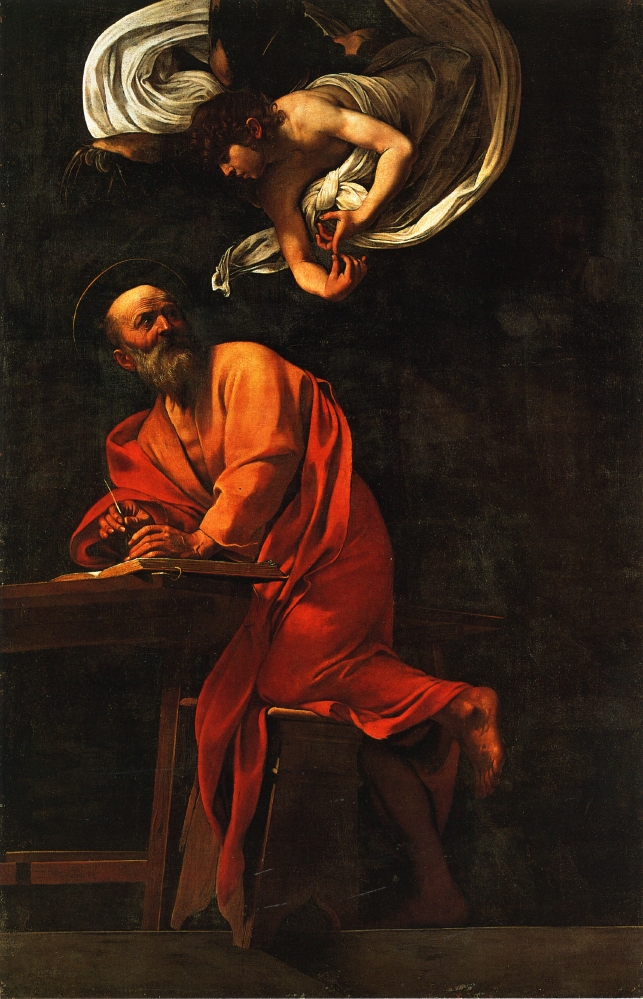
Caravaggio’s “Inspiration of Saint Matthew” (1602) stages revelation as a quiet interruption in a room of deep shadow. An elderly apostle sits at a rough desk with his legs casually crossed and a quill poised over a bound volume. Above and behind him, an angel tumbles down on a swirl of drapery like a gust of wind turned visible, counting on his fingers as if dictating the next line. The saint’s head tilts, his eyes lift, and the quill hovers between hesitation and obedience. With almost nothing in the way of setting—a bench, boards, parchment, a crimson robe—Caravaggio makes the act of writing look like an event that ripples the air. The painting holds the viewer at the moment when language has not yet descended into ink, when thought is becoming text because a messenger has entered the room.
Historical Context
The canvas belongs to a celebrated commission for the Contarelli Chapel in San Luigi dei Francesi, where Caravaggio had already transformed religious painting with “The Calling of Saint Matthew” and “The Martyrdom of Saint Matthew.” This third scene completes the narrative arc by showing the evangelist at work under divine guidance. An earlier version—now lost—reportedly depicted Matthew with rustic awkwardness, his foot thrust toward the viewer as an angel physically guided his hand. Roman patrons found it too informal. Caravaggio responded with a subtler, more dignified solution: the same immediacy of contact, but translated into a poised exchange of glances and gestures. The result kept the artist’s radical naturalism while satisfying the chapel’s demand for gravity.
Subject and Narrative Instant
The subject is authorship under inspiration. Matthew, patron saint of accountants and chroniclers, must translate experience into gospel. Caravaggio chooses the instant when the line is about to be written, not the moment of finished proclamation. The angel leans in counting—one, two, three, four—an image that has stirred much commentary. It may signal the enumeration of genealogies that open Matthew’s gospel, the ordering of beatitudes, or the measured cadence of dictated prose. The ambiguity is purposeful: the gesture makes inspiration intelligible without turning it into spectacle. What the viewer sees is a conversation of hands, eyes, and breath—spiritual materialized as choreography.
Composition and the Architecture of Attention
The composition is a duet arranged on a diagonal. Matthew occupies the lower left, a mass of warm red, solid and earthbound. The angel spirals from the upper right, a bright knot of limbs and white drapery that behaves like a ribbon of air. Their eyelines cross near the saint’s raised brow; the quill, angled upward from the page, echoes the same vector. Caravaggio clears the background to a dark void so that nothing competes with this line of address. Furniture forms a triangle of support: desk slab, bench, and footstool stabilize the saint against the angel’s gust. The whole design drives the eye in a loop—Matthew’s hands to the book, up the quill, along the diagonal to the angel’s counting fingers, then back through the saint’s lifted gaze to the page where meaning will land.
Chiaroscuro and Light as Dictation
Light is the painting’s third character. It enters from the left and seems to break over the saint’s robe before catching the angel’s tumbling body and billowing cloth. The illumination is directional and disciplined, carving Matthew’s face and hands with the same care it gives to the folds of drapery. Darkness is not emptiness; it is the stage that lets the beam behave like speech. In the Contarelli cycle, Caravaggio consistently uses light to announce vocation: the slanted shaft that chooses a tax collector, the cone that falls on a martyr. Here, a softer but equally authoritative glow clarifies the exchange between scribe and messenger. The viewer reads the light as dictation turned visible.
The Angel and the Grammar of Gesture
Caravaggio’s angel is boyish, athletic, and entirely alive to gravity. Drapery wraps and unwraps the body in a helix, making motion plausible. Feathers are suppressed into darkness; the messenger floats because the composition says so, not because anatomy cheats. The angel’s fingers count, a practical, almost teacherly gesture that grounds inspiration in human habit. A slight smile animates the mouth; the eyes aim toward the saint, not the heavens. This is guidance at close range, a companionable authority that reassures Matthew that he is not merely imagining the words. The counterpoint between the angel’s whirling fabric and the saint’s heavy robe narrates the meeting of quick spirit and patient craft.
Matthew’s Pose and Psychology
Everything about Matthew’s body makes sense of the task at hand. The cross of legs hooks the saint to the bench; his left foot curls on the rung, ready to push closer to the desk. Wrists and fingers are shown with observational rigor: the left stabilizes the page, the right steers the quill; both are caught mid-adjustment, the subtle choreography of a writer about to commit. His expression records recognition rather than surprise. The furrowed brow, slightly parted lips, and brightened eyes belong to someone hearing a phrase take shape. Caravaggio refuses ecstatic rapture and instead offers alert receptivity—exactly the psychology a gospel requires.
Fabric, Wood, and the Tactility of Thought
As in all Caravaggio, matter persuades. The saint’s robe is a triumph of saturated red, its weight and nap modeled by long ramps of shadow that break into sharp ridges of highlight at every fold. The desk is a slab of austere timber, its edge catching a line of light that describes thickness and grain. The bound book is not a generic prop: the leather glows where thumb and palm have burnished it; pages tilt with a believable stiffness. The angel’s white drapery writes its own script in the air, each crease and twist describing the arc of descent. These textures are not indulgent detail; they make the invisible labor of thinking feel material and credible.
Color and the Emotional Climate
The palette is laconic and purposeful: a dominant red for Matthew, a luminous white for the angel, and a field of warm browns and blacks that absorb everything else. This two-color drama has psychological force. Red is earth and blood, the heat of work; white is clarity and grace. Their meeting creates the painting’s mood: a warm silence suddenly ventilated by cool motion. Caravaggio avoids the sweetening effects of blues and golds. The scene remains intimate, sober, and grounded—even as a messenger from elsewhere enters it.
Tools of the Evangelist
The quill, inkwell, and codex form a small still life of vocation. The pen’s nib glints; a second quill lies ready; the book’s ribbon marker peeks from the margin. Such objects, rendered with loving exactness, tether inspiration to routine. There is always another page, another dip of ink, another correction. Caravaggio suggests that sanctity includes craft: accuracy of hand, patience of posture, respect for materials. The painting thus honors the mundane faithfulness that underwrites miracle.
Theology Without Emblems
No medieval attributes clutter the scene—no winged ox of the evangelist, no haloed putti strewing symbols. Matthew wears a thin golden halo, barely more than a ring of light; the angel needs none. The doctrine is embodied, not illustrated. Revelation, the canvas argues, does not annihilate human process but partners with it: the divine speaks and the mind writes; grace arrives and posture adjusts. The angel’s counting fingers imply order, not trance. The gospel will be a book, a human artifact shaped line by line under a beam of accompanying light.
Dialogue with the Other Contarelli Paintings
Viewed in the chapel, this canvas converses with its companions. In “The Calling,” light crosses a tavern and finds a man at a table; here it crosses a studio and finds a man at a desk. There, a hand points and a life pivots; here, a hand counts and a sentence forms. “The Martyrdom” explodes with diagonals of force; “Inspiration” distills those diagonals into a single, quiet arrow from angel to page. Together, the three works narrate vocation as interruption, consummation, and transmission: summoned, spent, and written.
From the Rejected Version to the Final Solution
Contemporary sources describe the first version of the subject as too familiar, a peasant-like Matthew taught to write by an angel who physically controlled his hand. The painting we now see withdraws the literal hand-over-hand guidance and replaces it with a more subtle relay. That shift is crucial. It preserves Caravaggio’s realism—the saint remains a recognizably ordinary man—while according him the dignity of a writer capable of craft under inspiration. The change also clarifies the painting’s theology: grace does not erase agency; it animates it.
Space, Silence, and the Viewer’s Seat
The room is a shallow pocket of darkness with a floor barely indicated by the bench’s legs. That emptiness creates acoustic silence. We can imagine the scratch of the quill, the rustle of fabric, and the soft intake of breath as a phrase falls into place. The desk’s angle and Matthew’s turned body open a wedge for the viewer to step into. Caravaggio’s stagecraft always brings the event into our air; here it places us just to the saint’s left, able to lean over his shoulder and read. The painting therefore functions as invitation: enter the silence where words are born.
Technique and Paint Handling
Caravaggio builds the scene with large tonal blocks and reserves his most acute edges for where light breaks across volume—the knuckles guiding the quill, the crease at Matthew’s brow, the sharp ridge of the desk. Flesh is modeled with translucent veils that let warmth glow beneath cooler highlights. The red robe is structured by long, confident strokes that turn creases without fuss; the white drapery is a counterpoint of glazes and dry scumbles that produce a believable satin. No passage feels ornamental. The eye moves without snag from form to form, as if guided by the same economy that governs Matthew’s prose.
Symbolic Undertones in a Quiet Key
While the painting eschews overt emblems, undertones are audible. Matthew’s crossed legs and the bench’s humble carpentry echo the carpentering Joseph of his infancy narrative; the counted fingers suggest the ordered genealogy that opens his gospel; the red garment intimates the flesh of the Word he records. The angel’s swoop has Marian overtones—a visitation to someone who will bear a text rather than a child. None of this is pressed. It remains available to a viewer attentive enough to hear it without losing the painting’s first claim: a man writes because he is addressed.
The Emotional Temperature of the Red
Caravaggio’s reds are never merely decorative. Here the robe’s warmth holds the painting together and keeps the angel’s descent from dissolving into spectacle. The saint’s body, wrapped and re-wrapped, becomes a furnace of attention from which the quill emerges like a white-hot instrument. The red also harmonizes with the Contarelli cycle’s palette, echoing gestures and garments across canvases so that the chapel reads as one sustained chord.
Matthew’s Face and the Ethics of Attention
Look long at the saint’s expression. It is neither ecstasy nor fear. It is concentration born of trust. The eyes accept that the voice is friendly, the brow accepts that the words are exacting, and the mouth accepts that the task will take the rest of the night. Caravaggio dignifies attention as a moral act. In a Rome dazzled by spectacle, he paints the holiness of listening hard enough to write well.
How to Look
Enter at the quill poised above the page and ride that line up into Matthew’s hand. Climb to his gaze and then cross the diagonal to the angel’s circling fingers. Follow the coil of white drapery as it returns your eye to the saint’s shoulder and down again to the book. Repeat the loop until the rhythm becomes audible: question, answer, inscription. If the chapel installation is in your mind’s eye, imagine how this measured exchange balances the explosive energy of the martyrdom and the sudden beam of the calling. The cycle becomes a single sentence made of three clauses.
Influence and Afterlife
“Inspiration of Saint Matthew” refined a visual grammar for divine dictation that many Baroque painters would adopt: the messenger at the edge of visibility, the writer’s hand held just before the stroke, the light that behaves like voice. The work also helped establish a more dignified, literate iconography for evangelists—men at desks rather than remote, enthroned symbols—bringing the church fathers nearer to the studious devotion of patrons and parishioners. In modern times the painting has become an emblem for anyone who works with words: a reminder that clarity arrives not from theatrics but from paying attention to the whisper that organizes thought.
Conclusion
Caravaggio’s “Inspiration of Saint Matthew” teaches that revelation does not shout; it leans in. A drape turns in the air, a hand counts, a brow lifts, a quill hovers, and a book receives what a life has heard. Everything in the painting honors process—the craft of writing, the patience of listening, the humility of being taught. By stripping away scenery and trusting light to carry meaning, Caravaggio converts a theological claim into an immediate human event. The evangelist becomes not a symbol far above us but a worker at a desk, interrupted by grace, ready to write a sentence that will outlast the night.