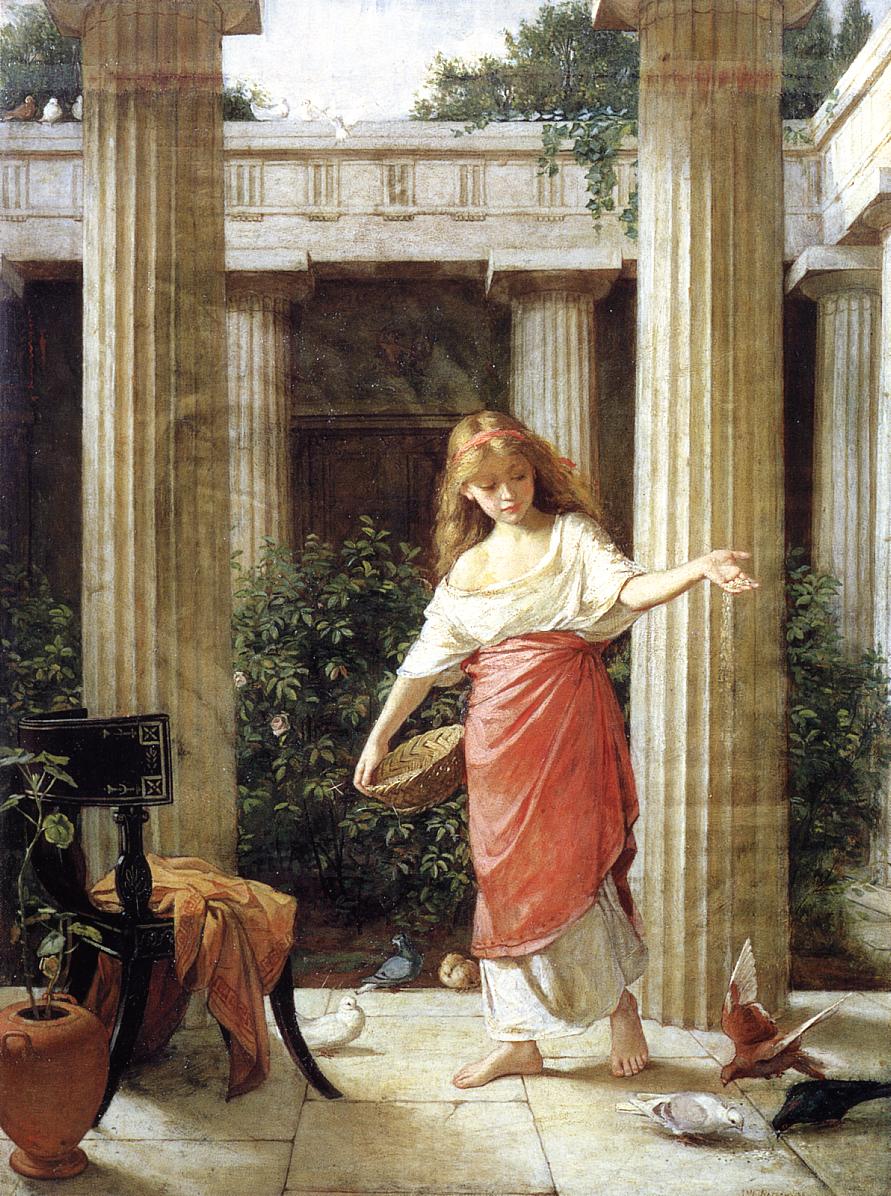
Image source: wikiart.org
First impressions and the quiet drama of a simple act
John William Waterhouse’s “In the Peristyle” (1874) looks, at first glance, like a calm fragment of daily life placed inside an idealized classical world. A young woman steps barefoot across pale stone tiles, tilting her body as she scatters food for the birds gathered at her feet. Nothing “big” seems to happen, yet the painting feels charged with attention: the attention of the figure, the birds, and the viewer. Waterhouse turns an ordinary gesture into a small ceremony, staged within architecture that frames it like a temple.
The quiet drama comes from balance. The scene is neither crowded nor empty. The girl is not centered like a formal portrait, yet she becomes the natural focus because everything around her supports her presence: columns rise like a chorus behind her, foliage darkens the middle ground to push her forward, and the bright floor behaves like a stage that catches light and holds the movement of her step. Waterhouse’s early classical mode often treats antiquity as a place for mood and moral atmosphere rather than strict archaeology, and here antiquity becomes a setting for tenderness, stillness, and a controlled sense of beauty.
The peristyle as a theatrical frame
The title matters because a peristyle is not just a generic courtyard. In Roman domestic architecture, a peristyle is a colonnaded garden space, a private interior that still feels open to air and sky. Waterhouse uses that idea to create a paradox: the figure is sheltered and exposed at the same time. The columns and entablature promise stability, privacy, and order, but the upper opening admits daylight and suggests a world beyond the house.
Look at how the architecture is used as framing rather than background. Two large columns stand like gateposts in the foreground, creating a visual entrance into the picture. They make you feel as if you are standing at the threshold, about to step into the courtyard. Behind them, more columns line up in softer focus, extending the space inward while keeping it contained. The stone surfaces show age through subtle stains and tonal variation, implying time’s gentle wear, not ruin. This is a lived classical setting, not a fallen one.
Waterhouse also places a horizontal band of architecture high in the composition, with sky and greenery above it. That band acts like a lid that keeps the scene intimate, while the patch of sky prevents the space from becoming claustrophobic. The peristyle becomes a stage set built from calm geometry, designed to make the small gesture of feeding birds feel significant.
The figure as movement, pause, and self containment
The young woman’s pose is the painting’s engine. Her right arm extends outward with open palm, offering food in a way that reads as both invitation and blessing. Her left hand holds a shallow basket close to her body, anchoring the action in something practical. She is mid step, with one foot placed forward, toes lightly contacting the stone. The step is careful, as if she is trying not to startle the birds, and that care becomes a key emotional note.
Her head tilts downward, eyes lowered toward the ground, concentrating on the small living beings around her. This avoids theatrical eye contact and makes the moment feel private. The viewer is allowed to watch, but the figure is not performing for us. That refusal of direct address is one reason the painting feels sincere: it depicts absorption rather than display.
Waterhouse subtly uses asymmetry to keep the pose alive. The extended arm creates a long diagonal, while the opposite shoulder and the basket create counterweight. The line of her hair and the slope of her head continue the diagonal rhythm. Even the folds of fabric follow the movement, falling in directions that echo the sweep of her gesture. The result is a figure that feels both graceful and real, poised between motion and stillness.
Clothing and the language of classical femininity
The costume is a Victorian imagining of classical dress, and it is painted to communicate softness against stone. A pale tunic slips slightly off one shoulder, revealing skin with a gentle, luminous highlight. Over it, a red drape or wrap gathers around her hips, providing the painting’s most saturated color and acting like a visual magnet. Waterhouse lets the red cloth do several jobs at once: it emphasizes the figure’s turn, clarifies her silhouette against the pale floor, and carries warmth into a setting dominated by cool stone.
The costume also hints at the theme of vulnerability without turning it into spectacle. Bare feet on stone suggest intimacy and domestic calm. The loose shoulder suggests ease, not scandal, like someone at home in a protected courtyard rather than dressed for public display. The entire effect is a controlled idealization, the kind of classical femininity popular in late nineteenth century British painting: serene, poised, and framed by antique architecture.
Yet there is also individuality. The red band in her hair gives a modern note of personality and ties the color story together. Her hair, painted with soft golden tones, catches light and becomes a secondary halo, reinforcing her gentle centrality in the scene.
Light as touch and as moral atmosphere
Light in “In the Peristyle” behaves like touch. It slides down columns, softens across the girl’s face and shoulder, and spreads on the floor in a wide, quiet sheen. The shadows are present but not harsh, suggesting either late morning or early afternoon, when brightness is strong yet still pleasant. This kind of light does not threaten. It reassures.
Waterhouse uses contrast carefully. The foliage behind the figure is darker and more textured, a mass of greens that creates a soft backdrop. Against that, the white tunic and illuminated skin come forward. The columns, while pale, carry warmer stains and vertical striations that prevent them from becoming blank. The floor tiles reflect and hold the light, turning the lower half of the painting into a luminous field where the birds stand out as moving accents.
This lighting does emotional work. It gives the scene a moral atmosphere of calm attention, as if kindness and beauty are aligned with clarity and warmth. Waterhouse often paints light not just as physical illumination but as a mood that tells you how to feel. Here it encourages tenderness and quiet contemplation.
Birds, instinct, and the choreography of the ground
The birds at the woman’s feet provide the painting’s most immediate sense of life. They are small, quick presences that contrast with the monumental stillness of the columns. Some peck, some pause, some seem mid flutter. Their scattered positions create a choreography across the stone tiles, like notes on a staff. The woman’s gesture directs them, but they remain independent, driven by instinct.
Because the birds are low in the composition, the viewer’s gaze drops to the floor and then rises again to the figure, repeating the rhythm of her own attention. This creates empathy: you find yourself looking where she looks. The ground becomes a shared space between human and animal, a little world of trust.
Birds in classical or symbolic painting often carry associations of peace, domestic harmony, or fleetingness. Even without pinning the scene to a single myth, the presence of birds suggests a theme of gentle guardianship. The young woman is not hunting, capturing, or controlling. She is offering. The act becomes an image of care that costs almost nothing materially but means something emotionally.
Still life elements and the sense of a lived interior
On the left side, Waterhouse includes objects that deepen the domestic feeling: a decorative chair with inlaid details, a draped cloth in warm orange tones, and a terracotta pot with a plant. These still life elements do not compete with the figure, but they enrich the world around her. They imply that this peristyle belongs to a household with taste, comfort, and routine.
The chair and fabric also add texture contrast. Stone is hard, cool, and permanent. Cloth is soft, warm, and transient. Terracotta is earthy and handmade. Green leaves are living and changeable. By including these materials, Waterhouse builds a sensory environment you can almost feel. The painting becomes not just a view but a tactile experience: cool marble underfoot, sun warmed fabric, dry clay, and the flutter of birds.
These objects also strengthen the composition. The chair’s dark shape anchors the lower left corner, balancing the cluster of birds and darker accents on the lower right. The warm cloth echoes the red drape on the woman, creating a color harmony that keeps the palette cohesive.
Texture, paint handling, and controlled detail
Waterhouse is often praised for his ability to combine careful drawing with a paint surface that feels alive. In this early work, you can see a disciplined approach to form. The architecture is constructed with clear verticals and believable depth. The figure’s anatomy is softly modeled, with transitions of light that feel smooth rather than overly sharp. The fabric folds are described with enough specificity to read as cloth, yet not so much that they become fussy.
The most persuasive textures are those that serve the mood. The stone columns show subtle streaking and weathering, suggesting age without decay. The foliage is painted with a clustered, leafy density that reads as living growth. The hair is rendered with a softness that catches light and gives the figure warmth. The floor tiles are relatively plain but luminous, allowing the action to remain the focus.
This balance between detail and restraint is central to the painting’s charm. The scene feels real enough to enter, but ideal enough to remain a dream of antiquity.
Waterhouse in 1874 and the appeal of classical revival
“In the Peristyle” belongs to a period when Waterhouse was working within the broader Victorian fascination with the classical world. Many British artists of the time painted Roman or Greek settings as spaces for beauty, moral reflection, and refined emotion. Rather than presenting antiquity as chaotic history, they often presented it as an orderly mirror where modern viewers could contemplate timeless virtues: patience, tenderness, composure, and longing.
Waterhouse would later become closely associated with poetic and mythic subjects, especially those drawn from literature and legend. But even here, in a scene that feels more genre like than narrative, you can sense the seeds of his later strengths. He is already interested in the inner life of a solitary female figure. He is already crafting environments that feel like psychological spaces, not just physical ones. The peristyle is not merely architecture. It is a metaphor for a protected interior self, open to light but guarded by columns.
The painting also shows Waterhouse’s ability to make the past feel emotionally accessible. The classical setting does not push the viewer away with cold scholarship. Instead, it invites you into a quiet moment you recognize: feeding birds, moving carefully, being gentle for its own sake.
Themes of innocence, attention, and controlled freedom
One of the most compelling themes in “In the Peristyle” is attention itself. The woman’s lowered gaze and measured step suggest mindfulness before that word became popular. She is present. The birds, alert and responsive, intensify that sense of presence. The entire scene becomes an image of careful relationship: the human offering, the animals accepting, the space holding both.
Innocence here is not childishness. It is a calm sincerity, a lack of cynicism. The figure’s softness is matched by the order of the architecture. Together they create a world in which gentleness seems natural. That is an idealization, of course, but it is an emotionally persuasive one. Waterhouse paints not the messiness of daily life, but the moment when daily life briefly feels harmonious.
There is also a subtle idea of controlled freedom. The peristyle is open to sky, but enclosed by walls and columns. The woman moves freely, but within a protected boundary. The birds can fly, yet they gather on the ground for food. This tension between openness and enclosure gives the painting its quiet depth. It is not just a pretty scene. It is a meditation on safety, choice, and the delicate trust that allows closeness without fear.
Why the painting lingers in memory
Many paintings impress through spectacle, drama, or grand story. “In the Peristyle” lingers because it offers something rarer: a sustained atmosphere of calm that does not feel empty. Waterhouse builds that calm through structural choices. The columns create order. The foliage creates softness. The light creates warmth. The birds create life. The figure ties everything together through a gesture that is both ordinary and ceremonial.
The painting also invites slow looking. Your eye moves from the bright floor to the birds, then up the red drape to the woman’s face, then outward along her extended arm, then back into the architecture and greenery. This gentle circulation keeps the image active without disturbing its tranquility. The longer you look, the more you notice the small harmonies of color and shape, and the more you feel the painting’s true subject: a moment of kindness held inside an ideal world.
For viewers drawn to John William Waterhouse, this work is especially interesting because it shows his classical imagination in a quieter register. It is not myth shouting its name. It is myth’s architecture used as shelter for everyday grace.