Image source: wikiart.org
Introduction to the Painting
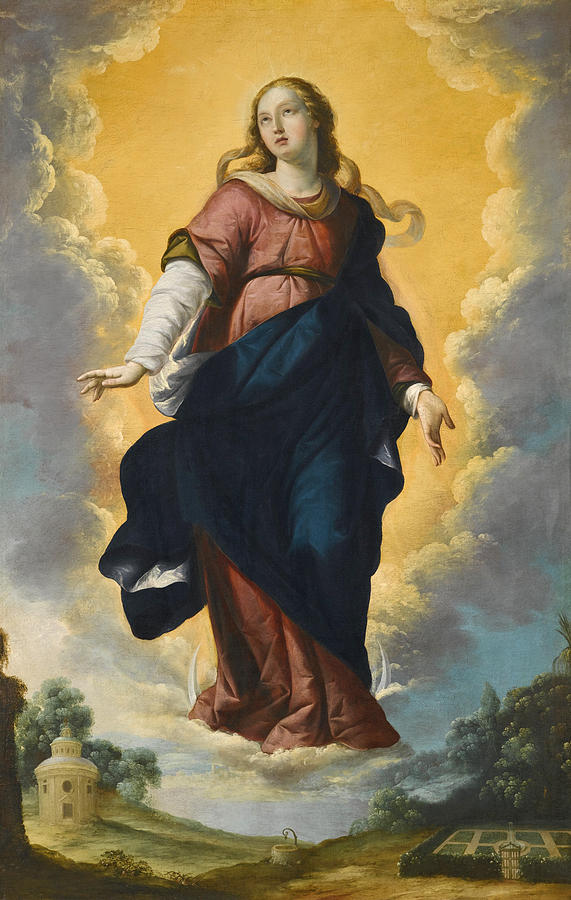
“Immaculate Conception” by Francisco de Zurbaran presents the Virgin Mary as a serene, floating figure framed by a radiant golden sky. She hovers above a peaceful landscape, her robes stirred gently as if by a heavenly breeze. The painting belongs to the long Spanish tradition of representing the doctrine of the Immaculate Conception, which affirmed that Mary was preserved from original sin from the first moment of her existence.
At first glance, the work is disarmingly simple. One central figure, a glowing background, a small stretch of earth below. Yet the more time you spend with it, the more the painting reveals a rich program of symbols and a carefully structured composition that transforms theological doctrine into a vivid visual experience.
Historical and Devotional Context
In seventeenth century Spain, devotion to the Immaculate Conception reached an intense level. Theologians, religious orders, confraternities and even municipal councils championed the belief that Mary had been conceived without sin, long before it became an official dogma of the Catholic Church. Images of the Immaculate Conception were commissioned for churches, convents and private chapels across the Iberian Peninsula.
Zurbaran was one of the major painters who helped shape the visual language of this devotion. Working mostly in Seville and later in Madrid, he produced several versions of the theme. Each one adapts the iconography slightly, but all emphasize Mary’s purity, her election by God and her role as a bridge between heaven and earth.
This painting fits squarely within that devotional climate. It is not a narrative of a particular moment in Mary’s life. Instead, it is a theological portrait, a visual meditation on who Mary is in the eyes of believers. Her placement in a blazing heaven above a small earthly landscape expresses the idea that her life, from its very beginning, was embraced by divine grace.
Composition and Overall Design
The composition is vertically oriented and strongly symmetrical. Mary stands in the center of the canvas, occupying most of its height. Her figure is framed by an oval of golden light and encircling clouds, which open like a heavenly curtain. Around this bright central field the sky becomes cooler and bluer, creating a soft halo that separates her from the outer edges of the painting.
Below, a narrow band of landscape stretches from side to side. It provides a stable base supporting the visionary apparition above. The horizon line sits low, which makes Mary appear even more monumental and distant from everyday human scale. On the left we see a small round building with a dome, perhaps suggesting a pilgrimage chapel or a symbol of the Church. On the right lies a manicured garden or orchard, hinting at paradise and the ordered harmony of creation.
Mary’s pose is slightly diagonal, with her weight on one leg, the other stepping forward in midair. Her arms are relaxed yet gently extended, palms partially open. This subtle movement keeps the composition from becoming rigid. It suggests that she is both receiving grace from above and extending it to the world below.
The eye of the viewer is drawn first to Mary’s illuminated face, then follows the flowing lines of her garments downward to the hem of her robe, and finally arrives at the landscape. This visual journey mimics the spiritual descent of grace from heaven to earth.
The Figure of the Virgin Mary
Zurbaran presents Mary as a young woman of modest beauty, with soft features, light skin and fair hair that falls in simple waves over her shoulders. Her head tilts slightly to one side, as if she is contemplating something beyond the viewer’s sight. Her gaze is directed upward and outward, not toward us but toward the divine source of the light that surrounds her.
Her clothing follows the established color codes of Marian iconography. She wears a rose toned tunic and a deep blue mantle. The rose color refers to charity and love, while blue symbolizes chastity, transcendence and the sky itself. Around her shoulders we glimpse a muted, creamy scarf that adds an additional layer of softness and modesty.
The folds of her garment are handled with care. The fabric does not cling dramatically. Instead, it falls in generous, dignified folds that emphasize both volume and grace. The blue mantle sweeps diagonally across her body, creating strong visual lines that help anchor the figure in space. At the same time, the gently stirred edges of the cloth suggest a supernatural wind that lifts her upward.
Mary’s hands deserve close attention. One hand emerges from the sleeve with delicate, elongated fingers and hangs slightly outward, as if ready to bless or receive. The other points downward in a discreet echo of traditional depictions where she crushes the serpent of sin. Here the gesture is more restrained but still suggests her active role in the defeat of evil.
Her expression is composed and introspective rather than ecstatic. Zurbaran does not paint her with the almost trance-like faces found in some Baroque works. Instead, she appears fully aware, thoughtful and serene. This mood reinforces the doctrinal character of the painting and invites contemplation rather than emotional frenzy.
Color, Light and the Golden Heaven
One of the most striking aspects of the painting is its glowing color palette. The background behind Mary is a warm, saturated gold that evokes both sunlight and heavenly radiance. It transitions subtly into the cooler blues and whites of the surrounding clouds. This interplay of warm and cool tones creates depth and emphasizes Mary’s central position.
Zurbaran handles light in such a way that it seems to emanate from Mary herself and from the golden field behind her. Her face, hands and the upper portions of her garments are softly lit, while shadows gather in the folds of her dress and around the lower part of her figure. This modeling is gentle but clear, giving her a solid, three-dimensional presence even as she floats weightlessly.
The blue of her mantle is rich and deep, providing a powerful contrast with the surrounding gold. This contrast highlights her role as the chosen one within the sea of divine light. The rose of her tunic harmonizes with both blue and gold, tying together the color scheme into a balanced triad.
The clouds are painted with convincing volume and texture. They vary from fluffy white to grayish blue, and their arrangement forms a soft oval frame. Their layered forms suggest that Mary has broken through the barrier between the earthly sky and the higher, spiritual heaven. The bright yellow region behind her can be read as the inner sanctum of divine light into which she has been admitted.
Symbolism of the Crescent Moon and Landscape
Near the hem of Mary’s garment, subtle white arcs hint at a crescent moon, one of the key symbols associated with the Immaculate Conception. Although less sharply defined than in some of Zurbaran’s other works, the moon here still clearly serves as her pedestal. It refers to the passage in the Book of Revelation describing a “woman clothed with the sun, with the moon under her feet and a crown of twelve stars.” In Catholic tradition this apocalyptic woman was often identified with Mary.
The moon also carries symbolic associations of change, phases and instability. By standing on it, Mary is shown as triumphant over changeable earthly conditions. Her purity and grace remain constant despite the flux of human history.
The small landscape at the bottom of the canvas gathers several motifs often associated with the Immaculate Conception. The walled garden or ordered plot of land on the right recalls the image of Mary as “hortus conclusus,” the enclosed garden of the Song of Songs, a metaphor for her virginity and spiritual beauty. The round building on the left may stand for a sanctuary or tower, alluding to titles such as “Tower of David” and “House of Gold” from the Litany of Loreto.
Between these structures lies a calm path and a modest fountain or well. Water is another symbol of purity and baptismal grace. The entire landscape thus becomes a condensed emblem of the virtues and privileges of Mary. It grounds the celestial apparition in a recognizable world, yet it also feels almost miniature compared to her presence, stressing her central importance.
Zurbaran’s Style and the Question of Workshop
Art historians often attribute this painting to Zurbaran with the participation of his workshop. Whether entirely by his own hand or assisted by pupils, the work clearly bears his stylistic imprint.
The solid, sculptural modeling of the figure, the calm gravity of the pose and the restrained yet intense use of color are all characteristic of Zurbaran. Unlike some of his contemporaries who favored swirling compositions and extreme gestures, Zurbaran often aimed for a dignified stillness. Here he allows movement in the flutter of the garments and the slight rotation of the body, but he avoids exaggeration.
The handling of the landscape and clouds also reflects his approach. Details are present but not excessively elaborated. Trees and buildings are described succinctly, with a few well chosen shapes and highlights. The focus remains firmly on the central figure and the theological message.
There is also continuity with his many depictions of saints and monks. Just as his Carthusian friars appear almost carved from light and shadow within simple settings, Mary here emerges as a stable, luminous presence within a modest yet evocative environment. The painting shows that the same visual language that served the representation of austerity and contemplation in his monastic works could be adapted to the exalted theme of the Immaculate Conception.
Emotional Impact and Devotional Reading
The emotional tone of this “Immaculate Conception” is one of quiet awe rather than stormy drama. The golden light is intense but not blinding. Mary’s face is uplifted but not ecstatic. The clouds part, yet they do not swirl wildly.
For a seventeenth century viewer, this measured serenity would have encouraged a contemplative response. The worshipper could kneel before the image, recite prayers or litanies, and allow the calm assurance of Mary’s purity to permeate their own spiritual concerns. Her upward gaze invites imitation. Believers are encouraged to look beyond their daily troubles and orient their hearts toward the divine.
At the same time, the painting is not distant or cold. The softness of Mary’s features and the gentle fall of her hair give her an accessible, human presence. She seems approachable, a compassionate intercessor rather than an aloof celestial queen. This dual character, exalted yet tender, is central to Marian devotion and Zurbaran balances it skilfully.
For modern viewers, the work can still function as a visual meditation. The strong vertical axis, the luminous color and the compositional clarity create a sense of peace. Spending time with the painting invites reflection on themes such as grace, dignity, and the possibility of a life shaped by inner purity and steadfastness.
Place of this Work within Marian Imagery
Throughout his career, Zurbaran painted multiple versions of the Virgin Mary, including Annunciations, Madonna and Child compositions and several Immaculate Conceptions. This particular canvas stands somewhere between his most mystical and his most narrative Marian works. It does not feature a crowd of angels or complex symbolic objects surrounding Mary. Nor does it place her in a detailed domestic or historical scene. Instead it gives us a single, monumental figure in an open sky, framed by a few carefully chosen symbols at her feet.
Compared with some of his earlier, darker versions of the theme, this “Immaculate Conception” is brighter and more expansive. The wide landscape, the luminous sky and the airy sense of space align it with later Baroque tendencies toward grandeur and openness. Yet it retains Zurbaran’s characteristic sobriety. There is no clutter of putti, no tumbling clouds, no competing narratives. Everything serves the central idea of Mary as immaculate and exalted.
Within the broader history of Marian art, the painting reflects the transition from more complex late medieval symbolic programs to the streamlined Baroque type that would become standard in Spain and Latin America. The combination of the crescent moon, the blue mantle, the golden atmosphere and the youthful, modest Mary situates this work firmly within that tradition.
Conclusion A Vision of Grace Suspended Between Heaven and Earth
“Immaculate Conception” by Francisco de Zurbaran is a focused, luminous meditation on one of Catholicism’s most cherished Marian doctrines. Through a balanced composition, a glowing palette of gold, blue and rose, and a serene central figure, the painting translates abstract theology into a visual experience of calm radiance.
Mary floats above a carefully constructed landscape that encodes symbols of purity, enclosure and sanctity. The crescent moon at her feet recalls scriptural imagery and proclaims her victory over changeable, earthly instability. Her upward gaze and open hands express both receptivity to divine grace and generosity toward the world below.
Zurbaran’s characteristic blend of realism and spiritual intensity makes the image particularly compelling. The Virgin is both human and exalted, approachable and majestic. The painting invites viewers, whether believers or admirers of art, to contemplate the possibility of a life suffused with grace and directed toward the light that shines behind the clouds.