Image source: wikiart.org
Introduction to Hylas and the Nymphs
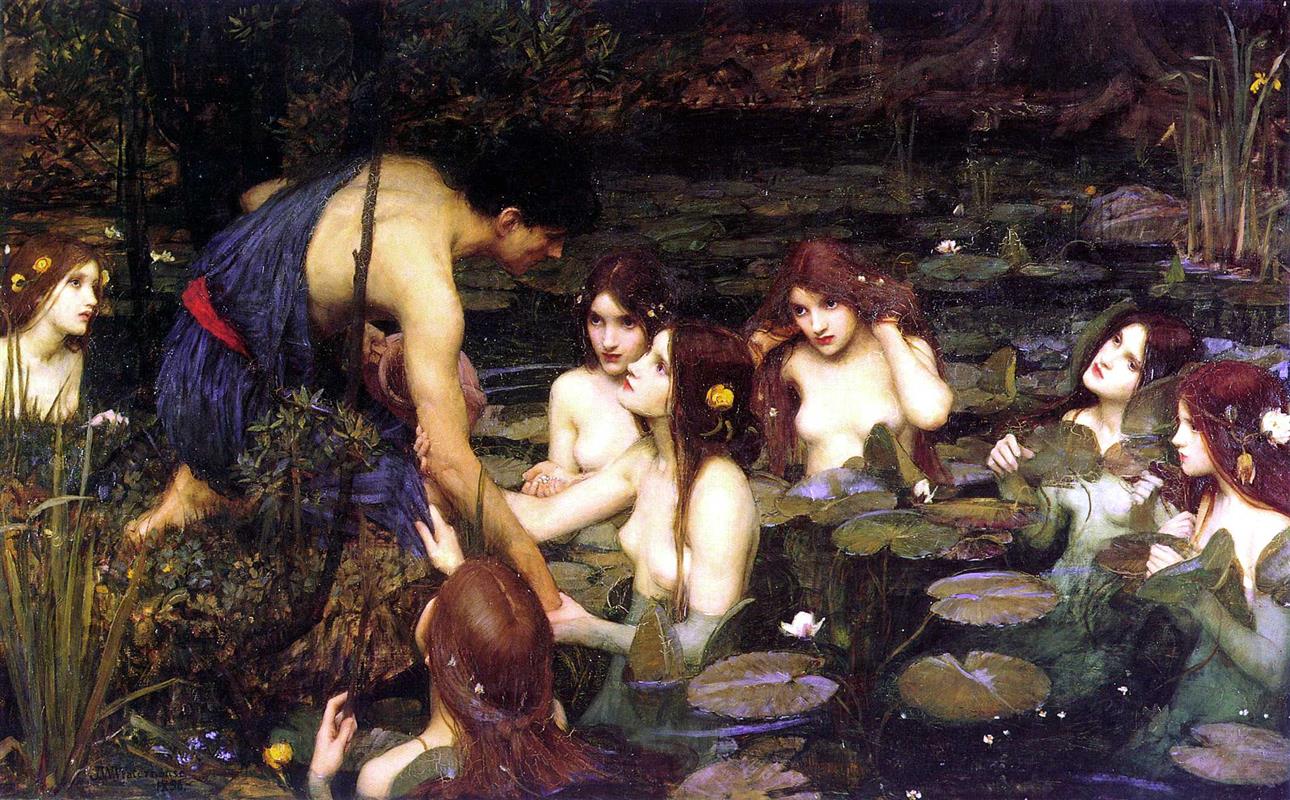
Painted in 1896, Hylas and the Nymphs captures a split second in a familiar classical story, the instant before a disappearance becomes a legend. John William Waterhouse chooses not to paint action in the heroic sense, no battle, no triumphant gesture, but a quiet seduction staged at the edge of a dark pool. The drama is psychological and visual. A young man leans down, drawn forward by faces and hands rising out of water, while the water itself seems to thicken into something like fate. The painting reads easily at first glance, yet the longer you look, the more it feels like a trap built from beauty, repetition, and irresistible softness.
The subject immediately places the work within Victorian and late nineteenth-century fascination with antiquity. Myth offered respectable distance for depicting desire, vulnerability, and danger, and Waterhouse was especially adept at using legendary narratives as containers for modern feeling. Here, the myth is not simply illustrated. It is reimagined as an atmosphere. You do not just witness an event. You feel the pull of the pool, the hush of the reeds, the way a single impulse can turn a body into a story.
The Myth and the Moment Waterhouse Chooses
Hylas is commonly associated with the Argonaut expedition. In many versions, he is a beautiful youth connected to Heracles and the crew, sent to fetch water. At the spring, nymphs see him and desire him. They lure him into the water, and he vanishes. The story can be told as abduction, enchantment, drowning, or transformation, depending on the teller. Waterhouse does not settle the question. Instead, he paints the threshold, the point where consent, curiosity, and compulsion blur.
That choice matters. If the painting showed Hylas already submerged, it would become a moral statement or a tragedy. If it showed him fleeing, it would become a warning. By freezing the instant of leaning in, Waterhouse makes the viewer participate. You are asked to decide what you think is happening, and your decision will likely shift as you keep looking. The painting becomes a test of perception. Are the nymphs predators, or are they embodiments of a natural force that Hylas cannot resist? Is Hylas innocent, or is he already complicit in the desire that draws him forward?
The myth also gives Waterhouse an ideal structure for tension: a human figure anchored in gravity and land, confronted by figures that belong to water and reflection. The narrative is literally about crossing an element boundary. In painterly terms, it is about crossing from solidity to liquidity, from daylight to shadow, from the known world to the seductive unknown.
Composition and the Geometry of Temptation
The painting’s composition is built like a slow spiral. Hylas enters from the left, kneeling and leaning toward the pond, his torso angled diagonally downward. That diagonal is answered by the angled heads and shoulders of the nymphs, who create a chain of faces leading the eye deeper into the image. The viewer’s gaze travels along arms, hair, and pale skin, then sinks into the dark water, where lily pads and reflections complicate the sense of depth. Waterhouse uses the pond not as background, but as a visual engine that draws everything inward.
A crucial device is repetition. The nymphs are not presented as one singular character but as a chorus, multiple variations on a single ideal. This repetition produces a mesmerizing effect, like a refrain in music. Faces, shoulders, and hair are echoed, and each echo diminishes the viewer’s ability to identify a single focal point. Instead, your attention moves from one figure to the next, exactly as Hylas seems to be drawn from one touch to another. The painting thus mirrors its own subject. It seduces through recurrence.
The spacing also creates suspense. Hylas’s body is mostly on land, yet his arm reaches into the water’s realm. Several hands touch him, but none seem to yank him violently. The gestures are gentle and persuasive. Waterhouse places the decisive moment in that narrow gap between secure footing and the soft surface that might give way. The pond’s edge becomes the painting’s moral and physical boundary, a line that looks natural but functions like a threshold in a dream.
Color, Light, and the Velvet Darkness of the Pool
Waterhouse orchestrates color as a contrast between flesh and shadow, but the contrasts are not harsh. The pool is dark, green-brown, and velvety, layered with lily pads and muted reflections. Against this, the nymphs’ pale skin appears luminous, almost floating. Yet the light does not feel like theatrical spotlight. It feels like low woodland illumination filtered through leaves, the sort of light that makes skin glow while everything around it deepens into mystery.
Hylas’s clothing introduces a key accent, a strong note of blue with a small strike of red at the waist. These colors mark him as distinct from the water-world. Blue is often read as calm, fidelity, or clarity, but here it also suggests the vulnerability of someone out of place, a traveler in unfamiliar terrain. The red is minimal but significant. It is the smallest hint of bodily urgency and heat within an otherwise cool, damp palette. Waterhouse does not need to make the scene explicit. He lets color imply what the story does not say aloud.
The green tones of the water and surrounding foliage are not cheerful greens. They are mature, stained, and heavy, the greens of decay and depth rather than spring. This gives the painting a faintly funereal undertone. Beauty here is not pure innocence. It is beauty that grows in shadow, beauty that can swallow. Even the lilies, symbols often linked to purity, become ambiguous in this setting. They drift on a surface that conceals what lies beneath.
Figure Painting and the Language of Touch
One of the most striking choices is the physical closeness between Hylas and the nymphs. Waterhouse arranges the hands so that touch becomes the narrative. Fingers rest on his wrist and forearm. A hand curls around him with a softness that feels intimate rather than aggressive. This is important because it shifts the story away from force and toward persuasion. The painting’s tension is in the gentleness. Viewers often expect danger to announce itself loudly. Waterhouse suggests that danger can be quiet and inviting.
The nymphs’ expressions are varied but related. Some gaze directly, some look sidelong, some seem absorbed in the act of drawing him closer. This variety prevents them from collapsing into a single stereotype. They are not simply identical sirens. They are a community of desire. Their individuality is subtle, yet present in slight changes of posture and gaze. Waterhouse thereby gives the scene a social texture. Hylas is not tempted by one figure but by a collective presence, the sense of being wanted from multiple directions at once.
Hylas’s posture is equally telling. He does not appear terrified. His head inclines toward the nymph nearest him, as if listening. His body is tense, but not in resistance. The tension reads as uncertainty mixed with attraction. Waterhouse makes the viewer read the scene through body language rather than explicit narrative signals. The painting becomes a study in the moment when the mind has not caught up with the body’s movement.
The Pond as Symbol and Psychological Space
The pond is more than setting. It is an idea. In myth and art, water often stands for the unconscious, transformation, the feminine, and the dissolution of boundaries. Waterhouse’s pond is not clear. You cannot see through it. It absorbs light. It holds reflections and distortions. In that sense, it functions like a psychological mirror that refuses to give a stable image back. Hylas looks into the water, but what he sees is not himself. He sees faces, invitations, and the promise of another world.
The lily pads add to this symbolism. They form a floating carpet, a delicate surface that suggests safety while also emphasizing the water’s depth. You could imagine stepping on them, yet you know you would sink. Waterhouse uses them as visual punctuation across the pond, breaking up darkness into shapes that feel touchable. This makes the trap more plausible. The pond looks inhabitable because it is decorated with life. Nature itself becomes complicit in the seduction.
There is also a quiet contrast between the cultivated ideal of classical nymphs and the raw, damp reality of the pond’s edge. The setting is not a marble temple. It is a muddy, plant-choked place. This mixture of idealized bodies and earthy environment intensifies the uncanny feeling. The nymphs appear too perfect for the setting, as if they belong to a different order of existence that has surfaced into the real world.
Waterhouse, Pre-Raphaelite Echoes, and Late Victorian Myth
Waterhouse is often associated with Pre-Raphaelite aesthetics, especially in his attention to detail, his love of literary and mythological subjects, and his emphasis on female beauty presented with an intense, almost emblematic clarity. In Hylas and the Nymphs, you can feel those echoes in the meticulous rendering of hair, skin, and botanical elements, and in the way the figures are arranged to create a decorative harmony across the canvas.
Yet the painting is also distinctly late nineteenth century in its mood. It is less about medieval chivalry or clear moral allegory and more about psychological ambiguity. The nymphs are not simply embodiments of evil. Hylas is not simply a moral lesson. The scene invites multiple readings, including readings shaped by Victorian anxieties about sexuality, the danger of sensuality, and the fear of losing self-control. The painting can be read as an allegory of temptation, but also as a more modern meditation on how desire can dissolve identity.
Waterhouse’s myth paintings often focus on moments of vulnerability: a woman on the edge of transformation, a figure caught between worlds, a story poised between choice and inevitability. In this work, vulnerability belongs to the male figure, which is notable. Rather than presenting masculine power, the painting presents masculine susceptibility. Hylas is young, beautiful, and exposed to forces he does not fully understand. The myth becomes a reversal of the heroic narrative. Instead of conquering the unknown, the hero is absorbed by it.
Gender, Power, and the Ambiguity of Enchantment
Many viewers feel the painting’s power precisely because it complicates power dynamics. The nymphs are nude, yet they are not passive. They occupy the water, they control the space, and they set the terms of encounter. Hylas is clothed, yet he is the one exposed, singled out, and physically guided. Waterhouse flips conventional expectations and uses that reversal to create unease.
At the same time, the painting refuses to reduce the nymphs to simple villains. Their faces are not monstrous. Their gestures are tender. The danger is inseparable from allure. This is why the scene feels unsettling. It suggests that enchantment is not an external spell cast upon an innocent victim, but a shared event that happens when someone meets a desire they cannot safely contain.
The work also invites reflection on the concept of the gaze. Hylas looks at the nymphs, and they look back. The viewer looks at all of them. The painting is structured around looking as a form of contact. The nymphs’ direct gazes can feel confrontational, as if they are aware of being watched and are watching you in return. That sensation collapses distance and makes the viewer feel implicated. You are not only witnessing seduction. You are placed inside a seducing image.
Technique, Texture, and the Sensual Surface
Part of the painting’s enchantment lies in its surface effects. Waterhouse differentiates textures with remarkable care. Hair is glossy and weighty, falling in thick strands that suggest touch. Skin is smooth and softly lit, with subtle transitions that avoid harsh outlines. The pond is layered, built from dark glazes and varied strokes that give it depth and heaviness. The lily pads have a leathery matte quality, a surface that catches light differently from water and flesh.
This orchestration of texture is not merely technical display. It supports the theme. The painting is about tactile temptation, and it is itself tactile in appearance. You can almost feel the damp air and the cool water. You can almost feel the warmth of skin against shadow. By making the image sensuously convincing, Waterhouse ensures that the narrative pull is not only intellectual. It is bodily, the way the myth’s lure is bodily.
The brushwork balances finish with liveliness. Details are present, but the painting does not become stiff. The water remains fluid, the foliage remains atmospheric, and the figures remain soft-edged enough to feel part of the same humid environment. This unity is important. If the nymphs were painted like porcelain figures pasted onto a landscape, the spell would break. Instead, they seem to emerge naturally from the pond’s darkness, as if the pool itself has produced them.
Why the Painting Still Captivates Viewers
Hylas and the Nymphs continues to captivate because it understands temptation as an experience rather than a lesson. The painting does not tell you what to think. It makes you feel a gradual pull. It presents a myth not as distant antiquarian content, but as a living structure of desire and risk that still makes sense in modern terms. Everyone understands the moment of leaning too far in, whether toward a person, a fascination, a choice, or a curiosity that might cost something.
The painting also endures because it is visually unforgettable. The cluster of pale figures in dark water creates a strong image memory, almost like a dream fragment. The story is simple, but the scene is complex, a choreography of glances, hands, and half-hidden bodies. Waterhouse offers a paradox: a calm scene that feels dangerous, a beautiful image that feels like a warning, a mythological moment that feels psychologically contemporary.
In the end, the painting’s most haunting quality may be its silence. There is no scream, no splash, no obvious struggle. There is only the hush of reeds and the closeness of faces. The tragedy, if it is tragedy, happens in quiet. Waterhouse makes that quiet irresistible, and in doing so, he shows how myth persists: not because it happened once, but because it describes something that keeps happening in the human mind.