Image source: wikiart.org
A Whirlpool of Love and Fate
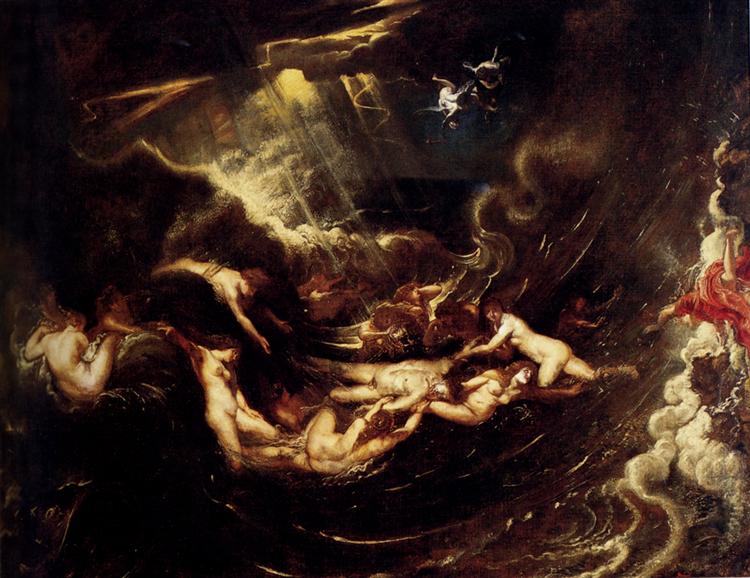
Peter Paul Rubens’s “Hero and Leander” (1605) plunges the viewer into a fatal instant where erotic desire, maritime violence, and divine judgment spiral together. The canvas narrates the Greek myth recorded by Musaeus and retold by Ovid: each night Leander swam the Hellespont from Abydos to meet his beloved Hero, priestess of Aphrodite in Sestos, guided by the lamp she set in her tower window. One stormy night the lamp blew out; Leander drowned; at dawn Hero discovered his body and leapt to her death. Rubens paints not the calm prelude or the mournful aftermath, but the storm’s vortex as the lovers’ fates seal. The sea curves like a colossal whirl, bodies wheel within its pitch, heaven opens in slant beams, and on the right a red-draped figure—Hero—reaches from a precipice, a scream of fabric frozen in paint. The picture condenses yearning, accident, and punishment into a single flood of motion.
The Myth as Moral Weather
Rubens understands the story as a weather system with a conscience. Winds, currents, and clouds do not merely describe a natural accident; they perform destiny. The extinguished lamp—suggested by the darkened upper left and the streak of light that fails to reach the swimmer—turns love’s signal into the tragedy’s engine. Hero’s vow to a goddess and Leander’s audacity to cross a strait become ethical currents that churn the elements. This moral meteorology suits the Baroque imagination, which conceives nature as expressive, not indifferent. In Rubens’s hands the sea becomes a judge whose sentence rolls through foam and undertow.
A Vortex Composition That Sucks the Eye
The entire scene rotates. From the lower right corner, where Hero bends forward in a cascade of red, the eye is dragged counterclockwise along a rim of white water into a dark abyss at center, then hurled outward toward scattered, twisting bodies and wreckage. The shoreline itself appears to curve, so that cliffs and surf collaborate in the swirl. Rubens uses this rotary design to choreograph despair: every figure is a compass needle pulled to catastrophe. Even the shafts of light from above are slanted, not vertical; they traverse the whirl as if blown sideways by a god’s breath. The composition functions like a tidal engine, converting paint into motion.
Light That Judges and Fails
Two rival illuminations divide the painting. A burst from the heavens sprays angled beams that gild spindrift and the upper waves. Yet within the sea’s mouth the light thins and dies; foam glows for an instant before darkness swallows it. Rubens paints this extinguishing as a theological metaphor—the fall of a guide, the failure of a promise. If bright skies are the language of favor in Baroque altarpieces, here the light is partial, displaced, not sovereign. A tiny pair of winged beings high in the air—messengers, perhaps Erotes or winds—float near the beams like insufficient helpers. They witness but do not rescue.
The Sea as Character, Not Setting
Rubens gives the water weight, shape, and agency. Thick arcs of foam curl like the muscles of a gigantic animal; streaks of turbulent scumble pull across the surface to suggest current; darker, glazed passages create depth that reads as cold and fatal. The spiral sucks bodies into concentric rings, so that the sea behaves as both stage and antagonist. This is not a blue decorative field. It is an actor with motives, a physicalized fate. The closer to the vortex’s eye, the smoother and more lethal the surface becomes, as if the water, confident of victory, no longer needs to show off its teeth.
Leander’s Body as the Epicenter of Drama
At the center-left, a young male figure tilts backward, the torso illuminated and the head thrown back—a swimmer losing the dialogue with water, lungs burning for air he cannot reach. The leg action slackens, arms no longer scull with competence; the body turns from athlete to victim in a single arc. Rubens uses anatomical truth to make doom persuasive: the chest expands without oxygen, neck muscles strain, fingers curl in reflex rather than propulsion. If love’s labor brought Leander into the sea, physics completes the tragedy, and the body narrates that completion with heartbreaking clarity.
Hero on the Cliff: Red That Screams
At the right edge, Hero leans into the void, a slash of saturated red against the storm’s browns and blacks. The drapery winds around her body like the same spiral that rules the waves, creating a visual rhyme between sea and cloth, storm and soul. Her gesture—arm extended, torso bent forward—reads as a double: she reaches to guide and simultaneously rehearses the plunge she will soon take. By placing her at the frame, Rubens positions the viewer as witness at the brink; we stand with her, looking into the whorl where the beloved disappears. The red, emblem of both love and martyrdom, is a Baroque thunderclap: a single color that transmits urgency across the entire painting.
Nereids, Tritons, and the Pageant of Witnesses
Scattered around the whirl are sea nymphs and tritons, bodies as pearly as foam, some grasping each other in fear, others fleeing the center. They are neither indifferent deities nor superheroes. They register shock, pity, and erotic panic—the sea’s beautiful citizens forced to watch a mortal die in their realm. Their pale flesh becomes a moral index: divine beauty cannot redeem reckless love from error. One voluptuous nymph clings to a companion like a child; another swims against the pull and fails; a triton blows a shell as if sounding a dirge drowned by wind. The chorus turns myth into theater, but a theater that refuses rescue.
Sound and the Imagined Tempest
Rubens’s brushwork writes a soundtrack. Short, broken whites along the crest of waves crackle as spindrift; long, dragged strokes in dark paint hum as undertow; bright slashes in Hero’s red robe ring like torn canvas; the central swirl’s smoother glazes throb as a low roar. Even the angled beams of light appear to hiss across rain. Viewers “hear” the chaos through these visual rhythms. The painting’s audible pressure amplifies its emotional one.
Color as Temperature and Time
The palette is a drama of warm and cool. Earthy browns and smoking blacks dominate the sky and surf, while flesh tones heat with pinks and apricots along the whirl’s rim—life reluctant to surrender. Hero’s red provides the chromatic peak, a living flame at the scene’s edge. Near the upper opening, yellow-white light leaks from clouds; it is not dawn, not yet, but the promise of morning that will arrive too late. Rubens uses these color shifts to store chronology in the canvas: storm present, dawn pending, love already past.
Brushwork That Behaves Like Water
Rubens modulates touch to mimic states of the sea. Where waves crest, paint breaks into granular foam; where the vortex deepens, glazes stack until darkness drinks light; where bodies slide, wet-in-wet blending lets skin appear slick with flood; where spray flies, the brush flicks out quick commas of white. On Hero’s drapery, paint is dragged and snapped, as if wind grabbed the cloth at the same instant as the painter’s wrist. Technique becomes mimesis; the canvas is not only a picture of a storm but a storm’s residue.
The Diagonal Sky and the Extinguished Lamp
At the very top, a cutout of architecture—a ledge, a window, the suggestion of a tower—catches a bit of the pallid beam. This is likely the perch from which Hero’s lamp once shone. Its geometry is skewed, tilted by the same forces twisting everything below. No literal lamp glows; the angle of the light is its absence made visible. The off-kilter fragment of architecture injects a chilling realism: this catastrophe has coordinates, walls, and weather; it happened in a city where lovers once kept appointments.
Sensuality and Tragedy Intertwined
Rubens does not shy from the erotic charge of the myth. The nymphs’ pale bodies coil through water with serpentine grace; Leander’s torso shines with youthful health; even Hero’s red drapery clings to form. Yet sensuality is not triumphant; it is vulnerable. Flesh glows precisely where doom presses hardest, as though human warmth were a protest the sea cannot hear. This mixture—beauty exposed to danger—generates the painting’s pathos and keeps it from moralizing. We are moved because we see what is worth saving and why it will not be saved.
Comparisons With “The Fall of Phaeton”
Rubens painted another catastrophe around the same time: “The Fall of Phaeton.” Both canvases rotate around a doomed youth whose ambition meets superior force; both use diagonal light as cosmic judgment; both pack bodies into a cyclone of motion. But “Hero and Leander” is wetter, darker, more intimate. Where Phaeton’s fall stages a universal warning about hubris, this storm stages the cost of love in a world governed by necessity. The sea lacks the thunderbolt’s clarity; it destroys by simple, indifferent strength. Rubens pivots from mythic punishment to tragic accident without losing baroque intensity.
Venetian Memory in Flemish Hands
The humid atmosphere, pearly nudes, and orchestration of warm darkness recall Venice—Tintoretto’s storms and Veronese’s flesh. Yet the draughtsmanship of Leander’s body, the disciplined rhetoric of the composition, and the emotional specificity of the chorus are Rubens’s own. He braids Italian light into Northern gravity, ensuring the picture reads both as spectacle and as study of human consequence.
Edges That Bleed Into Our Space
Hero’s placement on the right margin makes the frame behave like a cliff edge. Her billowing cloth seems to spill off the canvas, as if the storm could cross into our weather. On the left, bodies and waves crop out mid-turn, implying a whirl that exceeds depiction. The picture’s inability to contain itself is part of its truth: catastrophe ignores borders, and grief has no polite edges.
Theological and Humanist Readings
Renaissance and Baroque viewers could read the scene theologically—love uncontrolled becomes idolatry punished—or humanistically, as the cruel arithmetic of chance. Rubens accommodates both. The vertical beams hint at a heaven not fully absent, yet their failure to rescue insists that human choice and physical law carry their own conclusions. This double valence gives the painting modern durability: it speaks to believers in providence and to readers of tragedy alike.
Time Suspended: The Instant Before Hero Leaps
Hero has not yet jumped. Rubens chooses an instant when recognition and resolve meet. The red robe arcs like a question mark, and the outstretched arm writes a sentence not yet ended. That suspension makes the painting inexhaustible. We know what she will do, but we remain in the throat-catch between sight and act—the very zone where drama is most human.
The Afterimage of Sound and Salt
Stand with the painting long enough and you carry away an afterimage that is almost tactile: the sting of salt in the eyes, the drag of wet cloth, the roar that makes speech impossible. This sensory memory is not an accident; it is Rubens’s design. He paints so that the viewer’s body remembers. When we recall the myth later, it is his water we feel, his darkness, his narrow beams across spray.
Legacy and Influence
“Hero and Leander” anticipates Rubens’s later tempests, shipwrecks, and flood scenes, and it feeds a Baroque appetite for scenes where nature and passion collapse into each other. Painters after him—Jordaens, Delacroix, Turner—study how he makes water into drama and light into judgment. Poets, too, find in his whirl the visual equivalent of meter gone wild, a lyric smashed by weather.
Why It Still Matters
Today the picture resonates because it renders risk and intimacy together. Many contemporary narratives—migration, extreme sport, climate danger—echo the decision to enter a hostile element for love, hope, or identity. Rubens doesn’t trivialize the attempt, and he doesn’t lie about the cost. He paints both with such conviction that the result feels uncomfortably present: we see ourselves in the red at the margin and in the body at the center, and we ask how many lamps guide us and how easily wind snuffs them.
Conclusion: Love in a World That Turns
“Hero and Leander” is a love story told by a storm. Rubens turns sea, light, bodies, and cloth into one grammar of turning—turning toward each other, turning into danger, turning under the rule of elements that do not care. The painting’s beauty lies in its refusal to separate tenderness from physics. It gives us lovers we can touch and a sea that can kill, and it binds them in a spiral that feels as inevitable as memory. Out of this whirl, Rubens forges a tragic clarity: love is brave; the world turns; and art, at its bravest, shows both.
