Image source: wikiart.org
Overview of Hercules Killing the Dragon of the Garden of the Hesperides
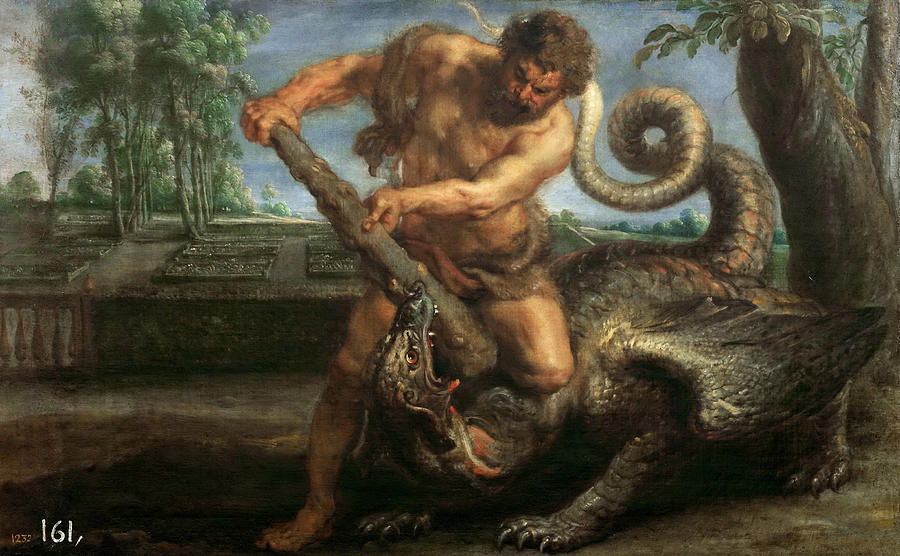
“Hercules Killing the Dragon of the Garden of the Hesperides” by Peter Paul Rubens stages one of the hero’s most famous labors as an intense close-quarters struggle. In the foreground, the muscular figure of Hercules dominates the composition as he forces his heavy wooden club down the throat of a monstrous dragon. The beast writhes on the ground, its scaled body twisting in an S-shaped coil, claws splayed and jaws gaping in a last, furious attempt to break free. Behind them stretches a formal Renaissance garden with hedges, pathways, and distant trees, a serene landscape that contrasts sharply with the violent confrontation unfolding in front of it.
Rubens chooses the exact moment of decisive action, when the outcome is almost certain but not yet complete. Hercules’s body is tensed, his weight driving forward, his face concentrated on the deadly task. The dragon’s eyes bulge and its forked tongue flickers, while its wings and tail curl in a frantic, serpentine arc. The painting condenses myth, heroism, and Baroque dynamism into a single, gripping scene.
Mythological Background: The Labor in the Garden of the Hesperides
In Greek mythology, the Garden of the Hesperides is a paradisal orchard located at the edge of the world. There, the Hesperides—daughters of the night or the evening—tend a tree that bears golden apples, gifts from Gaia to Hera. These apples grant immortality, making them objects of intense desire and jealousy among gods and mortals alike. To prevent theft, Hera sets the dragon Ladon as the garden’s guardian, a many-headed serpent coiled around the tree.
Hercules’ Eleventh Labor, imposed by King Eurystheus, requires him to obtain these golden apples. The stories differ in detail: in some versions he tricks Atlas into retrieving the apples, in others he slays Ladon directly. Rubens chooses the latter tradition, focusing on the confrontation between the hero and the dragon.
By showing Hercules physically overpowering the guardian monster, the painting emphasizes the theme of human strength facing supernatural danger. It becomes an emblem of perseverance and heroic resolve, a visual statement that even divine obstacles can be overcome through courage and might.
Composition and Spatial Tension
Rubens constructs the composition around the interlocking diagonals of Hercules and the dragon. Hercules stands slightly off-center, his powerful torso leaning to the right as he drives the club downward. His legs are braced, one foot planted firmly beside the dragon’s head, the other pushed back for balance. This stance creates a diagonal thrust from upper left to lower right.
The dragon’s body curves in the opposite direction. Its tail rises in a looping arc behind Hercules, then sweeps down and around toward the beast’s massive hindquarters. Its head, pressed against the ground, anchors the lower center of the scene. The interplay of these two diagonal lines—one human, one monstrous—generates a sense of coiled energy, as if the entire painting were a spring about to snap.
The horizon lies relatively high, allowing Rubens to spread the figures across the foreground and bring the viewer close to the action. The background garden, with its straight pathways and orderly hedges, recedes calmly into the distance. This serene perspective is framed by trees on either side, especially the sturdy trunk at the right that provides visual support for Hercules’s vertical mass. The contrast between the peaceful, geometric garden and the violent, twisting combat in front accentuates the drama. It is as if chaos has invaded a place of order.
The Figure of Hercules: Embodied Strength and Determination
Rubens presents Hercules as the quintessential Baroque hero: massive, muscular, and intensely focused. His body is almost completely nude, save for a small piece of fur or cloth around his waist that hints at the lion skin associated with his earlier labors. The hero’s broad shoulders, powerful thighs, and bulging arms testify to years of toil and combat.
The energy flows through his entire body. His right arm grips the club near its base, while his left hand reinforces the downward pressure. The muscles of his shoulders and back contract visibly as he uses his full weight to drive the weapon into the dragon’s mouth. His torso twists, one side compressed, the other stretched, creating a dynamic torsion that conveys the intensity of the struggle.
Hercules’s expression matches this physical exertion. His brow is furrowed, his mouth set in a grim line, eyes fixed on his opponent. There is no hint of hesitation or fear—only concentrated effort. Rubens avoids any theatrical shouting or wide-eyed heroics; instead, he captures the hero at a moment of disciplined, almost workmanlike focus. Killing the dragon is not a dramatic gesture for show; it is a difficult task that demands all of Hercules’s experience and strength.
The Dragon: Guardian of the Garden and Embodiment of Chaos
The dragon Ladon, though clearly doomed, is no mere backdrop. Rubens renders the creature with the same attention to anatomy and gesture that he grants to Hercules. Its head, with gaping jaws and sharp teeth, is thrust upward against the pressure of the club. The eyes glisten with a mix of rage and desperation, while the red tongue and the hint of fire in its mouth underscore its lethal nature.
The body, covered in dark, overlapping scales, conveys weight and toughness. Clawed feet dig into the ground, the hind legs braced as if trying to push the monster backward out of Hercules’s grip. The thick tail coils behind the hero, looping in a dramatic spiral that almost forms an exclamation mark within the composition.
In classical symbolism, dragons often represent chaos, greed, or the primal forces guarding precious treasures. Here Ladon is the living barrier between Hercules and the golden apples. By pressing its head into the earth with his club, Hercules is literally subduing chaos and making the miraculous fruit accessible to the human world. The dragon’s struggle, though fierce, ultimately emphasizes the magnitude of the hero’s victory.
The Garden of the Hesperides: An Ordered Paradise
Behind the brutal combat stretches a surprisingly ordered landscape. Formal hedges define geometric patterns, and paths lead into a carefully arranged garden. Tall trees rise in the middle distance, their trunks slender and vertical against the softer greens of the foliage. A low balustrade marks off the garden from the foreground, as if separating the cultivated world of the gods from the wild zone where the battle takes place.
This setting reflects the notion of the Garden of the Hesperides as a place of perfect order and harmony, a divine orchard outside ordinary human experience. Rubens’s decision to depict it as a formal Renaissance garden connects classical myth to the world of his own patrons, who often surrounded their palaces with similar landscapes. It suggests that the mythical paradise and the cultivated estates of noble collectors share an ideal of order, control, and beauty.
The peaceful garden also heightens the contrast with the violent foreground. While Hercules and the dragon grapple in raw, physical conflict, the distant hedges stand untouched, as if the timeless serenity of the gods remains unaffected by even the most titanic struggles. Yet we know that the outcome of this battle will determine whether the apples of immortality remain safely enclosed or pass into mortal hands.
Light, Color, and Atmosphere
Rubens uses light and color to reinforce the painting’s emotional charge. A soft, diffused light illuminates the scene, falling most strongly on Hercules’s body and parts of the dragon’s head and wings. The hero’s skin glows with warm tones—ochers, rosy highlights, and touches of golden light that model his muscles. This warmth contrasts with the cooler, darker greens and browns of the dragon, whose scales catch the light in small, glinting facets.
The sky is gently overcast, with patches of blue and gray that suggest either early morning or late afternoon. This subdued lighting avoids theatrical spotlighting and instead creates a more naturalistic atmosphere. The garden in the distance is painted in cooler greens and grays, receding softly into the horizon.
Despite the relatively muted palette, Rubens injects flashes of color to spark the composition: the reddish interior of the dragon’s mouth, hints of red around its eyes, and subtle reddish accents on Hercules’s skin where exertion flushes his flesh. These touches of warm color focus attention on the clash between the two figures and underline the physical strain of combat.
Baroque Drama and Movement
“Hercules Killing the Dragon of the Garden of the Hesperides” is quintessentially Baroque in its emphasis on movement, tension, and emotional intensity. The twist of Hercules’s torso, the coil of the dragon’s tail, and the diagonal slant of the club create a network of crossing vectors that give the painting a sense of violent motion frozen in time.
Rubens rarely allows his figures to remain static. Even when the bodies are grounded, as Hercules’s feet are, their muscles and limbs are engaged in action. Here, every part of Hercules—from his clenched fist to his bent knee—participates in the effort to subdue the dragon. The viewer can almost feel the pressure of the club and hear the roar of the beast.
The dragon’s sinuous form adds to this dynamism. Its tail circles in a shape close to a spiral, a favorite motif in Baroque art for conveying motion and instability. This serpentine curve echoes the natural coiling of a snake ready to strike, but here it is disrupted by Hercules’s firm grip and downward thrust. The painting thus captures not only physical power but the moment when chaos is being forced into submission.
Heroism, Virtue, and Symbolic Meaning
Beyond its mythological narrative, the painting can be read as an allegory of virtue overcoming vice, or reason mastering destructive impulses. Hercules, traditionally a symbol of strength, endurance, and heroic labor, represents the disciplined effort required to achieve noble goals. The dragon stands for the obstacles—whether external dangers, inner vices, or political enemies—that must be confronted and overcome.
The setting in a carefully ordered garden reinforces this interpretation. To protect or gain access to an ordered, fertile world, one must defeat the forces that threaten it. Seen in this light, Hercules’s labor becomes a metaphor for defending civilization and moral order against destructive chaos. For Rubens’s patrons, this could also reflect contemporary political or religious struggles, suggesting that rulers and believers must emulate Hercules in their steadfast resistance to threats.
The golden apples themselves are not visible in the painting, but their absence is meaningful. Rubens focuses entirely on the effort preceding the reward. The moment of triumph is not when Hercules holds the apples aloft but when he exerts every muscle to bring down the dragon. Virtue, the painting suggests, lies in the struggle itself—the willingness to confront danger, endure hardship, and push through to victory even before the prize is secured.
Rubens, Workshop Practice, and Classical Inspiration
Like many of Rubens’s mythological scenes, this painting likely involved collaboration with his workshop. Rubens often designed compositions and painted key passages while assistants helped execute landscapes, secondary figures, or details. Regardless of the degree of collaboration, the overall conception—the dynamic composition, muscular hero, and coiling dragon—bears his unmistakable stamp.
Rubens drew on both ancient sculpture and Renaissance predecessors when forming his vision of Hercules. The hero’s powerful physique recalls classical statues of athletes and strongmen, while the twisting pose and expressive anatomy show Rubens’s study of Michelangelo and other masters. At the same time, the dragon’s monstrous form reflects the Baroque fascination with combining natural observation and imaginative invention. Its claws, scales, and wings seem assembled from various real creatures—reptiles, birds, and mammals—into a fantastical whole that still feels plausible.
By translating a myth from Greek literature into a vivid, immediate scene, Rubens demonstrates how classical stories remained relevant in his own time. The painting serves both as a celebration of ancient heroism and as a vehicle for contemporary values such as courage, discipline, and the protection of ordered society.
Lasting Impact and Contemporary Appeal
Today, “Hercules Killing the Dragon of the Garden of the Hesperides” continues to captivate viewers because of its raw physicality and clear narrative. The painting requires no extensive explanation to communicate its central drama: a powerful man fighting a deadly monster. Yet the more one studies it, the more layers of meaning emerge—from the mythological context of the golden apples to the symbolic struggle between order and chaos.
The work also showcases Rubens’s extraordinary ability to animate the human body. Hercules’s figure is not an idealized, static statue but a living organism caught mid-action. The viewer can sense the tension in his muscles, the weight of the club, and the resistance of the dragon’s jaws. In an age saturated with heroic fantasy imagery, Rubens’s painting still feels fresh because it combines mythic grandeur with convincing physical reality.
For modern audiences, the painting can be read as a visual meditation on perseverance. Whether faced with personal challenges, social upheaval, or inner conflict, the image of Hercules pressing relentlessly against the dragon’s resistance remains a potent symbol of determination. Rubens invites viewers to see in the hero’s labor a reflection of their own struggles and to imagine themselves capable of similar courage when confronting their metaphorical dragons.