Image source: wikiart.org
Introduction to Hercules and Cerberus
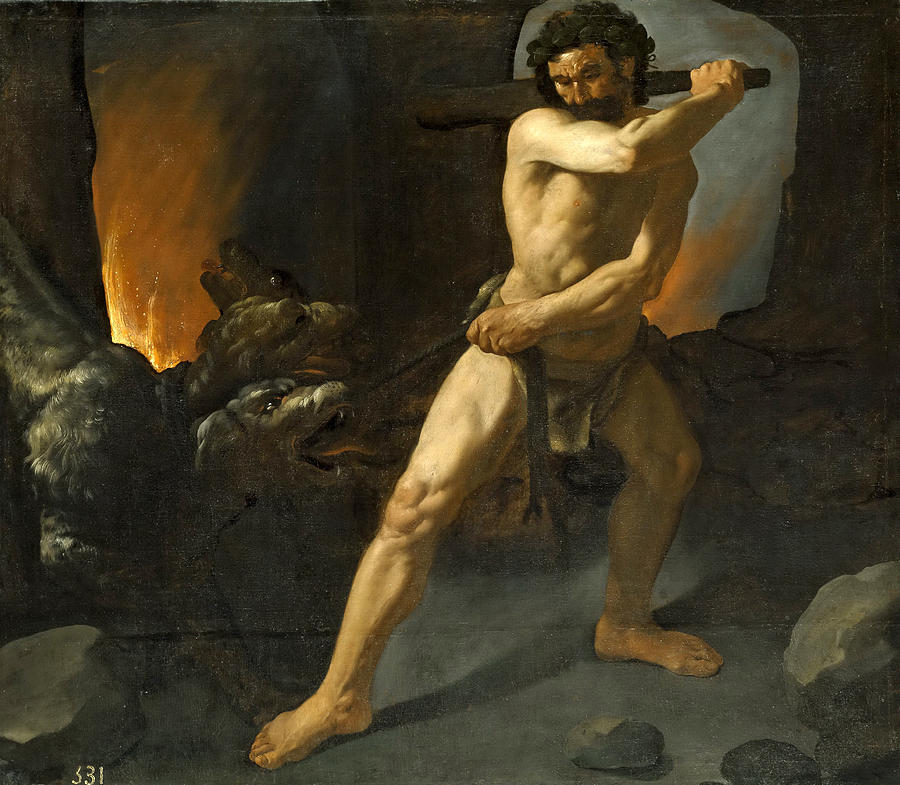
“Hercules and Cerberus” by Francisco de Zurbaran is a vivid and muscular interpretation of one of the most dramatic of the hero’s labors. The painting shows Hercules in the underworld at the climactic moment when he subdues Cerberus, the monstrous three headed guard dog of Hades. The hero dominates the foreground, nearly nude except for a rough loincloth, his body twisted in a powerful arc as he hauls the beast forward with a leash and raises his club in his other hand. Behind them flames leap up from the darkness, suggesting the fiery depths of the underworld.
Zurbaran is usually associated with religious imagery and quiet monastic scenes, but in this work he shows his ability to channel the energy of classical myth through the same intense realism and dramatic lighting that mark his sacred paintings. “Hercules and Cerberus” becomes both a gripping narrative and a moral allegory about strength, courage, and the struggle against dark forces.
Zurbaran and the Mythological Cycle
In seventeenth century Spain, mythological subjects were often commissioned for royal palaces or aristocratic residences. They allowed painters to display their mastery of the nude figure and to explore complex allegories about power and virtue. Zurbaran painted a series of works on the labors of Hercules, and this canvas belongs to that cycle.
The labor of capturing Cerberus is traditionally the last and most daunting of Hercules’ tasks. To complete it he must descend into the underworld itself, confront a creature that embodies death, and bring it to the surface. Many artists used this story to explore extremes of terror and violence. Zurbaran does something slightly different. He emphasizes not horror but focused heroism. Hercules is not panicking in the face of the monster. He is grounded, determined, and fully engaged in the immense effort required to restrain Cerberus.
By treating this pagan hero with the same dignified seriousness that he gives to Christian saints, Zurbaran hints at a continuity of virtues. Hercules, like the martyrs and confessors in his religious paintings, becomes an exemplar of perseverance and moral strength.
Composition and the Tension of the Diagonal
The composition of “Hercules and Cerberus” is organized around a strong diagonal that runs from the lower left to the upper right. Hercules’ legs form the base of this line, while his raised club extends it upward. His body twists along the diagonal in a dramatic contrapposto. The result is a feeling of coiled energy, as if the entire figure is about to spring into action.
Cerberus occupies the shadowy area to the left of the hero. The three snarling heads push forward from the darkness, their eyes and teeth catching the light. The line of the leash pulls back toward Hercules’ hands, completing a triangular system of forces. One vector comes from the dog lunging forward, another from the hero pulling back, and a third from the raised club. The viewer senses a dynamic equilibrium. The painting catches the exact moment when the outcome is not yet fixed but Hercules seems likely to prevail.
The background space is compressed. Dark rocky walls close in on either side, and brilliant flames erupt behind the figures. There is no open sky or escape route, only an enclosed underworld environment. This tight setting heightens the intensity of the scene and keeps the viewer’s attention on the struggle between man and monster.
The Sculpted Anatomy of the Hero
Hercules’ body is one of the focal points of the painting. Zurbaran clearly studied the male nude carefully and perhaps drew inspiration from classical sculpture. Every muscle is defined, from the bulging biceps and forearms to the powerful quadriceps and calves. The heroic anatomy is not coldly idealized, however. The skin glows with a warm, almost bronze tone, and the muscles are rendered with a sense of strain and movement rather than static perfection.
The twist of the torso, with the chest turned toward the viewer and the hips angled away, shows how deeply he is engaged in the effort of restraining Cerberus. The left leg is firmly planted, bearing the weight, while the right leg braces behind, toes gripping the ground. Veins and tendons stand out subtly under the skin, conveying real exertion.
This emphasis on tough, working muscle rather than serene beauty gives Hercules an earthbound, human quality. He is a heroic worker more than a marble god. That fits the nature of his labors, which involve digging, wrestling, cleaning, and fighting. Zurbaran’s Hercules feels like someone who has spent a life performing hard physical tasks, yet at this crucial moment he is pushed almost to the limits of his strength.
Cerberus as Embodiment of the Underworld
Cerberus, the three headed dog, emerges from the shadows at the left side of the painting. Two of the heads are clearly visible, snarling with open mouths and sharp teeth, while the third is more obscured in darkness. The beast’s fur is painted in rough, thick strokes that give a sense of coarse texture. Red touches around the eyes and mouths suggest ferocity and a hint of infernal glow.
The dog’s body remains mostly unseen, merging with the darkness around it, which reinforces the idea that Cerberus is as much a creature of the underworld itself as an individual animal. The flames behind him could be read as the fires of Hades, casting a hellish light on the scene.
The leash that Hercules grips is a crucial visual link. It leads from the hero’s hands directly into the jaws of Cerberus. This line of tension symbolizes Hercules’ control over death and terror. He is not simply pushing the monster away. He has seized it and is dragging it where he wills. The labor thus represents a conquest of fear and a demonstration that even the darkest forces can be mastered through courage and strength.
Chiaroscuro and the Theatre of Fire and Shadow
Zurbaran’s use of light and shadow in this painting is highly theatrical. A strong light source from the right or slightly above illuminates Hercules’ body, carving it out from the surrounding darkness. Highlights mark the shoulders, chest, abdomen, and thighs. At the same time, deep shadows fall across his back, under his arms, and between his legs, emphasizing the volume of the form.
The flames in the background introduce a second powerful light. Their orange and yellow glow licks around the edges of the scene, particularly behind Cerberus and across the rocky walls. This warm light interacts with the cooler light on Hercules, creating a complex play of reflections and shadows that suggest turbulence and danger.
The ground and rocks in the foreground are comparatively dark and subdued, with only a few gleaming patches. This contrast draws the eye upward to the hero’s torso and face, where the key emotional action takes place. It also helps anchor the composition so that it does not become visually chaotic despite the swirling flames and contorted forms.
Overall, the chiaroscuro contributes a sense of heightened drama. Hercules and Cerberus appear as actors lit on a stage surrounded by darkness, their struggle spotlighted for the viewer’s contemplation.
Expression and Emotional Climate
While the anatomy of the hero is impressive, the true emotional core of the painting lies in Hercules’ face. His brows are drawn downward, his eyes narrowed in concentration and determination. The mouth is slightly open, the lips pressed tightly together, as if he is exhaling with effort or uttering a low battle cry. His hair and beard, dark and somewhat wild, add to the impression of a man pushed to the limit of his strength.
This is not the triumphant smile of a hero celebrating victory. It is the focused, almost grim expression of someone who knows that failure would be disastrous. The labor is deadly serious. Cerberus, if freed, would not only prevent his escape but perhaps drag him deeper into the underworld.
Cerberus’ faces present a counterpoint of raw aggression. Gums and teeth are bared, tongues loll, and the eyes gleam. These are not noble adversaries but embodiments of chaotic violence. Their ferocity accentuates Hercules’ courage. He does not appear terrified, only resolute, which raises him morally in the viewer’s eyes.
Moral and Allegorical Interpretations
Within the intellectual climate of the seventeenth century, mythological scenes were often read allegorically. “Hercules and Cerberus” can be interpreted as an image of the soul confronting its deepest fears and passions. Cerberus may stand for unrestrained appetites, destructive habits, or spiritual dangers. Hercules, through discipline and divine favor, seizes these forces and brings them under control.
The descent into the underworld itself can be understood as a metaphor for interior exploration. To conquer vice or overcome trauma, a person must often venture into dark and frightening regions of the self. Hercules’ near nudity emphasizes vulnerability. He does not face the monster wrapped in armor but almost stripped bare, relying on his strength and his club.
In a Christian environment such as Zurbaran’s Spain, this allegory could easily be connected with themes of sin, redemption, and spiritual warfare. Hercules becomes a prefiguration or secular echo of Christ’s harrowing of hell, when Christ descends to the dead to free the righteous. Although the painting does not force this parallel explicitly, the fiery underworld backdrop inevitably evokes religious imagery that many viewers would have recognized.
Comparison with Other Depictions of the Labor
Artists throughout Europe depicted Hercules and Cerberus, often with significant variations. Some chose to show Hercules already triumphant, dragging the subdued dog on a chain. Others emphasized the arrival in the upper world, with gods or kings looking on.
Zurbaran’s version is distinctive in its intense focus on the physical struggle. There are no divine spectators, no architecture of palaces or Olympus, and no ornamental details. The scene is stripped down to essentials: hero, monster, rock, and fire. This concentration is typical of Zurbaran’s style, which often isolates a single figure or small group against a dark background to enhance meditative impact.
In contrast to more decorative or courtly interpretations, his Hercules is a rough, even slightly crude figure. The loincloth is ragged, the body hairy, the expression almost stubborn. This earthy quality matches the labor itself, which involves not ceremony but raw force. It also harmonizes with the values of Spanish Baroque realism, where everyday physicality often coexists with spiritual depth.
Material Detail and Textural Contrasts
Although the painting is dominated by human and animal forms, Zurbaran also pays attention to textures and surfaces in the environment. The rocky ground is rendered with uneven patches of gray and brown that suggest a rough, hazardous footing. Scattered stones in the foreground create a sense of instability and danger, as if Hercules must watch his step even while wrestling the monster.
The loincloth is painted with simple strokes yet appears coarse and heavy, contrasting with the smoother flesh. Cerberus’ fur is darker and thicker, with a slightly matted appearance appropriate for a beast of the underworld. The flames behind them are more fluid, their shapes flickering and twisting with bright yellows, oranges, and touches of white.
These textural contrasts enrich the visual experience. The viewer almost feels the difference between the hero’s warm skin, the dog’s bristling coat, and the unforgiving stone. At the same time, Zurbaran avoids unnecessary decorative detail, keeping everything subordinate to the central drama.
Contemporary Relevance of Hercules and Cerberus
For modern viewers, “Hercules and Cerberus” can speak in several ways. It captures the timeless motif of facing one’s demons. Anyone who has wrestled with addictions, destructive relationships, or inner fears can see themselves in Hercules as he confronts the snarling beast emerging from darkness. The painting reminds us that courage does not consist in the absence of fear but in the decision to seize and master it.
The image also raises questions about the responsible use of strength. Hercules clearly possesses superior power, symbolized by his muscular body and heavy club. Yet his success depends not only on brute force but on determination and the willingness to enter hostile territory. The painting invites reflection on how strength, physical or moral, should be used to protect, purify, and transform rather than to dominate blindly.
Finally, the work offers insight into the Baroque fascination with intense emotional states and dramatic turning points. In an era similarly marked by upheaval and uncertainty, contemporary audiences can find in this heroic struggle a visually compelling symbol of resilience in the face of chaos.
Conclusion A Baroque Vision of Heroic Struggle
“Hercules and Cerberus” by Francisco de Zurbaran stands as a powerful fusion of classical myth and Spanish Baroque intensity. Through the monumental figure of Hercules and the snarling triple headed Cerberus, the painter captures a moment of high tension that symbolizes the eternal confrontation between courage and terror, order and chaos, virtue and destructive forces.
The composition’s strong diagonals, the sculptural modeling of the nude body, the dramatic interplay of fire and shadow, and the grim determination of the hero all work together to create an image that is both physically convincing and spiritually resonant. The absence of superfluous details focuses the viewer’s attention on the raw essence of the labor.
Beyond its mythological narrative, the painting functions as an allegory of inner struggles that every person faces. It suggests that true heroism involves entering the darkest places, confronting fear directly, and harnessing strength with purpose. In this light, Zurbaran’s Hercules is not only a figure from ancient legend but a companion for anyone seeking to overcome the monsters that guard the thresholds of growth and freedom.