Image source: wikiart.org
Introduction
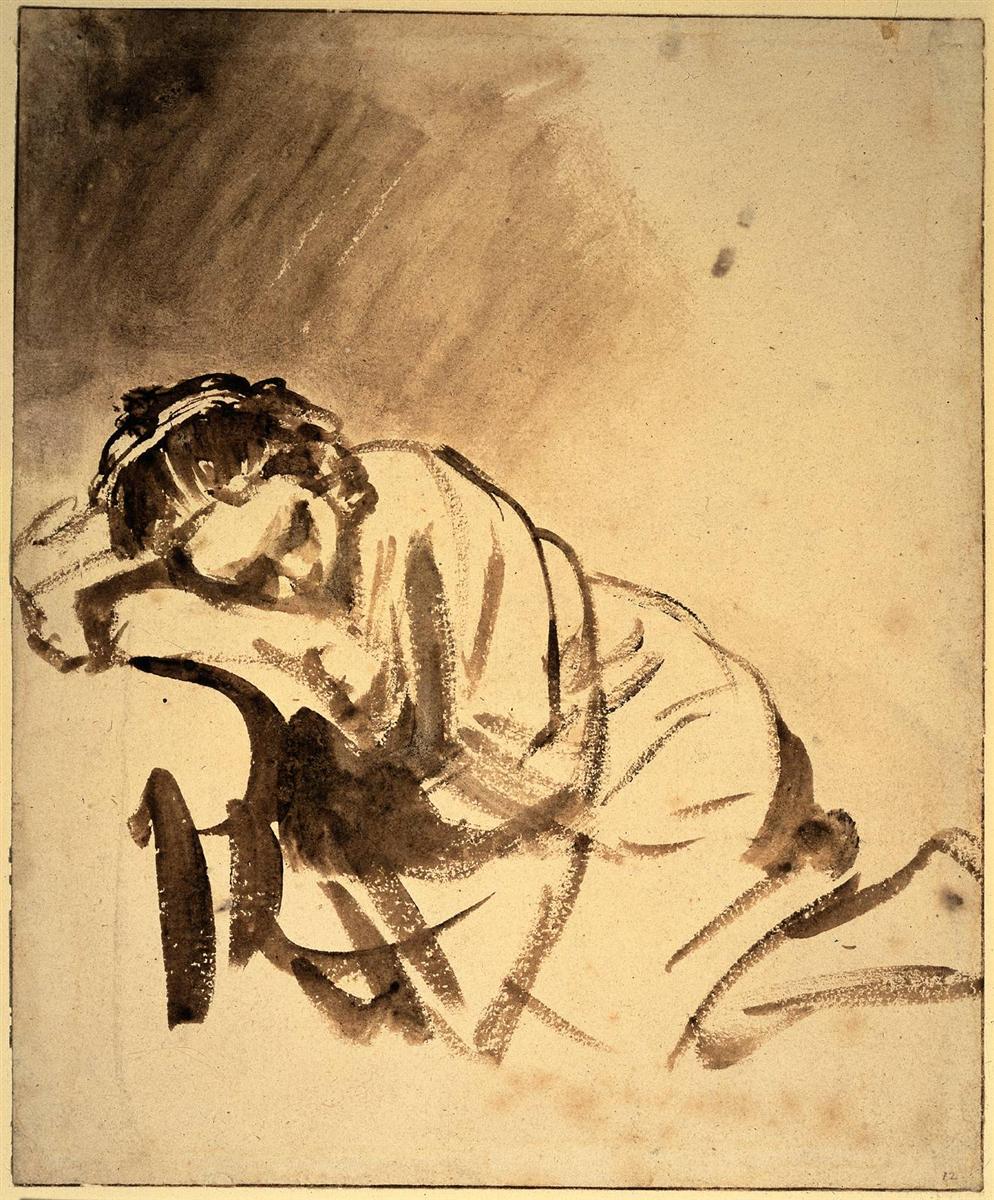
Rembrandt’s “Hendrickje Sleeping” (1654) is a sheet of extraordinary tenderness in which almost nothing is stated and nearly everything is felt. With a handful of brushstrokes in brown wash and a few firmer, ink-dark accents, the artist records a woman dozing, her head pillowed on a bent arm, her body folding into the gravity of rest. The sheet is small and unpretentious, yet it holds a roomful of quiet. In place of description, Rembrandt offers presence. In place of finish, he offers touch. The drawing belongs to his late manner, when he increasingly trusted economy and rhythm to carry human truth. Here, intimacy is not staged; it is overheard.
A Life Moment Transformed into Art
Hendrickje Stoffels, Rembrandt’s companion and frequent model, appears across the artist’s work in roles both sacred and secular. In this drawing she is not an allegory, not a biblical heroine, not even a posed sitter. She is a person who has slipped from wakefulness into sleep, likely in the studio where she had been working alongside the painter. The scene feels unpremeditated: the chair is sketched with a few indications; the ground is left largely untouched; the atmosphere is made of the wash itself. The artist does not rouse her, does not perfect the arrangement, does not complete the furniture; he simply follows the arc of her body with a brush that seems to breathe as it moves.
Composition and the Architecture of the Pose
The composition turns on a long, luminous diagonal that runs from the left shoulder down through the curve of the spine to the folded legs at the right. This diagonal is countered by the short, sturdy vertical of the chair’s support, a dark stroke that behaves like a punctuation mark in a sentence of soft clauses. The head is cupped by the forearm, its oval tilted toward the viewer but protected by the sheltering arm and loosened hair. The overall silhouette is triangular and low, giving the figure the grounded stability of sleep. Nothing interrupts the flow; even the blank page above the head works like quiet air, a space where the room can exhale.
Medium, Wash, and the Memory of Touch
The material language is spare: a brush charged with diluted brown pigment establishes the form in wide, supple passes; a darker, more saturated ink gives emphasis at the chair, the hair, and a few key folds; a dryish drag here and there leaves a granular, broken mark that reads as worn fabric or the nap of paper. The wash dries in uneven pools and veils, creating zones of damp luminosity that look like shadow made of breath. These material accidents are not corrected; they are welcomed. They embody the very thing the drawing describes: the body’s surrender to gravity, the mind’s drift, the world’s softening around a sleeper.
Economy of Line and the Calligraphy of Rest
Rembrandt’s late drawing is a form of calligraphy in which line behaves like speech. A few long arcs articulate the back and thighs; short, quick turns indicate knees and ankles; a looping cluster maps the hair; a thicker hook of ink fixes the chair leg. The head is almost not drawn at all, a few shaded planes suggesting brow, cheek, and closed eye. Because the lines are so few, each one must carry more than contour; it must carry weight, fabric, breath. The economy persuades the eye to supply what is missing, which is why the image feels so alive. We are not reading an inventory of parts; we are following a single, unbroken sentence of rest.
Light, Shadow, and the Weather of Quiet
There is no external light source indicated—no window, lamp, or candle—but the drawing glows. The wash gathers more densely beneath the arm and along the skirt’s lower edge, suggesting shadow pooled by the floor. Lighter, airy passes sweep diagonally across the background and fuse seamlessly with the blank paper, creating a zone of hush that lets the figure float without floating away. The face holds the tenderest modulation: a touch of darker tone beneath the brow, a smudge along the cheek, a soft highlight on the temple where paper is left bare. The effect is not illusionistic modeling; it is tonal mood. The sheet’s weather is afternoon-dim, the hour when rooms grow gentle.
Sleep as Subject and Metaphor
Sleep is a radical subject because it suspends action and public identity. In sleep a person becomes most herself and least performative. Rembrandt’s treatment honors that suspension. Hendrickje is neither displayed nor defended; she is allowed to be unavailable to the viewer. The drawing therefore becomes a meditation on trust. Only in a studio where affection has replaced formality could such a moment be recorded without voyeurism. The metaphor widens: just as the figure rests from work, the drawing rests from laborious finish. It dozes in its own materials, content to be incomplete.
Hendrickje as Muse and Partner
Across Rembrandt’s mid-1650s work—paintings such as “Bathsheba,” domestic scenes, etched Holy Families—Hendrickje’s presence is palpable. She is not an interchangeable model; she is a known person whose features and energies the artist has lived with for years. That knowledge allows him to omit without losing likeness. A few strokes suffice to summon the curve of her head, the habit of her hair, the way her body settles. The omissions are not laziness; they are intimacy. He knows how little is needed to call her forth because he knows her so well.
Speed, Revision, and the Feeling of Event
The hand that made this drawing moved quickly. Brushstrokes do not pause to enclose forms; they sweep and are gone. Yet the speed is not nervous. It is the tempo of someone who understands his subject and trusts his hand. In a few places the brush tries one path and then chooses another—a faint, abandoned curve at the skirt, a doubled line at the forearm. Such near-misses and corrections are the drawing’s heartbeat. They record the moment as an event, not a diagram. We feel the painter’s breath align with the sleeper’s, the strokes slowing as if unwilling to wake her.
The Studio as Sanctuary
The blankness around the figure is not vacancy; it is privacy. Rembrandt allows the room to disappear so that the sleeper may keep her sleep. We receive just enough environment—a chair’s edge, a patch of floor—to settle the body. The rest is withheld, as if the studio itself understood the etiquette of quiet. The sheet enacts the ethic that runs through Rembrandt’s late work: the world needs only what is necessary to honor the human at its center. Everything extraneous recedes.
Kinships with Other Late Works
“Hendrickje Sleeping” feels at home with the artist’s small, luminous portrayals of everyday care from the same year. The lamplight etchings of domestic rites, the private step into water, the young woman trying earrings—all translate intimacy into form. The drawing shares their humility and their confidence. It knows that spare means can carry large feeling. It also shares their refusal of moralizing. No inscription explains or corrects sleep. It simply happens, and art attends.
Sound, Time, and the Imagined Sensorium
Good drawings make you hear. One can imagine the muffled scrape of the chair, the fabric’s quiet shift, the faint rhythm of breath. The wash laid across the upper left suggests the hush of a still room, the way sound loses edges when someone nearby is asleep. Time slows. The sheet asks the viewer to keep company with a minute or two more of silence, to adopt the drawing’s pace. In museums, where eyes flick fast, this paper works like a hand on the shoulder, steadying the gaze until it matches the sleeper’s pulse.
The Ethics of Looking
To depict a sleeping companion is a privilege; to look upon such an image is an extension of that privilege. Rembrandt’s choices teach the viewer how to look. He lowers contrast, softens detail, and keeps emphasis on the curved masses rather than on the face, which remains protected by the arm. This distribution of attention invites respect. We are near but not intrusive, present but not demanding. The paper models decency in viewership, a value too seldom taught by art that seeks to dazzle or shock.
Why the Drawing Feels Modern
Contemporary viewers recognize in this sheet a familiar truth: that the most revealing portraits often occur when the subject is not trying to be seen. The drawing’s openness to accident, its trust in abbreviated mark-making, and its celebration of process over polish anticipate later centuries of modern art. What keeps it timeless is not technique alone but attitude—an unforced humanity that places tenderness above finish.
From Gesture to Memory
Ultimately the drawing functions like a memory recorded in the lightest possible script. It keeps a trace of an hour that would otherwise vanish: the way Hendrickje’s head fit into the bend of her arm, the weight of her torso on the chair edge, the descending rhythm of shoulder to hip to heel. If the sheet appears incomplete, that is because memory is incomplete. The artist remembers only what mattered, and that is enough to call the person back.
Conclusion
“Hendrickje Sleeping” is one of those late Rembrandt works in which presence outshines description. With nearly nothing—wash pooled into tone, a few strokes turning on a wrist, a dark accent for a chair leg—the artist builds a sanctuary of rest. The drawing is not a study for something grander; it is the grandness of attention itself. In it we witness love turned into economy, mastery turned into modesty, and art turned into a companion for a sleeping figure. The sheet leaves space for breath and for silence, and that space becomes the subject’s dignity. In a world that often demands more words, more lines, more claim, this image demonstrates how little is needed when the gaze is honest and the hand is sure.