Image source: wikiart.org
Introduction
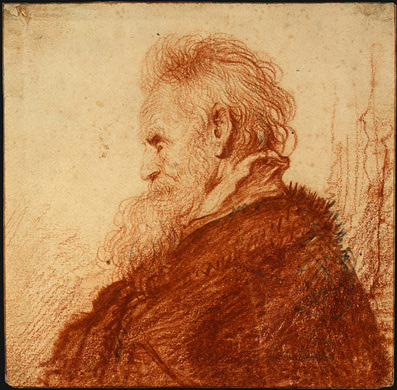
“Head of an Old Man” (1631) distills Rembrandt’s fascination with human character into a single, concentrated profile. The work captures a weathered face turned in quiet contemplation, a ridge of brow and cheekbone modeled in light, and a mantle of rough fur suggested by swift, confident strokes. Even within this intimate format, Rembrandt builds an entire world of time, feeling, and tactile presence. What initially reads as a straightforward likeness quickly unfolds into a study of aging, humility, and the dignity found in everyday physiognomy.
The Moment In Rembrandt’s Career
The year 1631 sits at a hinge point in Rembrandt’s life. He had recently moved from Leiden to Amsterdam, positioning himself for rapid ascent as a portraitist and history painter. In this transitional period, he developed a personal repertoire of “heads” that were not necessarily formal portraits of named sitters but concentrated explorations of features, moods, and light. These heads were laboratories in which he refined expressive modeling, learned how to make skin appear to breathe under light, and discovered how a few directional strokes could suggest the weight of a mantle or the prickly edge of fur. “Head of an Old Man” belongs to this matrix of experimentation: smaller in scale, intimate in tone, and yet astonishingly ambitious in its atmospheric reach.
Subject And Pose
The sitter is shown in profile, which immediately creates a classical clarity of contour while also fostering a sense of privacy—he looks away, self-contained, inaccessible to our gaze. Profile allows Rembrandt to articulate ear, brow, nose, chin, and beard with sculptural precision, as though he were carving relief out of paper. The old man’s gaze, directed beyond the sheet’s edge, suspends him in thought. Nothing overtly dramatic occurs, yet the turn of the head and the set of the lips produce a quiet drama of interiority. Profile also emphasizes the silhouette of the skull and the fall of hair, encouraging the viewer to follow the outline like a coastline while the inner passages of shading supply geological depth.
Medium, Touch, And The Feel Of The Page
Although commonly referred to as a “painting,” the work you see here is executed with the immediacy of drawing, using a reddish medium that reads as iron-rich chalk. The surface registers pressure—firm where the artist wants to define, feathered where he wants to suggest—and this pressure creates an almost acoustic rhythm. The hatched passages around the temples and the beard show a musician’s timing: even strokes establish the base tone; interleaved crosshatching deepens the timbre; a few lifted highlights let the page’s natural light ring through. The result is not merely a description of an elderly head but the tactile sensation of bone under skin, coarse hair, and rough textile.
Light As Sculptor
Rembrandt treats light as both subject and tool. It comes from above and slightly in front, catching the forehead, the bridge of the nose, and the forward cheek before trailing off into the darker recesses of the beard and collar. The modeling is achieved not by smudging large half-tones but by modulating line density: where light dissolves, the marks loosen and disperse; where shadow gathers, the marks thicken and knit together. This economy is a hallmark of his early mastery. Instead of fully filling a shadow, he lets a scattering of parallel strokes imply weight. The viewer’s eye finishes the form, and that participation makes the image feel alive.
Texture: Fur, Hair, Skin
Three textures dominate the sheet—fur, hair, and skin—and each receives a customized vocabulary of marks. Fur erupts from the shoulder in short, broken flecks, irregular and bristling. Hair is wirier and directional, swept back from the temple in longer, rhythmic strokes that crest and fray as they approach the crown. Skin is the most delicate: a veil of light hatchings suffices to turn the plane of the brow or the swell of the cheek. The contrast among these textures is not a display of virtuosity for its own sake but a narrative of the man’s lived materiality—how clothing protects, how hair rebels with age, how skin thins and tightens around bone.
The Line As Psychology
In this work, line is never neutral. A tremor in the contour along the cheek suggests vulnerability; a crisp edge at the nose implies alertness; dense crosshatching beneath the jaw conveys the drag of years. These decisions are psychological. Rembrandt is not caricaturing age, nor sentimentalizing it; he is finding within each stroke a temperature—cool restraint around the eye, warmer insistence in the beard—that culminates in a believable mind at rest. The greatest accomplishment is the mouth: only a few inflected marks yield a phrase of expression, half weary, half serene.
The Grammar Of Profile
Profile can be rigid, but Rembrandt finds elasticity in it. The head does not sit flat against the picture plane; it arcs outward, gently, as if moving through air. He achieves this by tipping the axis of the neck and by letting the far edge of the cranium dissolve into suggestion. The near edge is detailed; the far edge is atmospheric. That exchange—presence on one side, absence on the other—makes the profile breathe. The sheet’s blank space is not emptiness; it is air, cold and thin, in which the old man’s breath would plume if we could see it.
Tronie, Study, Or Portrait
Works like this are often classed as “tronies,” a Dutch term for character heads that study expressions or types rather than particular individuals. Whether this sitter was known to Rembrandt matters less than the function the image serves: it trains the artist’s eye for large-scale history scenes, it offers collectors a portable meditation on character, and it gives viewers the pleasure of looking without the social protocols of portraiture. The absence of accessories and setting strips the figure to essentials. Cloth and fur indicate warmth, not status. The only ostentatious thing here is the beauty of looking itself.
Time, Age, And The Human Condition
Rembrandt’s art repeatedly returns to age as a vessel of truth. Youth offers grace; age offers narrative. The creases engraved by habit and hardship tell stories in shorthand. In “Head of an Old Man,” time is visible not as tragedy but as accumulation: of days worked, prayers said, winters endured, love remembered. The beard’s cascading strokes resemble a river delta where long life deposits its silt. Nothing is pitiable, nothing heroic; the tone is humane. This makes the image inexhaustible, because viewers of different ages recognize different passages of themselves in it.
Economy And Suggestion
One of the most striking qualities is how little is actually drawn. The ear is resolved with a handful of loops; the eye socket is indicated by shadow rather than outline; the shoulder dissolves into a fringe of fur and then into almost nothing. This economy asks the viewer to meet the artist halfway. Because our brains are wired to complete patterns, suggestion can appear more “real” than exhaustive description. Rembrandt relies on that neurological partnership. He leaves the page open where reality would be open—at the edges of perception—and this openness gives the head a living, perishable immediacy.
Scale And Intimacy
The relatively small format invites viewing at arm’s length, even closer. That closeness has ethical implications: we look without intruding, because the sitter is turned away, yet we also feel a kind of caretaking attention. The sheet becomes a site of quiet encounter. Unlike grand canvases designed to awe, this work seeks a whispering resonance. The result is intimacy without sentimentality, a balancing act that explains why these heads have been treasured for centuries by artists and collectors alike.
Comparisons Within Rembrandt’s Oeuvre
Across the early 1630s, Rembrandt explores similar elderly heads in oils and drawings. In paint, he often builds flesh with impasto and glazing; in drawing, he achieves analogous depth by layering pressure and rhythm. What unites these efforts is a relentless search for expressive truth. In this sheet, you can already sense the later Rembrandt—the one who will turn paint into light and shadow into empathy—emerging from a disciplined practitioner who understands anatomy, optics, and the behavior of materials. The seed of that late, monumental simplicity is present here in the way a single, well-placed hatch can turn a plane convincingly.
The Architecture Of Shadow
Shadow in this head is not a pool; it is architecture. Under the brow, it creates a lintel over the eye. Along the cheek, it lays a soft buttress that supports the nose. Beneath the beard, it becomes a vaulted recess where the voice would resonate. By treating shadow as structural, Rembrandt makes the face read as a built space—habitable, navigable—rather than a flat mask. This is why his heads feel explorable. The eye wants to walk through them.
The Moral Temperature Of Warm Tones
The reddish drawing medium carries symbolic warmth. It infuses the flesh with circulatory life and the fur with an autumnal glow. The color is not merely optical; it has a moral temperature. Against the cool blankness of the ground, the warm strokes make the old man feel present in the world, not ghosted by age. Warmth also softens what could otherwise be a severe profile, rounding it emotionally. With minimal means, Rembrandt thus coordinates optics and ethics: warmth equals regard, and regard equals dignity.
Gesture, Breath, And Quiet Movement
Even in stillness, the head contains movement. The hair lifts slightly, as if caught by a faint draft. The beard flows downward, echoing gravity. The shoulder slopes away, relieving tension from the neck. These subtle vectors guide the eye along natural paths, giving the picture a pulse. The rhythm is andante, not allegro. Nothing startles; everything settles. Such pacing is the signature of an artist who understands that the most persuasive movement is often the suggestion of breath.
Clothing As Frame
The rough garment and fur collar function as a frame for the head. They carry less psychological information, yet they are crucial to compositional stability. The dark mass at the lower right anchors the luminous head and prevents it from floating. The prickle of fur acts as a transitional texture between the solidity of the shoulder and the airy openness of the background. By orchestrating these relationships, Rembrandt ensures that the viewer’s attention rises, like a flame, toward the face.
The Discipline Of Restraint
Many artists are tempted to finish every corner. Rembrandt resists. The background remains largely untouched, with faint scaffolding lines suggesting earlier placement ideas. This restraint signals confidence. It tells us the drawing is about what matters—the head—and that extraneous detail would only dilute the statement. The unworked ground also intensifies the illusion of light. Because the page itself supplies the brightest value, the artist can reserve his most forceful strokes for mid-tones and shadow, preserving a full, breathable value range.
Humanity Over Anecdote
It is tempting to invent stories about who the sitter was, what he believed, or what he felt at the moment of posing. Rembrandt gives us only enough to encourage empathy, not gossip. By avoiding anecdote, he protects the sitter’s privacy and cements the image’s universality. Anyone’s grandfather could be here, or no one’s. The work becomes a mirror for the viewer’s encounters with age and patience rather than an illustration of someone else’s biography.
Why This Image Still Feels Modern
Contemporary viewers recognize in Rembrandt’s head a quality that modern photography and portrait drawing continue to pursue: candor without cruelty. The unsparing record of wrinkles is counterbalanced by a generous handling of light and a refusal to exaggerate. The result is neither flattering nor cruel; it is accurate to life’s texture. That equilibrium, difficult to hold, gives the drawing a modern temperament. It respects both the truth of appearance and the interior dignity that appearance can veil.
What To Look For Up Close
Stand close and trace the contour from forehead to nose to beard; notice how the line thickens and thins with intention. Look at the tiny reserve along the bridge of the nose where the ground shows through as a strip of light. Compare the directional flow of strokes in hair and fur; they are cousins, not twins. Observe how the background’s faint scaffolding never competes with the head; it whispers of process and then disappears. Finally, locate the place where the collar dissolves into the page—there the artist trusts your eye to complete a shape that he declines to draw.
Legacy And Influence
The clarity, restraint, and psychological depth of studies like this shaped expectations for portraiture well beyond the Dutch Republic. Later draftsmen and painters learned from Rembrandt how to conjure a presence with minimal means, how to let paper participate as light, and how to replace decorative polish with expressive truth. The lineage runs through eighteenth- and nineteenth-century portrait studies and continues into modern figure drawing classes where students, whether they know it or not, echo Rembrandt’s grammar of hatch, reserve, and emphasis.
Conclusion
“Head of an Old Man” exemplifies Rembrandt’s capacity to turn a simple study into a meditation on life’s weathering and worth. With a small sheet, a warm drawing medium, and disciplined attention, he invites us into a silence that feels inhabited. We come away not with a story about a specific person, but with a renewed sense of how faces hold time, how light blesses matter, and how art—at its most economical—can be inexhaustibly humane.