Image source: wikiart.org
An intimate encounter with Rubens’s drawing
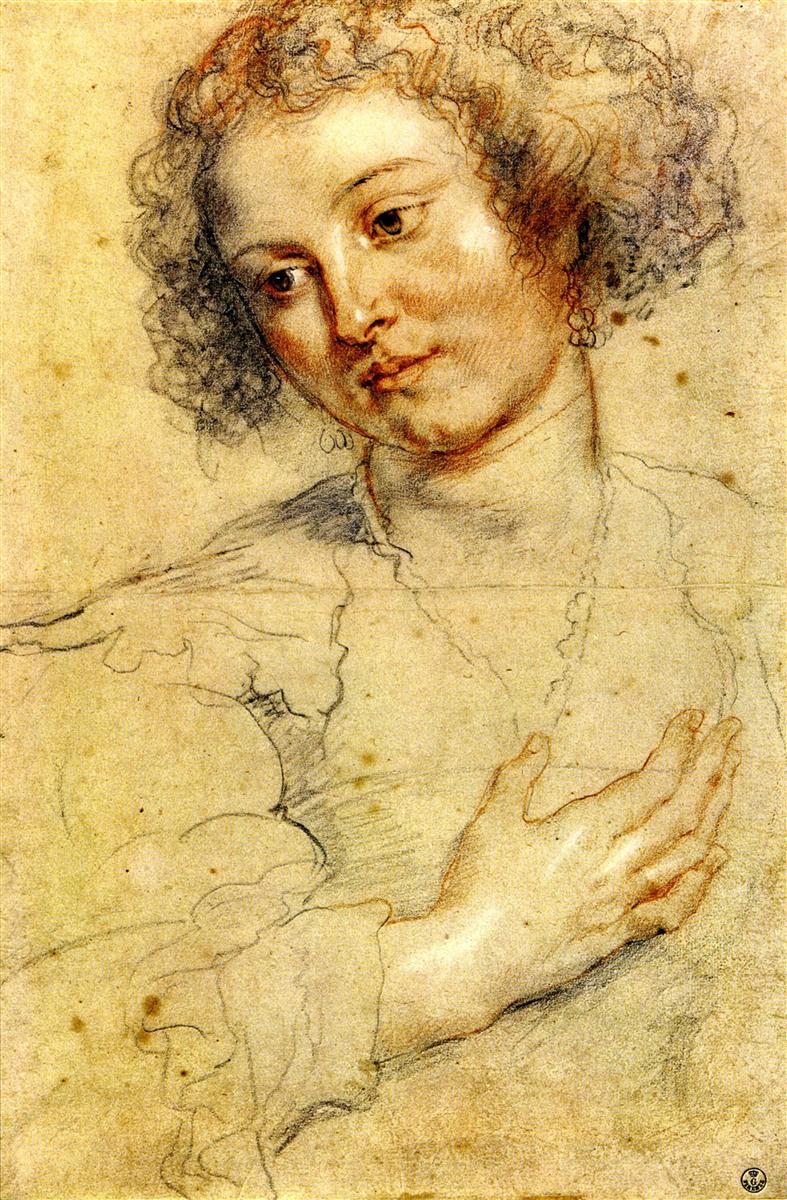
“Head and Right Hand of a Woman” reveals Peter Paul Rubens in a quieter, more introspective mode than the large altarpieces and mythological canvases that made his name. This work is not a finished oil painting but a drawing in chalks and perhaps a wash, a study that focuses on the most expressive parts of the human body. The woman’s head tilts gently downward, her eyes cast to the side in a tender, reflective gaze. One hand crosses her chest, fingers spread in a graceful, slightly hesitant gesture.
The sheet is full of pentimenti, partially realized folds of fabric, and soft smudges of color. These unfinished elements give viewers a rare glimpse into Rubens’s working process. He searches and adjusts, feeling his way toward a pose that balances elegance with psychological depth. Far from being a mere preparatory sketch, the drawing has its own emotional atmosphere, one of hushed contemplation and delicate sensitivity.
The subject and the ambiguity of identity
Unlike many of Rubens’s portraits, this drawing does not identify its sitter explicitly. She may be a studio model, a member of the artist’s circle, or even a study for a specific figure in a larger composition. Some scholars have proposed that the drawing could relate to images of saints, allegorical figures, or mythological heroines. The hand laid gently across the chest could signal modesty, devotion, or emotional agitation, depending on the final context Rubens had in mind.
This ambiguity is part of the drawing’s charm. Free from a fixed narrative, the woman becomes an archetype of sensitive femininity. Her facial features are soft and rounded. Her hair, a mass of loose curls, frames her face in an almost cloudlike halo. The hint of jewelry at her ear and around her neck suggests a certain refinement, yet the absence of elaborate costume or setting keeps the focus on her inner life rather than social status.
The slightly downward gaze invites viewers to share in a private moment. She does not confront us directly; instead, she seems absorbed in her own thoughts. Whatever Rubens’s original intention, he captures an expression that feels recognizably human, hovering between shyness, introspection, and gentle melancholy.
Composition centered on head and hand
The composition is strikingly asymmetrical. The woman’s head occupies the upper left quadrant of the sheet, while her right hand appears lower and toward the right, creating a diagonal line that guides the viewer’s eye across the page. The rest of her body and clothing are only lightly indicated by a web of lines and shaded areas.
This focus on head and hand is deliberate. In the visual language of classical and Renaissance art, these two body parts are considered the most expressive. The face communicates emotion through eyes, mouth, and the tilt of features, while the hands reveal mood and intention through gesture. By isolating these zones, Rubens concentrates the portrait’s psychological charge.
The hand, in particular, is beautifully drawn. The fingers are slender and slightly curved, with well observed joints and subtle changes in tone. The hand rests on the chest in a way that suggests both self containment and openness. It is neither clenched nor limp. Instead it hovers in a poised, almost speaking gesture, as if the woman might be about to say something heartfelt.
Together the head and hand create a silent dialogue. The downward eyes and the resting hand echo each other in softness, reinforcing a sense of modest, inward emotion.
Medium, line, and the warmth of chalk
Rubens uses a combination of black, red, and possibly white chalk to build up the drawing. The black chalk establishes contours and shadows, defining the shapes of the curls, the outline of the face, and the folds of the garments. Red chalk adds warmth to the cheeks, lips, and fingers, giving the woman a living, breathing presence. White highlights along the bridge of the nose, the forehead, and parts of the hand catch the light and suggest the softness of skin.
The paper itself has aged to a warm, yellowed tone, which harmonizes beautifully with the red chalk. This natural patina enhances the sense of intimacy, as if the drawing were a cherished object that has passed through many hands. Small stains and spots remind us of the sheet’s material reality and of the centuries that separate us from Rubens’s studio.
Rubens’s line is both precise and spontaneous. Around the features of the face the contours are firm and confident. In the unfinished areas of the clothing the lines become light and exploratory, looping and overlapping as he searches for the right arrangement of fabric. This shifting quality of line allows us to see the drawing evolving in real time, as if we are watching Rubens think on the page.
The subtle modeling of the face
The woman’s face is the most fully resolved part of the drawing. Rubens carefully models the features with gentle gradations of tone. The forehead is broad and smooth, the eyebrows delicately arched. Shadows around the eyes and under the lower lip give the face depth and structure.
The eyes themselves are especially captivating. They are slightly downcast, with irises softly shaded and a small highlight suggesting moistness. The upper eyelids droop just enough to convey a sense of pensiveness or modesty rather than fatigue. The pupils look toward the lower right, directing the viewer’s attention toward her hand and further emphasizing the internal connection between thought and gesture.
Her mouth is closed but not tight. The corners of the lips turn down slightly, hinting at a serious or reflective mood. Yet a faint fullness in the upper lip prevents the expression from becoming stern. There is a softness, a vulnerability, that keeps the face open to interpretation.
The overall modeling of the head combines careful observation with idealization. Small asymmetries and irregularities—slight differences between the eyes, the natural fullness of cheeks—make the face feel real, while the harmonious proportion and smooth transitions of light and shadow give it a calm, ideal beauty.
Curling hair and the play of line
The woman’s hair forms a halo of loose curls around her face. Rubens renders these curls with energetic, almost calligraphic strokes of black and red chalk. Some ringlets are clearly defined, with sharp edges and dark centers, while others dissolve into wispy lines that merge with the background.
This combination of precision and vagueness gives the hair a sense of movement and volume. It seems as though a light breeze or a recent motion has disturbed the curls, leaving them in gentle disarray. The more defined curls near her cheek help frame the face, drawing focus to the eyes. Further out, the lines become more chaotic and intertwined, echoing the complexity of human thought and feeling.
The liveliness of the hair provides a dynamic contrast to the stability and calm of the facial features. It is as if Rubens is visually suggesting that beneath the composed exterior lies a whirlwind of interior life.
Gesture and the language of the hand
The right hand, though less finished than the head, is rendered with great sensitivity. Rubens uses red chalk to emphasize the fleshy areas of the palm and the knuckles, while black chalk defines the outline and the creases between fingers. The thumb is slightly tucked in, and the fingers spread gently across the chest.
This gesture can be read in several ways. Placed over the heart, it suggests emotion—perhaps surprise, modesty, or a vow. It could indicate that the woman has heard something that moves her deeply or that she is about to speak in a heartfelt way. The placement also recalls devotional imagery where saints or the Virgin Mary press a hand to the chest in signs of humility or acceptance.
Because the arm and shoulder are only sketched, the hand appears almost disembodied, a floating emblem of feeling. Rubens invites us to focus not on anatomical accuracy but on expressive potential. The delicacy of the fingers, the careful articulation of joints, and the soft shading all work together to make the hand a companion to the face in revealing inner life.
Unfinished fabric and the beauty of incompletion
The clothing that surrounds the woman is only partially developed. Rubens indicates a high neckline and ruffled sleeves with quick, looping lines. In some places he darkens shadows to suggest depth, but he leaves large areas nearly blank.
This incompletion gives the drawing an open, breathing quality. We can sense where Rubens might have gone had he chosen to refine the costume, but he stops at the point where the essential structure of the pose is clear. The viewer’s imagination is free to fill in the missing details.
The roughness of the fabric contrasts with the more meticulous treatment of the face and hand. This deliberate imbalance of finish emphasizes the hierarchy of importance in the drawing. Head and hand matter most; costume is secondary. At the same time, the ghostlike outlines of the garment create a dreamlike atmosphere, as if this woman exists partly in the realm of ideas and only gradually assumes physical form.
Function as a study and window into Rubens’s process
Works like “Head and Right Hand of a Woman” were central to Rubens’s creative practice. As a busy workshop master, he relied on drawings to plan compositions, test poses, and develop individual figures. Such studies were often pinned to studio walls for reference or incorporated into more elaborate designs.
This particular drawing may have served as a study for a painting where the same woman, or a similar figure, appears in a more complex scene. The combination of tender expression and hand-on-chest gesture could fit a variety of subjects: a penitent saint, an allegory of Virtue or Charity, a grieving figure at the foot of the Cross, or even a poetic mythological character.
Regardless of its final use, the sheet shows how Rubens built figures from the inside out. He begins with the most expressive components—face and hand—before fully defining costume or background. The drawing also reveals his interest in the emotional truth of a pose. Even at this exploratory stage, the woman’s mood is palpable. Rubens is not satisfied with an anatomically plausible head and hand; he wants them to speak.
Emotional tone and the quiet lyricism of the drawing
The overall emotional tone of the drawing is one of gentle lyricism. There is no dramatic action, no extreme expression. Instead the woman appears absorbed in a quiet, inward movement of feeling. Her downcast eyes, the softness of her mouth, and the hand pressed to the chest suggest a moment of self reflection or tender response.
This subtlety differs from the grand gestures and intense passions often found in Rubens’s large canvases. Here he explores a smaller, more intimate register of emotion. The drawing feels almost like a private note, a visual whisper rather than a shout.
For modern viewers, this intimacy can be especially compelling. We sense the presence of an individual woman of Rubens’s time, yet her expression is universal enough to transcend the centuries. The drawing captures a mood many people recognize: that quiet, slightly melancholic self awareness that arises in moments of reflection or emotional vulnerability.
Place within Rubens’s portrayal of women
Rubens is famous for his robust, sensuous female figures, often depicted in mythological or biblical scenes. “Head and Right Hand of a Woman” offers a gentler image. The sitter is youthful and softly rounded, but the emphasis is less on physical voluptuousness than on facial expression and character.
The drawing shows Rubens’s respect for the complexity of his female subjects. Even when preparing studies, he invests them with psychological nuance. The woman here is not a generic beauty. Her slightly asymmetrical features, thoughtful eyes, and expressive hand give her individuality. She inhabits a space somewhere between model and character, suggesting that Rubens saw his sitters as partners in the creation of meaning rather than merely as bodies to be idealized.
This approach connects the drawing to the broader history of portraiture and the portrayal of women in early modern Europe. It offers a counterpoint to more formal, status driven female portraits by presenting a figure who is valued for her inner life as much as for her outward appearance.
A timeless study of sensitivity and presence
“Head and Right Hand of a Woman” may be a study on paper, but it has the emotional completeness of a finished work. Through subtle modeling, lively line, and a carefully chosen gesture, Rubens creates an image that feels timeless. The woman’s thoughtful gaze and the hand at her chest speak across centuries, inviting viewers into a quiet moment of empathy.
The drawing exemplifies Rubens’s ability to infuse even the simplest study with humanity. It shows how he used the tools of draftsmanship not only to solve formal problems but to explore the textures of feeling. In the delicate interplay of head and hand, line and color, finished and unfinished, the drawing offers a glimpse of the artist at work and of a human spirit momentarily caught in the net of his attention.