Image source: wikiart.org
Introduction
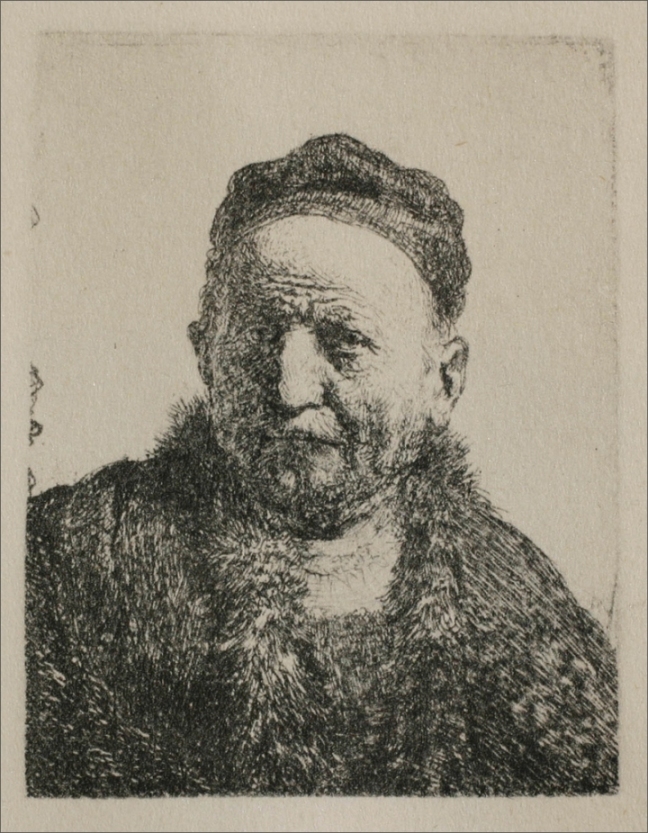
Rembrandt’s “Head and Bust, Full Face” (1630) is a small etching with the gravitational pull of a painted portrait. The sitter confronts us directly, his head slightly lifted within a snug cap, his shoulders wrapped in a dense fur collar whose rich texture darkens the lower third of the sheet. The background is almost entirely untouched, a quiet field of paper that turns the figure into an island of attention. With a vocabulary of compact strokes, cross-hatching, and deft reserves of white, the young Rembrandt builds presence without spectacle. The plate belongs to his Leiden years, when he was forging a language of light and character through intimate, highly experimental prints. What distinguishes this image is the tension between direct address—full-face orientation—and the overwhelming tact with which features, skin, and fur are described. The result is a meeting rather than a display: a living head set before us with unsentimental care.
The Work’s Place in the Leiden Period
In 1630 Rembrandt was in his early twenties and working in Leiden, a university town that fostered a culture of learning and close looking. He was producing small etchings of beggars, elders, scholars, and youthful tronies—heads in character not bound to personal identity. These prints circulated widely among collectors who prized virtuoso drawing and scenes of everyday life. “Head and Bust, Full Face” is part of that program, a study that explores how far etched line can go in creating the tactile illusion of flesh and fur while remaining frank about its means. The figure looks outward, establishing a direct line between artist, subject, and viewer that is rare among the more oblique or bowed heads of the same period.
Etching as the Record of Touch
Etching preserves the movement of the hand with startling fidelity. A copperplate coated with a wax ground receives the artist’s needle like paper receives a pen; acid later bites the exposed metal to form grooves that hold ink. In this print, Rembrandt exploits the medium’s responsiveness to generate distinct languages for skin and fur. The cap is indicated by short, slightly elastic strokes that suggest worn cloth; the forehead and cheeks are modeled with tiny, irregular hatchings that create the granular topography of aged skin; the beard and fur collar burst into more assertive, spiky marks that catch light like bristles. The variety of stroke is not decorative. It converts line into texture and pressure into presence.
The Force of Full-Face Orientation
Many early Rembrandt heads show subjects in profile or three-quarter view, poses that imply privacy or contemplation. A full-face orientation, by contrast, is confrontational in the best sense: it asks the viewer to share the same air. The sitter’s gaze, though not theatrically sharp, is steady and assessing. He is not an emblem of age or profession; he is a person holding our look. This directness intensifies the ethical tone of the print. The viewer cannot treat the figure as a type or a specimen. The exchange becomes personal.
Light, Reserve, and the Art of Breathing Space
Because etching builds darkness and leaves light as untouched paper, the blank field behind the head is not empty; it is air. Rembrandt lets the page glow around the cap and cheeks, creating a soft halo that prevents the mass of the fur from swallowing the face. Highlights on the forehead, nose, and lower lip are reserved as tiny patches of white, calibrated so precisely that they read as moist flesh rather than glare. The brightest passage is not a theatrical beam but a carefully managed breathing space. The head seems to inhabit the page rather than sit upon it.
The Psychology of the Features
The face is built with restrained planes rather than emphatic outlines. A tight network of short strokes maps the forehead’s creases; the eyelids are indicated with small curves and minute shadows that preserve softness; the cheekbones rise in broad half-tones that avoid caricature. The mouth is set, not clenched, with the lower lip catching a fleck of light. Taken together, these decisions yield a mood of alert reserve. The sitter is present without performance, aware without anxiety. Rembrandt resists the temptation to code an emotion. He trusts that the subtlety of feature and gaze will carry the hum of interior life.
Fur, Beard, and the Theater of Texture
The lower half of the plate confers much of its power. The fur collar—dense, directional, almost musical in its patterning—anchors the head like a stage’s proscenium. Rembrandt renders the pile with clusters of short, rhythmic strokes that splay and overlap, creating the sensation of strands catching and releasing light. The beard, by contrast, is wirier, described with crisper, straighter marks that separate it from the softer pelt. This contrapuntal treatment of textures accomplishes two things. It intensifies the tactile richness of the image and it focuses attention upward to the face, which emerges like a calm island from a sea of marks.
Scale, Cropping, and Intimacy
The print’s modest size compels near viewing. You have to hold it close for the microtonal transitions of cheek and the tiny flickers inside the eyes to register. This scale produces intimacy and alters the social contract between art and viewer. We are not scanning a spectacle; we are examining a person at conversation distance. The tight cropping at the shoulders heightens that nearness. The bust fills the lower field, pushing the head forward so the viewer must address it squarely. The eye recognizes a body that shares our space.
Chiaroscuro as Character, Not Trick
Chiaroscuro in Rembrandt’s hands is less a trick of contrast than a way of thinking about character. The principal value relationships here are subtle: the transition from lit forehead to shadowed brow, the gentle recession along the left cheek, the deepening tone where fur meets skin. None of these contrasts is violent. They conspire to show a face that has lived in good light—a light that is honest, steady, and undramatic. The values register nuances of temperament: patience in the even modeling of the cheeks, experience in the small dark around the mouth, resilience in the frankness of the gaze. Light becomes psychology.
The Cap and the Social Temperature of the Image
Headgear in seventeenth-century prints can function as social sign. The cap here is simple and workmanlike, neither fashionable nor exotic. It tells us little about status but much about tone. Its soft rim frames the forehead without grandeur; its worn surface, built by quick, scuffed strokes, implies habitual use. By refusing decorative costume, Rembrandt keeps the conversation on the face. The cap’s job is to clear space around thought.
Background Silence and the Ethics of Omission
The decision to leave the background largely unworked is more than economy. It is an ethic. No architectural setting, no curtain or niche, no symbolic attribute competes for attention. The omission protects the sitter from being drafted into a narrative he has not chosen. He is allowed to be himself—head and bust, full face—without explanation. Such restraint is one reason the image feels modern. It trusts that presence can hold a page.
The Plate as Object and the Life of Impressions
Etchings live as families of impressions rather than as single fixed images. Differences in inking and wiping can change atmosphere markedly. A plate tone left on the surface may veil the background with a faint gray that pulls the head into a cooler day; a clean wipe turns the field bright, setting the face forward. Heavier inking enriches the fur, making it almost velvet; lighter inking brings out the granular topography of the skin. These variants suit the subject. A life is not one look but many. The plate admits that multiplicity.
Relation to Other Heads of 1630
Compared with Rembrandt’s bowed elders and sidelong scholars from the same year, “Head and Bust, Full Face” is assertive. It meets the viewer without interposed action—no book, no window, no staff. In that sense it anticipates the frankness of later painted portraits, where sitters arrive with all their complexity and the painter’s light negotiates their presence. At the same time, it keeps the inwardness of the Leiden studies: the subtle surface, the quiet perseverance of the gaze, the humane refusal to sensationalize age.
The Sound of Line and the Time of Looking
Give the print time and it becomes audible. The fur hums in low registers, a rolling texture across the bottom; the beard crackles softly; the skin murmurs with fine, even strokes; the cap rustles. Rembrandt operates like a composer, staging distinct timbres so the eye reads in rhythms rather than in a single blur. That rhythm affects the viewer’s time in front of the image. You linger over the fur, quicken across the cheeks, and rest at the eyes. The print trains attention toward the features that matter.
Lessons for Draftsmen and Painters
Artists can extract specific craft lessons from this etching. Reserve paper for your brightest lights instead of cross-hatching them into dullness. Differentiate materials through stroke character: wiry marks for beard, feathery clusters for fur, granular netting for aged skin, and smoother runs for cloth. Build form from small value steps rather than heavy contour, and let accents—the highlight on the nose, the catchlight in the eye—remain tiny and decisive. Above all, know when to stop. The quiet behind the head is not an absence but a deliberate presence that gives the portrait space to breathe.
Humanism Without Rhetoric
Nothing in the print pleads for sympathy or stages virtue. The sitter’s dignity arises from the accuracy and tact of attention. Rembrandt’s humanism works by looking well: he records the grain of skin and the lay of fur without prejudice and gives the viewer an encounter that feels equal. This approach stands apart from satirical prints of the period and from stiff, idealizing portrait conventions. The image’s moral strength lies in its sobriety.
Why the Image Endures
“Head and Bust, Full Face” endures because it is exact about something universal: how a face meets the world. The etching catches the moment before speech, the poised interval in which a person takes measure of another person. The scale is intimate, the means modest, the effect profound. The print is not about costume or story; it is about presence. In a few square inches, Rembrandt demonstrates that attention—unhurried, intelligent, and kind—is the making of likeness and the beginning of understanding.
Conclusion
In 1630 Rembrandt used copper, ground, needle, and acid to set a head before us with disarming clarity. The full-face orientation invites a direct exchange; the varied stroke languages make skin, beard, and fur palpably real; the unworked background becomes air. The face is neither heroic nor pathetic; it is simply, powerfully there. The print is a manifesto for the sufficiency of essentials. With a limited palette of marks and a deep sense of how light sponsors perception, Rembrandt converted smallness into intensity and introduced a person to the page with the respect that true portraiture requires.