Image source: wikiart.org
Historical Context And Why This Interior Performance Matters
Henri Matisse painted “Guitarist” in 1903, at a moment when he was leaving behind the soft, tonal naturalism of his academic training and edging toward the simplified planes and decisive color relationships that would soon fuel Fauvism. He was studying how a picture could be held together by a few large shapes, how color could replace detailed modeling, and how decorative pattern could share equal status with observed form. A musician seated in a small room offered the ideal laboratory: an expressive human gesture, a clearly readable instrument, and a stage set made of textiles and walls that could be tuned like chords. This version of “Guitarist” condenses those ambitions into a compact, blazing harmony dominated by reds and warm browns, with the player’s pale suit and the black-rimmed contours anchoring the entire design.
First Impressions: A Red Room That Hums
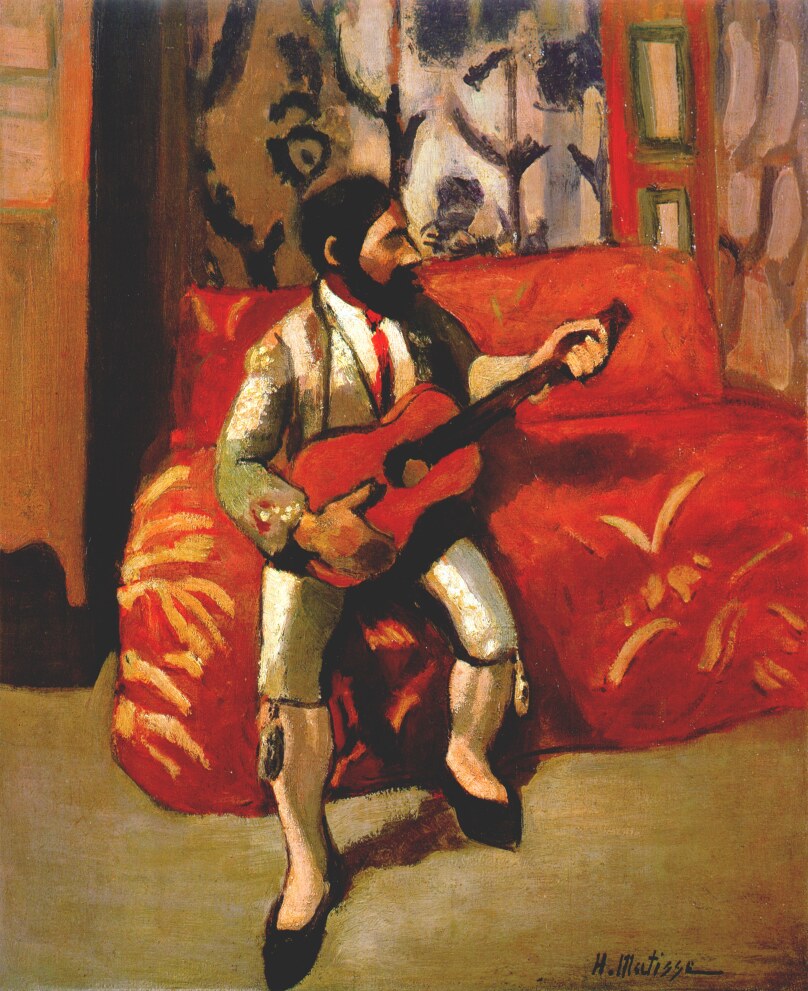
The canvas greets you with heat. A saturated red sofa fills the middle ground like a glowing theater curtain, its surface brushed with quick decorative marks that suggest patterned fabric without pedantic detail. Against that flare, a bearded guitarist sits three-quarter view, legs parted, left hand along the neck of a red instrument, right hand resting near the sound hole. The backdrop is a pale, patterned wall with inky blue motifs; at the far right a vertical band frames a window or panel edged in green and orange. The floor is a quiet, clay-like gray that saves the painting from floating away on red. The entire scene hums with a warm, interior light that feels less like natural daylight than like the glow of the room’s own color.
Composition: A Central Triangle Anchored By A Couch
Matisse structures the composition with a triangle resting on the guitarist’s feet and rising to the head and shoulder. The broad, rectangular block of the sofa stabilizes this triangle and provides a chromatic stage. The patterned wall acts as a backdrop that nearly touches the figure, keeping depth shallow and the surface unified. Flanking verticals—the dark door or screen on the left and the green-edged panel on the right—operate like proscenium wings. The centered placement of the musician risks stiffness, but Matisse offsets that with the diagonal of the guitar, the open angle of the legs, and the head turning toward the right so that the triangle breathes.
Color Architecture: Reds In Command, Neutrals As Peacekeepers
This picture is orchestrated as a red-led chord. The couch is a hot vermilion or cadmium red, warmed further with orange strokes and cooled in places with touches of crimson shadow. The guitar echoes this family in a slightly deeper register, linking instrument and setting into one chromatic field. Skin tones are handled with warm ochres and pinks edged by cool gray notes, and the suit is a pale, metallic greenish gray that catches light in creamy, almost enamel-like passages. The patterned wall holds cool blues and muted violets that temper the red stage, while the floor is a low-chroma gray-brown that gives the eye rest. Because the darkest accents are rarely pure black and the lights rarely pure white, the color retains breath; temperature, not brute contrast, does most of the descriptive work.
Light And Atmosphere: Interior Glow Instead Of Window Spotlight
“Guitarist” is lit as though the room itself were radiating. Shadows are soft and warm; transitions across the suit and face are made with temperature shifts rather than extreme value jumps. The one crisp light effect appears on the player’s calves and sleeves, where Matisse lays down thick, pale strokes to suggest sheen—perhaps satin or brushed cotton—catching the ambient glow. The room is a climate rather than a diagram of light sources, exactly the kind of steady illumination Matisse preferred when he wanted color relations to carry the image.
Pattern And Decoration: The Room As A Second Performer
Behind the musician, stylized foliage motifs climb the wall in midnight blue and gray, and lighter leaf-like shapes repeat in the red fabric of the sofa. These patterns are not timid wallpaper; they pulse forward and help shape the figure. Dark, branching forms behind the head complicate the profile and keep it from floating; lighter marks on the couch echo the gesture of strumming. By allowing the decorative to come forward, Matisse shows how ornament can be structural—part of the picture’s rhythm rather than background noise.
The Figure: Gesture Over Detail
The guitarist is presented without anecdotal props. The beard, profile, and crimson necktie deliver character, but Matisse resists portrait likeness. The focus is on posture and the choreography of playing: left forearm angled along the neck, right hand cupped at the body, legs braced to stabilize the instrument. The shoes are simplified into soft black wedges; the suit resolves into planes that switch from warm to cool as they turn. Even the face is a collection of carefully chosen facets—a warm cheek wedge, a cool brow plane, a dark beard mass—so that the head reads clearly at a distance while avoiding fussy description up close.
The Guitar: Formal Keystone And Emotional Center
Chromatically and structurally, the instrument is the painting’s keystone. Its red body ties it to the sofa while its shape—two rounded bouts connected by a narrow waist—repeats and softens the rectangular insistence of the furniture. The straight line of the neck points toward the green-framed panel at right, linking the central actor to the room’s architecture. Because the guitar is described with the clearest geometry and the richest red, it becomes the eye’s natural resting point, the visual analogue to a sustained musical note.
Drawing: From Adjacency To Cloisonné Contour
Across much of the picture Matisse draws by adjacency, letting edges arise where colors meet: the pale suit against red couch, the warm face against the cool patterned wall, the gray floor against shadow. But he also deploys deliberate dark contours around the figure and instrument—Cloisonné-like lines that recall Gauguin and the Nabis. These outlines do not flatten the picture so much as belt it together, protecting key forms from being swallowed by the saturated couch. They act like the binding on a textile: a thin structural seam that keeps the cloth from fraying.
Brushwork And Materiality: Dense Notes And Open Air
The paint handling alternates between dense, tactile notes and open, breathing patches. On the couch and guitar Matisse works with a loaded brush, leaving ridges of pigment that catch light and intensify the reds. On the wall and floor he thins the mixture so that scumbles and soft drags register as air and ground. The suit’s highlights are applied with buttery confidence; the patterned marks are dashed with speed; the beard is a mass of short, dark strokes that hold the profile together. This variety of touch gives the room a physical life that literal detail would only dilute.
Space And Flatness: A Shallow Stage Held By Design
Depth is gentle and persuasive without being deep. The couch’s seat and back create two planes meeting at a crease; the wall rises immediately behind; the floor tilts toward us without plunging. Everything occurs within a shallow box that suits the intimacy of chamber music. Yet nothing feels cramped, because the large shapes—couch, figure, wall—are so clearly proportioned that the eye can breathe. Matisse’s modernism is already present here: spatial plausibility coexisting with a strongly asserted surface.
Rhythm And Movement: Hearing With The Eyes
Although the image is still, rhythm courses through it. The curve of the guitar repeats in the arc of the player’s forearm and the rounded pattern motifs; diagonals in the legs, necktie, and panel edges counter the couch’s horizontals; scattered marks on the sofa move like notes across a score. Even the little tassels or buttons on the breeches act as syncopations. This choreography of forms is how Matisse makes sound visible—without motion blur, without narrative, simply through coordinated shapes.
Cultural Inflection: A Spanish Echo Without Ethnography
The costume suggests a Spanish inflection—cropped jacket, breeches, low shoes, red tie—yet Matisse avoids literal costume painting. He borrows the silhouette and the romance of Iberian music as an atmospheric key, a way to justify the exuberant reds and the coexistence of decorative flourish with disciplined structure. The painting reads as a homage to a tradition of guitarists in European art while remaining rooted in his Paris studio’s modern space.
Dialogues With Precedents And Peers
“Guitarist” converses with several lineages. From Manet it takes the authority of large, flat planes that describe with minimal means. From Gauguin and the Nabis it borrows the use of dark contour and assertive pattern. From Vuillard it shares the idea that wallpaper and upholstery can be as much subject as figure. Yet the temperament is unmistakably Matisse’s: the color is hot but balanced; the design is frank; the whole surface breathes with an unforced calm even as reds dominate. It foreshadows the larger, louder Fauvist canvases of 1905 by demonstrating, in a modest scale, how harmony can sustain intensity.
Likely Pigments And Practical Choices
The chromatic decisions suggest a straightforward early-twentieth-century palette. Lead white builds the high keys of wall, suit highlights, and floor; yellow ochre and raw sienna warm flesh and furniture undernotes; cadmium or vermilion reds drive the sofa and guitar; ultramarine and cobalt lend cools to the wall pattern; viridian or terre verte peeks through the panel trim and mixes into olive grays; raw and burnt umbers anchor the darkest passages; and ivory or bone black, used sparingly, firms up contours and the deepest shadows. Paint weight varies deliberately: leaner mixtures for air and ground, richer bodies for the salient reds, ensuring both luminosity and structural clarity.
The Ethics Of Omission: Letting Relations Speak
Matisse excludes everything that would distract from the chord of the room. There is no mapped fretwork, no lace on cuffs, no descriptive wood grain, no texture on the wallpaper beyond a handful of signs. Even facial features are pruned to essentials—a profile wedge of nose, a closed eye suggested by a stroke, the beard as a single mass. These omissions are not gaps; they are choices that keep the picture legible at a glance and alive over time. The mind supplies detail; the painting supplies relation.
How To Look Slowly And Profitably
Let the picture resolve first as three big zones: the red couch, the guitar-playing figure, and the pale patterned wall. Once the structure holds, trace the diagonal from the bouquet of marks on the left back cushion through the guitar body to the green-edged panel at right; notice how that path calibrates warm to cool. Move closer and watch edges form by contact—pale sleeve against red cushion, warm cheek against cool pattern, red guitar against dark vest. Step down to the floor and appreciate its restraint; it is the rest between phrases. Back away again until the whole locks into a single, humming chord. You will find that the painting becomes easier to “hear” the longer you look.
Place Within Matisse’s 1903 Trajectory
Seen alongside contemporary studio scenes and landscapes, “Guitarist” clarifies Matisse’s priorities just before Fauvism peaks: simplifying forms into firm planes, allowing decoration to participate structurally, trusting temperature shifts more than academic modeling, and keeping the surface unified even when color runs hot. Within two years he would transpose this discipline into blazing outdoor light. Those later canvases feel inevitable because smaller interiors like this established the armature.
Enduring Significance
“Guitarist” endures because it finds grandeur in a small room. It shows how saturated color can be calm, how pattern can be structural, how a few tuned shapes can describe not only a person playing music but the sensation of music itself. The painting’s red chord stays with you: it is the warmth of performance, the intimacy of a domestic stage, and the confidence of a painter learning to conduct color like sound. Long after you forget the specifics of the room, you remember the hum—the feeling of sitting with a guitarist as the air glows.