Image source: wikiart.org
A First Look at Hals’s Children and Their Unusual Liveliness
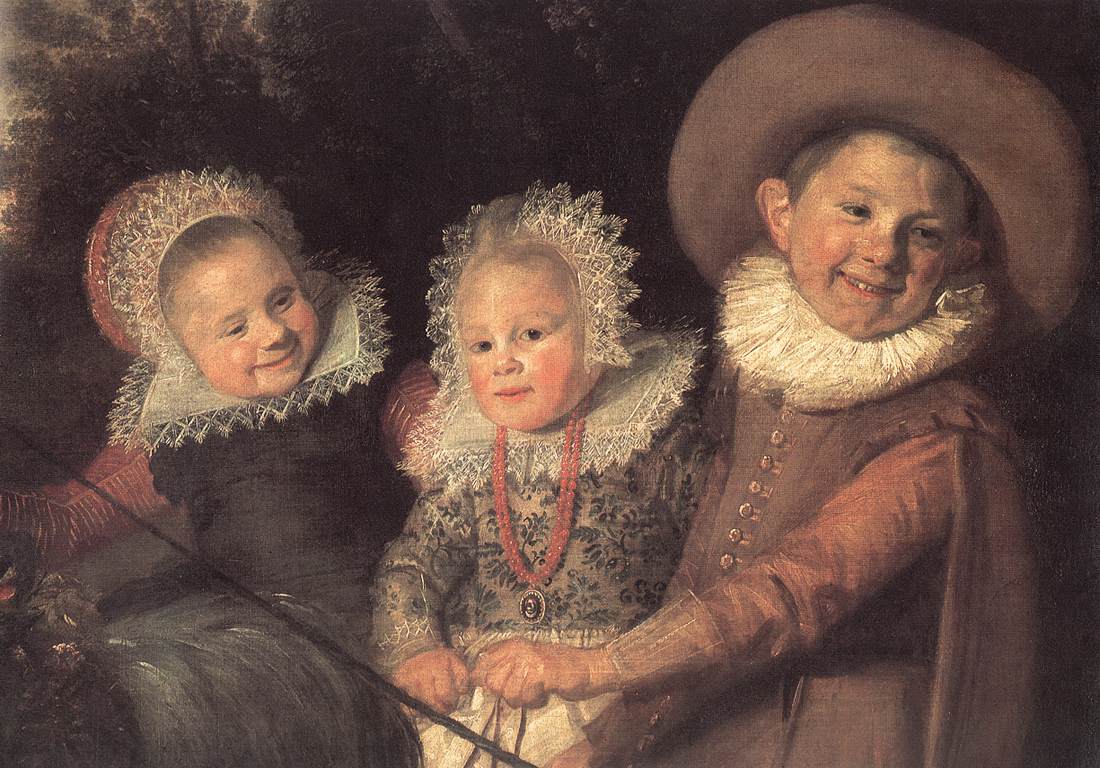
Frans Hals’s Group of Children (1620) is immediately disarming because it refuses the stiffness that often clings to early seventeenth century portraiture. Three children fill the scene, pressed close together in a shallow space, their faces warm with life and their expressions distinctly individual. One child on the left smiles with a playful, almost conspiratorial softness. The central child faces forward more directly, calm but alert, cheeks flushed and eyes attentive. On the right, a boy in a wide brimmed hat smiles broadly, his posture suggesting cheerful confidence. The painting feels less like a formal record and more like a captured moment of shared presence, as if Hals has briefly persuaded his sitters to forget the seriousness of being painted.
Yet this is still a portrait, and portraiture in this period was rarely casual. The children’s clothing, lace collars, and carefully rendered accessories signal family status and social ambition. Hals gives the viewer both things at once: the honest vitality of childhood and the constructed dignity of a prosperous household. That tension becomes the painting’s central energy. The children are dressed to represent the family, but their faces insist on their own personalities.
The Meaning of Childhood in Dutch Portrait Culture
In the Dutch Republic, portraits of children were often expressions of lineage, prosperity, and continuity. They documented heirs, celebrated family stability, and communicated the household’s place within the social order. At the same time, childhood was also viewed through a moral lens. Children were seen as beings to be shaped, trained, and guided toward virtue. Portraits could therefore emphasize innocence, obedience, and promise.
Hals complicates these expectations by making the children feel vividly present. Instead of turning them into symbols of future adulthood, he lets them remain children. Their cheeks are rosy, their mouths curve into natural smiles, and their eyes engage the viewer in a way that feels spontaneous. The portrait still honors the family’s social identity, but it does not erase childhood’s unpredictability.
The painting also suggests that the sitters are not isolated individuals but a small community. Their closeness implies family bonds, shared upbringing, and a world of everyday interaction. Hals’s genius is that he can imply this domestic reality without painting a full domestic interior. He achieves intimacy through grouping, expression, and touch.
Composition and the Sense of a Shared Moment
The composition is compact, built around the tight clustering of the three figures. Hals places the children so that their heads form a gentle arc across the canvas, creating a rhythm of faces that the viewer reads almost like a sentence. This arc gives the painting unity. It also establishes a subtle hierarchy of attention, since the rightmost child, with the large hat and open smile, occupies more visual space and feels slightly more dominant.
The children’s bodies overlap, which increases the sense of closeness and shared space. The right child’s arm appears to reach behind or around the group, suggesting a protective or companionable gesture. This overlap prevents the portrait from feeling like three separate likenesses pasted together. Instead, it feels like one social moment involving three distinct personalities.
Hals also uses the direction of gazes to keep the scene alive. The children do not all look in exactly the same way. Their attention feels varied, as if the painter, or someone nearby, has just said something amusing. This implied off canvas presence is important. It makes the portrait feel like an interaction rather than a posed arrangement.
Facial Expression and Hals’s Gift for Character
Few painters of the period captured expression as persuasively as Hals, and here his approach is especially effective because children’s expressions can quickly look forced if handled too rigidly. The left child’s smile is gentle and slightly sideways, suggesting amusement that is contained but real. The central child’s expression is more neutral, perhaps cautious, perhaps simply attentive, as if watching the scene unfold rather than leading it. The right child’s grin is expansive, confident, and outward facing, almost as if he is proud of being seen.
These differences create a portrait not only of faces but of temperaments. Hals makes it easy to imagine these children in motion, speaking, teasing, or reacting to one another. The painting becomes a study of childhood psychology, where emotions shift quickly and social energy moves through small groups in subtle ways.
The flushing of cheeks and the lively handling of flesh tones also adds to the sense of reality. The children look warm blooded and present, not pale icons. Hals’s color choices emphasize vitality without exaggerating it. The result is a portrait that feels affectionate without becoming sentimental.
Costume, Lace, and the Family’s Social Message
Even though Hals allows the children to feel natural, their clothing remains carefully chosen. Lace collars and headdresses are prominent. These white elements frame the faces, drawing attention to expression while also signaling expense and refinement. Lace required labor, skill, and maintenance. In portraiture, it often communicates the household’s ability to sustain such refinement, implying both wealth and discipline.
The children’s garments also suggest differentiation within unity. While the palette remains cohesive, there are variations in texture, pattern, and accessories. The central child wears a striking necklace, likely coral, which stands out as a bright accent. Coral jewelry was often associated with protection for children, as well as with status. Whether read as practical belief or social display, it adds a layer of meaning: childhood is cherished, but also vulnerable, and the family responds with symbols of care.
The right child’s broad hat introduces another kind of social signal. Hats in portraits can suggest emerging masculinity, confidence, and public identity. The hat enlarges the child’s presence, making him appear slightly older or more socially assertive. At the same time, the hat’s scale has a playful effect. It contributes to the charm of the portrait, as if the child is trying on the role of adulthood while still unmistakably remaining a child.
Light, Shadow, and the Warmth of Flesh
The lighting in the painting is gentle, favoring the faces and lace. Hals allows the background to remain dark and unobtrusive, creating a soft stage where the children’s heads and collars emerge as bright focal points. This contrast is crucial. It makes the children appear close and tangible, as if they are leaning toward the viewer from a shadowed interior.
Hals’s handling of light on skin is especially persuasive. He gives the children a warm, slightly glowing complexion, with subtle highlights on cheeks and foreheads that suggest real light catching real flesh. The shadows are soft rather than harsh, which keeps the mood friendly and intimate. This is not a dramatic, high contrast portrait designed to impress through severity. It is designed to charm through presence.
The white lace collars and caps catch light in flickering patterns, giving Hals an opportunity to show off painterly skill. Yet the lace does not feel like mere display. It functions compositionally, framing faces and creating unity among the group. Hals turns fashion into structure.
Brushwork and the Illusion of Spontaneity
A hallmark of Hals’s work is brushwork that feels brisk and alive, and this painting benefits from that approach. The children’s expressions, especially the smiles, depend on subtle shifts at the corners of mouths and around eyes. Hals’s brushwork suggests these shifts without over describing them. He paints the feeling of a smile rather than drawing its outline too rigidly.
The textures of fabric and lace are also achieved through suggestive, confident strokes. Hals knows where precision matters, the face, the edge of a collar, the glint of an accessory, and where suggestion can do more, the broader areas of clothing, the shadowed background, the soft transitions in sleeves. This creates a sensation of ease, as if the painting came together quickly, even though the effect is the result of deep skill.
The brushwork contributes to the painting’s emotional truth. A portrait of children can easily feel stiff if the paint is too controlled. Hals’s painterly freedom matches childhood’s energy. The technique becomes part of the subject. The liveliness of paint echoes the liveliness of the sitters.
Relationships, Touch, and the Social World of Siblings
One of the most affecting qualities of Group of Children is the implied relationship among the sitters. The children are positioned close enough to suggest familiarity and comfort. They do not appear separated by etiquette or posed as isolated individuals. They feel like a unit, perhaps siblings or close relatives, gathered together for a portrait that records not only their likenesses but their bond.
The right child’s arm, reaching behind the others, is especially significant. It introduces a gesture of connection that transforms the group into something more than a lineup. It can be read as protective, affectionate, or simply possessive in a playful way. This gesture suggests social dynamics within the family: older and younger, bold and shy, leader and follower. Even if we cannot identify the children, the painting allows us to sense a hierarchy of personality and comfort.
The central child’s calmer expression becomes a stabilizing point, while the left and right children provide more overt smiles. This balance creates a believable group dynamic. Not everyone performs the same way, and Hals respects that. He lets each child appear as themselves.
Childhood, Vulnerability, and the Quiet Presence of Care
Portraits of children often carry an undercurrent of vulnerability, even when they look joyful. Childhood in the seventeenth century came with risks, and families were acutely aware of fragility. The careful clothing, the jewelry, and the formal act of commissioning a portrait all speak to the value placed on children and the desire to preserve them in image and memory.
The coral necklace on the central child reinforces this undercurrent. It can be read as protective, a sign of care as much as adornment. The portrait therefore becomes not only a display of prosperity but a testimony of affection. The family invests in these children, materially and emotionally, and the painting stands as evidence of that investment.
Hals does not make the mood heavy. He keeps the surface bright with smiles and warm tones. But the very act of painting children, of fixing their likeness in oil, suggests the importance of preservation. The portrait becomes a kind of safeguard, a way of holding childhood still for a moment, even as childhood rushes forward.
Frans Hals in 1620 and His Particular Empathy for Life
By 1620, Hals had already shown an ability to inject portraiture with a sense of immediacy. He often painted adults with lively expressions and naturalistic poses, but painting children requires a special kind of sensitivity. Children’s faces change quickly, and their attention can be difficult to hold. Hals’s success here suggests not only technical skill but human empathy. He seems to enjoy the presence of his sitters, and the sitters seem to respond.
This empathy is visible in the painting’s mood. The children do not look intimidated by the act of being painted. They look engaged, even entertained. That feeling implies a studio atmosphere where the painter knows how to draw out expression without forcing it. The portrait thus becomes a record of an interaction between artist and sitters, not merely a record of appearance.
Hals also avoids turning childhood into a moral lesson. He does not paint solemn cherubs meant to symbolize innocence. He paints real children with real personalities. That realism is what makes the painting feel modern. It speaks to the universal experience of childhood as a mix of play, pride, shyness, and social energy.
Why the Painting Still Charms Today
Group of Children remains compelling because it feels both historical and immediate. The lace, clothing, and formality root it firmly in the Dutch Golden Age, yet the expressions feel timeless. Anyone who has watched children react to attention will recognize the mix of delight and self consciousness. Hals captures that mix with remarkable clarity.
The portrait also succeeds because it is not only cute or decorative. It is structurally strong. The composition guides the eye, the contrast between faces and background creates focus, and the interplay of expression creates narrative. The painting offers a small world: three children together, a moment of connection, and a sense of a family’s pride and care.
In the end, Hals gives the viewer more than a record of three young faces. He gives an image of childhood as lived experience, framed by the social rituals of portraiture but not trapped by them. The children remain themselves within the formal boundaries of the painting. That is the achievement. The portrait preserves status, but it preserves life even more.