Image source: wikiart.org
Historical Context And Why This Alpine View Matters
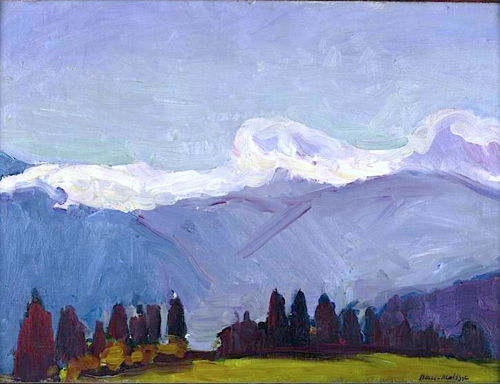
Painted in 1901, “Green needles on the Cross Javernaz” belongs to the pivotal season when Henri Matisse turned away from academic finish toward a language in which color, plane, and brushwork build the world. He had studied the rigor of drawing in Paris, absorbed Cézanne’s constructive color, noted the Nabis’ decorative flattening, and looked hard at the outdoor light of Impressionism. Switzerland gave him a living laboratory: strong horizons, abrupt weather, dark conifers against high skies, and a topography that naturally compresses space into clear belts of ground, forest, mountain, and cloud. This canvas is one of the clearest statements of that experiment. It is not a postcard of a specific summit so much as an orchestration of alpine atmosphere—how the cool of distant slopes, the dark rhythm of firs, and the lucid weight of cloud create a stable chord.
First Reading: A Mountain Built From Color Belts
The picture divides itself into legible bands. At the bottom, a narrow field of green—bright but tempered—forms a stage. Above it, a serried line of dark, tapering forms articulates a stand of firs. Behind them, a pale, expansive mountain rises in blue-violet, slashed here and there by diagonal drags of the brush that read as facets and shadowed ravines. Capping the mountain is a band of milky white cloud, thick and rolling, whose volume is declared by turns from cool lilac to warm white. The sky is an easy breath of blue, high and even, slightly lighter than the mountain so that the cloud reads as volume rather than cut-out. The whole scene is simple in ingredients and rich in sensation. Matisse offers the landscape as a set of forces—upward thrust, horizontal calm, hovering cloud—rather than a catalog of features.
Composition As Clear Geometry
The rectangle is engineered like a frieze. A low green belt anchors the bottom; a vertical palisade of conifers rises as a dark counter; a triangular mountain occupies the middle distance; and a long, looping cloud rides the top of the slope in a shallow S-curve. The proportion of sky to land is generous. That choice gives the painting its Alpine breath and allows the eye to rest in open air after moving through the denser forest band. The small differences in height among the firs, their occasional pairing, and the tiny gaps between them create a rhythm that keeps the lower edge alive without clutter. The mountain is centered but not symmetrical; faint diagonal marks lean to the right, countering the long arc of the cloud and preventing stasis. The composition is fixed enough to be calm and varied enough to keep the eye circling.
Color Architecture And The Prelude To Fauvism
Matisse builds the landscape from a tuned chord rather than from local color. The dominant cools—blue of sky, blue-violet of mountain—are warmed strategically by the cloud’s milky whites and faint lilacs and by the yellow-green of the meadow. The dark firs are not black holes; they are saturated mixtures that read as living greens built with blues and umbers, then deepened into near-black at their cores. Small touches of warm brown at the base of a few trees and a tincture of burgundy in the distant ridge add bite to the cool climate. Nothing is neutral; even the “gray” of the mountain is a breathing mix that leans cool or warm where the chord needs adjusting. This is the grammar that will soon explode in Matisse’s Fauvist canvases: color as structure, temperature as modeling, relation instead of recipe.
The Cloud Band As Protagonist
Although the title foregrounds needles and a named site, the eye knows immediately that the cloud is the protagonist. It is painted thickly, with creamy strokes that crest and fold. The white is not dead; it carries lilac shadows, greenish reflections at its lower edge, and touches of warm light where it thins. It behaves like a sculpture the wind is pushing along the mountain’s spine—heavy enough to cast scale, light enough to lift. By making the cloud a continuous ribbon, Matisse ties the two halves of the sky together and gives the mountain a horizon line that is felt rather than drawn. It is the hinge of the painting, the place where air meets ground and where the color chord comes into tune.
The Fir Line: Rhythm, Scale, And Human Measure
The vertical row of conifers provides rhythm and scale. Each tree is struck quickly—dark tapering body, a hint of colored light at one edge—and together they make a palisade that looks both natural and designed. Their spacing suggests walking pace; one could imagine stepping along the field, tree to tree. The reds tucked into some of the silhouettes and the warm notes at their bases are not literal blossoms; they are scale markers and chromatic contrast, keeping the band from flattening into a silhouette. In the hierarchy of the picture they are the percussion section: steady beats under the mountain’s slower time and the cloud’s long melody.
Modeling Through Temperature, Not Shadow
There are no hard cast shadows here, which is true to alpine midday when light is high and even. Volume is achieved through temperature shifts. The mountain turns not by being shaded darker but by cooling into blue-violet and warming toward gray-lilac in planes that face or turn from the sun. The cloud swells by flickering between warm and cool whites; the field rises by catching yellow light in stripes and calming into cooler green toward the trees. This method keeps the picture unified. Nothing breaks the chord with theatrical contrast; everything participates in the same ambient morning.
Brushwork And The Feel Of Materials
Touch varies across the painting to record matter and air. The sky is laid with broad, smooth sweeps that show the bristle’s path and leave a faint weave—exactly the right speed for empty air. The mountain’s strokes are angled, dragged, and sometimes knife-like, giving the rock a planar feel without insisting on geology. The trees are compact, directional marks that taper and overlap; their darker paint sits slightly higher, catching real light and reinforcing solidity. The cloud is built with the fattest paint, wet-into-wet, so its highlights are physical as well as optical. This orchestration of touch permits the painting to describe without fussy detail.
Space Compressed Into A Decorative Field
Depth exists and is convincing—the field is near, the forest nearer, the mountain behind, the sky beyond—but recession is intentionally shallow. The field tilts like a thin carpet; the forest acts like a dark frieze; the mountain rises as a single plane; the cloud sits nearly on the picture surface. The result is a landscape that remains a designed fabric. You can enter the scene imaginatively yet still experience it as a balanced pattern of bands and arcs. That dual readability—world and wall—marks Matisse’s modernity.
Drawing Through Abutment Rather Than Outline
Edges arise where colors meet. The mountain’s top is drawn by the abutment of violet and white; the tree tips are clipped against the pale foothill; the field’s edge exists where green runs into shadow. Linear outlines, when they appear, are brief and broken—small emphases rather than scaffolding. This method puts color in charge of both form and light, and it keeps the surface integrated. The viewer never feels that a drawing has been colored in; one feels that a world has precipitated from tuned patches.
Weather, Season, And The Psychology Of Air
The palette suggests clear, cool air—late morning or early afternoon in high country. The field has a springlike, sap-green cut; the trees read as evergreen rather than deciduous; the mountain carries fresh snow blown into shapes along its ridges. The mood is not sublime in a Romantic sense; it is centered, open, oxygen-rich. Matisse is less interested in drama than in balance—the way a viewer’s lungs feel in such a place, the way the world arranges itself into stable belts, the way color relationships settle the nerves.
The Motif As A Laboratory For Ideas
Why paint this subject now? Because Alpine geometry tests every principle Matisse is adopting. The mountain is a plane built from color; the cloud is volume made from warm and cool; the firs require strong, simple silhouettes; the field demands a tuned ground color that will carry the whole. With a few elements he can evaluate how far omission can go, how lean a palette can remain, and how strongly temperature can model form. The successful answers in this picture will support the bolder experiments of 1905, where similar belts of color and living blacks and whites will propel the Fauvist landscapes.
Dialogues With Impressionism And Post-Impressionism
The painting inherits from Impressionism a faith in outdoor light and the discipline of painting from the motif. It departs from Impressionism’s flicker, however, in favor of larger, flatter color planes. The Cézannian lesson is audible in the mountain’s constructive strokes and in the reliance on adjacency rather than contour. One also hears a Nabi taste for decorative simplicity in the aligned tree band and the near-tapestry of sky and mountain. Yet the temperament is unmistakably Matisse’s: harmonizing, calm at high chroma, steady in its omissions.
Materiality And The Skin Of Paint
Pigments of the period make the high key possible: cobalt and ultramarine for sky and mountain; mixtures leaning to viridian or Prussian for the trees; lead white massed in the cloud; earths and small cadmium touches warming the field and fir edges. Paint layers alternate between thin, breathable scumbles and denser, body-color ridges. The weave of the canvas shows in sky and mountain, letting physical light mingle with painted light. The result is a surface that looks quick without seeming tentative.
Rhythm And The Viewer’s Path
The picture invites a loop. The eye often enters through the bright band of field, steps along the tree tops, climbs the short diagonal marks that articulate the mountain, rests in the rolling cloud, and then floats out into the wide sky before returning to the ground. That circuit repeats more slowly as new correspondences reveal themselves: a violet in the ridge echoing a cool in the cloud’s underside; a warm yellow in the field rhyming with a honeyed edge on a tree; a thin blue stroke in the mountain answering a pale streak in the sky. The landscape teaches the viewer how to breathe with it.
Abbreviation And The Courage To Omit
What is left out is as eloquent as what remains. There is no minute bark texture, no snow-granule description, no twig counting. The distant settlement or path, if present in nature, is suppressed. Matisse withholds anecdote so that color relations can carry the image. That economy keeps the painting fresh, legible at the scale of a glance, and endlessly revisitable. The eye supplies detail gladly when the broader harmony is convincing.
How To Look Slowly And Profitably
Stand back and receive the big chord: green ground, dark fir belt, blue-violet mountain, creamy cloud, light blue sky. Let the cloud’s physical paint catch real light; notice how it turns from cool to warm without losing whiteness. Move closer and follow the mountain’s diagonal marks; watch edges form where colors meet rather than by outline. Track the small warm notes inside the fir band that prevent it from collapsing into a silhouette. Step back again until the belts resolve into a single, calm proportion. In that near–far oscillation you reenact the painter’s method of tuning until the whole breathes.
Relation To Matisse’s 1901 Landscapes
Compared with the more complex “Swiss Landscape,” this canvas is stricter in geometry and sparer in palette. Compared with “The Bridge,” it eliminates anecdotal elements so that color belts can be read with clarity. Alongside “Copper Beeches,” it shares the frontal plane and vertical rhythm but shifts from the heated red-green complement to a cooler blue-green chord. Across all of them you can watch the same principles solidifying: simplified shapes, decorative compression, temperature modeling, and the elevation of color to the status of structure.
Why This Painting Endures
“Green needles on the Cross Javernaz” endures because it turns a familiar alpine view into a poised demonstration of modern pictorial thought. It shows that a landscape can be built from a few tuned bands, that clouds can be made of color temperature rather than theatrical light, and that the sensation of clear air can be recorded without granular detail. The scene remains convincing as nature and satisfying as a designed surface. In it, Matisse finds a way to let the world be simple and still feel entire.