
Image source: wikiart.org
Introduction to “Gone, But Not Forgotten” (1873)
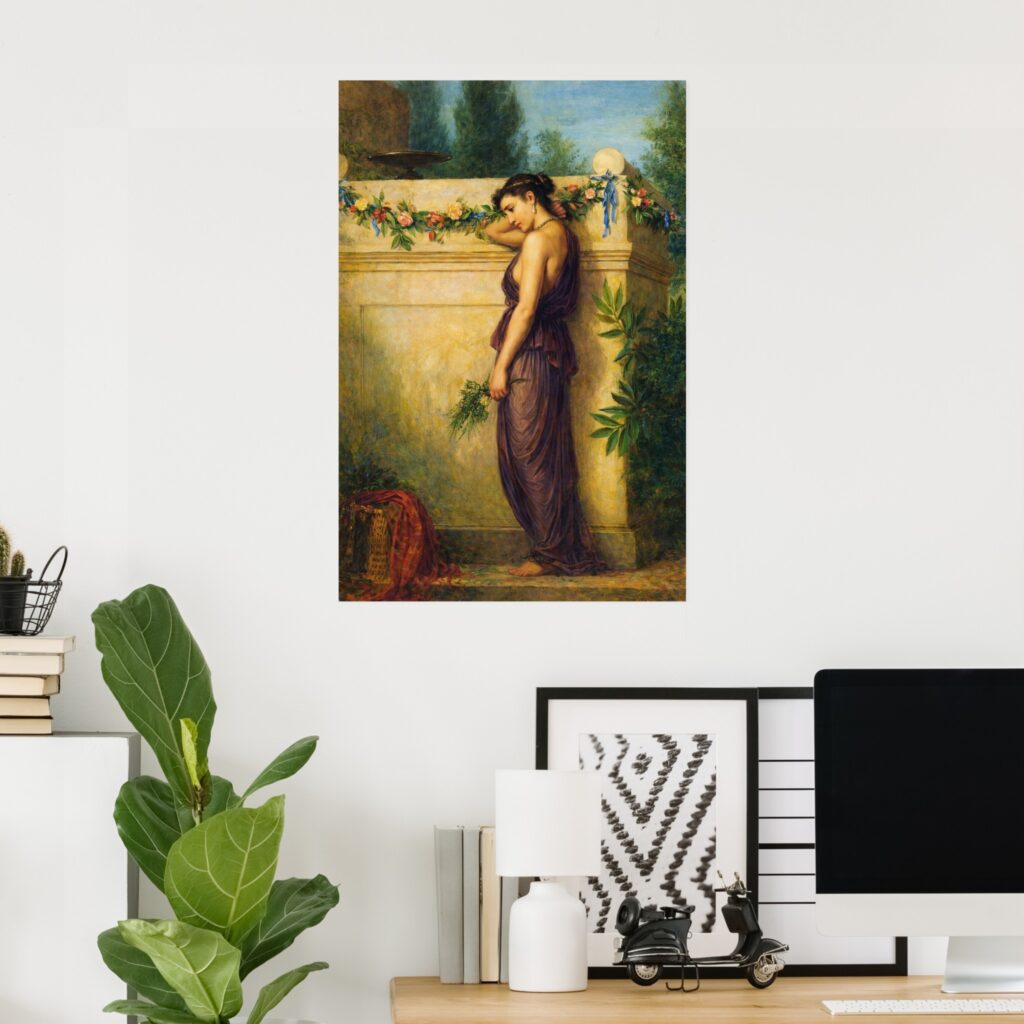
“Gone, But Not Forgotten” is an early work by John William Waterhouse, painted in 1873, and it already shows the artist’s gift for turning a quiet figure into a full emotional narrative. The scene is simple: a solitary young woman stands beside a pale stone structure that reads as a terrace wall, a memorial, or a tomb-like parapet. Her body leans into the architecture as if it is the only solid thing left in a moment that feels unsteady. The title frames everything we see as remembrance, not just sadness, but the mental act of keeping someone present through grief.
Waterhouse would later become famous for his literary heroines and mythic tragedies, yet here he achieves a similar effect with minimal storytelling props. There is no dramatic gesture, no crowd, no obvious event. Instead, we get a pause, a hush, and a body language that suggests exhaustion from feeling. The painting’s power lies in how it makes memory visible without illustrating a specific plot. It invites the viewer to step into the silence and supply what the figure cannot say.
John William Waterhouse in 1873
In 1873, Waterhouse was still near the beginning of his career, developing the visual language that would eventually place him alongside the most recognizable painters of late Victorian Britain. At this stage, he is clearly interested in the classical and the theatrical, but he uses them in a restrained way. Rather than staging an epic, he borrows the mood of antiquity, the stone, the foliage, the drapery, and uses them as a setting for intimate emotion.
This is also the kind of subject that sits comfortably within Victorian taste for moral feeling and poetic melancholy. Viewers of the period were receptive to images of contemplation, mourning, and the nobility of restrained sorrow. Waterhouse does not sensationalize loss. He gives it a dignified posture and a believable human weight. Even if you know nothing about Waterhouse’s later paintings, “Gone, But Not Forgotten” reads as an artist testing how far subtle expression can carry a narrative.
What Is Happening in the Scene
The woman stands in profile, her head slightly turned so we can see her face and lowered gaze. One arm is bent, resting against the stone, with her head leaning into the crook of that arm. The other arm hangs down, holding a small cluster of greenery or flowers. That simple detail shifts the painting from generic sadness into a ritual moment. She has brought something to place, to offer, or to leave behind.
The stone structure functions like a boundary between interior feeling and exterior world. Behind and above it is a soft, indistinct space of air and foliage. In front of it is the figure, close enough for us to read the tension in her pose. Her feet are bare or lightly shod, grounding her and making her vulnerability feel immediate. Nothing suggests movement forward. The scene is built around stopping, lingering, and staying with what cannot be changed.
The Figure as the Center of Meaning
Waterhouse’s figure is not idealized into an untouchable symbol. She feels like a real person caught in a private moment. Her shoulders slope inward. Her neck bends with a heaviness that implies long, sustained emotion rather than a sudden burst of tears. The face is calm but withdrawn, the kind of expression that happens when grief turns inward and speech feels pointless.
Her clothing is crucial to the mood. The drapery falls in soft, vertical folds, clinging and loosening in a way that suggests both classical costume and a contemporary sensibility for graceful silhouette. The dress is dark, but not harshly black. It reads as mourning-adjacent, a tone of shadow rather than a flat declaration. That matters because the painting is not only about death or absence, it is about memory, which is never a single color. Memory is layered, like fabric, like translucent folds over skin.
Composition and the Art of Stillness
The composition is designed to feel stable, even as the subject feels emotionally unsteady. The stone parapet forms a strong horizontal line across the upper half of the painting. This line acts like a lid on the scene, pressing down gently and creating a sense of enclosure. The woman’s body forms a vertical counterweight, her figure rising from the ground like a column. Together, these shapes create an architectural quiet.
Waterhouse positions the figure slightly off-center, leaving space around her that feels like absence made visible. The emptiness is not blank; it is filled with muted texture, air, and shadow. But it functions as emotional negative space. It gives her room to grieve, and it gives the viewer room to feel the title’s meaning. The angle of her head and the curve of her arm lead the eye down, away from any horizon or future. Everything in the pose says: stay here.
Color Palette, Atmosphere, and Mood
The palette is dominated by soft, earthy tones: stone creams, olive greens, and a veil of warm, dusty light. The painting feels as if it is viewed through time, like a remembered scene rather than an immediate present. This is a powerful choice for a work about not forgetting, because the surface itself seems aged into gentleness, as though the painting has absorbed the atmosphere of recollection.
Waterhouse uses contrast sparingly. The figure’s darker dress stands out against the pale stone, but the edges are softened. Shadows are not sharp cuts; they are gradual transitions. This produces an emotional effect: grief here is not theatrical. It is quiet, persistent, and enveloping. The greenery that trails along the parapet and rises on the right side adds life, but it is not vibrant life. It is life continuing without celebration, a reminder that the world keeps growing even when someone is missing.
The Role of Flowers, Garlands, and Greenery
Floral elements in mourning imagery often carry double meanings: beauty and decay, offering and farewell, nature’s cycle and human interruption. In this painting, the garland laid across the stone suggests deliberate decoration, like a memorial prepared for a ceremony or a remembered anniversary. The woman’s small bunch of leaves or flowers becomes the personal counterpart to the more formal arrangement above. One feels public, the other intimate.
Greenery also softens the stone. It blurs the line between constructed monument and living world. That tension matters. Stone suggests permanence, the human desire to fix memory in place. Leaves suggest change, the ongoing movement of time. The title “Gone, But Not Forgotten” sits exactly in that tension: someone is gone, time has moved forward, but the mind refuses to let the person disappear.
The ribbons tied near the rounded ornaments on the parapet echo this idea. Ribbons are fragile, temporary, and easily altered by wind or weather. They are a human gesture against the hard certainty of loss. They say: I was here, I remember, I marked this place.
Light, Texture, and Waterhouse’s Handling of Paint
One of the most affecting aspects of this painting is its surface softness. The transitions between background and foreground are misty, as though the air itself is part of the emotion. The stone is painted with a chalky delicacy, while the figure’s skin carries a warmer, living tone. This difference in texture helps the theme: the body is present, the memorial is cold, and the space between them is memory.
Waterhouse’s brushwork does not call attention to itself with flashy effects. Instead, it supports the mood by keeping everything slightly subdued. The folds of fabric are readable but not overly crisp. The background is suggestive rather than detailed. This invites the viewer to focus on what matters: the woman’s inwardness and the act of remembrance. It also creates a dreamlike ambiguity. We are not sure where we are exactly, and that uncertainty makes the scene universal. It could be anywhere a person goes to remember.
Victorian Mourning and the Painting’s Emotional Restraint
To modern eyes, Victorian art can sometimes seem coded or ceremonial, but “Gone, But Not Forgotten” avoids feeling like a mere illustration of custom. Its restraint feels psychologically true. Mourning is often quiet, repetitive, and private, even when it includes public rituals. Waterhouse captures the moment after the formalities, when the visitor is left alone with the weight of what cannot be undone.
The woman’s posture suggests a body trying to hold itself together. She does not collapse, but she leans. That small difference is everything. It communicates endurance. She is still standing. She has brought her offering. She has come to the place of memory and done what she can do. The painting honors that limited but meaningful human action.
The title strengthens the emotional frame. It does not say “Lost Forever,” or “Never Again,” or anything absolute. It says: the person is gone, but the relationship continues through remembrance. That is a very Victorian idea, but it is also timeless, because it describes how grief often works in real life.
Classical Echoes and the Timelessness of Grief
Even without explicit mythological reference, the painting feels classical. The drapery, the stone, and the garden-like setting suggest an antique world or at least an idealized space removed from modern clutter. Waterhouse uses this timeless setting to lift the subject from a specific biography into a broader meditation. Grief is not tied to one era. By placing the figure in a vaguely classical environment, he implies that people have always mourned, always brought flowers, always leaned against stone and tried to hold themselves steady.
This classical mood also refines the emotion. Rather than presenting grief as raw, Waterhouse presents it as solemn and dignified. The figure becomes both a person and a symbol of remembrance. Yet she never loses her humanity, because her pose and expression remain individual, specific, and quietly vulnerable.
Why the Painting Still Works Today
“Gone, But Not Forgotten” remains compelling because it does not over-explain itself. It trusts the viewer to recognize the language of posture, offering, and silence. Many paintings of sorrow rely on overt drama, but Waterhouse chooses the smaller truth: grief often looks like stillness, like waiting, like resting your head on your arm because the body cannot carry the feeling alone.
The image also resonates because it is about memory as an action. The woman has come to a place, carried something in her hand, and paused. Remembering is not only thinking, it is doing. It is returning. It is repeating gestures that keep a bond alive. This is why the painting’s simplicity becomes its strength. The fewer the details, the more easily the scene becomes personal. Viewers can project their own losses and their own acts of remembrance into the space Waterhouse creates.
Finally, the painting offers a quiet kind of comfort. It does not promise that grief ends, but it suggests that remembrance itself has meaning. The figure’s endurance, her calm, her refusal to rush away, all imply that holding someone in memory is a form of love that persists.