Image source: wikiart.org
Introduction
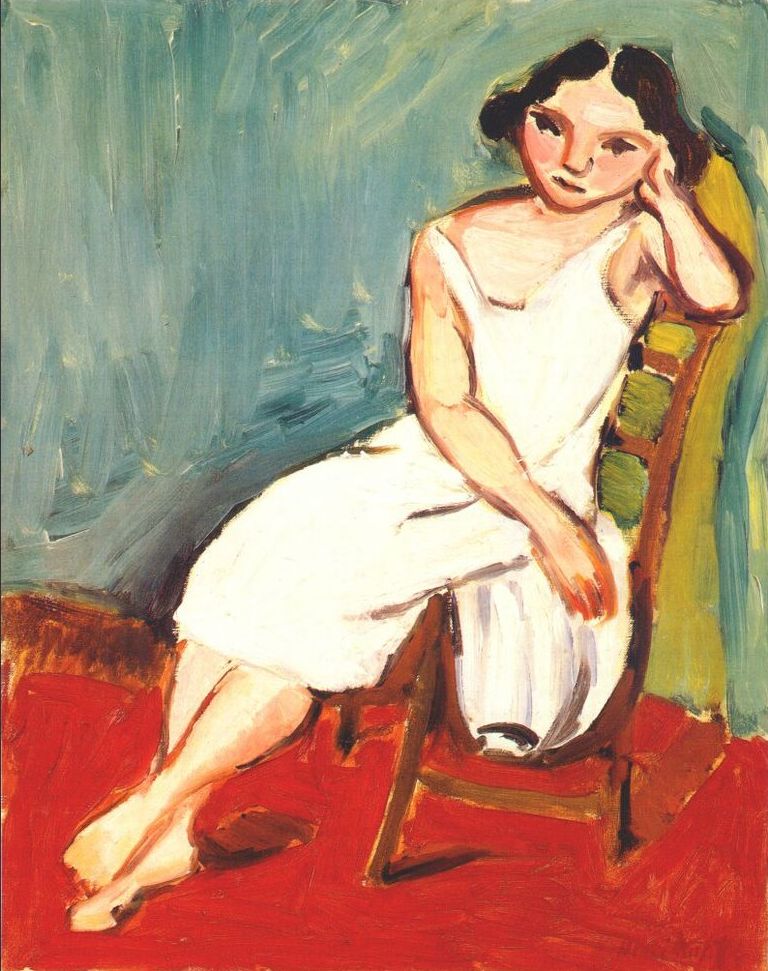
Henri Matisse’s “Girl Seated” (1909) is a compact demonstration of how a few resolute colors, a handful of contours, and a single gesture can carry an entire world of feeling. A young woman in a simple white slip turns diagonally across a wooden chair with a green cushion, her cheek propped in her right hand, her bare feet extending toward a radiant red floor. Behind her, a cool field of blue-green air fills the wall with long, lively strokes. Nothing here is ornamental for its own sake. Everything—pose, palette, brushwork—serves the portrait’s calm but alert presence. Painted at a pivotal moment when Matisse was refining the explosive discoveries of Fauvism into a clear, architectonic language, this canvas offers a lyrical manifesto for balance, purity, and serenity achieved through color.
A Moment of Transition in 1909
The year 1909 sits at the hinge of Matisse’s early career. The blazing shocks of 1905–1906 had loosened color from descriptive duty and established contour as a principal carrier of form. In the two years that follow, he gathers those freedoms into a more measured syntax: large, legible planes; chords of color tuned for harmony rather than clash; figures and interiors organized by firm, musical intervals. “Girl Seated” belongs squarely to this consolidation. It is not an anecdotal scene; it is an experiment in clarity, testing how a pared-down portrait can remain human and tender while obeying a disciplined decorative order. The canvas keeps the Fauvist heat—especially in the red floor—yet demonstrates a new patience with structure, the same patience that yields the grand simplifications of “Dance I” and “Music.”
Composition and the Architecture of the Pose
Matisse arranges the figure as a diagonal wedge within a simple room. The chair’s back and the sitter’s spine set a shallow angle that crosses the vertical of the wall, preventing the picture from freezing into symmetry. The white dress creates a luminous triangle whose apex is the bent right elbow and whose base is the pairing of feet on the floor. The head, slightly tilted and cupped in the hand, completes a gentle S-curve that runs from crown to toes. This arabesque is the painting’s true subject: a line of thought, embodied as posture. Negative space is crucial. Nearly half the canvas is the blue-green wall, an uncluttered breathing field that concentrates attention on the modest drama of the figure. The chair’s legs and rungs, simplified to a few ochre strokes, anchor the diagonal and keep the composition from floating.
Color Architecture: Red Ground, Blue-Green Air, White Form
Color structures the scene more powerfully than perspective. The red floor is a saturated, warm plane that pushes forward; the blue-green wall recedes into cool air; the white dress shines between them like a lamp. This triad—red, blue-green, white—governs the painting’s mood. The red is not a carpet rendered with texture; it is a field laid with broad, directional strokes, its chroma modulated only where the chair’s shadow rests. The wall is painted with long, sweeping passages that mix blue, teal, and small drifts of gray, producing an atmosphere rather than a mapped interior. The white of the dress is not a constant; it carries flashes of rose, ochre, and gray, responding to surrounding colors rather than to a single light source. Flesh notes at face, forearm, and feet are warm and economical—enough to register humanity without collapsing the dress’s monumental simplicity.
Contour as Conductor
A handful of dark lines conduct the entire arrangement. Matisse draws with the brush: a firm arc for the jaw, a snake-like line for the hair, quick notes for the lowered eyelids, a single emphatic stroke for the strap and edges of the dress. These contours neither fuss nor fade; they structure the meeting of planes and allow color to carry volume. Around the chair’s rails and the figure’s forearm, the line thickens and thins, imparting rhythm like a phrase mark in music. Because the contour is so authoritative, Matisse can leave broad areas of the wall and floor unmodeled. The eye accepts their flatness as intentional and delights in the intervals they create.
Brushwork and the Living Surface
Up close, the surface vibrates with physical decisions. The wall’s long strokes sweep upward and to the left, their bristles leaving ridges and gaps that admit glimpses of warmer underpaint. The floor’s red is pulled in shorter, more angular marks, echoing the firmness of the chair and the groundedness of the feet. In the dress, thick swathes of white ride over darker drawing, then skip and thin near the edges to catch a glancing light. The face is handled with small, decisive notes that preserve clarity; the blush at the cheek, the shadow under the chin, and the brief curve of the mouth are all set with restraint. The varied facture keeps every zone alive without crowding the figure with descriptive detail.
Space and the Shallow Stage
Depth is shallow by design. There is no window, no still-life table, no perspectival recession—only the meeting of wall and floor and the immediate company of the chair. The room is more stage than chamber, a field against which the figure reads like a relief. This shallowness is not a limitation; it is a strategy that intensifies presence. The viewer feels close to the sitter, near enough to register her mood but not so near as to intrude. The floor’s red, taken as a large, unbroken plane, functions almost like a proscenium, and the green wall, with its long directional strokes, provides a curtain of air. Matisse needs no more to convince us that space holds the figure with calm pressure.
Gesture, Psychology, and the Ethics of Rest
The sitter’s pose—cheek propped in hand, legs crossed loosely at the ankles—offers a reading of interiority without theatrical strain. Her gaze is lowered but not closed; her mouth gathers slightly, suggesting thought rather than melancholy. The hand at the temple is a classic motif of contemplation, yet here it is scaled to domestic ease rather than heroic rumination. Matisse’s ethic, articulated around this time, sought images that offer balance and serenity. “Girl Seated” embodies that aim. The picture dignifies idleness as a mode of attention, arguing that rest can be as eloquent as action when framed by exact color and line.
The White Dress as Pictorial Engine
The dress is far more than costume. As a large, planar form, it organizes the composition and calibrates the color chord. Its whiteness is relative—warmer against the wall, cooler over the red floor, and mixed with faint rose to keep it from chalkiness. A few dark accents—the strap, the hem’s inner edge, a crease at the lap—prevent the form from dissolving into glare. The dress’s simplified shape converts anatomy into design, replacing modeled volumes with broad, legible curves. In doing so it accomplishes Matisse’s recurring portrait problem: how to preserve human presence while letting pattern and plane lead.
The Chair and the Domestic Frame
The chair is a workhorse of structure. Reduced to ochre rails and a green cushion, it provides the geometry that lets the white dress flare and fold without losing readability. Its angled stance, with the front leg catching a crisp shadow, creates a wedge that pushes the figure toward the center while keeping the composition open on the left. By leaving the chair so spare, Matisse avoids anecdote; this is not a catalog of furniture but an instrument for balancing forces. The green cushion also extends the wall’s cool into the lower right, knitting background to foreground in a decorative loop.
Drawing by Planes Instead of Shadows
Rather than relying on chiaroscuro, Matisse draws by placing planes in right relation. The upper arm turns because a warmer, slightly darker note abuts a paler one; the calf reads because a streak of ochre meets the red floor; the curve of the cheek is set by a soft pink against a cooler ground. This method, absorbed from his long study of Cézanne and pursued with singular conviction, grants solidity without sacrificing the surface’s truth. The viewer is never asked to forget the canvas; rather, the painted planes assert that form can arise from color alone.
Comparisons within Matisse’s 1909 Practice
“Girl Seated” converses with other works from the same year. It shares with “Woman in Green” the reliance on a tempered palette organized around one dominant hue, and with “Naked by the Sea” the preference for shallow space and clear silhouettes. Yet it remains distinct for its domestic intimacy and the frank pleasure it takes in the meeting of red floor and blue-green wall—a chord Matisse would reprise in interiors and odalisques in the following decade. Where monumental canvases like “Dance I” aim for archetype, this picture maintains a scale of conversation, reminding us that Matisse’s quest for clarity applied as much to quiet rooms as to public rhythms.
Decorative Order Without Excess
Calling the painting “decorative” is descriptive rather than dismissive. The wall is a curtain of color, the floor a carpet of warmth, the chair a scaffold of ochre lines, the dress a luminous central shape. Interest is distributed evenly across the surface while the face retains sovereignty. There is ornament, but it is structural: the head’s soft halo against the wall, the echo between the green cushion and the wall, the counter-rhythms between the floor’s angular strokes and the wall’s long slants. This order allows the viewer to roam the surface without encountering dead zones, and to return repeatedly to the quiet intelligence of the sitter.
Material Presence and Evidence of Process
The painting wears its making openly. Along the neckline and shoulder you can see where a contour was moved outward to grant more air to the white dress; at the wall’s left edge, earlier warmer passages glow under cooler teal; on the floor, a darker red pool under the chair’s front leg suggests a late decision to deepen the shadow. These traces give the work time and credibility. They show that the painting reached clarity by testing relations rather than by executing a pre-drawn plan. The final state preserves the music of those decisions.
Why the Painting Still Feels Fresh
The canvas remains fresh because it trusts a few strong relationships. Red against blue-green still sparks; white still shines when carefully tuned; a single diagonal pose still organizes a room. Matisse avoids nostalgia and mannerism by refusing excess information. He gives only what the eye needs to believe and the mind needs to rest. In an age saturated with images, such economy offers relief. The painting models a way of seeing that is attentive, selective, and generous.
Conclusion
“Girl Seated” proves that the quietest subjects can carry the weight of an artist’s most serious ambitions. With a red floor, a blue-green wall, a white dress, and a handful of black contours, Matisse constructs a portrait of contemplation that is both intimate and monumental. The brush leaves its living record; the planes meet with conviction; color performs the work of space and light. Nothing about the image is accidental, yet nothing feels forced. This is the essence of Matisse’s 1909 clarity: a humane modernism in which the decorative becomes the means of truth, and a single resting figure becomes the measure of a room’s radiant order.