Image source: wikiart.org
Introduction to Rembrandt’s “Girl in the Window” (1645)
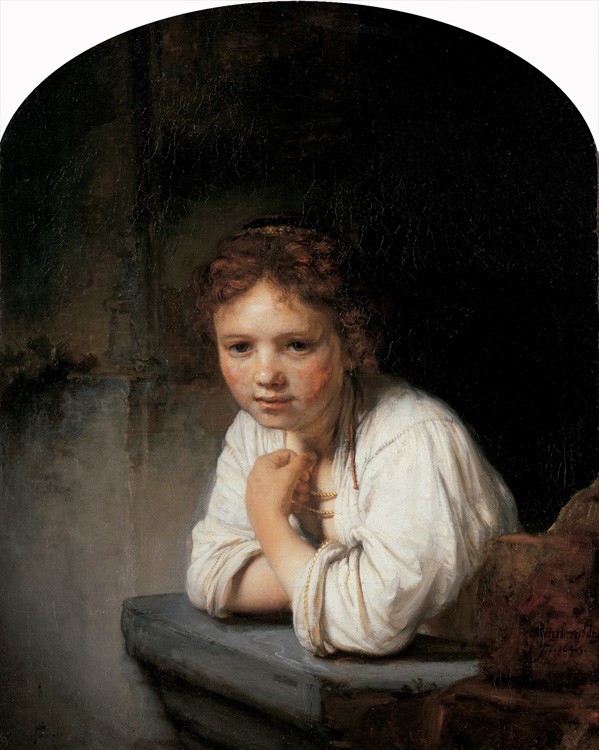
Rembrandt’s “Girl in the Window” is among the most disarmingly intimate pictures of his middle period. Painted in 1645, it presents a young woman leaning on a stone sill, gazing outward with an expression that seems to blend curiosity, warmth, and quiet intelligence. The simplicity of the scene belies a sophisticated orchestration of light, gesture, and texture. What looks at first like a spontaneous glimpse of everyday life is, on closer inspection, a carefully staged meditation on seeing and being seen. The painting becomes a dialogue between viewer and sitter, interior and exterior, paint surface and human skin. It is a quintessential demonstration of how Rembrandt converts modest subject matter into a profound reflection on human presence.
Encounter at the Threshold
The key to the picture’s effect is the threshold itself. The girl leans on a ledge that reads as a windowsill, and the dark recess behind her suggests the interior of a room. The viewer, placed outside the building, meets her at the boundary between private and public. This architectural framing device is not merely compositional; it carries psychological weight. The ledge brings her body close to us and sets the terms of engagement. We are not peering into a distant domestic scene but meeting a person at arm’s length. Her pose—forearms parallel to the sill, one hand resting against her chin—invites lingering attention while also asserting her self-possession. The threshold works as a stage for mutual recognition.
Light as Conversation
Rembrandt’s command of light is the painting’s primary storytelling engine. Illumination enters from the left, bathing the girl’s face and the linen of her chemise, then dissipating into the brown-black of the background. The lighting is not clinically even; it is mobile and caressing, as if a cloud were slowly crossing the sun. This variability is crucial to the portrait’s life. The highlight on the cheekbones and the moist glint on her lower lip communicate flesh in all its responsiveness, while the softer passages along the neck and sleeve suggest air and warmth. Rembrandt’s light does not simply describe form—it carries emotional temperature. The girl’s thoughtful gaze seems to develop out of the very tones that shape her face, making expression and illumination inseparable.
The Palette of Warm Flesh and Weathered Stone
The color range is narrow yet eloquent. Warm reds and pinks flush the cheeks and ears, speaking to youthful blood and recent movement. Subtle ochres and browns ground the scene in masonry, wood, and shadow. The white of the chemise is never a flat, chalky plane; it is modulated with pearl greys, cool blues, and buttery highlights that register the fall of light across creases and folds. A restrained patch of red hair, gathered and slightly tousled, picks up the ruddy notes of the skin and discreetly echoes the brick on the right. By orchestrating a conversation among stone, skin, and cloth, Rembrandt gives the scene chromatic coherence and rhetorical clarity. Everything is tuned to the scale of human warmth against a cool, receding interior.
Brushwork and the Tactile Illusion
Close study reveals a virtuosic range of handling. The face and hands receive small, calibrated strokes that melt at viewing distance into pliant skin. The chemise, by contrast, exposes more visible, elastic brushmarks that describe folds with quick, confident turns of the wrist. The stone sill has a crusted surface built up from thicker paint, catching light on tiny ridges to mimic weathered mineral. This alternation of refined and rough surfaces is classic Rembrandt. It beckons us to imagine touch: the cool rasp of stone supporting the weight of the forearms, the give of linen at the elbow, the subtle pressure of knuckles against the chin. By turning paint into tactile suggestion, Rembrandt animates the viewing experience with a kind of phantom sensation.
Gesture and the Psychology of Rest
The girl’s posture offers an essay in poised stillness. Her weight rests on the sill, shoulders slightly forward, one hand loosely clasped while the other props her chin. The pose is neither heroic nor coquettish; it is an embodied pause. The resting chin implies thinking as much as physical support, and this dual function turns the gesture into a sign of interior life. The downward angle of her eyes pulls us into a zone of consideration rather than confrontation. She meets us, but she also keeps something for herself. That balance—openness moderated by reserve—makes the painting emotionally sustainable. We can look for a long time because the figure never empties out into a fixed mood; she persists as a mind at rest, not a mask.
The Window Motif and Northern Traditions
Figures at windows are a recurring motif in Northern European art, and in Dutch painting the device ties portraiture to genre. The window allows a sitter to appear informally, without the status symbols of commissioned portraiture, while still claiming a real-world setting. Rembrandt adapts this tradition to his own ends. Instead of scattering anecdotal details—pots, a curtain, a garden—he simplifies. The ledge, a shadowy interior, and the merest suggestion of architectural depth suffice. The reduction heightens presence. The motif becomes less about narrative location and more about relational space: the boundary where viewer and subject converge. In this respect, the painting anticipates modern ideas of the picture plane as a site of exchange between art and life.
Tronie, Portrait, or Genre Scene
Scholars often discuss the picture under the category of a tronie, a Dutch term for a character study that is not a commissioned likeness. The painting’s informality, lack of specific attributes, and attention to expression support that classification. Yet it also behaves like a portrait, because the girl’s individuality feels irreducible. Rembrandt had a unique ability to endow even invented faces with biographical depth. Whether the model was a specific person or not, he created an image that viewers instinctively read as someone in particular. This ambiguity is productive. It frees the picture from the duties of social representation while preserving the charge of personal encounter.
Costume and Social Suggestion
The girl’s white chemise is plain, open at the neck, and slightly rumpled from leaning. It signals an interior, quotidian world rather than formal presentation. A delicate string of beads at the throat hints at adornment without grandeur. The ensemble suggests neither poverty nor wealth, but simple domestic ease. Rembrandt avoids the gap between genre stereotypes and portrait status indicators; he selects clothing that anchors the figure in a believable environment while refusing to drown her in detail. The result is a sense of social realism that remains humane and unexaggerated: the dignity of an ordinary person revealed by attention, not by costume.
Emotional Ambiguity and the Ethics of Looking
The painting’s emotional tenor is a blend of friendliness, shyness, and private thought. The girl does not perform; she receives us. Her faint smile is more a readiness to smile than a display of it, and the mild flush on her cheeks could be the evidence of recent movement or exposure to outside air. This carefully managed ambiguity raises questions about the ethics of looking. Are we intruding upon a private moment, or has she approached the window to meet us on purpose? The painting never answers, and in that undecidability lies its moral poise. Rembrandt respects the boundary he constructs, allowing nearness without appropriation.
The Architecture of Silence
Behind the girl, a deep, cool shadow dominates the upper left. The darkness is not empty; it is a resonant space that makes the lit figure more vivid. Rembrandt composes with silence as much as with form. The emptiness carries weight, like a held breath. It pushes the girl forward while also reminding us that the interior continues. The unarticulated architecture suggests a column or niche, but Rembrandt refuses to define it fully. This suspended description gives the painting an atmospheric hush, as if the world around the window were larger and quieter than our encounter can register.
Time Suspended in a Single Look
The painting condenses time into a single, repeatable instant: a person leaning, thinking, aware of being seen. Because the gesture is a pause rather than an action, the image avoids narrative resolution. Every time we return, the moment is still there, open and renewable. This suspension grants the picture a contemplative rhythm. It also aligns with Rembrandt’s wider interest in interiority—he frequently favors moments of inwardness over outward drama, even in biblical scenes. Here, the inwardness surfaces in a secular context, and the ordinariness makes it all the more persuasive.
Material Poetics of Skin
Rembrandt’s fascination with skin is legendary, and in “Girl in the Window” he deploys a full toolkit of optical tricks to achieve lifelike flesh. The cheeks mottled with tiny reds, the translucent film at the edge of the lower lip, the faint coolness along the jaw where light thins—all are calculated to mimic physiology. But the point is not virtuosity for its own sake. The material illusion generates empathy. We feel the presence of a living person because the paint performs the work of blood, breath, and temperature. This material poetics converts pigment into the sensation of a pulse.
The Sill as Stage and Measure
The stone ledge functions as more than a boundary; it is a prop that sets scale and introduces weight. We can sense the pressure of forearms on the hard surface, which in turn locates the body in real space. The ledge’s projecting edge also serves as a stage front, a reminder that painting is an art of flat surfaces conjuring depth. Rembrandt plays both sides of this paradox. The ledge is convincingly solid, yet it is also a painted bar that runs across the lower foreground, enhancing the composition’s shallow theater. The girl seems to step into our world, but the ledge gently insists on the fiction that makes the miracle possible.
Comparison to Rembrandt’s Middle-Period Portraiture
Placed alongside Rembrandt’s commissioned portraits of the 1640s, this painting feels freer and more experimental. The polish of civic portraiture gives way to an informal intimacy that allows more daring light effects and more elastic brushwork. Yet the discipline learned in formal portraiture undergirds the work: anatomy is accurate, characterization is penetrating, and the hierarchy of focus—face paramount, hands next, clothing secondary—is perfectly judged. The picture illustrates how Rembrandt’s studio practice could move between market genres while maintaining a personal signature rooted in empathy and light.
The Role of the Viewer
The painting actively recruits the viewer as a participant. Without our look, the encounter at the window would not occur. The girl appears to be reacting to attention—curious, perhaps slightly amused. This reciprocity creates a mild, benevolent tension. Our gaze animates her, and her gaze returns the favor. Rembrandt thus stages the phenomenology of looking as the painting’s subject. We are encouraged to experience the dynamics of attention without the distractions of elaborate storytelling.
Subtle Markers of Youth
The subject’s youth is conveyed without sentimentality. Signs include the freshness of skin, the softness of features, and the unassuming clothing. Tiny irregularities—the wisps of hair that escape the braid, the faintly reddened nose—steer the portrait away from idealization. Rembrandt had little interest in the polished innocence common in aristocratic images of young women. He prefers creaturely truth, the kind that finds beauty in unselective observation. The result is not an emblem of youth but a person who happens to be young.
Intimacy Without Possession
One of the picture’s great achievements is its ability to be intimate without becoming proprietary. Many images of women at windows in European art flirt with voyeurism, but Rembrandt neutralizes that risk by granting his subject full, unforced presence. Her posture is comfortable, not theatrical; her expression is attentive, not provocative. The modesty of the chemise and the self-contained gaze set a tone of mutual respect. The painting models a way of looking in which closeness and dignity support each other.
The Arc of the Upper Edge and the Composition’s Cohesion
The painting’s top corners are rounded, creating a gentle arch that echoes the arc of the girl’s bowed head and the curve of her forearms. This subtle geometry unifies figure and frame. The arch also amplifies the sense of enclosure and directs the eye inward, concentrating attention where it matters most. Rembrandt’s geometry is never diagrammatic; it is sensed rather than declared. But once perceived, it explains why the composition feels inevitably right.
The Lure of the Ordinary
Perhaps the most striking lesson of “Girl in the Window” is the grandeur of the ordinary. Nothing overtly historic, allegorical, or heroic unfolds. Instead, a quiet human moment is treated with the seriousness usually reserved for grand subjects. This revaluation of everyday life is a hallmark of Dutch art, but Rembrandt invests it with unmatched psychological gravity. The painting suggests that the drama of existence lies in the simple fact of presence, the daily miracle of a human face meeting the world.
Craft, Care, and the Humanistic Ideal
Technical mastery and moral outlook converge in this work. The careful gradations of light and the exacting study of physiognomy are expressions of care—care for how people look, how they occupy space, how they think with their bodies. This ethic of attention constitutes a humanistic ideal. To paint someone well is to honor their existence. By bringing an unknown girl to the window and rendering her with such scruple, Rembrandt affirms the worth of uncelebrated life.
Legacy and Modern Resonance
The painting continues to resonate because it anticipates modern concerns with the everyday, the snapshot, the candid glance. Viewers accustomed to photography sense in it a proto-photographic immediacy, but the work’s painterliness keeps the experience anchored in the slow time of making and looking. It demonstrates how art can feel immediate while remaining deliberately constructed. This duality—apparent spontaneity built on craft—shapes much of subsequent portraiture and continues to guide how we think about the truthful image.
Conclusion: A Window Open to Thinking
“Girl in the Window” offers a distilled experience of Rembrandt’s art. It combines rigorous observation with emotional tact, turning a small domestic vantage into a site of profound encounter. The painting’s power lies in its refusal to overstate. It invites us to dwell in the interval between interior and exterior, subject and viewer, paint and flesh. In that interval we witness thought taking form on a human face. The window proves to be less a frame than a passage, not just for light, but for the living exchange that makes art indispensable.