Image source: wikiart.org
Introduction
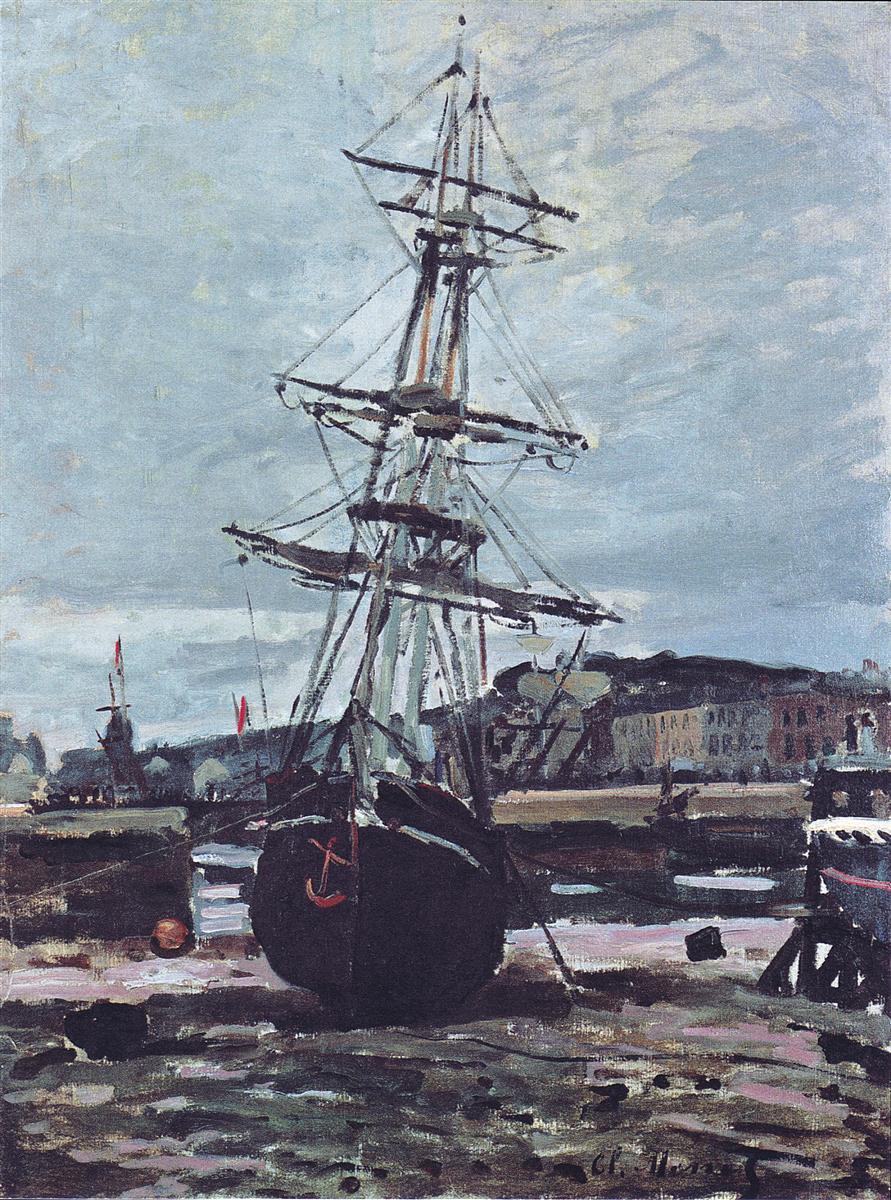
Claude Monet’s Gestrandetes Boot in Fecamp from 1868 is a striking example of how much atmosphere, structure, and emotion he could bring to a seemingly ordinary harbor scene. At first glance, the painting appears simple. A large grounded boat dominates the foreground, its tall mast rising into a pale sky, while other vessels, buildings, and harbor details recede quietly into the background. Yet the longer one looks, the more the painting reveals its complexity. Monet transforms a working port into something poetic, unstable, and deeply modern. Rather than treating the scene as a straightforward marine view, he turns it into a study of presence, mood, and visual tension.
The title already suggests a story. A stranded or grounded boat is not an image of movement but of interruption. It is a vessel meant for travel that has been temporarily halted. That idea alone gives the painting a slightly uneasy character. This is not the sparkling leisure world often associated with later Impressionism. Instead, it is a place of labor, weather, and pause. The harbor is active but muted. The sky is open but heavy. The central boat stands upright and monumental, yet it is fixed in place. This contrast between vertical strength and physical immobility gives the painting its unusual power.
Painted in 1868, this work belongs to an important moment in Monet’s career. He was still young, still developing, and still shaping the language that would later define Impressionism. In paintings from this period, one can already see his fascination with light, atmosphere, and transient conditions, but there is also a greater solidity and tonal gravity than in some of his later work. Gestrandetes Boot in Fecamp shows Monet balancing observation and emotion, structure and sensation. It feels immediate, but it also feels carefully composed.
What makes this painting so compelling is the way it resists spectacle while still commanding attention. There is no dramatic storm, no crowded harbor bustle, no grand narrative episode. Instead, Monet gives the viewer a scene that is quiet, somewhat austere, and built from contrasts of scale, texture, and tone. The result is a painting that feels honest to the physical world while also carrying a subtle psychological charge.
The Harbor as a Modern Subject
In the nineteenth century, the harbor was an ideal subject for a modern painter. It was a place where nature and industry met, where wind, water, labor, commerce, and changing weather all existed together. For Monet, ports and coastal sites offered more than picturesque scenery. They provided a dynamic environment in which the effects of light, air, and atmosphere could be observed directly. Fecamp, with its maritime identity and working shoreline, would have appealed to him precisely because it was not detached from everyday life.
This painting does not romanticize the harbor into a decorative seascape. Instead, it presents the place as a lived and used environment. The grounded boat, the rough foreground, the distant vessels, and the low buildings all suggest a world defined by practical function. The viewer is not invited into a fantasy of coastal beauty but into a specific working moment. Even the sky, broad as it is, feels less like an idealized backdrop and more like a real atmospheric condition pressing down over the scene.
That sense of modernity matters. Monet was part of a generation that turned away from conventional historical and mythological subject matter in favor of the visible world around them. Scenes like this one could seem modest compared to academic painting, but they were radical in their own way. They insisted that contemporary life, even in its plainest forms, deserved serious artistic attention. A boat at rest in a harbor could be just as worthy a subject as a classical hero or a biblical event.
What Monet finds in this harbor is not only visual interest but also a feeling of temporary suspension. The grounded boat becomes a symbol of the harbor itself as a place of waiting. Ships arrive, depart, unload, and pause. Tides rise and fall. Weather shifts. Human activity is organized around these cycles, but not entirely in control of them. The harbor is therefore both structured and uncertain. Monet captures that duality beautifully.
Composition and the Power of the Central Boat
The composition of Gestrandetes Boot in Fecamp is anchored by the large vessel placed almost directly in the center of the image. This choice gives the painting an immediate architectural force. The hull is dark and weighty, sitting low at the bottom of the composition, while the mast and rigging shoot upward, creating a towering vertical form that organizes the entire canvas. The boat functions almost like a monument, a constructed object that divides and holds the surrounding space together.
This strong central placement might seem risky, since a centered object can easily appear static or awkward. Monet avoids that problem by building complexity around the central axis. The lines of the rigging, the angled crossbeams, the distant ships, and the harbor edge all create subtle asymmetries that keep the composition alive. The viewer’s eye moves upward along the mast, outward across the sky, then back downward through the hull into the foreground. The painting therefore feels balanced without becoming rigid.
The boat is enormous in relation to the rest of the scene. It overshadows the distant vessels and structures, asserting itself almost like a figure standing before the harbor. Yet because it is stranded, its scale feels slightly ironic. It looks powerful, but it is inactive. This tension between grandeur and helplessness gives the work emotional depth. The boat is imposing, but it also appears vulnerable, dependent on the conditions around it.
Monet also uses the boat to divide different spatial zones. The foreground is rough, muddy, and material. The middle ground includes the vessel itself and the harbor edge. The background opens into architecture, other ships, and sky. This layered organization helps the viewer feel the physical reality of the place. At the same time, the central boat acts almost like a screen through which the rest of the harbor is partially obscured. The viewer never has an uninterrupted panoramic view. Instead, one experiences the harbor through interruption, blockage, and framing.
That compositional choice is essential to the painting’s mood. Rather than presenting the port as open and expansive, Monet makes it feel concentrated and intimate. Even with all the sky above, the scene has a sense of enclosure because the central boat dominates so much of the visual field. The viewer stands before it, confronted by its mass and structure.
Color, Tone, and Atmospheric Restraint
One of the most remarkable qualities of this painting is its restrained palette. Monet does not rely on brilliant color contrasts to create drama. Instead, he works with muted blues, grays, blacks, browns, and pale off whites, punctuated by small notes of red. This restraint gives the painting a cool and somewhat somber beauty. The atmosphere feels damp, overcast, and maritime in the fullest sense.
The sky is built from soft, varied blues and grays, with visible brushwork that suggests moving cloud and unstable weather. It is not a flat background but an active field of shifting tone. The water and harbor surfaces echo these hues, though darkened and mixed with earthy notes. The result is a strong sense of environmental unity. Sky, water, boat, and shore all seem bound together by the same air.
The dark hull of the central boat is especially important. It creates the strongest tonal weight in the painting and provides an anchor against which the lighter sky and paler surfaces can be measured. Monet uses black and deep brown not merely as descriptive colors but as structural tools. The boat’s darkness grounds the composition physically and emotionally. Without it, the scene might drift into pure atmosphere. With it, the painting remains firm and substantial.
The small red accents are used with great intelligence. They appear in flags and in the anchor mark on the boat, introducing flashes of warmth into an otherwise cool palette. These details are tiny, yet they matter enormously because they activate the composition. They prevent the muted scheme from becoming monotonous and guide the eye across the scene. Monet shows how a small touch of color can transform an entire visual field.
This tonality also suits the subject. A stranded boat in a working harbor should not feel overly polished or decorative. The subdued colors create a sense of honesty and immediacy. The viewer senses the chill of the air, the moisture in the ground, and the worn surfaces of the harbor. Monet is not trying to flatter the scene. He is trying to see it truthfully and to make that truth painterly.
Brushwork and the Material Surface of the Painting
Even in this relatively early work, Monet’s brushwork is central to the painting’s effect. The surface feels alive with quick, responsive marks that describe without overdefining. The rigging is indicated through sharp, linear strokes, the sky through broken and blended touches, and the foreground through rough, irregular applications of paint. This variety of handling helps Monet distinguish materials while maintaining overall unity.
The mast and rigging are especially impressive because they are rendered with economy. Monet does not painstakingly map every rope and beam in academic detail. Instead, he suggests the structure through a network of dark strokes that capture its essential complexity. The viewer reads the vessel as solid and intricate even though the actual paint handling remains loose. This is one of Monet’s great gifts: he knows how to preserve immediacy without sacrificing form.
The foreground is painted in a broader, rougher way. Muddy ground, puddled surfaces, and scattered harbor textures are conveyed through thick, uneven marks that emphasize materiality. These passages remind us that Monet is not simply depicting a place. He is also presenting paint as paint. The roughness of the handling echoes the roughness of the subject itself.
The sky, by contrast, is softer and more open. Here the brushwork seems to breathe. The strokes are visible, but they merge into a luminous field of changing tone. This contrast between the crisp dark structure of the boat and the looser atmosphere around it is a key element in the painting’s vitality. Solid object and unstable weather exist in visual dialogue.
This painterly surface points toward the future development of Impressionism, but it also retains a seriousness of construction associated with Monet’s earlier years. He is still deeply concerned with form, weight, and design. The painting is not merely an optical impression. It is an organized and forceful statement built from observed sensation.
Stillness, Interruption, and the Mood of the Scene
What gives Gestrandetes Boot in Fecamp its emotional distinctiveness is the tension between stillness and implied movement. Boats usually suggest travel, wind, and changing direction. Here, however, the main vessel is stuck. Its sails are absent, its hull is grounded, and its upright mast seems almost theatrical in its uselessness. The painting becomes an image of pause rather than motion.
That pause does not feel peaceful in a sentimental way. It feels provisional. One senses that this situation could change with the tide, with labor, with time. But in the moment Monet shows us, everything is held in suspension. This suspended quality gives the painting a slightly melancholic tone. The harbor continues in the background, but the central form remains fixed, isolated in its inactivity.
There is also a kind of dignity in that stillness. The boat does not collapse or appear ruined. It stands. Its vertical mast remains proud against the sky. This balance between vulnerability and endurance is one reason the painting feels so human. The stranded boat can be read as a working object, but it can also feel like a metaphor for persistence under difficult conditions.
The emptiness of the immediate foreground contributes to this mood. There are no bustling figures to animate the scene or distract from the boat’s presence. Instead, the viewer encounters a space of mud, stone, and harbor debris. This gives the painting a raw honesty. It is a coastal scene stripped of ornament, built around waiting and weather.
Monet’s achievement lies in the fact that he makes this quiet interruption feel visually compelling. He proves that drama does not require grand action. A halted moment can be just as intense as a storm or a departure, especially when it is rendered with such control of tone, structure, and atmosphere.
Monet in 1868 and the Road Toward Impressionism
In 1868, Monet was still in the process of becoming the artist now associated with the shimmering surfaces and radiant colors of Impressionism. Works from this period often show a fascinating mixture of bold modern observation and stronger tonal construction. Gestrandetes Boot in Fecamp belongs to that phase. It already contains the seeds of his mature approach, yet it retains a density and gravity that make it distinct from some of his later paintings.
The emphasis on direct observation is unmistakable. Monet is clearly interested in the immediate look of the harbor, the exact weather conditions, the relation of boat to sky to shore. He paints not an ideal marine scene but a specific one. That commitment to the visible moment is fundamental to Impressionism. At the same time, the composition is more centered and monumental than many later Impressionist works, where forms often dissolve more fully into light and atmosphere.
This makes the painting especially valuable in understanding Monet’s development. It shows him exploring how far he can loosen the surface while still maintaining compositional authority. It shows him responding to changing weather and outdoor conditions while keeping the scene structurally coherent. It shows him discovering how modern life and modern painting could meet.
Fecamp itself also matters in this context. Coastal Normandy played an important role in the emergence of modern French landscape painting. Its harbors, cliffs, beaches, and changing skies offered artists endlessly variable subjects. For Monet, such places were laboratories of vision. They allowed him to observe how light transforms matter and how atmosphere shapes perception.
In this work, one can already feel the Impressionist commitment to the transient, but one can also see the persistence of a more robust pictorial order. That combination is what makes the painting so rewarding. It is both exploratory and assured.
Why This Painting Still Feels Powerful Today
One reason Gestrandetes Boot in Fecamp continues to resonate is that it captures something universally recognizable: the experience of pause within a world that is built for motion. The grounded boat becomes more than a maritime detail. It becomes an image of interruption, waiting, and endurance. That theme remains deeply relatable.
The painting also appeals because it is unsentimental. Monet does not exaggerate the harbor’s beauty or turn it into an easy postcard view. He allows roughness, darkness, and ambiguity to remain. This honesty makes the work feel modern even now. It trusts the viewer to find meaning in ordinary surfaces and subtle tensions.
Its visual strength is equally enduring. The huge mast rising against the pale sky is unforgettable. The dark hull planted in the foreground has a sculptural presence. The broken brushwork keeps the painting fresh and immediate. Even viewers who know little about Monet’s career can feel the authority of the image.
Perhaps most importantly, the work reminds us that Monet was never only a painter of pleasant light effects. He could also be a painter of structure, mood, and quiet seriousness. Gestrandetes Boot in Fecamp broadens our understanding of his art by showing how attentive he was to weight, labor, atmosphere, and interruption.
Conclusion
Gestrandetes Boot in Fecamp is a powerful early Monet because it combines clarity of observation with emotional resonance. The painting presents a harbor scene, but it does so in a way that transforms ordinary maritime reality into something more contemplative and enduring. The grounded vessel at the center gives the composition its monumental strength, while the muted palette and broken brushwork create an atmosphere of cool stillness and suspended time.
This is a painting about more than boats and shoreline. It is about the relationship between movement and pause, structure and weather, labor and silence. Monet sees the harbor as a place where human purpose meets natural condition, where a vessel designed for motion can be held still by circumstance. Instead of treating that fact as merely descriptive, he turns it into the emotional core of the picture.
Seen today, the work feels both historically important and immediately alive. It reveals a young Monet already capable of extraordinary compositional intelligence and atmospheric sensitivity. It also shows how much meaning he could draw from the simplest subjects. In Gestrandetes Boot in Fecamp, the harbor is not just a setting. It becomes a stage for stillness, endurance, and the quiet drama of the visible world.
