Image source: wikiart.org
First Impressions and the Quiet Drama of Spring
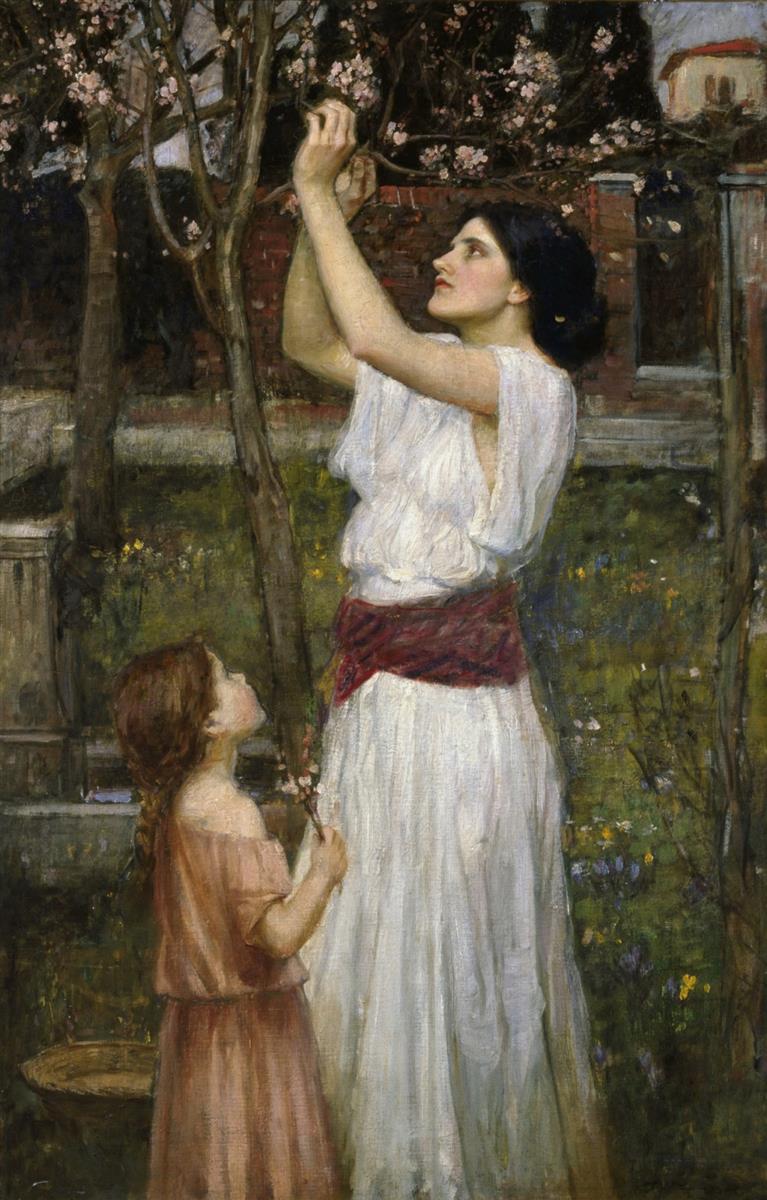
John William Waterhouse’s Gathering Almond Blossoms (1916) feels like a pause held carefully in the hands. Nothing erupts, nothing shouts, and yet the painting is full of action: a reach, a gaze, a small offering, a harvest so delicate it almost counts as a whisper. Two figures occupy a garden space that is neither theatrical nor purely natural. It is a lived-in enclosure, bordered by masonry and soft growth, where human routine meets the turning of the seasons. The almond blossoms are the visible reason for the scene, but the deeper subject is attention itself, the way spring draws people into gestures of care.
Waterhouse builds a narrative that reads instantly even if you never learn the title. A tall young woman in a white dress stretches upward toward a low branch. Below her, a child stands ready, holding what looks like a small twig of blossoms and waiting with the patience of someone who has done this before. The moment is domestic, but it is not mundane. The upward reach transforms ordinary gathering into something almost ceremonial, as if the act of selecting blossoms becomes a small rite of renewal.
Historical Context: Waterhouse in 1916
Painted late in Waterhouse’s career, Gathering Almond Blossoms belongs to a period when his art often softened into quieter, more intimate scenes. The earlier Waterhouse is frequently associated with mythic women, literary heroines, and dramatic narratives drawn from classical sources and Victorian poetry. By 1916, the scale of drama often changes. Instead of grand mythological staging, the focus narrows to a single tender action, a contemplative face, a garden wall, a branch in bloom.
Even without leaning on biography, the date matters. In the mid 1910s, the European imagination was shaped by upheaval and uncertainty, and it is hard not to read this painting as a deliberate turn toward steadiness. Waterhouse does not depict crisis here. He depicts continuity. The seasons still arrive. Blossoms still open. A child still looks upward to learn how to gather what is fragile without bruising it.
The Scene: Two Figures and One Shared Task
The composition is built around cooperation. The woman is the active gatherer, but the child’s presence makes the action communal rather than solitary. The girl stands close, angled toward the woman, her head tilted up in a look that is not merely admiration. It is attentiveness. She is watching how it is done.
The basket at the lower left anchors the entire narrative in practicality. It tells you the blossoms are being collected, not simply admired. At the same time, the basket is understated, almost incidental, because Waterhouse wants the act to feel less like labor and more like choosing. The blossoms are not a crop. They are a gift of spring, taken carefully, almost reverently.
The woman’s face is turned in profile, serene and focused. She does not smile. She concentrates. That choice is crucial. The emotion here is not performative happiness. It is absorption, the calm that comes from doing one small thing well.
Composition and Structure: Vertical Reach and Gentle Balance
The painting is organized as a tall, elegant vertical. The woman’s extended arms create a diagonal lift, pulling the viewer’s eye upward toward the bloom-laden branch. The child’s smaller figure forms a secondary vertical, reinforcing the sense of growth and aspiration. Together, they create a ladder of attention: basket, child, woman, blossoms.
Waterhouse uses the tree trunks as structural pillars. They frame the figures while also slicing the space into distinct zones: foreground figures, middle garden, and background wall and architecture. These trunks are not decorative. They function like stage flats in a quiet theater, defining where the action belongs.
The brick wall across the back introduces a strong horizontal element that stabilizes the composition. Without it, the painting might feel too airy, too lifted into the blossoms. The wall keeps the moment grounded. It says: this is a garden, not a dreamscape. Yet the wall is softened by foliage and muted tones, so it does not become harsh. It is firmness rendered gently.
Color Harmony: Whites, Earth Tones, and Blossom Pink
The most striking color note is the woman’s white dress, which occupies a large central area and acts like a reservoir of light. Waterhouse does not paint it as a flat white. It is built from layered greys, creams, and faint cool shadows, giving the fabric weight and breath. The white becomes a kind of visual silence, making every other color feel more intentional.
Against the dress, the deep red sash around the waist reads as a heartbeat of warmth. It cinches the figure and creates a strong midline that helps balance the verticality of the pose. The sash also links the woman to the earthier tones of the garden and the child’s clothing, bridging the luminous white with the softer browns and russets below.
The blossoms themselves are small and pale, with touches of pink and creamy white. They do not overwhelm the painting, which is important. Almond blossoms in real life can look exuberant, almost frothy. Waterhouse chooses restraint. He suggests abundance without turning the scene into a floral explosion. That restraint keeps the focus on the act of gathering, not merely the spectacle of bloom.
Light and Atmosphere: A Soft Day Without Harsh Shadows
The lighting feels diffuse, like an overcast spring afternoon or a garden shaded by branches. There are no dramatic shafts of sunlight, no hard-edged shadows. Instead, light is present as a gentle clarity that reveals forms without sharpening them. This kind of illumination suits the emotional aim of the painting: tenderness, calm, the sense that time has slowed.
The background is slightly darker and more muted than the figures, which helps the woman and child come forward. Yet Waterhouse avoids a crude spotlight effect. The transition between figure and environment is handled with softness, as if the garden air itself wraps around them.
This atmosphere also supports the theme of transience. Blossoms are brief, and a soft light feels more fleeting than a bright noon. The painting does not insist on permanence. It invites you to notice what will pass.
Brushwork and Surface: The Blend of Detail and Suggestion
Waterhouse is careful about where he concentrates detail. The faces and the gesture of hands are relatively refined, because the story lives there. You read intention in the woman’s focused profile and in the child’s upward gaze. The fabric of the dress is modeled with enough nuance to convey folds and weight, but it remains painterly rather than hyper-detailed.
In the garden and background, the brushwork loosens. Flowers in the grass become small touches of color, more suggestion than botanical rendering. The brick wall is present as texture and tone rather than meticulous masonry. This balance is part of Waterhouse’s skill: he gives you just enough specificity to believe in the place, then lets paint do what paint does best, evoke rather than inventory.
The blossoms themselves sit between detail and suggestion. They are legible as blossoms, but they remain airy, almost trembling. That helps convey their fragility and reinforces why the woman’s hands are posed so carefully.
Gesture and Expression: A Study in Care
The emotional center of the painting is the woman’s raised arms and delicately poised hands. She reaches up, but she does not grasp. Her fingers are not clenched. They are attentive, prepared to pluck lightly, to choose a cluster without tearing the branch. That subtlety turns the act into a lesson in restraint.
The child mirrors that lesson. She holds a small spray of blossoms and looks up as if waiting for the next addition, but her posture is calm, not impatient. She is present in the rhythm of the task, not demanding its completion. Waterhouse paints intergenerational cooperation without sentimentality. There is affection here, but it is expressed through shared focus rather than overt embraces or theatrical smiles.
The woman’s expression, seen in profile, is quietly serious. It suggests that beauty deserves concentration. In a world full of distractions, Waterhouse makes attention feel like a virtue.
The Garden Setting: An Enclosed World of Bloom and Brick
The setting matters because it frames nature as something encountered through human care. This is not a wild orchard. It is a garden shaped by boundaries: a low stone or concrete edging in the foreground, a brick wall behind, and hints of built structures beyond. Nature appears within a human-made enclosure, which echoes the act of gathering: selection, arrangement, preservation.
The contrast between blossoms and brick is particularly effective. Brick implies durability and time. Blossoms imply briefness. Placing them together makes the blossoms feel even more precious. The painting becomes a meditation on different kinds of time, the long time of walls and the short time of flowers.
Even the distant glimpse of architecture reinforces this. Beyond the garden, life continues in houses and streets, but Waterhouse keeps it subdued. The garden is a protected pocket where the season can be noticed.
Symbolism of Almond Blossoms: Renewal, Hope, and the First Signs of Change
Almond blossoms are often associated with early spring, with the first confident sign that winter is giving way. In that sense, they symbolize beginnings, renewal, and a kind of hope that does not require grand declarations. The blossoms appear, quietly and inevitably.
Waterhouse leans into that meaning through the act of gathering. To gather blossoms is to acknowledge their beauty while accepting their fragility. It is also to bring spring indoors, to turn a seasonal event into something held, arranged, perhaps shared. The child’s presence deepens this symbolism. Renewal is not only seasonal, it is generational. Spring returns, and so does learning, imitation, and the passing on of gentle rituals.
The painting also suggests an ethic of careful taking. You can harvest without ravaging. You can enjoy without consuming everything. In this way, the almond blossoms stand for a relationship with beauty that is respectful rather than possessive.
Waterhouse’s Late Style: Pre-Raphaelite Echoes, Softer Edges
Although Waterhouse is often connected to the Pre-Raphaelite orbit, this work shows a quieter version of that inheritance. The emphasis on the female figure, the lyrical mood, and the garden setting all resonate with Pre-Raphaelite taste for poetic realism and symbolic nature. Yet Waterhouse’s handling here is less sharp-edged than early Pre-Raphaelite precision. The contours soften. The atmosphere thickens. The scene becomes more about feeling than about crystalline detail.
The white dress, for example, could have been rendered with intense linear clarity. Instead it is modeled with painterly transitions, emphasizing softness and lived texture. The garden is not a catalogue of plants, but a field of suggestion. Waterhouse is less concerned with proving his ability to describe every leaf and more concerned with conveying the sensation of spring and the intimacy of the act.
This is why the painting reads as gentle rather than decorative. It is beautiful, but its beauty serves mood and meaning, not mere ornament.
Themes: Domestic Ritual, Learning, and the Sacred Ordinary
At its core, Gathering Almond Blossoms elevates a small domestic action into something quietly sacred. The figures are not engaged in myth or legend. They are doing something ordinary. Yet Waterhouse composes it with the dignity of a timeless scene. The upward reach becomes a visual metaphor for aspiration and care. The child’s gaze becomes a metaphor for learning and trust.
There is also a subtle sense of protection. The garden walls protect the blossoms from harsher forces outside. The woman protects the blossoms through careful touch. The child protects the gathered flowers by holding them and standing ready. Protection repeats at multiple levels, suggesting that tenderness is not passive. It is an active way of being in the world.
The painting can also be read as an image of stewardship. Spring’s gifts are fleeting, and the figures respond not by trying to own them forever, but by meeting them with attention in the moment.
Why the Painting Lingers: The Power of a Single Moment
Many paintings impress through spectacle. Waterhouse’s painting lingers through quiet. It asks you to watch hands reaching for blossoms and to feel how much meaning can live inside a small gesture. The emotional temperature remains steady, but it is not cold. It is warm in the way a familiar ritual is warm.
The work also succeeds because it is balanced between clarity and mystery. You understand what is happening, yet you are not told everything. Who are they to each other, mother and daughter, older sister and younger sister, caretaker and child. Waterhouse leaves room for viewers to supply their own experiences of learning, gardening, springtime, and the tender seriousness of shared tasks.
That openness is part of its enduring appeal. The painting becomes not just an image of almond blossoms, but an image of how to meet what is beautiful and brief with care.