Image source: wikiart.org
Introduction: A Painting Built Around a Warning and a Wish
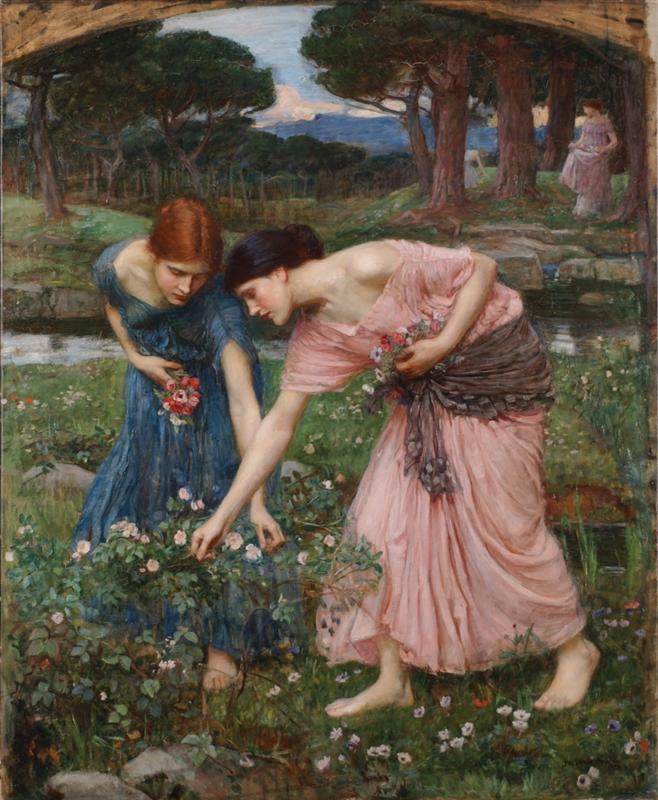
John William Waterhouse’s Gather Ye Rosebuds While Ye May (1909) takes a familiar line and turns it into a lived moment. The phrase comes from Robert Herrick’s poem To the Virgins, to Make Much of Time, a short, persuasive lyric that urges the young to seize their season before it passes. Waterhouse does not paint the poem as an illustration with obvious narrative labels. Instead, he distills its mood into an image of attention: two young women bending toward a rosebush, hands careful, faces intent, time felt in the body. The act is ordinary, even quiet, yet it carries the weight of a proverb. This is the painter’s gift here: he makes “carpe diem” feel less like a slogan and more like a sensation, something you notice in the softness of petals, the chill of water near bare feet, the brief glow of a sky that will change within minutes.
The picture belongs to Waterhouse’s late career, when his art often returns to women poised at thresholds. Sometimes the threshold is mythic, as with nymphs or sorceresses. Here it is seasonal and human. The women are not performing for us. They are absorbed in the small urgency of choosing which blooms to take and which to leave. Waterhouse frames the scene so that we, too, become gatherers. Our eyes move from flower to flower, from fabric to skin, from reflection to horizon, collecting sensations the way the figures collect roses. The theme is not simply youth, but youth experienced as time, as something already slipping away even while it is being held.
The Title and the Carpe Diem Tradition
The title does more than name the subject. It supplies a lens through which every detail becomes charged. Roses are the classic emblem of beauty and brevity, a flower that opens lavishly and then collapses. The act of gathering suggests selection, preference, and consequence. To gather is to choose now rather than later, because later will not offer the same abundance. Waterhouse’s interpretation avoids moralizing gestures, yet the message is quietly built into the scene’s structure: the women lean forward into the present, while space behind them stretches toward distance and, by implication, the future.
What makes the carpe diem tradition compelling is its double emotion. It is celebratory, because it honors pleasure and vitality. It is also melancholy, because it knows those things are temporary. Waterhouse balances both feelings through tone. The garden is lush and tender, but not ecstatic. The sky carries a cooler light, and the landscape feels still, as if holding its breath. Even the women’s concentration reads as gentle seriousness. They are not carefree in the shallow sense. They are careful, as if they sense that a small mishandling, a second too long, could bruise something that cannot be restored.
The title also invites the viewer to participate. It quietly addresses us: gather. Look. Take in what is here. That invitation is essential to the painting’s enduring appeal as a poster image because it turns passive viewing into a kind of attentive harvest.
Composition: The Bend Toward the Roses
Waterhouse organizes the painting around two diagonal bodies that tilt toward the rosebush. This bending creates a visual rhythm like a shared breath. The women mirror each other without becoming identical. One wears a deep blue dress and has reddish hair, her head lowered, her shoulders angled inward. The other, dressed in soft pink with a dark sash, leans farther forward, extending her arm into the blooms. Their heads nearly align, drawing the viewer into their private focus. The composition makes intimacy from coordination rather than touch. They do not look at one another, yet their proximity suggests companionship, perhaps shared youth, perhaps shared understanding.
The rosebush occupies the lower foreground, where the paint becomes busiest and most tactile. Leaves, stems, and blossoms form a lively mesh that contrasts with the smoother passages of fabric and skin. Waterhouse ensures that the viewer’s eye lands first on the women’s faces and arms, then drops to the flowers, then drifts outward to the water and trees. It is a controlled sequence: desire, touch, reflection, distance.
A subtle structural feature is the arch-like framing at the top, which feels like a natural bower or a curved shelter. This visual “roof” encloses the scene, making it feel like a protected moment, a brief chamber of time. Beyond that enclosure, the landscape opens into a distant horizon, suggesting that the moment is both held and already receding.
Setting: Garden, Water, and the Feeling of a Threshold
The setting blends cultivated and wild elements. A rosebush implies a tended garden, but the surrounding grasses, scattered flowers, and uneven stones suggest a landscape that is not fully domesticated. Water appears in a narrow pool or stream, with reflections that echo the figures and flowers. Waterhouse often uses water as a psychological device: it is a mirror, a boundary, and a symbol of change. Here, the water’s presence makes the act of gathering feel more precarious. The women are barefoot, close to the bank, and the wet surface catches the light in a way that hints at coolness and vulnerability.
The trees in the background are tall and dark, their canopies broad like umbrellas. They give the scene depth and also a hint of solemnity. Trees outlast people and seasons. Their steady forms contrast with the delicate blossoms being plucked. In a painting about seizing the day, that contrast matters. It reminds the viewer that there is a larger time scale at work, one that is indifferent to individual youth.
A third figure appears farther back, standing among the trees and facing toward the scene. This figure is quieter than the foreground pair, almost like a memory or a future self. Whether she is a companion waiting, a chaperone, or simply another presence in the garden, she introduces a sense of watching and being watched. It is not a dramatic surveillance. It is a gentle reminder that youth exists within a wider social and temporal world.
The Figures: Youth Shown Through Gesture and Attention
Waterhouse’s women are often read through the lens of beauty, but what is most striking here is their attention. The blue-dressed woman holds a small cluster of flowers near her waist, already gathered, already removed from the bush. Her lowered gaze suggests deliberation, as if she is deciding what is worthy of picking. The pink-dressed woman reaches farther, her body angled in a longer curve, her arm extended with purposeful delicacy. Her bouquet is fuller, pressed against her torso as she gathers more. The contrast suggests two modes of the same impulse: one is cautious, the other more eager. Together they represent the tension inside the carpe diem theme: savor slowly, yet do not hesitate too long.
Their bare feet add an important note. Barefoot figures feel closer to nature, less armored by social formality. In a painting about the fleeting present, bare feet also signal immediacy. You feel the ground. You feel the temperature. You are here. This grounding counters the idealizing softness of the dresses, reminding us that youth is not only a vision but also a physical state, one that experiences the world directly.
Waterhouse avoids exaggerated facial drama. The expressions are quiet, inward. This restraint keeps the message from becoming theatrical. The painting does not need a tragic face to communicate transience. It uses the simple fact of bending, reaching, and choosing.
Roses as Symbol: Beauty, Pleasure, and the Thorns of Time
Roses carry a long history in Western art as symbols of love, desire, purity, and mortality. In the context of Herrick’s line, the rose becomes a stand-in for youth itself: fragrant, vivid, and quick to fade. Waterhouse paints the blossoms in pale pinks and soft whites, not blazing reds. That choice shifts the mood away from overt passion and toward tenderness and vulnerability. These are roses that feel like morning rather than midnight.
The rosebush is also thorned, though the thorns are not emphasized. Their quiet presence matters because it suggests that seizing the day is not without risk. To gather rosebuds is to accept that joy can prick. Waterhouse’s women handle the flowers carefully, implying knowledge. The act of gathering becomes a metaphor for living with intention, taking what you can without tearing yourself apart or stripping the bush bare.
Notice, too, how the gathered flowers differ from the flowers still on the plant. Once picked, they become a possession, but also a countdown. A rose in the hand begins its fading immediately. Waterhouse quietly captures that paradox: to seize beauty is to begin losing it. The painting’s emotional complexity lives in that soft contradiction.
Color and Light: Blue and Pink as Emotional Counterpoint
The most immediate color harmony is the pairing of the blue dress and the pink dress. Blue often reads as cool, reflective, and calm. Pink reads as warm, tender, and intimate. Waterhouse uses these colors not as simple stereotypes but as balancing forces. The blue dress sinks into the garden’s greens and shadowed areas, blending with the landscape’s depth. The pink dress lifts forward, catching light and drawing attention, like a blossom itself. The dark sash at the pink figure’s waist introduces a note of gravity, almost like an echo of time’s seriousness tied around youth’s softness.
The background palette is muted: greens, browns, and a pale sky that feels slightly overcast. This restraint keeps the foreground figures luminous without making the scene overly sweet. Light seems diffuse, as if filtered through trees, producing gentle transitions rather than sharp contrasts. That diffused light suits the theme. Harsh noon light would feel too permanent, too declarative. This is light that suggests a passing hour.
Waterhouse’s handling of skin is especially subtle. The visible shoulder and arm of the pink-dressed woman glow softly, not as spectacle, but as a sign of living warmth against the coolness of water and shade. The painting’s color strategy is emotional rather than purely decorative. It makes the viewer feel both comforted and slightly wistful.
Water and Reflection: A Quiet Memento Mori
The water at the women’s feet is not a dramatic mirror, yet it introduces reflection as an idea. Reflection is always about time in some sense: it is an image that exists only as long as the surface holds still. A ripple erases it. In a painting about taking the moment, reflection becomes a perfect companion symbol. It is beauty you cannot grasp, only see.
Waterhouse positions the water so that it is part of the immediate foreground, close to the act of gathering. This suggests that the women’s choice happens beside the awareness of change. The water is not far away, not safely in the distance. It is right there, cooling the scene, murmuring that nothing stays fixed.
The presence of stone edges and a suggestion of a bank or walkway adds a threshold feeling. Gardens are often places of cultivation, but water edges are places of transition. You stand where solid turns to liquid, where footing becomes uncertain. That physical boundary echoes the metaphorical boundary between youth and whatever comes after.
The Background Figure and the Sense of Time Beyond the Moment
The figure in the background is easy to overlook, but it is crucial for the painting’s temporal atmosphere. She stands more upright, less absorbed in the flowers, and she occupies a space closer to the trees and distance. This placement gives her a different relation to time. The foreground figures are fully in the present, bent into action. The background figure is more like an observer, aligned with the slow continuity of the landscape.
This creates a subtle narrative without telling a story outright. The background figure could be a future version of the same impulse, looking back at youth’s gathering. She could be the social world, reminding us that private moments happen within broader structures. She could even be a visual pause, a note of stillness that makes the foreground movement feel more urgent.
Waterhouse often enriches his scenes with this kind of secondary presence, not to distract, but to deepen. Here it suggests that time is layered. There is the immediate time of picking a blossom. There is the longer time of walking, waiting, and remembering. And there is the immense time of trees and sky.
Waterhouse in 1909: Late Style, Pre-Raphaelite Echoes, Modern Sensibility
By 1909, Waterhouse was working in a period where the ideals associated with Pre-Raphaelite painting had already become part of art history, yet their visual language still held power. His late style often blends the Pre-Raphaelite love of detail and literary themes with a softer, more atmospheric approach to paint. In Gather Ye Rosebuds While Ye May, the botanical elements and the poetic title echo the earlier movement’s devotion to nature and verse. At the same time, the painting’s mood feels modern in its quietness. It does not shout its message. It lets the viewer discover it through looking.
The women are not mythic in costume, yet they are not strictly everyday, either. Their dresses feel timeless, suspended between historical romance and contemporary elegance. That ambiguity allows the theme to feel universal. This is not only about a particular era’s youth. It is about youth as a recurring human experience.
The painting also reflects a late Waterhouse tendency toward tenderness over drama. Instead of a climactic scene, we get a sustained moment. Instead of a single heroine, we get companionship. Instead of narrative spectacle, we get the sensual intelligence of hands choosing blossoms.
Why the Painting Endures: The Viewer as Gatherer
What makes Gather Ye Rosebuds While Ye May endure in reproduction is its balance of clarity and mystery. The subject is instantly readable, yet the meaning keeps opening. Viewers can approach it as a pastoral scene, as an emblem of youth, as a meditation on time, or as a study in color harmony and gesture. It rewards close looking because the emotional message is encoded in painterly decisions: the bend of a spine, the nearness of water, the muted sky, the quiet watcher in the trees.
The painting also offers a form of gentleness that feels rare. Its urgency is not frantic. It is intimate. The women do not fight time; they cooperate with it by paying attention. The message becomes less “take everything” and more “notice what matters while it is here.” That is why the scene feels consoling even as it is wistful. It does not scold the viewer for mortality. It invites the viewer into a practice of seeing.
In the end, Waterhouse turns a famous line into a shared ritual. The roses are beautiful because they are brief. The moment is precious because it cannot be repeated exactly. The painting becomes its own rosebud, held in color and form, offering the viewer a chance to gather, again and again, the feeling of a day that is passing.