Image source: wikiart.org
First Impressions and the Painting’s Central Idea
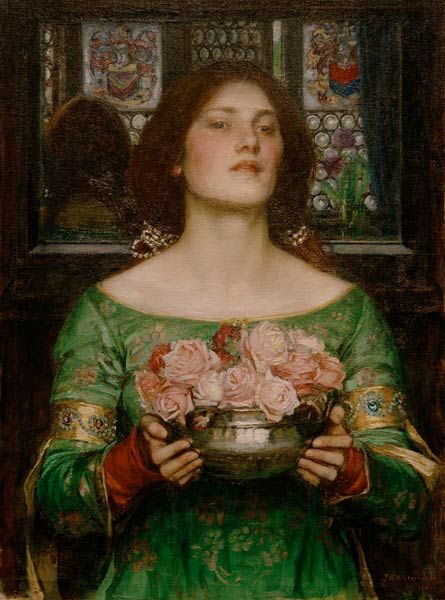
John William Waterhouse’s Gather Ye Rosebuds While Ye May (1908) presents a single figure at close range, giving the scene the intimacy of a private encounter. A young woman faces forward with her head slightly raised, her expression poised between calm and challenge. She holds a shallow metal bowl filled with pale pink roses, offering them outward but not quite surrendering them. That subtle tension, invitation paired with reserve, becomes the painting’s emotional engine.
The title points toward the classic carpe diem message, most famously associated with Robert Herrick’s poem urging the gathering of rosebuds before time steals their bloom. Waterhouse does not illustrate the poem literally with fields, revelry, or obvious narrative action. Instead, he distills the theme into a concentrated emblem: youth, beauty, and a brief abundance held in the hands. The result feels less like a story and more like a moment of self-awareness, as if the sitter understands the meaning of the flowers as clearly as the viewer does.
The Figure as Presence, Not Portrait
The woman is painted as an archetype rather than an individual biography. Her features are softly modeled, her skin luminous against the darker interior, and her lips slightly parted as though she has just breathed in the rose scent or is about to speak. Yet she remains quiet. Waterhouse builds her presence through stillness and frontal clarity. She occupies the center like an icon, but her humanity keeps the scene from becoming stiff or devotional.
Her gaze is key. It does not melt into romantic softness, nor does it harden into rejection. It steadies itself on the viewer with a composed confidence, suggesting someone aware of her own beauty and the social meanings attached to it. The raised chin adds a note of pride, even defiance. In a painting about fleetingness, this self-possession matters. It implies that the subject is not merely a passive symbol of youth, she is a participant in the drama of time, choosing how to present herself at the edge of ripening.
Roses and the Language of Time
Roses in Western painting carry a dense range of meanings, love, sensuality, innocence, secrecy, and mortality. Here, their pale pink tone leans toward tenderness rather than seduction, but their fullness signals a peak that cannot last. Waterhouse loads the bouquet with a quiet urgency. These are not scattered petals or wilting stems. They are abundant, freshly cut, and arranged like a harvest, which makes the implied countdown sharper. The viewer senses that this bowl will not look the same tomorrow.
The fact that the roses are gathered rather than growing matters too. They have already been removed from their source. That single act is a metaphor for the human experience of taking hold of the present. To gather beauty is to acknowledge it will fade. The painting’s emotional power comes from keeping this truth gentle rather than tragic. The roses glow with promise, yet they also whisper about loss.
The Act of Offering and the Question of Agency
The bowl is held with both hands, centered at the level of the woman’s chest and extended slightly toward the viewer. This is the composition’s decisive gesture. It can read as a gift, an invitation, a ritual offering, or a test. Because the figure remains still, the gesture becomes all the more charged. The painting asks what it means to accept what is offered, and what it costs to refuse.
There is also a subtle reversal at work. The viewer might expect the young woman to be the rosebud, the object being gathered. Instead, she is the one who has already gathered. She becomes the agent who presents the symbol, controlling the terms of the exchange. That shift makes the scene feel psychologically modern. It is less about a moral lesson delivered from outside, and more about an inner knowledge held by the subject herself.
Costume, Color, and the Mood of Green
The rich green dress dominates the lower half of the canvas. Its color carries multiple associations: spring, vitality, renewal, and the living world that produces blossoms. Against the pale roses, the green intensifies their softness, turning the bouquet into a warm, breathing focal point. Waterhouse uses the dress as both atmosphere and structure, a field of color that anchors the figure and frames the flowers.
The garment feels loosely medieval in mood, with its wide neckline and ornamental sleeves, but it is not a strict historical reconstruction. It belongs to Waterhouse’s preferred realm of imagined pasts, a stage set where symbolic actions can unfold. The costume contributes to the sense that this is not a portrait of a specific modern woman but a timeless embodiment of a theme. At the same time, the tactile handling of fabric, the way light slips across folds and along the neckline, keeps the figure grounded in physical reality.
Interior Space and the Stained Glass Backdrop
Behind the woman is a dark interior punctuated by a stained glass window. The colored panes and small heraldic or decorative motifs introduce a medieval atmosphere and suggest a private, enclosed world. This setting matters because it contrasts with the idea of roses, which belong to gardens and open air. Waterhouse brings the flowers indoors, as if time itself has been carried inside, held under watch.
Stained glass also filters light, turning illumination into something curated rather than natural. That reinforces the theme of selection and gathering. Just as the roses have been chosen and cut, the light has been chosen and shaped by patterned glass. The painting becomes a meditation on how beauty is framed, displayed, and preserved, even as it remains temporary.
Composition and the Quiet Architecture of Symmetry
The painting is structured with a calm symmetry. The figure is centered. The bowl is centered. The roses form a rounded mound near the center of the canvas, like a heart within the body of the composition. This balance gives the image a ceremonial quality. It feels like a moment staged for contemplation rather than action.
Yet Waterhouse avoids stiffness through subtle asymmetries. The head angle, the soft fall of hair, and the nuanced placement of hands prevent the figure from becoming a rigid emblem. The background, darker and textured, shifts gently in tone, and the stained glass details create a visual counterpoint to the smoothness of skin and petals. The whole arrangement guides the eye in a slow loop: face to roses to hands to sleeves and back again.
Light, Skin, and the Painting’s Sensuous Restraint
Waterhouse’s handling of light is restrained and intimate. The brightest passages appear in the woman’s face, neck, and the roses. These areas glow softly, as though lit by a diffused window rather than a harsh beam. That choice keeps the mood contemplative. The painting feels like late afternoon indoors, a time when color deepens and edges soften.
The skin is treated with a smooth, luminous delicacy, but the effect is not sugary. The slightly flushed cheeks and the grounded tones of the lips suggest warmth and life rather than porcelain perfection. The roses receive a similarly tender touch. Their petals are suggested through layered strokes and gentle transitions, enough detail to feel real, enough softness to feel symbolic. Sensuality is present, but it is controlled, held within a composed presentation.
Texture and Brushwork: Soft Focus as Meaning
One of the painting’s most telling qualities is its soft focus. Edges blur slightly, especially in the background and hair, while the bouquet remains relatively more defined. This is not merely an aesthetic choice. It echoes the theme of the fleeting moment. Sharp edges imply permanence and certainty. Soft edges imply memory, passing time, and the way perception itself changes as moments slip away.
The brushwork also suggests a tension between precision and atmosphere. Decorative details are present in the sleeves and stained glass, but they do not overwhelm. Waterhouse lets the viewer sense complexity without insisting on hard-lined clarity. The painting becomes less about cataloging objects and more about absorbing a mood.
Emotional Tone: Between Invitation and Warning
The title carries a moral message, but the painting’s emotion is more ambiguous. The woman’s expression does not clearly plead, seduce, or mourn. It hovers. That hovering is what makes the image linger in the mind. It feels like a warning delivered in a whisper rather than a shout.
The roses, too, are not coded as purely romantic. They can be read as the sweetness of youth, the pleasures of love, or the briefness of any beautiful season, not only romance. The woman may be inviting the viewer to seize joy, or she may be reminding the viewer that joy is already slipping. The painting holds both readings at once, which allows it to speak to different viewers and different stages of life.
Waterhouse in 1908: Late Style and Lasting Themes
By 1908, Waterhouse was deep into the mature phase of his career, continuing to explore female-centered subjects that blend literature, myth, and symbolic atmosphere. Even when he turns to a title drawn from poetry and proverb, he keeps the focus on a single figure and a concentrated emotional situation. Rather than building a complex scene with multiple characters, he trusts the viewer to read meaning in posture, expression, and objects.
This approach also reflects how his art often treats women as bearers of psychological and symbolic weight. The figure is not a decorative accessory to a narrative. She is the narrative. The flowers are not background props. They are the argument. That economy of means, one figure, one offering, one charged title, makes the work feel distilled, like a late-career meditation on themes he had long carried: beauty, desire, fate, and the passing of time.
Decorative Detail and the Pre-Raphaelite Echo
Although Waterhouse is sometimes grouped alongside Pre-Raphaelite tendencies, his work often balances decorative richness with a softer, more atmospheric realism. In this painting, the patterned sleeves and the stained glass feel like an echo of medievalizing Pre-Raphaelite interiors, where symbolic objects and historical textures support the subject’s emotional world.
What stands out is how those decorative elements remain subordinate to the figure. They do not compete for attention. Their role is to deepen the mood, to place the woman within a world that feels both sheltered and slightly timeless. The effect is like a stage set designed to make the central gesture, the offering of roses, more resonant.
The Viewer’s Role: A Moment of Choice
The painting quietly recruits the viewer. The bowl is presented forward, and the woman’s gaze holds steady. This creates a subtle participation. Are you meant to take the roses, admire them, decline them, or simply understand what they signify. The work becomes a moment of choice, mirroring the moral and emotional choice implied by the title.
That invitation also carries a hint of unease. If you accept the rosebuds, you accept the reality that they will fade. If you refuse, you risk missing their brief beauty. Waterhouse turns a common proverb into a personal confrontation. The painting does not resolve the dilemma. It stages it, beautifully and calmly, then leaves the viewer to feel the weight of time in their own mind.
Why the Painting Endures
Gather Ye Rosebuds While Ye May endures because it merges clarity with mystery. Its symbolism is readable, but its emotional direction is not fixed. The image offers beauty without sentimentality and meaning without heavy-handed storytelling. Waterhouse transforms a familiar carpe diem message into an encounter with a self-possessed figure whose offering feels both generous and knowing.
The painting also captures a particular kind of melancholy that is not dark, but luminous. It is the melancholy of recognizing how quickly loveliness passes, and how much courage it takes to meet that truth without panic. In Waterhouse’s hands, the rosebuds become a quiet philosophy, held in a bowl, carried forward, and presented to the viewer as if time itself were asking to be noticed.