Image source: wikiart.org
Introduction
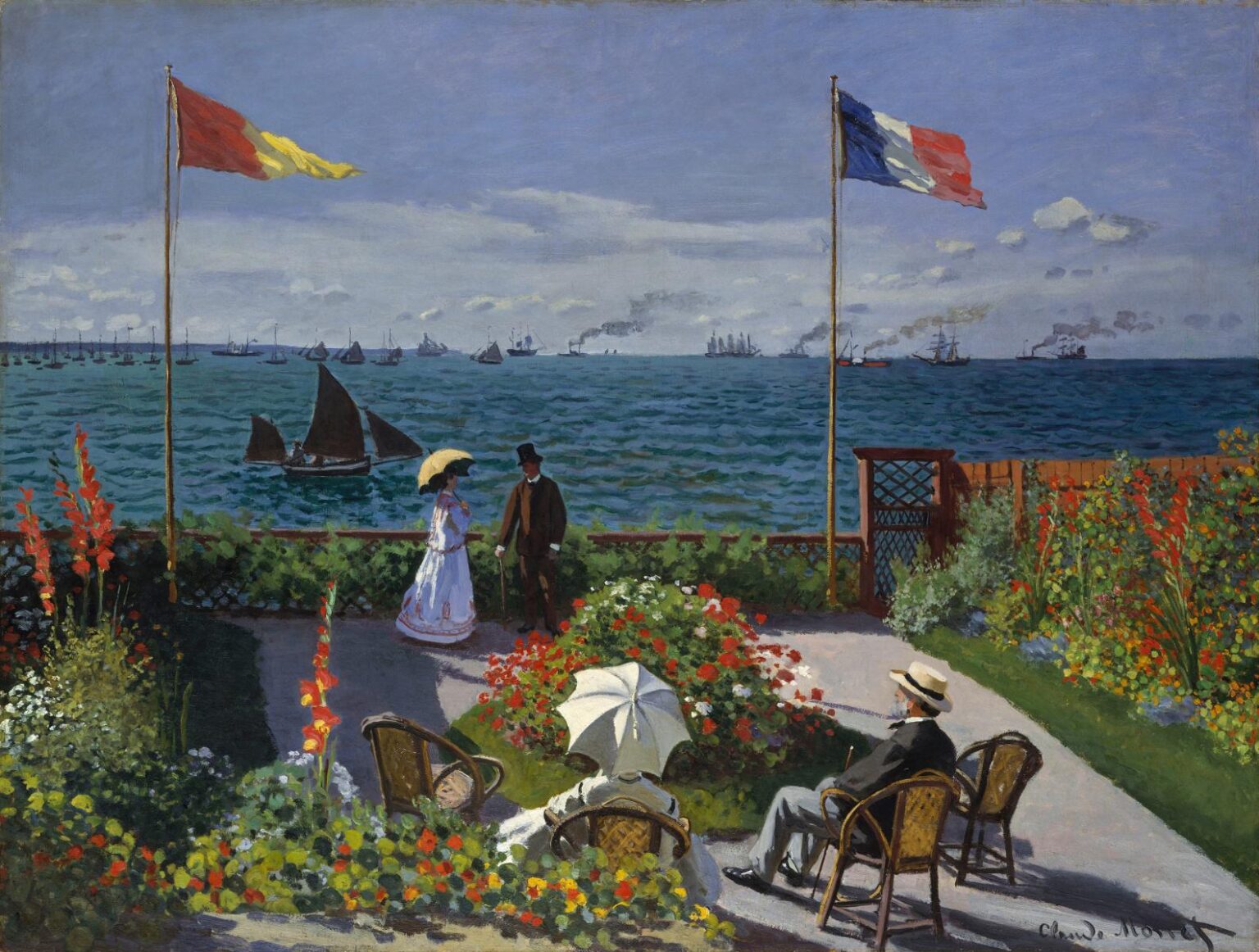
Claude Monet’s Garden at Sainte-Adresse from 1867 is one of the most striking and carefully organized paintings of his early career. At first glance, it appears to be a bright seaside garden scene filled with flowers, fashionable figures, and fresh ocean air. Yet the more one looks, the more complex the painting becomes. This is not only an image of leisure by the water. It is also a study in space, order, color, modern life, and the meeting point between nature and design. Monet transforms a pleasant summer view into a work that feels both immediate and thoughtfully constructed.
The painting is set at Sainte-Adresse, a coastal town near Le Havre in Normandy. Monet spent time there during the 1860s, and the seaside setting gave him an ideal subject for exploring light, atmosphere, and contemporary recreation. In this painting, he combines two worlds that fascinated modern artists of the period: the cultivated domestic garden and the expansive open sea. The result is an image that feels elegant and relaxed, but also visually bold. The flowers in the foreground, the figures seated and standing along the terrace, the flags lifted by the breeze, and the distant boats all contribute to a scene full of motion, rhythm, and social meaning.
What makes this work especially memorable is the balance Monet achieves between structure and sensation. The garden is arranged with almost decorative precision, while the water and sky shimmer with a softer, more fleeting touch. Human presence is central, yet the painting never becomes purely a portrait or a narrative scene. Instead, Monet invites the viewer to experience the place itself, the feeling of being there on a bright windy day by the sea.
Composition and Spatial Design
One of the most remarkable aspects of Garden at Sainte-Adresse is its composition. Monet organizes the scene with a clarity that gives the painting immediate visual strength. The foreground is occupied by a richly planted garden terrace, where bright flowers spread across beds and borders in dense patches of red, yellow, white, blue, and green. A curving pathway leads the eye inward, guiding the viewer through the cultivated space. Seated figures rest in wicker chairs, while a standing couple occupies the middle ground near the edge of the terrace. Beyond them lies the open sea, populated by sailboats, steamships, and a distant horizon.
This arrangement creates a layered effect. The viewer first notices the lush immediacy of the flowers, then the elegant people enjoying the terrace, and finally the vast maritime distance. Each zone has a distinct character. The garden feels enclosed and intimate. The sea feels expansive and public. The painting therefore creates a subtle contrast between private leisure and the larger modern world beyond.
The vertical lines of the two flagpoles are especially important. They frame the scene and provide strong structural anchors within the composition. The flags at the top also add a lively note of movement, suggesting the sea breeze that animates the whole painting. These upright poles contrast with the horizontal spread of the horizon and the flat expanse of water. The result is a composition built on clear geometric relationships, with verticals, horizontals, curves, and diagonals all working together.
There is also an interesting tension between natural irregularity and human order. The flowers seem abundant and spontaneous, yet they are carefully placed within tidy borders. The path curves gracefully, and the fence line creates a visual edge between garden and sea. Monet does not depict wild nature. He depicts cultivated nature, shaped for pleasure and display. This sense of arrangement gives the painting a refined elegance that separates it from a purely rustic landscape.
Light, Color, and Atmosphere
Color plays a central role in the power of this painting. Monet fills the scene with vivid hues, yet he keeps the image harmonious rather than chaotic. The blues of the sky and sea dominate the upper half of the painting, creating a cool, luminous atmosphere. Against these blues, the reds, oranges, yellows, and greens of the flower beds appear especially brilliant. The white clothing and umbrellas reflect the sunlight and provide points of brightness that help unify the composition.
The sea is not rendered as a flat blue field. Monet breaks it into varied tones, from deep blue to greenish turquoise, allowing the surface to ripple with light. This treatment gives the water a sense of life and movement. The sky, too, is full of subtle modulation. It is bright, but not empty. Clouds drift across it, softening the expanse and creating a more natural sense of weather and depth.
What is especially effective is the way Monet uses sunlight to connect all parts of the painting. The light touches the flowers, the path, the clothing, the chairs, and the sea, making the entire scene feel coherent. Even though the garden and the ocean belong to different visual worlds, they are united by the same clear afternoon illumination. Monet shows not just the objects in front of him, but the atmosphere that surrounds them.
The contrast between warm and cool colors is also key. The warm reds and yellows of the flowers push forward, while the cool blues of the water and sky recede. This gives the painting both vibrancy and depth. At the same time, Monet avoids heaviness. The bright palette keeps the scene airy and festive. The overall effect is one of pleasure, comfort, and seasonal fullness.
This use of color also points toward Monet’s later development. Even in 1867, before Impressionism was fully established as a movement, he was already deeply interested in how light transforms color and how color can create an immediate sensory impression. Garden at Sainte-Adresse stands as evidence of how advanced his vision already was in the late 1860s.
The Figures and the World of Modern Leisure
The figures in this painting are essential to its meaning. They are not heroic, dramatic, or emotionally intense. Instead, they are calm, elegant, and absorbed in the quiet rituals of leisure. Some sit in conversation or contemplation, while others stand near the terrace edge looking out over the water. Their clothing suggests middle class or upper middle class respectability, and their poses convey ease and formality at once.
Monet presents leisure not as idleness, but as a cultivated way of life. The people in the painting inhabit a world of seaside visits, garden promenades, social conversation, and scenic enjoyment. This was a distinctly modern subject in the nineteenth century. Rail travel and changing patterns of urban life made coastal resorts and leisure destinations more accessible, and artists became increasingly interested in depicting these new forms of recreation.
In Garden at Sainte-Adresse, leisure is inseparable from setting. The figures do not dominate the garden. Instead, they belong to it, just as they belong to the terrace and the sea view. Their presence helps establish the scale of the scene and gives it a social dimension, but Monet does not turn them into individualized portraits in the traditional sense. They function more as participants in a modern environment.
This choice is significant. Rather than telling a dramatic story, Monet captures a moment of lived experience. The painting suggests a kind of social harmony, a shared enjoyment of weather, scenery, and company. At the same time, there is a certain restraint in the way the figures are placed. They do not interact in a theatrical way. They remain composed and somewhat separate. This emotional reserve contributes to the painting’s atmosphere of elegance.
The standing couple near the center is particularly important because they occupy the threshold between garden and sea. They represent the human link between the cultivated terrace and the maritime horizon beyond. Their dark and light clothing also creates a strong visual contrast, making them stand out without overpowering the scene. Monet uses them almost like compositional markers, reinforcing the central axis of the painting.
The Garden as a Modern Subject
The garden in this painting is more than a decorative foreground. It is one of the main subjects of the work. Monet does not treat it simply as a background for human activity. He gives it presence, complexity, and visual richness. The dense beds of flowers, the trimmed hedges, and the winding path all suggest careful cultivation. This is a place designed for looking as much as for walking or sitting.
Gardens held special significance in nineteenth century painting because they occupied an in between space. They were natural, but ordered by human intention. They could be domestic and intimate, yet also visually abundant and varied. For an artist like Monet, they offered a perfect setting in which to study color, sunlight, seasonal growth, and spatial arrangement.
In Garden at Sainte-Adresse, the garden acts almost like a stage from which the sea can be viewed. It frames the human experience of the coast. The flowers do not compete with the ocean, but they change the way the ocean is seen. Instead of presenting the sea in isolation, Monet places it beyond a terrace of cultivated beauty. This creates a richer and more layered visual experience.
The flowers themselves are painted with lively touches that suggest variety rather than botanical precision. Monet is interested less in the scientific identity of each bloom than in the overall effect of blooming color under sunlight. The flower beds become fields of painterly energy. Their reds and yellows pulse against the greenery, while white blossoms echo the white umbrellas and garments worn by the figures.
This attention to the garden also anticipates Monet’s later fascination with cultivated landscapes, most famously at Giverny. Long before his water lilies and flower gardens became central to his art, he was already exploring how designed natural spaces could serve as major pictorial subjects. Garden at Sainte-Adresse is therefore an early and important example of a theme that would remain vital throughout his career.
Sea, Ships, and Modernity
Beyond the terrace lies one of the most compelling elements of the painting: the sea filled with boats and steamships. This is not an untouched natural horizon. It is an active modern space. Sailboats glide near the shore, while darker steam powered vessels appear farther out, their smoke rising into the sky. Monet includes these details not merely for scenery, but to show a world shaped by travel, commerce, and technology.
The sea in this painting represents openness and distance, but it also represents connection. It is a route of movement and exchange. The visible ships remind the viewer that Sainte-Adresse was part of a larger maritime world. Monet therefore places the peaceful terrace within a network of modern life. The relaxing figures in the garden are not detached from history. They are quietly positioned at the edge of a changing world.
The contrast between sail and steam is especially interesting. It places older and newer forms of movement side by side. This mixture of traditional and modern elements is characteristic of much nineteenth century art, especially in works concerned with contemporary life. Monet does not dramatize this contrast, yet he lets it enrich the meaning of the scene. The painting becomes a portrait of a modern coast where pleasure, technology, and nature coexist.
There is also a visual advantage to the ships. They punctuate the horizon and keep the sea from becoming empty. The masts, sails, and smoke plumes create rhythmic accents across the distance. These small details lead the eye across the width of the canvas and reinforce the sense of atmospheric depth.
The sea is therefore not just a background. Like the garden, it is a major subject. But whereas the garden is ordered, bounded, and close, the sea is open, shifting, and expansive. Monet uses this contrast to enrich the painting both visually and conceptually. The viewer experiences comfort in the foreground and freedom in the background, all within a single frame.
Japanese Influence and Visual Modernity
Many viewers have noticed that Garden at Sainte-Adresse has a strong decorative clarity that feels distinct from more traditional European landscape painting. One reason for this is the influence of Japanese art, especially Japanese prints, on artists in France during the second half of the nineteenth century. Monet, like many of his contemporaries, admired Japanese compositions, and this painting reveals some of that influence in its structure and visual logic.
The elevated viewpoint, the strong flat bands of color, and the sharp division between foreground and background all recall aspects of Japanese print design. The flags rising vertically at the top edges of the composition also have a bold graphic force. The garden, path, and sea are arranged in a way that emphasizes pattern as much as natural depth. This does not make the painting less realistic. Instead, it makes the image feel more immediate and modern.
The decorative impact of the work is striking. The flowers form dense patches of color, the chairs create repeating curves, and the flags add asymmetrical movement. Monet seems interested not only in representing a place, but also in designing a surface full of visual harmony. This concern with the painting as a flat arrangement of shapes and colors is one of the qualities that makes his art feel so innovative.
At the same time, Monet never abandons observation. The wind in the flags, the glitter of the water, the softness of the clouds, and the bright summer atmosphere all feel directly experienced. This is one of the painting’s greatest achievements. It combines decorative strength with sensory immediacy. It is both designed and observed, both structured and alive.
Place in Monet’s Career
Garden at Sainte-Adresse occupies an important place in Monet’s development. It comes from a period when he was still forming the language that would later make him one of the defining figures of Impressionism. In this work, one can already see several of his most important concerns: the depiction of modern life, the effects of natural light, the relationship between outdoor space and human presence, and the use of color to create visual unity.
At the same time, the painting is more composed and stable than many of his later works. It does not dissolve into flickering brushwork or purely optical sensation. Instead, it retains a strong sense of design. This makes it especially interesting, because it shows Monet at a moment of transition. He is moving away from older conventions, but he has not yet abandoned structure for greater spontaneity.
The work also demonstrates that Monet was never simply a painter of loose impressions. Even at his most atmospheric, he was capable of careful organization. In Garden at Sainte-Adresse, this discipline is obvious. Every part of the composition feels considered, from the placement of the chairs to the position of the flags and the spacing of the ships on the horizon. The painting’s freshness is therefore not accidental. It is the result of controlled artistic intelligence.
For viewers familiar with Monet’s later masterpieces, this painting offers a valuable reminder of how broad his talent was. He could paint gardens, figures, sea views, flowers, and modern social life all within one coherent image. He could create atmosphere without losing form. He could evoke pleasure without becoming sentimental. These qualities help explain why the painting remains one of the most admired works from his early career.
Why the Painting Still Feels So Alive
One reason Garden at Sainte-Adresse continues to appeal to viewers is that it captures a universal kind of pleasure. The scene is specific to nineteenth century France, yet the experience it conveys is timeless: sunlight, flowers, wind, water, company, and the quiet enjoyment of a beautiful day. Monet turns these simple elements into something unforgettable through clarity of vision and richness of execution.
The painting also feels alive because it contains many kinds of movement. The flags flutter. The water ripples. The ships travel across the horizon. The flowers seem to sway in the breeze. Even the path leads the eye gently through space. Nothing is static, yet nothing is agitated. The motion is calm and sustaining, which gives the work an atmosphere of ease.
Another lasting strength of the painting is its balance. It is neither too crowded nor too empty. It is decorative without becoming artificial. It is elegant without becoming distant. It is modern without losing the pleasures of nature. Monet creates a world in which visual beauty and lived experience seem perfectly aligned.
Ultimately, Garden at Sainte-Adresse is a painting about seeing. It asks the viewer to notice how space is organized, how color creates feeling, how social life can be embedded in landscape, and how a garden terrace can become a meeting place between intimacy and vastness. It shows Monet already thinking like a great painter, capable of transforming an ordinary moment of leisure into an enduring image of modern beauty.
