Image source: wikiart.org
Introduction
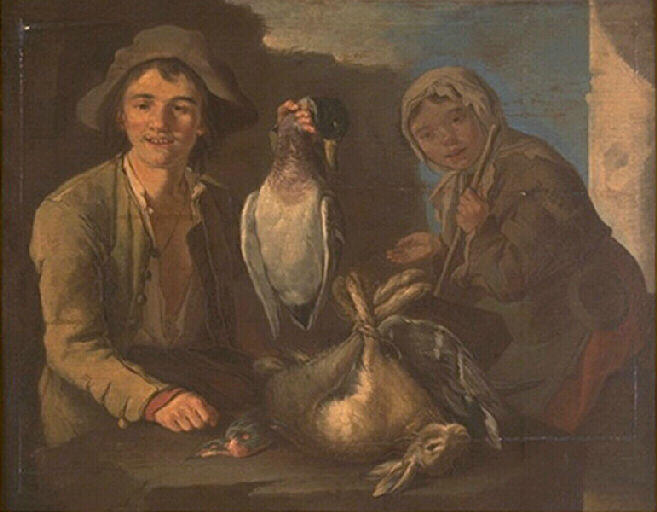
“Game Dealers” by Bartolomé Esteban Murillo is a compelling example of the artist’s fascination with everyday life and the dignity of the poor. Instead of saints, angels, or noble patrons, Murillo gives center stage to two humble young figures who present the results of a day’s hunting. A boy and a girl sit behind a simple table covered with freshly killed game: a hare, several birds, and a mallard duck that the boy proudly lifts for inspection.
At first the painting looks like a straightforward genre scene, a slice of daily commerce in seventeenth century Spain. Yet, as is often the case with Murillo, the canvas reveals more the longer one looks. Behind the rustic subject lies an intricate exploration of poverty, pride, collaboration, and survival. The painting is both a character study and a still life, a record of social reality and a quiet moral reflection on labor and hunger.
Historical And Social Context
Murillo worked in Seville during a period marked by stark contrasts. The city was home to wealthy merchants and powerful religious institutions, yet also plagued by disease, famine, and widespread poverty. Children who lost parents to plague or economic hardship often survived by selling small goods on the streets. These young workers became one of Murillo’s signature subjects.
“Game Dealers” belongs to this tradition of genre painting focused on poor children and adolescents. Collectors of Murillo’s time were drawn to such scenes partly for their novelty and partly because they aligned with Counter-Reformation ideals of charity. The paintings invited viewers to contemplate the lives of the less fortunate and, ideally, respond with compassion.
At the same time, Murillo’s genre scenes were influenced by Northern European models, especially Dutch and Flemish paintings of village life and kitchen interiors filled with food. In those works, game and fish often carried symbolic meanings associated with gluttony, transience, or the fragility of life. Murillo borrows some of this visual vocabulary but infuses it with his own humanistic approach. The children in “Game Dealers” are not caricatures. They are individuals whose daily toil becomes worthy of close, sympathetic observation.
Composition And Spatial Setting
The composition is tightly framed, focusing on the young dealers and their goods. The boy occupies the left side of the canvas, seated with his body angled slightly toward the viewer. His right hand rests on the table while his left hand holds the mallard by the neck, suspending it in front of his chest. The duck’s limp body hangs downward, its green head and iridescent feathers rendered with care.
The girl stands slightly behind and to the right, leaning forward with one hand resting on a support and the other possibly holding a staff or bundle. Her face emerges from the shadows, framed by a simple headscarf. Between them, on the table, lies a heap of game: another duck with wings folded, a tied bundle of birds, and a hare whose head and paws protrude toward the bottom edge of the painting.
Murillo arranges the figures and game in a triangular structure that anchors the composition. The apex lies near the boy’s face and raised hand, while the base extends across the table. This triangular form creates stability and focuses the viewer’s attention on the interaction between human and animal forms. The background remains indistinct, a simple wall with patches of light and shadow that suggest an outdoor or semi-outdoor setting, perhaps near a market stall or the entrance to a house.
The limited depth of the space draws the figures close to the viewer. One has the impression of standing directly in front of the table, as if a passerby in a market who has paused to consider the wares. This immediacy reinforces the painting’s documentary flavor while also enhancing its emotional impact.
The Boy As Proud Vendor
The boy dominates the composition both by his size and by his pose. He looks directly at the viewer, mouth slightly open in an almost mischievous half smile. His teeth are irregular, his nose somewhat broad, his complexion tanned from outdoor labor. Murillo does not idealize his features, yet there is warmth and vitality in the boy’s expression.
He wears a rough, earth-toned jacket over an open shirt, signaling his modest social status. The jacket is unbuttoned, hinting at comfort rather than strict formality. A soft hat sits loosely on his head, casting a faint shadow across his forehead. The relaxed fit of his garments suggests clothing that is worn and perhaps handed down, yet still functional.
The way he grips the duck by the neck and raises it implies both pride and a practiced familiarity with his trade. He wants us to see the quality of the game, to acknowledge the success of the hunt or purchase. The gesture has a showman’s flair, as if he is calling out to potential customers on a busy street. At the same time, there is a hint of vulnerability in his direct stare. He relies on the viewer’s interest for his next meal.
Murillo captures this mixture of courage and need, presenting the boy as an emblem of youthful resilience in harsh circumstances.
The Girl As Companion And Counterpart
The girl on the right provides a quieter counterpart to the boy’s assertive presence. Her pose is slightly more withdrawn. She stands behind the game, leaning forward but not fully entering the viewer’s space. Her face, framed by a simple kerchief, has softer, more rounded features. She looks toward the viewer, yet her gaze appears more hesitant, as if she is less accustomed to direct negotiation.
Her clothing is layered and practical, with muted browns and grays that blend somewhat into the background. Murillo renders her with fewer sharp contrasts than the boy, which contributes to her gentler aura. She may be a sister, cousin, or simply a fellow worker.
The dynamic between the two suggests a small partnership. The boy handles the front-line selling and the physical display of the goods, while the girl perhaps assists with carrying or preparing the game. Her presence humanizes the scene, transforming it from a solitary hustle into a shared effort. Murillo often paired children in his genre paintings to emphasize companionship and collaboration amid hardship.
The Still Life Of Game
At the center of the table Murillo paints a vivid still life of dead animals. The mallard held by the boy is depicted with particular attention: the weight of its body pulls downward from his hand, the green head droops, the feathers change from dark to light along the wings. The other bird on the table lies bound with twine, belly exposed and wings folded close to its body. Next to it, the hare is stretched out, its fur rendered with shorter, softer strokes that differentiate it from the sleek feathers of the birds.
This still life serves several roles. On one level it is a display of technical skill. Murillo captures different textures—feather, fur, and flesh—with convincing realism. On another level it reveals the economic basis of the children’s work. These animals constitute their merchandise, the tangible outcome of hunting or trading. Each carcass represents potential income, meals, or barter.
The dead game may also carry symbolic weight. In the visual tradition of the time, such displays often reminded viewers of the transience of life and the proximity of death. Here, that theme is intertwined with the realities of survival. The children’s lives depend on transforming the death of animals into sustenance. The viewer is prompted to consider the cycle of life and the precarious line between hunger and abundance.
Light, Color, And Atmosphere
Murillo employs a restrained yet effective palette. Warm browns, muted greens, and earthy grays dominate the scene. The boy’s jacket and the hare’s fur share similar tones, visually linking human and animal life. The splash of color on the mallard’s head introduces a point of visual interest, while the pinkish hues of the boy’s face and hands harmonize with the flesh tones of the game.
Light falls from the upper right, illuminating the boy’s face, the mallard, and parts of the table. The girl’s face is also touched by this light, though more softly, creating a sense of depth between the two figures. The background on the left remains darker, providing a contrast that makes the characters stand out.
The overall atmosphere is subdued, reflecting the seriousness of the children’s work rather than the bustling energy of a market. Yet the warm handling of light and soft transitions between tones lend the scene a kind of quiet beauty. Murillo’s brushwork is loose and painterly, especially in the clothing and background, while more precise in the faces and the details of the game. This combination gives the painting both immediacy and solidity.
Genre, Morality, And The Viewer’s Role
Murillo’s genre paintings often carry an implicit moral or social message without resorting to overt symbolism. In “Game Dealers” the viewer is placed in the role of a potential customer. The boy’s straightforward gaze and raised duck seem to address us directly, inviting a transaction. This engagement draws us into the children’s world.
At the same time, the painting encourages reflection on issues of inequality and opportunity. The children are industrious and resourceful, yet their material circumstances are clearly modest. Their work involves the messy reality of death and manual labor, far removed from the refined lives of many viewers.
By presenting them with dignity and a hint of humor, Murillo suggests that virtue and liveliness can flourish even under difficult conditions. The painting does not sentimentalize poverty, but it does challenge viewers to recognize the humanity of those who struggle at the margins of society. In this sense, “Game Dealers” functions as a quiet appeal to charitable awareness and social conscience.
Technique And Painterly Qualities
Looking closely, one sees that the surface of the painting is built up with loose, confident strokes. Murillo uses broader, more gestural brushwork for the clothing and background, allowing pigment to blend and leaving small traces of underpainting visible. This approach creates a sense of spontaneity and life.
The faces of the boy and girl, however, are handled with greater precision. Subtle touches of light define the contours of cheeks, noses, and chins. The boy’s slightly uneven teeth, the girl’s gentle smile, and the reflections in their eyes are carefully observed details that animate their personalities.
The game animals receive a similar mix of freedom and control. The hare’s fur is suggested with quick strokes that nonetheless capture its soft, dense texture. The feathers of the duck show delicate gradations of color, particularly around the neck where green shifts to white. Murillo’s skill lies in knowing how much information to provide and where to let the viewer’s imagination complete the picture.
Place Within Murillo’s Oeuvre
“Game Dealers” fits within a group of Murillo’s works that depict young workers with food or goods, such as boys selling fruit, children eating, or peasants engaged in simple tasks. These paintings combine genre elements with still life and often found eager markets among collectors seeking scenes of “picturesque” poverty.
Yet Murillo’s treatment differs from that of some contemporaries who emphasized rough humor or moralizing harshness. He tempers realism with compassion. The children in “Game Dealers” are neither idealized nor degraded. They occupy a middle ground of credible humanity, shaped by their environment but not reduced to stereotypes.
For modern viewers interested in Baroque art, the painting provides insight into how Spanish artists examined social issues through the lens of everyday life. It complements Murillo’s more famous religious works by showing his engagement with worldly realities and his ability to find spiritual resonance in secular subjects.
Emotional Resonance And Lasting Appeal
The enduring appeal of “Game Dealers” lies in its mixture of warmth and honesty. The boy’s open grin, the girl’s shy presence, and the heap of game on the table create a vivid snapshot of a particular moment. One can almost hear the sounds of a distant marketplace or the calls of other vendors.
At the same time, the painting invites deeper contemplation. The viewers may wonder about the children’s lives beyond this scene. Where did they come from? How often do they manage to sell all their goods? What hopes and fears accompany them as they navigate the streets with their bundle of animals?
Murillo does not answer these questions, but he makes them possible by presenting characters who feel alive and complex. This imaginative engagement ensures that “Game Dealers” remains more than a historical curiosity. It continues to speak to contemporary concerns about youth, work, and social inequality, even as it delights with its painterly beauty.
Conclusion
“Game Dealers” by Bartolomé Esteban Murillo is a rich and nuanced canvas that showcases the artist’s talent for blending genre painting, still life, and psychological portraiture. Through a simple arrangement of two young vendors and their game, Murillo opens a window onto the lives of the poor in seventeenth century Seville, inviting viewers into an intimate encounter with their resilience and resourcefulness.
The carefully structured composition, expressive faces, and skillfully rendered animals reveal an artist deeply attentive to both visual detail and human feeling. The boy’s proud gesture and the girl’s quieter support embody a partnership forged in necessity, while the heap of dead game underscores the precarious nature of their livelihood.
Bathed in warm light and painted with confident brushwork, the scene radiates a quiet dignity. “Game Dealers” stands as a testament to Murillo’s ability to find beauty and meaning in ordinary lives, reminding us that behind every market stall and every modest trade there are stories of courage, struggle, and hope.