Image source: wikiart.org
Historical and Artistic Context of Francisco de Zurbaran’s Funeral
Francisco de Zurbaran is best known for his solemn saints, meditative monks and glowing still lifes, yet a work like “Funeral” reveals another facet of his imagination. Instead of a single isolated figure, he presents an entire community gathered in a shadowy interior, united by a shared ritual of mourning. The painting belongs to the Spanish Baroque period, when painters explored dramatic light, intense emotion and spiritual themes grounded in everyday life.
“Funeral” appears to be a relatively small canvas and probably functioned as a study or intimate work rather than a grand altarpiece. Its loose handling and subdued palette suggest that Zurbaran was experimenting with atmosphere and group dynamics. At the same time, the subject fits perfectly within the Catholic culture of seventeenth century Spain, where processions, funerals and brotherhood ceremonies punctuated the rhythm of urban life.
By focusing on an unnamed funeral rather than on a specific saint or biblical episode, Zurbaran highlights the universal experience of death and communal mourning. This gives the painting a different tone from his strictly devotional works. It still speaks about faith and salvation, yet it does so through the ordinary lives of men and women who could have been his contemporaries in Seville.
First Impression and Overall Mood
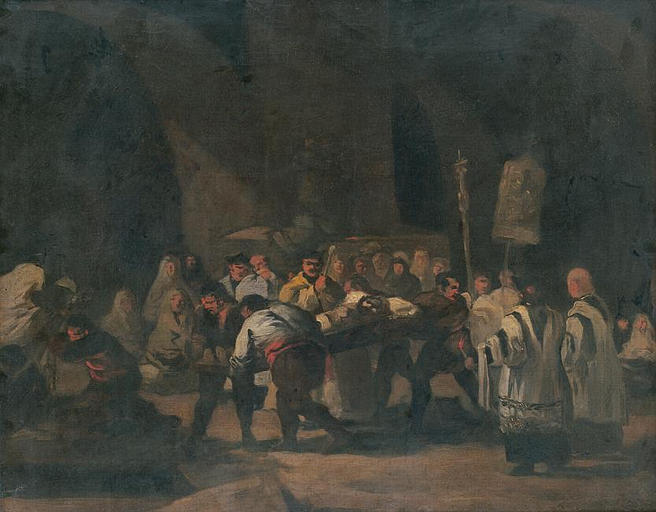
At first glance, “Funeral” appears dark and hazy. The viewer’s eye must adjust to the dim light that barely filters into the vaulted interior. Out of this murky atmosphere, a dense group of figures slowly emerges. In the center, several men in rustic clothing strain to carry a body laid out on a bier. To the right, priests in white vestments walk in solemn procession, one of them holding a banner on a tall pole. Behind them, a cluster of mourners and religious figures watch the scene unfold.
The painting’s overall mood is quiet and heavy. There are no theatrical gestures or bright colors. Instead, Zurbaran builds tension through the weight of the body, the bowed heads of the attendants and the density of the surrounding shadows. The space feels enclosed and slightly oppressive, emphasizing the gravity of the event.
Despite this somber atmosphere, the painting is not purely bleak. There is a sense of order and ritual. The priests guide the procession, the mourners follow established roles and the community gathers as one body. Death here is not chaotic but framed by ceremony and faith.
The Setting and Architectural Space
Zurbaran stages the funeral in a vast, cavernous interior that could be a church crypt, a monastery scriptorium or a vaulted chapel. Massive archways loom in the background, their surfaces barely touched by light. The architecture is not sharply defined. Instead it functions as a dark shell that encloses the figures and focuses our attention on their actions.
The space opens slightly toward the left, where a faint glow suggests an entrance or side aisle. This soft illumination does not reveal much detail, yet it hints at the world outside the funeral chamber. The contrast between the hidden architecture and the cluster of human figures enhances the feeling of an ephemeral moment unfolding inside a long enduring stone structure.
Zurbaran pushes the crowd forward toward the picture plane. The floor at the bottom of the canvas tilts slightly upward, encouraging us to step into the scene. The effect is immersive. We stand almost at ground level, close enough to imagine the muffled sound of footsteps and whispered prayers.
The Funeral Procession: Figures and Gestures
The central motif of the painting is the group of men carrying the corpse. Dressed in short jackets and shirts with rolled up sleeves, they look like ordinary townspeople or confraternity members rather than clergy. Their bodies bend under the weight of the bier. One man strides forward with a resolute step, while another twists his torso to adjust his grip. The diagonal of the stretcher cuts across the composition, creating a dynamic line that leads from left to right.
On the right side of the bier, two priests in white surplices and dark cassocks form a calmer vertical counterpoint. They walk slowly, heads slightly bowed, absorbed in prayer. In front of them, another cleric raises a long processional cross or banner, which catches a bit of light and stands out against the darkness behind. These vertical elements anchor the composition and remind us that this event is both civic and liturgical.
Behind the central group stretches a dense wall of mourners. Some wear hooded cloaks that cover their faces, giving them a ghostlike presence. Others have their heads bare or lightly covered, their expressions softened by the indistinct brushwork. They blend into a single mass of grief and contemplation.
In the lower left corner, a figure kneels or stoops beside a shapeless form, perhaps another mourner overcome by emotion or a person preparing objects for the ceremony. This area is more obscure and loosely painted, which adds a touch of mystery. It suggests that the scene extends beyond what we clearly see, just as real funerals contain private sorrows that remain hidden even within public ritual.
Light, Shadow and the Restricted Color Palette
“Funeral” is one of Zurbaran’s most atmospheric works. Instead of the crisp chiaroscuro that defines his saints and still lifes, he uses a smoky, diffuse light that seems to seep slowly through the air. The color palette is dominated by browns, greys and muted blacks with small touches of white and red.
The strongest highlights fall on the white surplices of the priests and on the shrouded body. These bright accents immediately signal the central subjects of the painting. The shroud glows with a pale, almost spectral light, emphasizing the presence of death yet also suggesting purity and hope. The priests’ garments create rhythmic patches of brightness amid the gloom, leading the eye across the composition.
Subtle red accents, such as sashes or belts on the men carrying the bier, punctuate the otherwise earthy tones. These small injections of color evoke human warmth and physical life, standing in poignant contrast to the lifeless body they transport.
The soft shadows blur contours and merge figures into one another. Faces are sometimes only partially visible, emerging from the dark like fleeting apparitions. This treatment enhances the sense that the painting captures an interior memory rather than a sharply photographed event. It also reflects Baroque interest in light as a metaphor for spiritual presence in a world marked by mortality.
Narrative Ambiguity and the Unnamed Deceased
One of the most striking aspects of “Funeral” is the anonymity of the deceased. The shrouded body rests on the bier with no visible face, no heraldic emblem and no obvious attributes. The painting does not identify the person as a saint, noble or martyr. This is unusual in Zurbaran’s work, where specific religious figures are normally given recognizable costumes and symbols.
This anonymity opens the image to multiple interpretations. It may represent a generic Christian funeral, meant to remind viewers that all believers eventually pass through this ritual. It may depict a member of a religious brotherhood, honored by his companions at death. Or it could be a study for a larger narrative cycle where the identity would be clarified through accompanying panels or inscriptions.
Whatever the historical context, the lack of specific identification gives the painting a universal character. The focus shifts from who has died to how the living respond. We become aware of grief expressed through gesture, posture and collective movement. The scene becomes a meditation on human mortality rather than a page from a particular saint’s legend.
Spiritual and Social Themes
“Funeral” weaves together spiritual and social dimensions. On one level, it presents a Christian understanding of death. The priests and liturgical banner indicate that the ceremony is framed by the church’s prayers for the dead. The stone interior suggests the protective embrace of sacred architecture where bodies are blessed and commended to God.
On another level, the painting stresses the role of community. The men carrying the bier are not passive observers but active participants who share the physical burden of the corpse. Their exertion speaks of solidarity and duty. The crowd of mourners, though largely anonymous, embodies the network of relationships that surrounds each individual.
In seventeenth century Spain, confraternities and lay brotherhoods often organized funerals for their members, especially for the poor who might otherwise be buried without ceremony. Zurbaran’s painting may allude to this charitable custom. If so, the “Funeral” becomes a visual tribute to Christian works of mercy and mutual support.
The painting also touches on the theme of the equality of all before death. There is no clear hierarchy among the lay figures. The rich and poor appear side by side, united by grief and faith. The priests provide spiritual leadership, yet they too are ultimately fellow mortals participating in the same mystery.
Baroque Realism and Zurbaran’s Style
Although “Funeral” is suffused with atmosphere, it remains grounded in the realism that characterizes Spanish Baroque art. The clothing of the carriers, the humble faces of the mourners and the heaviness of the shrouded body all affirm Zurbaran’s careful observation of daily life.
At the same time, he simplifies forms and omits extraneous detail in order to focus on the essentials of the scene. Compared with some of his carefully finished altarpieces, this painting is more spontaneous. Brushstrokes remain visible. Edges dissolve into shadow. This creates a feeling of immediacy, as if the painter were recording the event quickly while it unfolded before him or reconstructing it from a strong emotional memory.
Zurbaran’s ability to balance realism and spiritual meaning is clearly evident here. The viewer believes in the physical reality of the figures, yet the mood and symbolism carry the imagination beyond the visible world.
Sketch Like Quality and Workshop Practice
The looseness of “Funeral” suggests that it may have been an oil sketch, perhaps done as a study for a larger composition. Spanish Baroque artists often prepared such works to test group arrangements, lighting schemes or narrative sequences. In this context, the painting reveals how Zurbaran built complex multi figure scenes.
We can see him experimenting with diagonals, clustering the carriers into a compact knot and setting them against the vertical procession of priests. We watch as he modulates darkness across the vaulted space, leaving some areas almost blank while packing others with overlapping forms.
Whether or not a large companion piece was ever executed, the sketch holds its own as a finished work. The very incompleteness invites viewers to imagine things that are only hinted at: the sound of chanting, the echo of footsteps on stone, the faint smell of incense.
Emotional Impact for Contemporary Viewers
For modern audiences, “Funeral” can feel startlingly contemporary. The lack of clear focus on a named saint or royal figure allows us to read the scene as any communal funeral. Many viewers today will recognize the mixture of ritual order and personal sorrow that defines such events.
The painting may prompt reflection on how different societies handle death, and how rituals help people process loss. It also resonates with the experience of collective grief, when communities gather after disasters, epidemics or wars. Zurbaran’s muted colors and blurred details mirror the way memory often records these events, not as sharp images but as atmospheres and gestures.
At the same time, the presence of priests and liturgical objects reminds contemporary viewers of the spiritual dimension that shaped Baroque culture. The painting poses quiet questions about hope, faith and what it means to accompany the dead with prayer.
Place within Zurbaran’s Oeuvre and the Spanish Baroque
“Funeral” stands somewhat apart from Zurbaran’s more familiar subjects, yet it resonates with them in important ways. The hush, the gravity and the careful orchestration of light all recall his great monastic scenes. Instead of a single kneeling monk or saint, he offers an entire congregation of believers confronting mortality.
Within the broader Spanish Baroque tradition, the painting aligns with the interest in everyday religious life that we find in works by contemporaries such as Murillo or Valdés Leal. In particular, the combination of realism and spiritual admonition calls to mind the famous “vanitas” and death themed paintings produced for confraternities in Seville.
For art historians and collectors, “Funeral” is valuable because it expands our understanding of Zurbaran’s range. It shows that he was not only a painter of solitary contemplation but also an observer of social ritual and group emotion.
Conclusion
“Funeral” by Francisco de Zurbaran is a haunting vision of communal mourning within the Spanish Baroque world. Set in a shadowy vaulted interior, the painting brings together priests, laypeople and hooded mourners around the shrouded body of an unnamed deceased. Through subtle light, a restrained palette and expressive yet understated gestures, Zurbaran invites viewers to contemplate the universal reality of death and the consoling power of shared ritual.
The anonymity of the corpse, the solidarity of the carriers and the presence of clergy transform the scene into a meditation on faith, charity and the equality of all before the grave. Although probably conceived as a sketch or study, the work possesses a completed emotional intensity. It balances realism and spirituality in a way that is characteristic of Zurbaran’s art at its most profound.
Looking at this painting today, we can sense not only the grief of a seventeenth century Spanish community, but also the enduring human need to gather, to remember and to commend our dead with dignity. “Funeral” stands as a moving testimony to that need, rendered with the quiet power that defines Francisco de Zurbaran’s best work.