Image source: wikiart.org
Introduction
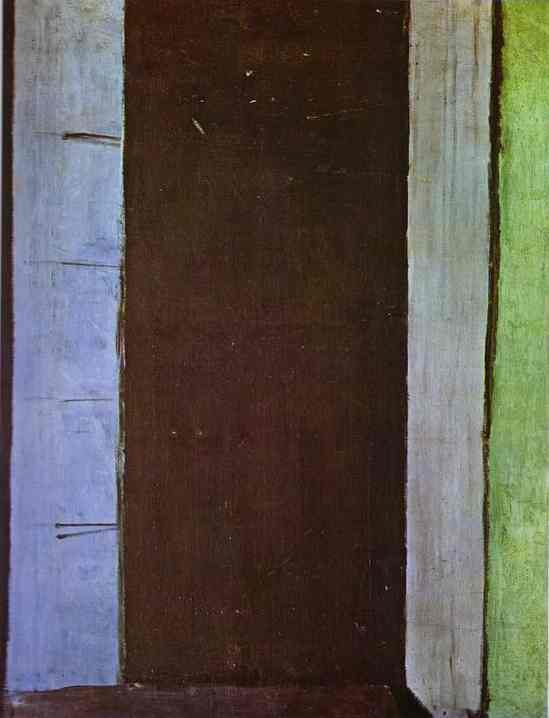
Henri Matisse’s “French Window at Collioure” (1914) is one of the bravest condensations of seeing in twentieth-century art. On a tall canvas Matisse presents a dark, nearly featureless central panel bordered by slim vertical bands of color: a cool blue strip at left, a pale stone-gray jamb, and a narrow field of acid green at the far right. At the bottom a slanted wedge of floor slips into view. The subject is a familiar one in his work—the studio window in the Mediterranean fishing town of Collioure—but everything that once signaled sunny Fauvist abundance has been pared away. What remains is a window reduced to its basic architecture of planes, edges, and temperatures: blackness in the middle where the view should be, light flickering only at the margins. The painting looks simple, but its simplicity is the result of a radical decision about what a picture can be.
What You See When You Stand Back
From across a room the canvas reads as three dominant verticals and a small diagonal. The center is an immense, matte, black-brown door of paint. It is flanked on the left by a blue-violet band the width of a shutter, then by a thin stone strip like a jamb; on the right a narrow green field plays the role of wall or terrace beyond. The lower right corner lifts like a shallow ramp, suggesting floorboards or a threshold. A few faint lateral marks puncture the blue at regular intervals as if to hint at hinges or latch bars. The painting is neither a view out nor a view in; it is a frontal address, a surface that admits it is a surface even as it evokes an aperture opening onto space.
Collioure As Site And Motif
Collioure had been the crucible of Fauvism in 1905, when Matisse and André Derain discovered in its fierce light a license for saturated color and quick, unblended strokes. In returning to Collioure in 1914, Matisse revisits the place where he learned to let color stand alone—and then withholds its usual fireworks. The window had long been one of his organizing motifs, a ready-made frame within the frame that let him measure interior against exterior, pattern against light. Here the motif is stripped to its armature. The window becomes almost a monochrome panel, not a device for looking at the world but for measuring the painting itself.
The Mood Of 1914
The summer of 1914 carried the weight of impending war. Matisse’s art from this season turns inward, from exuberant harmonies to disciplined structure. “French Window at Collioure” is often read as a nocturne or an emblem of shuttered vision: the middle of the picture—the supposed place of the view—is a void. Whether the darkness stands for night, for a closed shutter, or for a refusal of picturesque sight, it establishes a gravity entirely different from his earlier Mediterranean windows. The glowing strips at the margins feel like day held at bay, light reduced to slim promises along the edge.
Composition As Architecture
The composition is a textbook of balance by proportion. The central panel occupies more than half the width, making the flanking colors read as buttresses. Their slightly uneven widths prevent symmetry from becoming stasis. The bottom right wedge introduces the painting’s only diagonal, a small but essential cue that locates us on an interior floor and not in front of a purely abstract stripe painting. The thickness of the outer contour lines varies, with slight dark beads where brush met edge; these small physical facts do the work of architecture, holding the verticals upright like posts in a frame.
The Palette And Its Temperatures
Color is few but highly tuned. The central field is a dense black-brown that veers warm, absorbing light rather than reflecting it. The left band is a cool, slightly violet blue that suggests the painted wood of a shutter; its coolness makes the center seem warmer and deeper. The stone-gray strip reads as a structural jamb, a neutral mediator that allows the leap from blue to black and later from black to green. The rightmost green is sharp and acidic, a note of coastal vegetation or sunlit stucco reflected by sea. Because the colors are presented as broad planes rather than modeled surfaces, their temperature relations do the work of space: warmth sits close, cool recedes, neutral consolidates.
Brushwork, Surface, And The Evidence Of Making
The surfaces are not mechanically flat. The central darkness shows a slow, even drag of a loaded brush; in places the undercolor ghosts through, proof that the field was layered to achieve just the right absorption. The blue band bears small horizontal strokes and faint ticks, reminders of wooden slats or crossbars but also confessions of the hand’s path. The stone-gray strip is scumbled, letting the tooth of the canvas vibrate; the green is more thinly stained, allowing the ground to lighten it. These differences in handling are crucial. With so little depicted, the painting depends on the viewer registering how each field was physically made.
Space, Flatness, And The Modern Picture Plane
Matisse keeps the picture shallow yet not inert. The dark center behaves like a void that could open, but it is also a slab on the surface. The flanking bands read as wall or shutter, but they are also painted borders. The diagonal wedge at lower right takes on outsize importance because it is the only cue that insists on a floor. The painting moves in and out of depth with minimal means; the artist wants us aware that we are in front of a painted object while still feeling the tug of an interior beyond.
The Window As A Painting About Painting
In art history the window is a metaphor for the picture itself. Renaissance theorists described painting as a window onto the world; Matisse, with typical directness, paints an actual window to test that claim. His 1913–1914 windows move steadily from view to surface: in some we see garden and sea, in others only panes and bars. “French Window at Collioure” completes the arc by nearly canceling the view. The painting is still a window, but the scene is the fact of painting—three vertical color planes and a diagonal plane of floor. By closing the shutters on scenery, Matisse opens a space for looking at the logic of the canvas.
Relationship To Cubism And To Nonobjective Abstraction
The canvas stands beside Cubism chronologically but does not adopt its fracturing of objects into facets. Instead, it submits the motif to radical selection. The outcome feels like a prototype for later nonobjective painting—Barnett Newman’s “zips,” Ad Reinhardt’s deep blacks—yet Matisse never abandons the anchor of the real. The left band can still be read as shutter, the right as wall, the bottom wedge as floor. The painting demonstrates that the path to abstraction can pass through extreme economy rather than total renunciation, preserving just enough referent to keep looking tied to lived perception.
Light, Shadow, And The Poetics Of The Edge
With nearly the whole middle swallowed in darkness, the picture’s drama shifts to the edges. Light occurs as a rim phenomenon. It is in the glancing pale of stone, in the thin scumble that lifts the blue, in the freshness of the green. The edges are not crisply taped; they are slightly frayed, breathing zones where one field contaminates another. This porosity keeps the painting alive and avoids the mechanical stiffness that would have come with industrial precision. The work becomes a meditation on thresholds: between inside and outside, day and night, representation and abstraction.
Scale And Bodily Address
At human scale the painting reads like a door one might approach. The viewer’s body is implicated: you stand before it as you would in a room, gauging width, height, and proximity. The big black field is the size of a person; the flanking bands take on the dimensions of jambs. This bodily recognition carries psychological power. The central darkness is not just a color; it is an entrance denied or deferred, an interior that does not yield. Matisse uses scale to convert minimal elements into a felt situation.
Process, Revision, And The Look Of Decision
Subtle pentimenti around the borders suggest that proportions were adjusted until the whole locked. The blue band shows small corrections where cross-marks were laid in and partly covered; the lower diagonal wedge bears the luster of overpainting. Matisse’s method here is not the rapid note taking of Fauvism; it is the measured laying of planes until the relations hold with inevitability. The painting feels decided rather than improvisational, which suits its theme of withheld vision and structural calm.
Reading Against The Background Of War
It is tempting to see the black center as a premonitory darkness in a time of anxiety. Matisse rarely trafficked in overt symbolism, yet the timing lends weight to the association. The painting’s refusal to yield an easy view aligns with a moment when the future was occluded. The flanking lights at the margin—blue as morning shade, green as Mediterranean wall—read as slim survivals of the cheerful Collioure of 1905. The work is sober without theatrics, a testament to clarity under pressure.
Dialogues With Other Windows In Matisse’s Oeuvre
Earlier windows—from Tangier to Paris—are orchestras of pattern and view. Later Nice interiors will erupt with screens, textiles, and sun. In the middle stands this severe canvas and its cousin “View of Notre-Dame” from the same year. Together they mark a point where Matisse tests how little the motif needs to remain itself. Where “View of Notre-Dame” places bars, river, and cathedral in ghostly silhouette, “French Window at Collioure” eliminates all but the framing architecture. The series forms a grammar lesson: subtract until the sentence still reads.
How To Look
The painting rewards slow attention to proportion and edge. Let your gaze rest first on the central black and try to decide whether it advances like a slab or retreats like a night sky. Then track the seam where black meets stone-gray; notice how the gray’s scumble keeps it breathing. Move to the blue and seek the faint lateral notches that stabilize it as shutter. Finally, stand before the green and feel how its sour brightness corrects the heaviness of the black. Step back until the bottom wedge clicks as a floor, then forward until it dissolves into brushwork. The picture teaches you to let small physical facts carry the illusion.
Legacy And Critical Afterlife
For decades the painting seemed too bare to some viewers, an oddity in the career of a colorist. As modern criticism began to prize flatness and the autonomy of the picture plane, it emerged as a touchstone. Its triad of verticals would echo in mid-century abstraction; its darkness would be admired for its material dignity rather than read merely as lack. Today it stands as one of the clearest statements of Matisse’s belief that painting can be decorative and austere at once, that beauty may be constructed from relations rather than from descriptive abundance.
Why It Matters Now
In an age crowded with images, “French Window at Collioure” remains a lesson in radical editing. It argues that clarity is not the enemy of feeling and that restraint can intensify the viewer’s bodily and psychological engagement. It shows how a painter can make architecture from color alone and convert a view into a surface that looks back at us. The canvas invites contemporary artists and designers to think in planes, choose their few colors carefully, and trust the power of the edge.
Conclusion
“French Window at Collioure” is a painting that closes down in order to open up. By denying the view and clearing the room, Matisse compels attention to the essential facts of painting: vertical plane, border, temperature, scale. The dark center is not a void but a field of decisions; the flanking bands are not margins but active actors that set the climate of the whole. Within this spare arrangement the artist achieves a somber lyricism—light pressed to the sides, a floor disclosed by a single diagonal, a window that is also the painting itself. More than a century on, the work remains startlingly fresh because it states, with extraordinary economy, how a picture can hold together, how it can be both object and opening, and how a few carefully tuned colors can carry the weight of seeing.