Image source: wikiart.org
Introduction to Fray Pedro de Ona
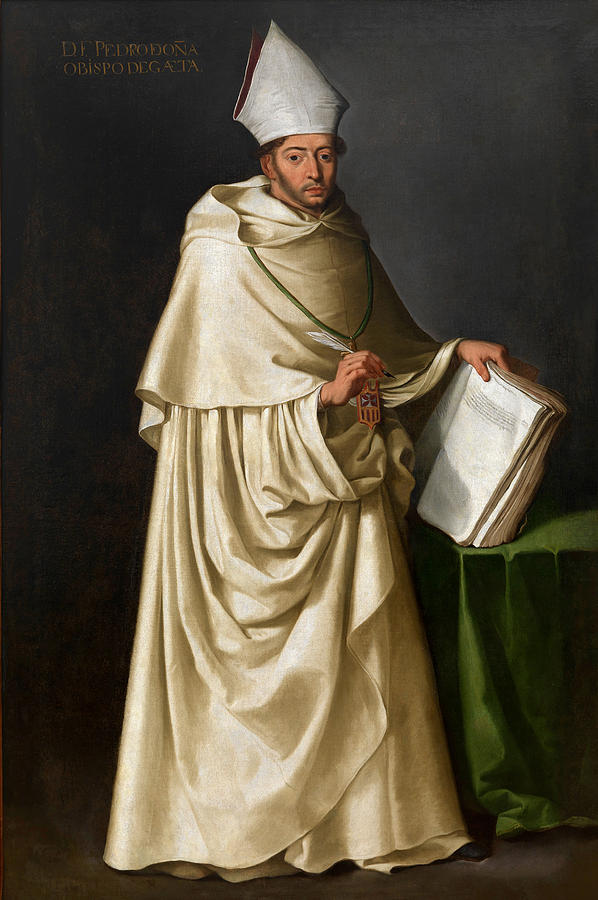
Francisco de Zurbaran’s painting “Fray Pedro de Ona” offers an impressive blend of portraiture, monastic devotion and quiet Baroque drama. At first glance the work appears simple. A bishop in a white habit stands before a dark background, one hand resting on an enormous book laid on a green table, the other holding a quill. Yet as the viewer spends time with the canvas, details of gesture, light and fabric reveal a complex image of authority that is rooted in humility and study.
Zurbaran is best known for his austere religious scenes and single standing saints. In this portrait he turns the same concentrated attention to a real historical figure, a Mercedarian friar who became a bishop. The result is both an official likeness and a spiritual emblem. Fray Pedro is shown not as a distant dignitary but as a contemplative churchman whose power flows from prayer and learning.
Historical and Religious Context
Fray Pedro de Ona belonged to the Order of Mercy, a Spanish religious community founded in the thirteenth century and devoted to the redemption of Christian captives. Members wore a distinctive white habit and were often depicted with the red and gold shield of the order. By the seventeenth century, when Zurbaran was active in Seville and later Madrid, the Mercedarians enjoyed strong royal support and many of their members rose to important ecclesiastical positions.
In the painting Fray Pedro is identified in an inscription as a bishop. His tall mitre and the large book suggest a man responsible for teaching and governing, yet still faithful to his monastic origins. This dual identity as friar and bishop lies at the center of the painting. Zurbaran’s challenge is to hold together the humility of a religious brother and the public weight of episcopal office.
The portrait would likely have hung in a Mercedarian convent or house as a record of an illustrious member and as an edifying example for future generations. Like other monastic portraits of the period, it unites commemoration with spiritual instruction. The viewer is invited to admire Fray Pedro’s achievements while also imitating his devotion to study and obedience.
Composition and Overall Structure
Zurbaran composes the work with clarity and economy. Fray Pedro occupies almost the entire height of the canvas, placed slightly to the left of center. His figure forms a tall vertical column of white that stands out against the dark neutral background. This verticality is gently offset by a diagonal from the upper left inscription down through his face, hand and the massive book resting on the green cloth.
The right edge of the canvas is anchored by the corner of the table. The book lies at a slight angle, so that its pages and thickness are clearly visible. Fray Pedro’s left hand rests on the open pages, stabilizing both the object and the composition. His right hand, holding a quill, is drawn back toward his chest where the badge of the Mercedarian order hangs from a green cord. This brings attention to the center of the figure and sets up a quiet triangular rhythm between head, hand and emblem.
There is no architectural frame, no window or curtain, only the plain background. This absence of external setting focuses attention entirely on the sitter and his attributes. It also creates a sense of timelessness, as if the bishop stands in a spiritual space between earth and heaven rather than in a specific room.
The Face of Fray Pedro de Ona
The psychological center of the painting is Fray Pedro’s face. Zurbaran portrays him with a strong nose, slightly hollow cheeks and a thoughtful mouth. His skin is rendered with subtle touches of warm and cool color, giving a sense of living flesh. The eyes are particularly expressive. They are directed outward but slightly to the side, not fixing on the viewer with aggressive intensity but meeting us with a measured, attentive look.
This expression suggests a man accustomed to listening, judging and teaching. There is no overt smile, yet the mouth is not severe. Instead, the features convey reserve and inner concentration. The viewer senses a personality shaped by study and responsibility. By avoiding dramatic emotion, Zurbaran makes Fray Pedro appear steady and reliable, the kind of shepherd who guides his flock through careful discernment rather than fiery rhetoric.
The mitre frames the head and amplifies its presence. Its tall white shape rises above the brow, catching light along its edges and expanding the vertical thrust of the figure. The hat underscores the dignity of the office while also reminding the viewer that this is a consecrated person who bears the fullness of sacramental authority.
The White Habit and Zurbaran’s Art of Drapery
One of the painting’s great pleasures is the rendering of the white habit. Zurbaran was a master in painting cloth and here he allows himself full freedom. The garment cascades in complex folds from shoulders to floor, forming waves and cascades of fabric that catch the light at varying angles. Broad planes alternate with deep recesses, creating a rhythm of brightness and shadow across the figure.
The color is not a flat white. It ranges from creamy tones in the highlights to soft grays and beiges in the shadowed areas. This subtle modulation gives volume and weight to the habit. The viewer can almost feel the heavy, slightly stiff texture of the cloth. The habit becomes a sculptural mass, giving the monk bishop a monumental presence within the pictorial space.
At the same time, the drapery is arranged with an eye to symbolism. The gathered folds around the waist suggest the cincture that binds a religious to his vows. The habit envelops the body completely, allowing no hint of vanity or worldly fashion. In this way it symbolizes renunciation and purity while also testifying to the dignity of the monastic state.
The Mercedarian Emblem and Green Cord
At the center of the chest, hanging from a green cord, is the shield of the Order of Mercy. Zurbaran paints it with careful detail. The small device bears a cross and vertical stripes in red and gold. Although tiny in comparison with the rest of the figure, it stands out vividly against the white habit, like a jewel on a stone surface.
This emblem serves several purposes. Historically, it identifies Fray Pedro’s religious allegiance. Spiritually, it reminds viewers of the order’s mission to free captives, a work that demanded both courage and financial sacrifice. For Mercedarian communities that might have contemplated this portrait, the badge would function as a small summary of their charism, worn close to the heart of one of their bishops.
The green cord that holds the emblem creates a soft line around the shoulders and down the chest. It introduces a new color into the otherwise limited palette of whites, browns and neutral tones. This hint of green echoes the green cloth on the table to the right, subtly tying together different parts of the composition.
The Book, Quill and Table
On the right side of the painting rests a massive book. Its pages are slightly open, tilted toward the viewer. The thick spine and heavy covers are carefully defined, suggesting an important, often used volume such as a breviary, a Bible or a book of canon law. Fray Pedro’s left hand presses lightly on its surface, as if he has just risen from study or is about to consult a particular passage.
The book is more than a still life object. It stands for the foundation of episcopal teaching. A bishop is guardian of doctrine and overseer of liturgy, and both roles require deep familiarity with the written tradition of the Church. By placing the book so prominently in the picture, Zurbaran underscores the intellectual dimension of Fray Pedro’s vocation.
In his right hand the friar holds a quill. The feather glows softly against the habit as it catches the light. This detail suggests that he is also a writer or at least a signatory of important documents. Bishops of the period wrote pastoral letters, decrees and treatises. The quill therefore signals active engagement in shaping the life of the Church. Combined with the book, it portrays Fray Pedro not only as a reader but as a contributor to the ongoing story of faith.
The table beneath the book is covered with a deep green cloth. Its heavy folds drop toward the floor, and their darker tones anchor the right side of the painting. Green often symbolizes hope and renewal. In this context the cloth may evoke the living tradition from which the texts emerge. Visually, it also adds a strong block of color that balances the otherwise dominant whiteness of the habit.
Light, Shadow and Atmosphere
Light enters the scene from the left, striking the upper torso, face and front of the habit while leaving the background in shadow. This contrast is not as radical as in some of Zurbaran’s more tenebrist works, but it still creates a powerful sense of volume. The illuminated folds of the robe stand out in sculptural relief against the dark plane behind him. The side of the mitre that faces the light glows, while the far side recedes into softer shadow.
This manipulation of light gives the bishop a sort of inner radiance. He seems to emerge from darkness, much as spiritual wisdom emerges from the hidden silence of study and prayer. The shadows are not threatening; instead, they provide a calm backdrop that enhances the impression of stillness and inward focus.
The atmosphere is quiet and restrained. There are no dramatic rays, no glowing halos painted in obvious fashion. Sanctity here is suggested through the serenity of the figure, the purity of the white habit and the concentration of the face rather than through supernatural effects. This low key approach suits the nature of the subject, a contemplative churchman whose holiness expresses itself in faithful service rather than spectacular miracles.
Portraiture and Idealization
Although the painting certainly intends to be a recognizable likeness of Fray Pedro de Ona, Zurbaran also idealizes his sitter according to the expectations of Baroque religious portraiture. The proportions of the body are slightly elongated, emphasizing dignity. The posture is upright and balanced, with no hint of fatigue or casualness. Every element, from the clean line of the habit to the controlled gesture of the hands, conveys discipline and inner order.
This idealization does not make the figure unreal. Instead, it shows Fray Pedro as he would have wished to be remembered, in the fullness of his vocation. Portraits of religious superiors often functioned as moral mirrors for those who looked at them. The viewer was not invited simply to admire physical likeness but to meditate on the virtues embodied. Zurbaran’s careful balance between individual character and archetypal bishop allows the painting to resonate beyond the life of one man.
Relationship to Zurbaran’s Other Works
“Fray Pedro de Ona” belongs to a larger group of full length portraits of Mercedarian friars and bishops painted by Zurbaran. In many of these works he presents solitary figures standing against dark backgrounds, holding books, crosses or other attributes. This formula allowed him to concentrate on the interplay of light and fabric while also expressing the contemplative seriousness of monastic life.
Compared with his more famous paintings of martyrs and saints in ecstasy, this portrait is quieter but no less intense. Where other canvases dramatize spiritual struggle, here the drama is interior. The same mastery of white drapery that animates his pictures of Carthusian monks and penitent Franciscans is applied to a more stately figure, creating continuity across his religious imagery.
For viewers familiar with Zurbaran’s oeuvre, the painting offers insight into how the artist understood holiness. Whether depicting biblical heroes, legendary virgins or real historical friars, he returns again and again to the themes of silence, humility and focused attention. Fray Pedro de Ona stands firmly within this spiritual world.
Contemporary Reflections
Today, “Fray Pedro de Ona” can be appreciated on multiple levels. As an artwork it showcases Zurbaran’s exceptional handling of cloth and light, his capacity to create presence with minimal setting and his sensitivity to character. Art historians study it to understand the visual culture of religious orders in seventeenth century Spain and the role of portraiture in shaping institutional memory.
On a more personal level, the painting speaks to anyone who values learning, responsibility and inner discipline. The massive book and quill suggest that serious thought and careful words still matter. The white habit reminds viewers that authority is most authentic when rooted in service and renunciation. Fray Pedro’s calm gaze across time can challenge modern audiences to consider how they unite knowledge, faith and leadership in their own lives.
Conclusion
Francisco de Zurbaran’s “Fray Pedro de Ona” transforms the official portrait of a Mercedarian bishop into a profound meditation on vocation. Through controlled composition, luminous drapery and psychologically nuanced expression, the artist presents a man who is at once friar and prelate, scholar and pastor, humble religious and figure of authority.
The tall white habit, small but brilliant emblem of the order, massive book and delicate quill all contribute to a visual narrative of faithful service grounded in study and prayer. Standing against the quiet darkness, Fray Pedro appears as a stable pillar of the Church, illuminated by the gentle light that touches his face and garment. In this restrained yet powerful image, Zurbaran invites viewers to see beyond external rank to the interior life of commitment that gives true weight to any office.