Image source: wikiart.org
Introduction
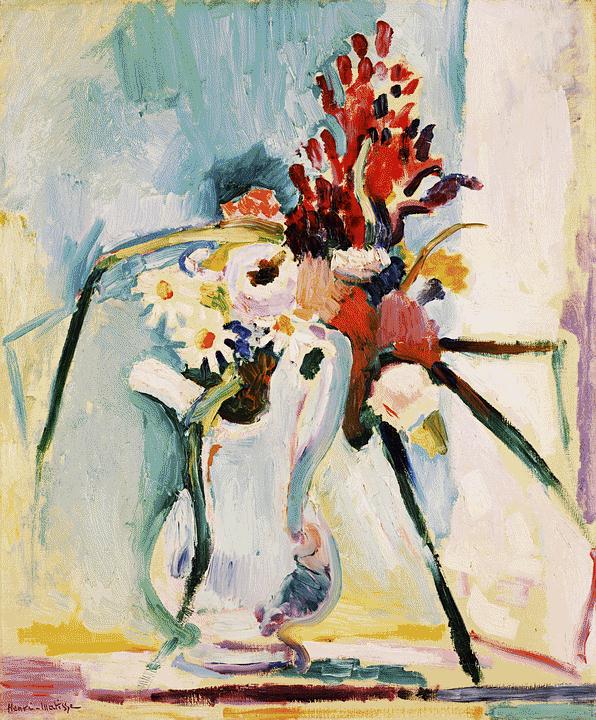
Henri Matisse’s Flowers in a Pitcher (1908) turns a familiar still-life motif into a compact laboratory of modern painting. A pale, curvaceous jug rises at center like a small piece of architecture. From its mouth, a restless bouquet erupts: crimson spikes and rounded blossoms collide with stems that shoot diagonally outward, cutting across the picture plane like vectors. The table and wall around the arrangement are not the neutral stage of nineteenth-century realism; they are active fields of color—icy blues, milky yellows, lavender shadows—laid with a brisk, visible hand. The composition has the feeling of something seen and seized in one breath, yet its apparent spontaneity conceals a rigorous orchestration of shape, temperature, and rhythm.
Historical Context
The year 1908 marks Matisse’s consolidation after the incendiary exhibitions of the Fauves. He had already demonstrated that color could be liberated from local description, now he searched for a calmer equilibrium where color would also provide structure. At the same time he was in deep dialogue with sculpture and with decorative arts from North Africa and the Islamic world, collecting textiles and ceramics whose clarity of contour and fearless palettes nourished his pictorial thinking. Flowers in a Pitcher belongs to this moment. It preserves Fauvism’s intensity while clarifying form, and it uses still life—traditionally a genre of quiet contemplation—as a place to test how a painting might be built from bold chromatic decisions rather than careful illusion.
Composition and Spatial Design
The canvas is organized around a vertical axis: the pitcher’s elegant S-curve rides up the center, its fat belly grounding the composition and its narrow neck focusing the bouquet into a tight mouth. Rather than arranging flowers symmetrically, Matisse lets stems orbit outward on slants that sweep to the right and left, energizing the rectangle. The table edge is barely indicated by a band of warm pigment at the bottom, just enough to keep the jug from floating. Behind, a large chilled plane—somewhere between wall and air—anchors the bouquet by contrast. The result is a shallow, breathable space that refuses deep perspective and instead treats the surface itself as the main stage of the drama.
Color Architecture
Color carries the architecture of the image. The palette is high key but not garish: cool mint and eau-de-nil greens in the stems; icy blues and aquas in the background; creamy yellows and pale pinks in the table field; rusted crimsons and wine reds in the flowers. Matisse avoids heavy earth tones. He orchestrates complementary tensions—reds against blue-greens, yellow cream against violet shadow—so that each hue intensifies the others. The pitcher reads pale, almost pearly, because it is hemmed by deeper, cooler strokes and by vamping reds above it. Instead of glazing or modeling with brown shadow, he shifts temperature: warm notes carry surfaces toward the viewer, cool notes push them back. The bouquet’s red plume becomes the chromatic apex that calibrates every other decision on the canvas.
Brushwork and Surface
The surface of Flowers in a Pitcher is frank about the time of its making. Wide, loaded strokes lay in the wall with quick changes of direction that prevent the blue field from congealing. Around the bouquet the brush becomes pointed and staccato, flicking petals into place and dragging stems in single, calligraphic sweeps. The pitcher itself collects several kinds of touch: soft, scumbled planes that let the canvas tooth breathe through; bounding lines loaded with darker color that snap the silhouette; and a few, thicker highlights that catch where the form would curve into light. Nothing is polished to a photographic finish. The painting’s vitality comes from a dialogue between deliberate placing of shapes and the visible record of the hand.
Contour as Binding Force
Matisse’s black-green contour performs the structural work that academic modeling once did. It thickens along turns of the pitcher’s profile, thins along straights, and abruptly hooks at the handle’s join, behaving like lead in stained glass. Around the bouquet, contour converts splashes of color into legible blossoms without pinning them down into botanical detail. A single stroke girds a daisy’s rim; a darker crescent states a petal’s shadow; a rapid zigzag locks the red spike to its stem. This contour gives authority to bold, flat passages of color and prevents the composition from dissolving into indistinct pigment.
Light Without Illusion
There is no single spotlight or directional sun. Instead, light is a condition generated by color relationships. The pitcher gleams because its pale planes are set against cooler surroundings and because the artist drops small, cool accents into its interior to suggest recess. Flowers brighten without white highlights simply by being tuned toward warm, saturated notes against the chilled ground. Shadows—such as they are—arrive as temperature shifts: lavender rather than black, cooler green rather than brown. This approach preserves the painting’s decorative flatness and keeps color luminous across the surface.
The Pitcher as Form and Character
The vessel is not a neutral container; it is the second protagonist after the bouquet. Its curves echo human anatomy: a broad belly, a pinched waist, a neck that lifts and then pours. Matisse amplifies this corporeal presence by giving the jug a crisp profile and by letting its handle read as a muscular loop instead of a fragile ear. Touches of blue and mauve inside the white form save it from blankness and rhyme with the background. This treatment reflects Matisse’s fascination with pottery and with simple utilitarian objects whose silhouettes carry centuries of refinement. In his hands, the pitcher is both useful object and abstract shape, an anchor that lets the more volatile bouquet act freely.
The Bouquet as Structure
Most still lifes treat flowers as a subject to be rendered; Matisse treats them as a way to organize the canvas. The bouquet rises in three distinct registers. At the base, soft whites and pinks offer a cushion of calm. In the middle, a compact knot of darks gathers, compressing energy before it shoots upward. At the top, a crimson flare bursts past the container’s rim, announcing verticality and completing the picture’s climb. The outward-thrusting stems set lateral rhythms that counter the vertical push, keeping the eye moving diagonally across the field. Daisies, a carnation-like bloom, and the red spike are not botanically separated so much as pitched as different percussive instruments in the same ensemble.
Background and Negative Space
The spaces between stems and around the pitcher work as actively as the solids. Matisse lets the blue-green wall breathe through as clean intervals, creating a lace of negative shapes that feels as carefully tuned as the bouquet itself. At the right edge a pale field opens, like reflected light on plaster, preventing the cluster of stems there from becoming heavy. Near the bottom, a soft yellow band suggests table and also functions as a warm counterweight to the cool sky of the wall. These voids are not gaps but deliberate silences that allow the color chords to resonate.
Rhythm and Movement
Despite its small scale, the painting pulses with rhythm. The diagonals of the stems behave like musical accents that cross the steady beat of the vertical pitcher. The eye enters at the bright red crest, descends the dark central stem into the jug’s throat, loops through the white daisies, and then skims along the long green shafts that leave the arrangement to the right. From there, the viewer travels back along the warm base to reascend the left edge of the pitcher. This loop is gentle but insistent. Nothing is static; the bouquet seems to have just been set down, flowers still settling toward balance.
Decorative Intelligence
Decoration in Matisse is not cosmetic; it is structural thinking. The painting’s apparent simplicity relies on decorative principles: symmetry abandoned in favor of dynamic balance, repeated motifs (petal, stem, curve) building pattern, and color distributed like a textile across the surface. One can imagine the canvas as a tapestry where object and ground are woven from the same materials. This decorative intelligence is what allows Matisse to flatten space without losing coherence. The still life becomes a screen of interlocking shapes whose harmony is felt instantly and examined at leisure.
Relationship to Earlier and Later Works
Flowers in a Pitcher converses with Matisse’s earlier “wild” years and with his later grand interiors. From Fauvism it inherits the conviction that color can substitute for light and that contours can speak more clearly than laborious modeling. Yet it is already leaning toward the more orchestrated spaces of 1908–1911, where table, wall, and object will be simplified into emblematic planes. The insistent red, the pale jug, and the mobilized background anticipate the theater of color that culminates in The Red Studio and other room-scales works, in which objects from Matisse’s real studio become actors on a chromatic stage.
Materials and the Evidence of Making
The painting’s material candor is central to its charm. Bristles rake the paint in the background; small ridges gather at the edges of the jug’s outline; a stem’s dark line breaks and resumes, revealing the speed of the hand. Passages of thin scumble let the ground tone play through, particularly in pale areas near the top, while thicker impasto collects on the crimson blossoms and at the base of the jug. These variances of thickness and transparency create a tactile rhythm that complements the visual one. You see not just what Matisse saw, but how he decided—stroke by stroke—to present it.
Viewing Distance and Optical Behavior
From several meters away the painting reads as a confident arrangement of big color blocks: white jug, red flare, blue ground, yellow base. As you move closer, it breaks into a mosaic of specific events—edged petals, quick stem turns, specks of dark that conjure floral centers. This dual behavior is by design. Matisse cultivates a legibility at distance—so the work commands a wall—and a wealth of close incident that rewards patient looking. The shift from afar to near echoes the movement of a person approaching a bouquet on a table, first taking its overall silhouette and then savoring the particularities of bloom and leaf.
The Ethics of Simplification
Simplification in Flowers in a Pitcher is not a denial of reality but a distillation of experience. Matisse declines to catalogue each petal or to articulate the room’s architecture because those additions would dilute the painting’s point: how color and shape alone can create presence and space. This ethic keeps sentimentality at bay. The flowers are not symbols of evanescence; they are fields of color that animate the jug and the wall. The painting is generous but unsentimental, offering freshness without sugar.
The Role of Warm and Cool Balance
The harmony of the painting rests on a precise calibration of warm and cool. Cool dominates the setting—blue wall, cool green stems, bluish whites in the jug—while warmth concentrates in the table band and in the flowers’ cores. Even the reds carry cool notes of violet that keep them from turning heavy. This distribution ensures that the composition breathes. If the background were warm, the jug would sink; if the stems were warm, they would smear into the flowers. By letting cool surround warm, Matisse makes the bouquet feel sunlit even without a literal source.
Time, Gesture, and the Human Hand
There is a sense of time in the picture, not narrative time but the time of gesture. The long, confident stem strokes testify to a single breath; the smaller, rotary petal touches indicate a different tempo; the soft scumbling across the wall suggests pauses and restarts. These temporal cues animate the painting and connect viewer to maker. You are aware not simply of a still life but of the act of making a still life, a record of decisions that turn seeing into structure.
Symbolic Possibilities
Matisse’s still lifes rarely depend on allegory, yet viewers often detect symbolic echoes. The jug, with its maternal curve, sets off the eruptive bouquet like a body releasing energy. The red headdress of blooms can read as a flame or a crown, lifting a humble domestic scene toward the ceremonial. The long, reaching stems suggest outwardness—aspiration or extension—while the daisies near the jug’s lip act as a circle of calm. Because these readings arise from form rather than iconography, they remain open and undogmatic, consistent with Matisse’s belief that painting should offer “a soothing, calming influence” while remaining fully alive.
Legacy and Influence
Flowers in a Pitcher exemplifies a way of making still life modern without irony or gimmickry. Its lessons endure: treat color as structure, not ornament; let contour dignify forms; allow background to participate as an active plane; and keep the surface honest so the viewer senses the painting’s making. Designers and painters alike continue to draw from this grammar—bold silhouette paired with vibrant ground, whites enlivened by cool accents, warm notes concentrated in small, strategic places. The canvas stands as a concise testament to Matisse’s ability to fuse immediacy with order.
Conclusion
In Flowers in a Pitcher, Henri Matisse takes a jug and a bouquet—subjects as old as painting—and rebuilds them with a twentieth-century intelligence. Composition arises from a play of axes and intervals; light is achieved through temperature rather than shade; the surface records gesture without apology; and decoration becomes structure. The painting’s freshness lies in its equilibrium: wildness tamed by contour, intensity cooled by pale grounds, spontaneity supported by design. It invites the viewer to look not only at flowers but through them—to the principles of color and rhythm that animate the visible world.