Image source: wikiart.org
Introduction to “Flowers and Fruit” by Claude Monet
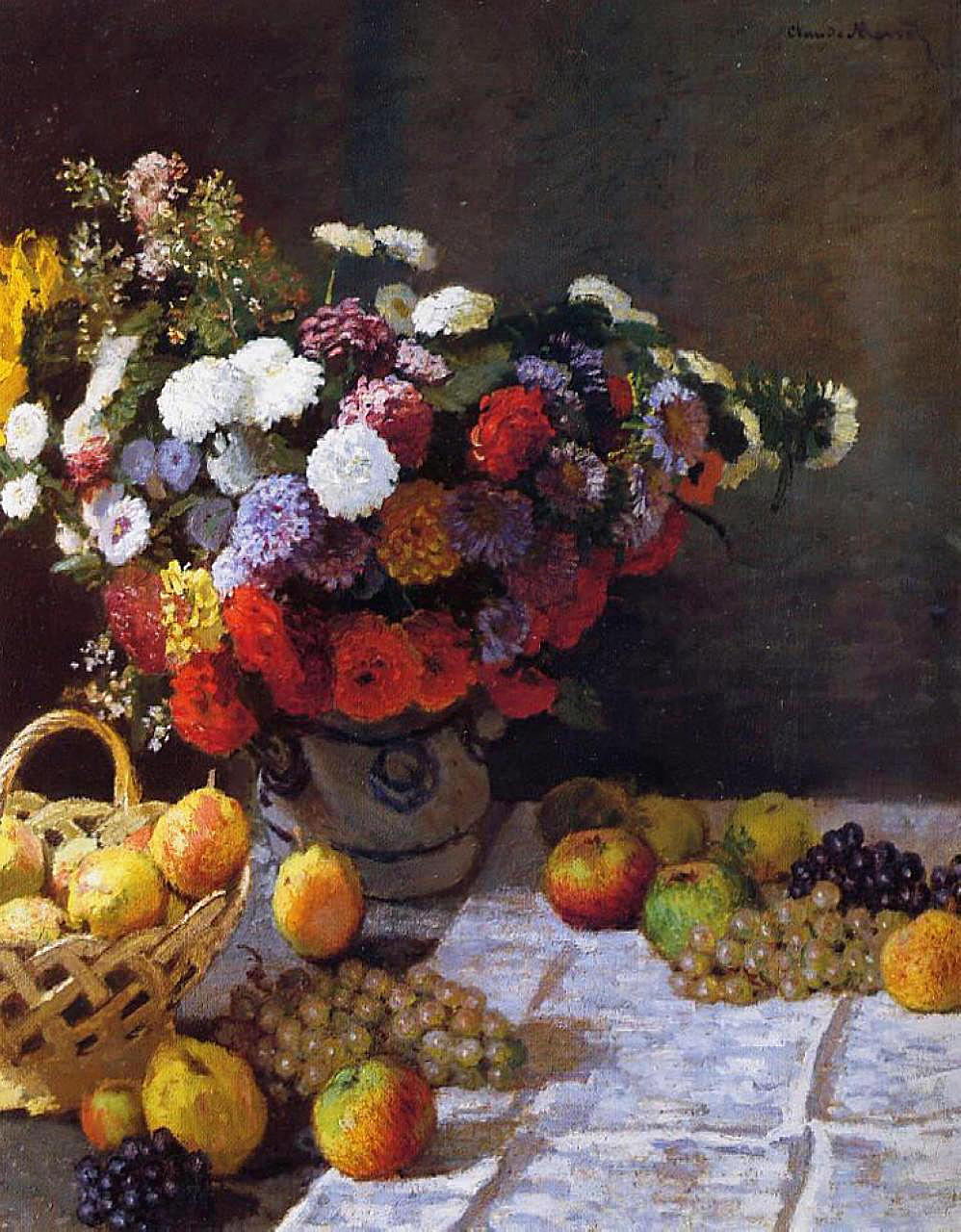
Claude Monet’s “Flowers and Fruit,” painted in 1869, is a rich and vibrant still life that reveals a fascinating side of the artist before his name became inseparable from Impressionism. Although Monet is most often associated with rivers, gardens, cliffs, haystacks, cathedrals, and shifting outdoor light, this painting shows how powerfully he could transform a traditional still life subject into something immediate, lively, and modern. The work brings together flowers, fruit, table linen, pottery, and shadow, yet it never feels like a simple arrangement of objects. It feels like a living surface, a moment of abundance captured before it changes.
At first glance, the painting presents a generous bouquet placed in a vessel at the center of a table, surrounded by apples, pears, grapes, and a woven basket. The objects are familiar, domestic, and accessible, but Monet’s treatment makes them feel urgent and dramatic. The flowers burst outward in reds, whites, yellows, violets, and greens, while the fruit below glows against the pale folds of the tablecloth. Behind this display, a dark background intensifies the color of the bouquet and gives the scene an almost theatrical depth. The composition is balanced but not stiff, carefully arranged yet full of motion.
Painted in 1869, the work belongs to a crucial period in Monet’s development. He was still refining the techniques that would later define Impressionism, but he had already moved away from the polished surfaces and controlled finish expected by academic taste. In “Flowers and Fruit,” he treats still life not as a quiet exercise in realism, but as a field of light, color, texture, and sensation. The brushwork is energetic, the colors are alive, and the objects seem to exist in the unstable space between material presence and visual impression.
Monet in 1869 and the Importance of Still Life
The year 1869 was an important moment in Monet’s artistic journey. He was still young, ambitious, and struggling for recognition, but he was already forming the habits of vision that would make him one of the central figures of modern painting. While his later career would be dominated by outdoor subjects, still life gave him a controlled setting in which to explore color relationships, surface effects, and the interaction between light and form. In a still life, the artist could arrange the objects, adjust the background, control the lighting, and focus intensely on the act of seeing.
“Flowers and Fruit” shows Monet using this traditional genre as a space for experimentation. The subject itself has deep roots in European art. Flowers and fruit had appeared for centuries in Dutch, French, and Spanish still lifes, often carrying symbolic meanings related to abundance, beauty, ripeness, mortality, and the passing of time. Monet does not reject that tradition entirely. The blossoms are fragile, the fruit is ripe, and the table suggests temporary plenty. Yet his approach is not moralizing or symbolic in a heavy-handed way. He is less interested in turning the objects into a lesson than in making the viewer feel their color, weight, freshness, and visual vitality.
This painting also reveals Monet’s connection to realism. The fruit is not idealized into perfect forms. The apples are mottled, the grapes vary in tone, and the flowers appear irregular, dense, and layered. The basket is roughly described with quick strokes, while the tablecloth is painted with visible marks that suggest texture rather than smooth finish. Monet wants the scene to feel observed, not invented. Still, he does not copy the objects with photographic precision. Instead, he translates them into paint, allowing the brushstroke itself to become part of the experience.
The Composition and Arrangement of Abundance
The composition of “Flowers and Fruit” is built around a strong contrast between fullness and openness. The left and central areas are densely packed with objects, while the right side contains more breathing room, especially in the dark background above the table. This asymmetry gives the painting energy. The arrangement does not feel mechanically centered, even though the vase of flowers dominates the middle of the work. Instead, Monet lets the bouquet spill outward, the fruit scatter across the table, and the basket lean into the lower left corner. The eye moves naturally through the painting, following color and form rather than a rigid geometric plan.
The bouquet is the visual anchor. It rises from the vase like a mass of living color, with white blossoms catching the eye near the top and red flowers forming a powerful band through the lower portion. Around them appear lavender, purple, yellow, and green accents, creating a sense of complexity without confusion. The flower arrangement has an almost explosive quality, as though the blossoms have expanded beyond the limits of the container. Monet does not isolate each flower with botanical clarity. Instead, he groups them into clusters of color and texture, allowing the viewer to sense the bouquet as a whole before noticing individual blooms.
Below the flowers, the fruit spreads horizontally across the table. This creates a stabilizing base for the upward movement of the bouquet. Apples and pears appear in warm yellows, oranges, reds, and greens, while grapes provide darker notes of purple and translucent pale gold. The basket at the lower left adds a diagonal rhythm, its woven structure contrasting with the rounded fruit and soft petals. The tablecloth, with its pale blues, whites, and grays, acts as a bright stage on which the fruit rests. Its folds and shadows guide the viewer’s eye from left to right, connecting the scattered objects into a unified arrangement.
The Dark Background and the Drama of Contrast
One of the most striking features of “Flowers and Fruit” is its dark background. Instead of placing the still life in a bright interior with clear architectural details, Monet uses a deep, muted backdrop that allows the flowers and fruit to glow. This darkness is not empty. It contains subtle variations of brown, green, gray, and black, creating a softly shifting atmosphere behind the objects. The background helps the painting feel intimate and concentrated, as if the viewer has come close to the table and is seeing the arrangement under controlled indoor light.
The dark background also intensifies Monet’s colors. The white blossoms appear brighter because they emerge from shadow. The red flowers seem richer because they are set against deep tones. The yellow fruit glows more warmly because the surrounding space is subdued. This contrast gives the painting a dramatic quality that connects it to older still life traditions, especially those that used shadow to heighten the sensual presence of objects. Yet Monet’s handling is more open and painterly than the polished finish associated with many earlier still lifes.
The background also prevents the painting from becoming decorative in a shallow sense. The flowers and fruit are beautiful, but the surrounding darkness gives them weight and seriousness. There is a quiet tension between freshness and shadow, abundance and impermanence. The objects are full of life, yet the dark space behind them reminds us that their beauty is temporary. Monet does not need to state this idea directly. It is built into the visual structure of the painting. The more the flowers glow, the more we sense the darkness around them.
Color as the Main Language of the Painting
Color is the driving force of “Flowers and Fruit.” Monet uses it not only to describe objects, but to create rhythm, depth, and emotional warmth. The painting contains a wide range of tones, from deep reds and purples to bright whites, yellows, greens, and blues. Yet the colors do not feel random. They are carefully distributed across the canvas so that each area answers another. The reds in the bouquet echo the reddish patches on the apples. The yellows of the flowers connect with the pears and golden fruit. The purples in the blossoms relate to the dark grapes at the lower edge.
The white flowers are especially important. They act as points of light within the dense bouquet. Monet paints them with thick, broken strokes that suggest petals catching illumination from different angles. These whites are not pure or flat. They contain hints of blue, gray, cream, and pale yellow, allowing them to feel integrated into the rest of the composition. The same sensitivity appears in the tablecloth, where white is broken into cool and warm variations. Monet understands that white objects are never simply white. They absorb surrounding colors, reflect light, and change according to shadow.
The red flowers give the painting its emotional intensity. Their color is deep, warm, and almost pulsing. They are placed low in the bouquet, near the vase and fruit, which helps connect the floral and edible elements of the still life. The reds suggest richness, ripeness, and sensual abundance. They also prevent the bouquet from feeling delicate or fragile in a conventional way. This is not a pale, polite flower arrangement. It is bold, physical, and full of energy.
The Flowers as a Study of Movement and Texture
Although the flowers are stationary objects, Monet paints them as if they are full of motion. Petals overlap, stems disappear into shadow, and blossoms push in different directions. Some flowers face the viewer directly, while others turn sideways or dissolve into the dark background. This variety creates a sense of natural irregularity. The bouquet feels freshly gathered rather than formally arranged. It has the looseness of something living.
The brushwork is central to this effect. Monet does not outline each blossom with precision. Instead, he uses touches, dabs, and strokes of color to suggest the textures of petals and leaves. A white flower may be formed from several thick patches of paint, while a red bloom may emerge from layered strokes of crimson, orange, and dark brown. This method allows the flowers to shimmer. They are not fixed in hard contour, but seen through the movement of the eye.
This treatment anticipates Monet’s later fascination with gardens and flowers, especially the water lilies of his mature period. In “Flowers and Fruit,” the blossoms are still placed within a traditional still life format, but Monet already seems interested in the way flowers can dissolve into color and light. He is not simply painting flowers as objects. He is painting the visual experience of looking at flowers, of seeing color masses, highlights, shadows, and textures all at once.
The Fruit and the Sensation of Ripeness
The fruit in the lower half of the painting gives the work a strong sense of earthly abundance. Apples, pears, grapes, and possibly other fruits are arranged across the table in a way that feels casual but carefully judged. Some are gathered in the basket, while others have spilled or been placed loosely on the cloth. This scattering makes the scene feel natural and domestic. It suggests that the table has been used, handled, and enjoyed.
Monet paints the fruit with remarkable attention to color variation. The apples are not simple red or green spheres. They contain transitions of yellow, orange, red, and green, with small marks that suggest texture and irregularity. The pears glow with golden warmth, while the grapes range from pale translucent green to deep purple-black. These differences create a rich contrast between smooth skins, clustered forms, and rounded volumes.
The fruit also serves a compositional purpose. It pulls the viewer’s eye downward after the visual intensity of the bouquet. The table becomes a landscape of small forms, each catching light differently. The grapes introduce a dotted rhythm, while the apples and pears provide larger rounded shapes. The basket, with its woven structure and curved handle, adds a rustic note that contrasts with the softness of the fruit and flowers. Together, these elements create a sense of plenty that is both visual and tactile.
The Tablecloth and the Beauty of Ordinary Surfaces
The tablecloth plays a larger role than it might first appear. Its pale surface brightens the lower part of the painting and gives the fruit a luminous setting. Monet paints the cloth with visible strokes of white, gray, blue, and beige, suggesting folds, creases, and reflected light. The cloth is not a neutral background. It is an active part of the composition, catching light and shaping the viewer’s movement across the canvas.
The folds of the tablecloth create subtle diagonals that lead the eye through the fruit. These lines break up the horizontal surface and prevent the lower half from feeling flat. The cloth also introduces a contrast between human order and natural abundance. It is a domestic object, spread across the table to create a clean setting. Yet the fruit and flowers interrupt that order with their irregular shapes and vivid colors. The result is a scene that feels both arranged and alive.
Monet’s handling of the cloth also shows his interest in the materiality of paint. He does not smooth the fabric into illusionistic perfection. Instead, he lets the brush marks remain visible. The texture of the painted surface becomes part of the texture of the cloth. This is one reason the painting feels modern. Monet invites the viewer to see both the object and the act of painting at the same time.
The Vase and the Hidden Center of the Painting
The vase is partly obscured by the mass of flowers, yet it is essential to the painting’s structure. It sits near the center, holding the bouquet and connecting the vertical rise of the flowers to the horizontal spread of the table. Its muted color keeps it from competing with the flowers and fruit, but its rounded body adds stability. The decorative mark on its surface provides a small point of visual interest, suggesting pottery without drawing too much attention away from the surrounding abundance.
The partial concealment of the vase is important. Monet does not make it the star of the still life. Instead, he allows it to function as a support, something necessary but modest. This choice reinforces the feeling that the bouquet is overflowing and difficult to contain. The flowers seem almost too large for the vessel, as though nature has exceeded the boundaries of domestic arrangement.
The vase also contributes to the painting’s balance of softness and solidity. The flowers are delicate and irregular, while the fruit is rounded and tactile. The vase has a firmer, more stable presence. Its darker tones help anchor the center of the composition, preventing the bouquet from floating above the table. Even though it is visually understated, it is the quiet hinge around which the whole arrangement turns.
Light, Shadow, and the Interior Atmosphere
Unlike Monet’s later outdoor paintings, where sunlight often becomes the main subject, “Flowers and Fruit” uses interior light in a concentrated way. The illumination appears to fall from the left, catching the basket, fruit, white blossoms, and portions of the tablecloth. Shadows gather behind and beneath the objects, giving them depth and weight. The result is not a bright, airy scene, but a richly atmospheric one.
This indoor light allows Monet to explore contrast more deeply. The fruit on the left glows warmly, while the right side of the table becomes cooler and more subdued. The bouquet contains both brilliant highlights and dense pockets of darkness. Some flowers seem fully visible, while others retreat into shadow. This variation creates a strong sense of depth within a relatively shallow space.
The light also gives the painting its emotional mood. It feels intimate, perhaps even slightly hushed. The viewer is not standing in a public garden or open landscape, but close to a table in a private interior. The objects are near enough to touch. Their colors seem intensified by the surrounding darkness. This closeness gives the painting a quiet sensuality, centered on the pleasures of looking, touching, smelling, and tasting.
A Still Life Between Tradition and Modernity
“Flowers and Fruit” stands between old and new ways of painting. Its subject belongs to a long still life tradition, but its technique points toward modern art. Monet respects the arrangement of flowers and fruit as a meaningful subject, yet he refuses the highly finished surface that older academic viewers might have expected. He lets the brushwork remain active. He allows edges to blur. He uses color relationships to hold the composition together rather than relying on precise outlines.
This balance makes the painting especially interesting within Monet’s career. It shows him absorbing tradition while pushing beyond it. The dark background, abundant fruit, and floral display connect the work to earlier European still lifes. Yet the flickering brushwork and attention to visual sensation anticipate the Impressionist approach. Monet is not yet painting the same kind of broken outdoor light that would define many of his later works, but he is already treating perception as something active and changeable.
The painting also suggests that modernity does not always require a modern subject. A bouquet and fruit basket could have appeared in a painting centuries earlier, but Monet makes them feel new through the way he sees them. The freshness lies in the handling, the color, and the refusal to over-explain. The objects remain ordinary, but the act of seeing them becomes extraordinary.
The Emotional Character of the Painting
The emotional power of “Flowers and Fruit” comes from its combination of richness and intimacy. The painting feels generous, but not grandiose. It celebrates abundance without becoming artificial. The fruit looks ripe, the flowers look full, and the table seems prepared for enjoyment. At the same time, the dark background and loose handling prevent the scene from feeling merely decorative. There is a sense of passing time, as if the beauty of the arrangement is already beginning to change.
The flowers may soon wilt. The fruit may soon be eaten. The tablecloth may be cleared. Monet captures the scene at the height of its visual fullness, but the viewer senses that this fullness is temporary. This gives the painting a quiet poetic quality. It is not a dramatic story painting, yet it contains a subtle awareness of transience. Beauty is presented as something immediate, physical, and fleeting.
The mood is also warm and inviting. The viewer is drawn toward the table, into the glow of the fruit and the dense color of the bouquet. The painting does not keep us at a distance. It offers the pleasures of color, texture, and abundance directly. Yet because Monet’s brushwork remains visible, we are also aware that this pleasure is mediated by paint. The scene is both real and constructed, both domestic and artistic.
Why “Flowers and Fruit” Matters in Monet’s Oeuvre
“Flowers and Fruit” matters because it broadens our understanding of Monet. It reminds us that he was not only a painter of landscapes and gardens, but also an artist deeply attentive to arranged objects, interior light, and the expressive possibilities of still life. The painting shows his ability to find movement in stillness and atmosphere in a simple domestic setting. It also demonstrates how early his interest in color and visual sensation had already become central.
The work also helps connect Monet’s early realism with his later Impressionism. In the fruit, flowers, basket, and cloth, he still gives the viewer recognizable forms and physical presence. Yet in the broken surfaces, lively brushwork, and shifting color, he moves toward a more modern language. The painting does not reject reality. It reimagines reality as something perceived through light, color, and touch.
For viewers who know Monet mainly through his water lilies, haystacks, or views of the Seine, this still life offers a more intimate encounter with his art. It shows the same sensitivity to light and color, but on a smaller and more domestic scale. It reveals how Monet could turn a tabletop into a world of visual discovery. Every apple, grape, petal, and fold of cloth becomes part of a larger experiment in perception.
Conclusion
Claude Monet’s “Flowers and Fruit” is a beautiful and important still life from 1869, a painting that captures the artist at a formative moment in his career. Through a richly arranged bouquet, glowing fruit, a pale tablecloth, and a dark atmospheric background, Monet creates a scene of abundance that feels both traditional and modern. The painting honors the long history of still life while transforming it through loose brushwork, vivid color, and a heightened attention to visual sensation.
The work is especially powerful because it makes ordinary objects feel alive. The flowers seem to expand outward from the vase, the fruit glows with ripeness, and the tablecloth catches light in broken strokes of white and blue. Nothing is treated as static or merely decorative. Every part of the painting participates in a larger rhythm of color, texture, and movement.
“Flowers and Fruit” reveals Monet’s early mastery of composition and atmosphere. It also shows the foundations of the artistic vision that would later reshape modern painting. Even within an indoor still life, Monet is already exploring the unstable beauty of appearances. He understands that light changes objects, that color creates emotion, and that paint can preserve not only what things look like, but how they feel in a particular moment of seeing.