Image source: wikiart.org
A late Waterhouse study and the idea of an enchanted setting
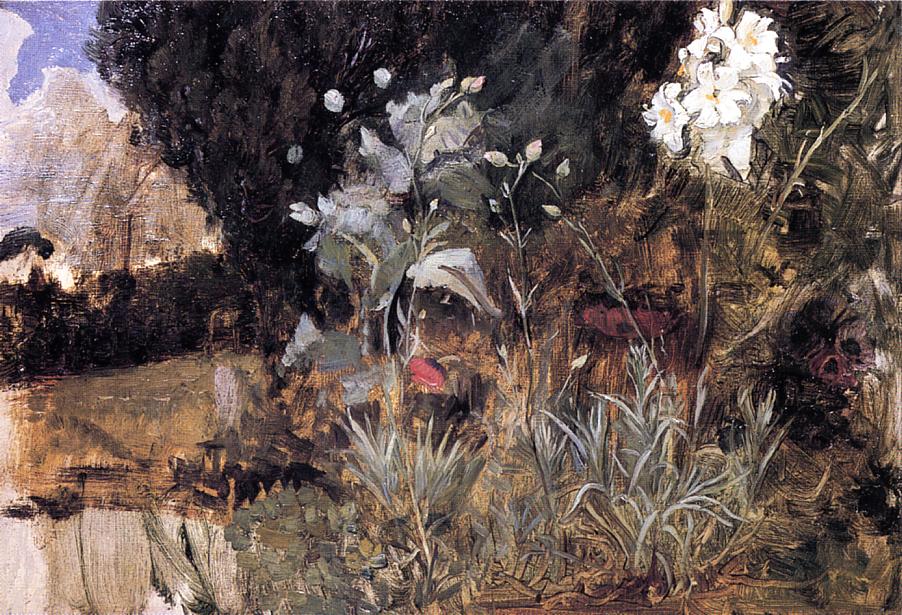
John William Waterhouse’s “Flower Sketch for The Enchanted Garden” (1916) reads like a private note made in paint, a compact rehearsal for a larger dream. Instead of presenting a finished narrative scene, it lingers at the threshold where a picture is still becoming itself. The title points us toward a destination, an “enchanted garden,” yet this panel stays deliberately local: flowers, stems, leaves, and the heavy architecture of shadow behind them. In late works like this, Waterhouse often allows atmosphere to carry meaning as strongly as story. The enchantment is not performed by characters or clear mythological props. It is suggested by the way vegetation gathers, by the hush of dark foliage, and by a faintly unreal light that seems to arrive from beyond the picture’s left edge.
The overall impression is of a garden corner seen at an angle, half concealed, half revealed. It feels observed rather than staged, as if the painter paused mid walk and recorded a patch of growth where blossoms flare briefly against dusk. Because it is a sketch, the painting also reveals a second kind of enchantment: the transformation of raw looking into image. Waterhouse shows us what he chooses to keep, what he chooses to ignore, and how he builds a world by balancing attention with omission. The result is both intimate and theatrical, a study that already contains the emotional logic of a finished scene.
Composition as a thicket of attention
The composition is anchored by a mass of deep, nearly black foliage that rises through the center and upper portion of the image. This dark canopy acts like a curtain, creating a stage space in front where the flowers can appear as bright actors. On the right side, a cluster of white blossoms sits high and close to the edge, glowing with a chalky brilliance. Below and nearer the center, paler blooms and long blades of foliage climb upward on thin stems, while small red accents punctuate the middle ground like scattered embers.
Waterhouse organizes the scene through contrast rather than symmetry. The left side opens outward into lighter air: a pale sky tinted lavender and gray, and a soft band of earth that recedes gently. This openness is crucial. It prevents the painting from becoming only a wall of plants. The left edge provides breath, distance, and a directional light source. The right side, by comparison, feels denser and more enclosed. The garden’s “enchanted” quality emerges from this push and pull between open space and secret space, between a visible path of light and a hidden depth of shadow.
Even in a sketch, the artist’s control of focal movement is clear. Your eye is drawn first to the white blossoms at the top right, then drops along the diagonal of stems into the mixed foliage below, then drifts left into the lighter field and sky. That looping motion keeps the image alive. It mimics how we actually look at a garden: we notice a bright flower, then follow its stem, then glance outward to gauge the surroundings, then return to the cluster that first caught us.
Light, dusk, and the color of quiet
The palette is built on muted earths and smoky greens, punctuated by whites and small reds. Rather than the crisp daylight of botanical illustration, this is garden light filtered through leaves, possibly late afternoon or early evening. The dark foliage is not flat black. It is a layered mixture of browns, greens, and gray violets, suggesting depth and humidity. The lighter left sky carries a cool lavender tone that makes the warm browns of the ground feel even more autumnal.
White blossoms are treated as light sources. Their paint is thicker and more opaque, with highlights that read as petals catching the last brightness. Because so much of the surrounding area is subdued, those whites feel almost spectral. They hint at moonlight without literally depicting it. That ambiguity is part of the mood. Enchantment here is not fireworks. It is a quiet shift in perception, the moment when ordinary plants start to look unfamiliar because the light has changed.
The red notes in the middle are especially telling. They are not large enough to become the subject, yet they are vivid enough to imply a deeper garden richness. They might be poppies or simply color markers for later development. Either way, they perform a psychological role: they suggest life and warmth inside the cool shadow, like small signals that the garden is still awake.
Brushwork and the pleasures of incompletion
As a sketch, the painting wears its process openly. Waterhouse uses brisk strokes to indicate leaves and grasses, allowing the ground to remain loosely described. In places, you can sense the direction of the brush more than the precise form of the plant. This is not carelessness. It is a way of translating the sensation of foliage, the flicker of thin blades, the irregularity of growth.
The background left contains areas that feel rubbed in or scrubbed, with the underlayer showing through. This creates a textured air that suggests distance without spelling it out. In the darker mass, the brushwork becomes denser, building a hedge like surface. The contrast between these two handling modes, airy on the left and thick on the center-right, creates the illusion of moving from open landscape into a private enclosure.
Incompleteness also generates narrative potential. Because details are not fully resolved, the viewer’s imagination supplies them. The garden becomes a place you could enter, not a diagram you must accept. The sketch invites participation: you look closer, you interpret, you wander visually. This is one reason preparatory works can feel so alive. They are not yet locked into a single definitive statement.
Botanical motifs and the feeling of a living border
Even without identifying every species, the painting convincingly captures the logic of a garden border. Long, sword like leaves rise from the lower right, suggesting irises or similar plants. Thin stems carry small buds, and larger white blossoms cluster above, possibly roses or another flowering shrub. The varied leaf shapes create a layered rhythm: broad leaves, narrow blades, rounded petals, delicate buds. This diversity prevents the composition from becoming monotonous and reinforces the idea of abundance.
Waterhouse does not treat the plants as isolated specimens. They interweave. Stems cross and overlap, and the border reads as a community of growth rather than a set of separate objects. That interconnection is central to the “enchanted garden” idea. A magical garden in art is often a place where nature seems to have its own will, where plants gather, conceal, and reveal. In this sketch, the thicket of forms suggests secrecy. The blooms are not displayed politely; they are half hidden, emerging from darkness like thoughts surfacing from a dream.
The ground plane is also important. The lower portion is painted with broken strokes that hint at soil, mulch, and low plants. It feels uneven and tactile. This supports the realism of the setting while still allowing the upper region to drift into more poetic shadow.
Space and the suggestion of a world beyond the frame
Although the subject is close, the painting subtly opens outward. On the left, faint linear marks and darker shapes hint at distant structures or landscape elements. They could be fences, garden architecture, or simply shorthand for a horizon line and trees. What matters is that they imply context. The garden border is not floating in emptiness. It belongs to a broader environment.
This is where the sketch begins to act like a map for a larger composition. If it is truly a study for “The Enchanted Garden,” it likely functions as a mood anchor. The garden must feel like a place with edges and depths, a place that can hold a figure, a story, or a spell. The left side supplies that necessary distance, while the right side supplies the enclosure that makes the garden feel private.
The placement of the brightest flowers near the top right edge is also spatially suggestive. It implies that the garden continues beyond the frame. We are seeing only a fragment, a corner that could be part of a larger labyrinth of plants. Enchantment thrives in partial views. A fully surveyed garden is a garden without mystery.
Waterhouse’s late style and the blending of traditions
Waterhouse is often associated with Pre-Raphaelite subjects and a romantic devotion to myth, poetry, and luminous detail. Yet this sketch shows how his later work can loosen into something closer to tonal painting and Impressionist immediacy. The forms are not meticulously outlined. Instead, they are suggested through value shifts, color temperature, and lively marks. The romance remains, but it is carried by atmosphere rather than by crisp narration.
This blending of traditions is significant. A garden in Waterhouse is rarely only a decorative setting. It is a psychological space where desire, danger, and reverie can gather. In earlier works, that meaning might be conveyed through a clearly depicted heroine or a recognizable legend. In a late sketch like this, meaning is condensed into the environment itself. The garden becomes the character. Shadow becomes the storyteller.
The economy of means also hints at confidence. A painter who can suggest leaf and petal with a handful of strokes is not abandoning skill. He is choosing a different kind of truth, one that privileges sensation over inventory. The enchantment is not in the exact number of petals. It is in the way a white bloom hovers against darkness.
Enchantment without figures: mood as narrative
What makes this image feel “enchanted” is its emotional temperature. The dark mass reads as protective but also slightly ominous. The white blossoms glow like signs. The small reds pulse quietly. The left sky feels cool and distant, as if the world beyond the garden is already slipping into twilight. These cues create a narrative without characters: a sense that something could happen here, that the garden is a threshold between ordinary time and a different, slower rhythm.
Gardens in art often symbolize liminal states. They are places where cultivated order meets wild growth, where human intention meets natural unpredictability. In an enchanted garden, that tension intensifies. The garden becomes a site of transformation. Waterhouse’s sketch supports that idea through the way it balances control and looseness. The composition is clearly arranged, yet the brushwork preserves the unruly energy of plants. The result feels like a place that is both designed and self directed.
There is also a gentle melancholy in the color scheme. The dominance of browns and deep greens suggests a season turning, or at least a light fading. Enchantment here is not purely bright. It is the kind that arrives with dusk, when familiar things become strange because the outlines soften and the mind begins to wander.
The sketch as a promise of the finished painting
As a preparatory work, “Flower Sketch for The Enchanted Garden” can be read as a promise. It offers clues about what the finished “Enchanted Garden” might prioritize: an environment thick with atmosphere, blossoms that act as luminous punctuation, and a sense of secluded depth. The sketch likely served multiple functions. It could test the placement of bright floral clusters against dark foliage. It could explore how to keep a garden scene from flattening into pattern. It could also establish a tonal key, a particular harmony of warm earth and cool air.
What is striking is how complete the mood already feels. Even if the forms are abbreviated, the painting communicates a coherent world. That coherence comes from value control. The darkest region is confidently dark, allowing the whites to sing. The mid tones are varied enough to create texture without stealing attention. The lightest region on the left gives the eye a resting place and suggests an external light source. These are compositional decisions that matter in any scale, and they would translate into a larger canvas.
The sketch also carries the intimacy of looking. It feels like the painter’s own moment with the garden, not yet filtered into grand performance. In that sense, it can be more moving than a finished work. It lets us stand beside Waterhouse as he decides what the garden is, and what it should make us feel.
Why this small painting lingers
The lasting appeal of this sketch lies in its restraint. It does not insist. It suggests. It offers a fragment of nature rendered with sensitivity to light and mood, and it trusts the viewer to sense the larger story implied by the title. The garden is enchanted because it is half hidden, because it glows in places and sinks into shadow in others, because it feels like a space where imagination can take root.
Waterhouse’s handling of paint reinforces that idea. The visible strokes remind us that this is an invented world, built quickly but thoughtfully. The flowers are not frozen in botanical perfection. They are alive in the act of becoming, much like the painting itself. That parallel between subject and method gives the sketch its quiet power. Growth is mirrored by brushwork. Blossoming is mirrored by the emergence of form from darkness.
In the end, “Flower Sketch for The Enchanted Garden” is less about identifying specific flowers and more about capturing the moment when a garden becomes a mood. It is a study of luminosity against shade, of nearness against distance, of order against the soft insistence of wildness. It is a small window into Waterhouse’s late poetic vision, where enchantment is not a spectacle but a feeling that gathers, gently and inevitably, at the edge of night.