Image source: wikiart.org
Introduction
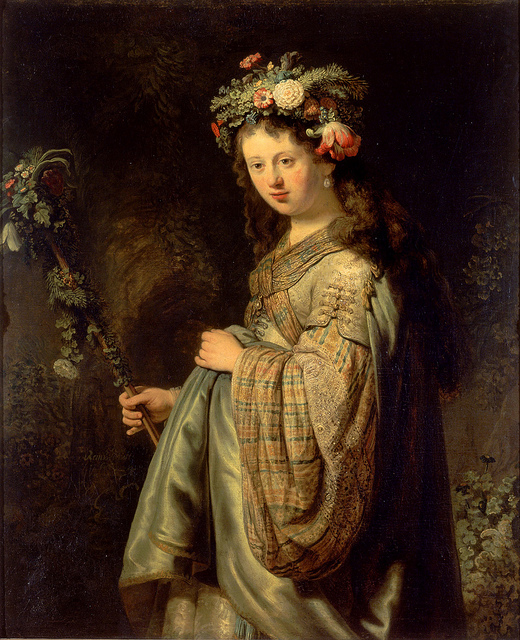
Rembrandt’s “Flora” (1634) transforms the Roman goddess of flowers and spring into an intimate, living presence. Instead of the aloof divinity often favored in mythological portraiture, the figure breathes with human warmth. She turns slightly toward the viewer, her face calm and luminous, crowned with a garland of peonies, roses, and greenery. Draped in shimmering textiles with embroidered borders and a cool, silvery mantle, she holds a staff wrapped in blossoms. The background is a dark arbor that absorbs light and allows every petal, thread, and highlight to register. Painted during Rembrandt’s first flourishing years in Amsterdam, “Flora” fuses portrait and allegory, fashion and antiquity, performance and sincerity, in a way that would shape Northern Baroque imagery for generations.
Historical Context and Purpose
The year 1634 was decisive for Rembrandt. He had recently moved from Leiden to Amsterdam, expanded his patronage network, married Saskia van Uylenburgh, and was increasingly sought after for portraits and ambitious narrative canvases. In this moment he often crossed categories, inviting sitters to assume historical or mythological roles that dignified their likeness while granting the painter access to lavish costume and poetic atmosphere. “Flora” belongs to this hybrid genre. It is not a strictly archaeological goddess but an early modern Dutch woman inhabiting Flora’s persona. The result is a work that satisfied contemporary appetite for both allegorical meaning and personal presence.
Identity and the Idea of Role-Play
Scholars have long debated whether the model is Saskia, Rembrandt’s bride. The gentle, direct gaze and youthful complexion invite this association, and Rembrandt used Saskia as model for other allegorical figures. Yet the painting’s power does not depend on a definitive identification. What matters is the logic of role-play. The sitter performs Flora in a manner that feels natural, as if myth were simply a language for honoring youth, fertility, and spring. Rembrandt thus proposes that allegory can be intimate rather than grand, lived rather than staged, and that the beauty of a person carries equal weight to the emblematic attributes she wears.
Composition and the Architecture of the Figure
The composition organizes the figure into a stable, pyramidal structure. The wreath crowns the apex; the torso and voluminous sleeves broaden toward the base; the staff held in the left hand sets a counter-diagonal that enlivens the silhouette. The right arm folds gently across the abdomen, gathering the mantle and securing the pose. The body turns in three-quarter view while the head tilts in a restrained contrapposto, a rhythm that animates without drama. Negative space around the figure is carefully rationed, especially at the left where the staff and floral bundle create a light corridor against the darkness. The arrangement keeps the viewer’s eye circulating between face, garland, hand, and drapery, ensuring that meaning flows across attributes rather than residing in a single emblem.
Light, Atmosphere, and the Baroque Eye
Illumination arrives from the upper left and cools as it moves across satin, skin, and hair. The light is not theatrical blaze but cultivated daylight, diffused enough to respect texture and roundness. It picks out the glaze on petals, the damp sheen of leaves, the satin’s soft specular flashes, and the modest warmth of the sitter’s cheeks. Rembrandt uses light as an argument for presence. The goddess is not marble; she occupies air. The dark arbor behind is not a void but breathable space in which the figure stands with authority. Subtle shifts of value dissolve the boundary between background and mantle, allowing the image to feel grown from shadow rather than pasted upon it.
The Crown of Flowers and Seasonal Meaning
The floral diadem is a catalogue of spring. Peonies sit heavily beside roses; small blossoms and herbs knit the larger forms into a crown. Rather than an abstract garland, it is a horticultural portrait, specific in species and believable in weight. The crown’s meaning is double. It names the goddess and it celebrates the cyclical renewal that seventeenth-century viewers read into marriage, family, and civic prosperity. Rembrandt paints the flowers with brushes that toggle between description and suggestion. Thick, satiny petals are articulated with confident strokes; airy sprays are indicated with quick, feathery touches. The garland is not fussed. It is alive.
The Staff and the Gesture of Office
Flora’s staff is wrapped with blossoms and greenery that spiral upward, a vertical echo of the wreath. It is both emblem and prop, giving the figure a ceremonial role. The hand that holds it is relaxed, a sign that this is a habitual office rather than a theatrical moment. Rembrandt makes the gesture practical. Pressure on the shaft creates a delicate hollow at the base of the thumb; a small glint of light runs along the knuckles. In this modest truthfulness the staff becomes part of the sitter’s body language, not merely a symbol added later.
Costume as Poetry and Proof
Rembrandt’s costume painting is virtuosic without vanity. The bodice and sleeves display an embroidered pattern that reads alternately as woven bands and metal-thread ornament. The outer mantle falls in heavy, satiny folds whose cool lights shift toward blue-green, a silky tone that sets off the warmer complexion. He suggests the weave and weight of fabric through a combination of crisp edges, dissolved transitions, and glazes that vary by temperature. The costume is anachronistic if measured against Roman antiquity, yet that is precisely the point. This is Flora for a Dutch audience, an emblem of bounty seen through fashionable textiles. The past is appropriated as a vehicle for present beauty.
The Psychology of the Face
The face holds the painting’s quiet authority. The mouth is relaxed, the eyes steady, the brow unknitted. There is alertness without tension, a mood appropriate to spring’s promise. Rembrandt modulates the flesh with delicate transitions. Small warm notes at the nostrils, earlobes, and lips bring life to the cooler planes of cheek and forehead. A subtle moisture on the lower eyelids gives the gaze a living glimmer. The expression is neither flirtatious nor stern. It suggests intelligence and a willingness to meet the viewer’s attention with her own. The face is where allegory becomes person.
Texture and the Hand of the Painter
Rembrandt orchestrates textures with a range of techniques. Thinly painted grounds absorb shadow; fuller, creamier pigment models the drapery’s highlights; minute, raised touches create beads of brightness on pearls and floral stamens. The transitions are not mechanical. Here and there a brushmark rides the surface like relief, catching actual light and converting it into pictorial glow. This interplay between material and illusion is central to the painting’s seduction. The viewer senses both the physical labor of paint and the immaterial subject of spring.
The Background as Living Darkness
The arbor’s darkness is not an abstract backdrop. It holds hints of foliage, recess, and pathway that ground the figure in an imagined garden. Rembrandt avoids sharp contours at the periphery, allowing edges of hair and mantle to breathe into the surrounding air. The darkness deepens near the base, anchoring the figure and preventing floating. In the upper zones it warms slightly, echoing the hair’s tones and creating a continuous, cohesive atmosphere. The result is a believable pocket of nature where Flora can appear, neither stage set nor wilderness, but a cultivated enclave that matches the civility of her dress.
Allegory, Marriage, and Dutch Culture
For a seventeenth-century Dutch viewer, Flora carried layered meanings. She was the patron of gardens and spring, but also a benign emblem for marriage and fertility. Portraits in historical guise allowed patrons to celebrate unions and households without excessive ostentation. “Flora” folds these cultural values into an image that is at once festive and modest. The figure’s downplayed grandeur suits a society that balanced prosperity with restraint. Instead of divine distance, Rembrandt gives approachable dignity, aligning mythology with everyday virtue.
Dialogue with Artistic Traditions
Rembrandt knew Italian and Northern precedents for Flora and related pastoral divinities. Titians or Guido Renis goddesses often bask in idealized sensuality, with glowing skin and open pose. Rembrandt shifts that tradition toward intimacy. He keeps the elegance but tethers it to the psychology of a specific sitter. The painting also converses with contemporary Dutch portraitists who luxuriated in texture and dress. Rembrandt absorbs their textile prowess, then adds a mythic frame that unlocks new expressive registers. The result is neither strict portrait nor borrowed antique, but a distinctly Dutch fusion of personhood and emblem.
The Rhythm of Hands and Drapery
Hands punctuate the composition. The right hand gathers the mantle across the abdomen, creating a horizontal pause that stabilizes the figure. The left hand wraps the staff and projects slightly forward, guiding the viewer into the space between figure and background. Folds of fabric echo these actions. The mantle’s long vertical curve answers the staff; smaller folds riffle near the wrist, adding energy. The drapery thus becomes choreography. It moves with the body and clarifies the erect grace appropriate to a goddess of growth.
Color Harmony and Emotional Temperature
Color is deliberately tempered. The palette mixes warm flesh and umbers with restrained greens and blue-grays. The flowers supply brighter notes—pinks and whites—without disrupting harmony. This moderation is emotional as well as optical. A too-brilliant chromatic scale would push the image toward pageantry. Rembrandt opts for a cultivated calm more in tune with the Dutch love of ordered gardens. The subdued color also heightens the sensation of light across satin and petals, where limited chroma allows value to carry radiance.
The Human Scale of Myth
Perhaps the most striking feature of “Flora” is how human scaled the goddess appears. She occupies the picture plane as a real person might, with the distance between viewer and figure kept conversational. There is no pedestal, no cloud, no architectural excess. Rembrandt trusts that the attributes—a wreath, a staff, a garden’s darkness—are enough to carry the mythic identity. Because the trappings are modest, the person becomes legible. The goddess is a way of seeing, not a costume that eclipses selfhood.
Technique, Ground, and Finish
Rembrandt likely worked over a warm ground that lends the painting an inward glow visible in the face and neck. He alternated lean underlayers with more saturated glazes and highlights, carefully balancing opacity and translucence. Certain passages, such as the mantle’s lower fold and the embroidery, reveal brisk, confident handling, while the face and hands receive tighter modulation. The varied finish keeps the eye awake, moving between painterly flourish and refined modeling. This variety is a hallmark of his art in the early Amsterdam years, when he explored how far painterly freedom could coexist with social polish.
Reception and Legacy
“Flora” exemplifies an approach to allegorical portraiture that would proliferate across Northern Europe: individuals adopting mythic or historical identities not to escape themselves but to announce virtues, seasons, and occasions. Later painters learned from Rembrandt how to let costume show wealth without smothering character, and how to let light establish moral and emotional tone. The painting also speaks to contemporary viewers because it treats beauty as cultivated presence rather than spectacle. Its appeal lies in balance—dress and person, emblem and intimacy, spring’s exuberance and Dutch restraint.
Why the Image Endures
The work endures because it feels honest. It celebrates seasonal abundance without bombast, honors myth without falsity, and finds in a single gaze the generosity associated with spring. The flowers will fade and the satin will crease, yet the face remains attentive and serene. The viewer leaves with an impression of renewal not only in nature but in the act of looking. The painting suggests that to observe carefully is itself a kind of spring, a way of making the world bloom again through attention.
Conclusion
Rembrandt’s “Flora” is a meditation on how a person can inhabit a role and, by doing so with sincerity, elevate it. The goddess of flowers appears not as marble but as a woman whose intelligence and poise carry the meaning of spring more persuasively than any apparatus. Light articulates textures, color maintains poise, and gesture clarifies office. Every element—garland, staff, embroidery, satin—serves the face, where allegory and individuality meet. In the crowded field of Baroque personifications, this “Flora” remains singular, a portrait of renewal grounded in human presence.