Image source: wikiart.org
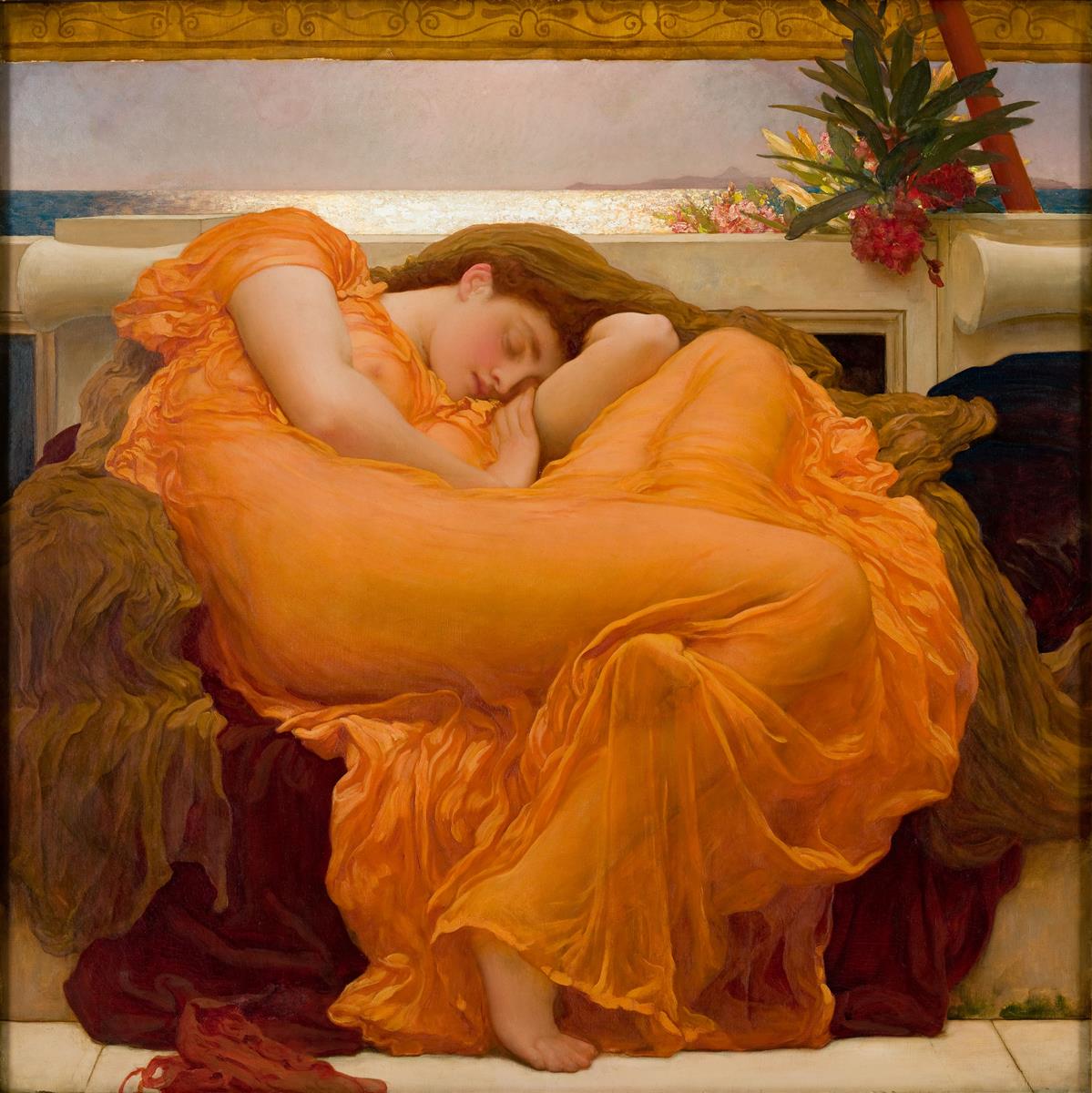
Flaming June by Frederic Leighton
Flaming June by Frederic Leighton is one of the most memorable paintings of the late nineteenth century. Completed in 1895, it presents a sleeping woman wrapped in a radiant orange gown, her body curved into a compact circle against a marble setting open to sea and sky. At first glance, the image seems simple. A young woman sleeps in the warmth of summer light. Yet the longer one looks, the more complex the painting becomes. It is a study in color, design, atmosphere, and mood. It is also a powerful example of how Frederic Leighton could turn a quiet moment into something monumental.
The painting is famous for its beauty, but its beauty is never empty. Every part of the composition feels carefully controlled. The pose folds inward like a closed flower. The drapery seems to glow from within. The setting is classical, but the emotional effect is deeply immediate. Rather than telling a story through dramatic action, Leighton builds meaning through stillness. The painting becomes a meditation on rest, sensuality, elegance, and transience. It invites the viewer into a suspended moment where time appears to slow down.
Part of the enduring appeal of Flaming June lies in how perfectly its elements work together. The figure, the dress, the marble bench, the flowers, and the distant water form a complete visual harmony. Nothing feels accidental. The result is a painting that seems both intimate and idealized, both human and almost dreamlike. It captures the richness of Victorian classicism while also reaching toward something timeless.
What Flaming June Shows
The subject of Flaming June is deceptively straightforward. A woman dressed in flowing orange fabric sleeps on a marble seat or ledge. Her head rests gently on her arm, and her body curls into itself in a pose of complete surrender to sleep. Her hair spills outward in soft waves, echoing the movement of the drapery around her. Behind her lies a bright strip of sea and pale sky, while a cluster of flowers appears near the upper right corner.
There is no obvious narrative event taking place. No other figures surround her. No clear action interrupts the silence. This lack of narrative is one of the painting’s greatest strengths. Instead of pushing the viewer toward a single literary interpretation, Leighton allows mood and form to carry the work. The painting becomes less about a specific story and more about a state of being.
The woman appears deeply asleep, not merely resting. Her closed eyes, relaxed mouth, and soft posture suggest a profound inward withdrawal. Yet the painting does not feel heavy or dark. The intense orange of the dress turns sleep into something warm and luminous rather than melancholy. Even though the figure is motionless, the painting never feels lifeless. The folds of fabric ripple across the surface, and the curve of the body gives the composition quiet energy.
This balance between repose and vitality is essential to the work. The sleeping figure embodies stillness, but the painting itself is full of visual motion. Leighton transforms inactivity into rhythm. The eye moves from the woman’s head to the round sweep of her knees, down through the cascading drapery, and back again through the trailing hair. The image feels complete, enclosed, and self-sustaining.
The Composition of Flaming June
One of the most remarkable aspects of Flaming June is its composition. Leighton arranges the figure so that her body forms an almost circular design. This circularity creates a sense of wholeness and containment. The woman does not simply recline across the picture surface. She folds inward, turning the composition into a closed shape that feels balanced and inevitable.
The curve of the spine, the bend of the knees, and the placement of the arms all contribute to this rounded form. Even the drapery follows the same rhythm, expanding and contracting like waves around the figure. The circular arrangement is important because it gives the painting both order and softness. It avoids rigidity while still feeling highly structured.
Leighton’s control of space is equally impressive. The figure occupies most of the canvas, making her presence immediate and dominant. At the same time, the narrow band of distant sea and sky opens the composition outward just enough to prevent it from becoming claustrophobic. This contrast between enclosure and openness adds tension to the scene. The woman is folded into a private world of sleep, but she exists within a larger, sunlit environment.
The painting also demonstrates Leighton’s mastery of visual emphasis. The brightest and most saturated area is the dress itself, which pulls the eye at once. From there, the viewer notices the soft flesh tones of the face, arms, and feet, then the cool stone and distant horizon. The eye is constantly guided by contrast, yet the transitions feel smooth rather than abrupt. The composition is therefore both highly disciplined and deeply pleasurable to look at.
The Orange Dress and the Power of Color
The color of the dress is the feature most people remember first. The orange drapery in Flaming June is not simply decorative. It is the emotional center of the painting. Its warmth defines the mood, transforms the figure into a source of light, and gives the entire work its title and identity.
Orange is an unusual and daring dominant color for a painting of this scale and seriousness. It can easily become harsh or overwhelming. Leighton avoids that danger through subtle variation. The gown moves through many shades, from glowing amber and gold to deeper copper and reddish orange. These changes keep the fabric alive and prevent the color from flattening into a single block. The result is richness rather than monotony.
The orange also interacts beautifully with the flesh tones of the sleeping woman. Her skin appears luminous and delicate against the saturated drapery. The contrast heightens the softness of the body and makes the figure seem almost sheltered within the folds of cloth. At the same time, the cool neutrals of the marble and the pale strip of blue water serve as calm counterpoints, allowing the warm tones to feel even more intense.
There is also a symbolic dimension to the color. Orange suggests heat, sunlight, and ripeness. It evokes summer at its fullest and most intense. In this context, the sleeping figure seems absorbed into the climate of June itself. She is not merely lying in summer light. She seems to embody summer, as if the season has taken human form. This union of body and atmosphere is one reason the painting feels so complete.
Light, Warmth, and Atmosphere
Light plays a central role in Flaming June, but it is not dramatic light in the theatrical sense. Leighton does not rely on violent contrast or deep shadow. Instead, he builds a glowing atmosphere in which warmth seems to permeate every surface. The effect is less about illumination from a single source and more about a general condition of radiant stillness.
The dress appears almost sunlit from within. The folds catch and release light in a way that gives the fabric extraordinary depth. Some areas seem nearly transparent, while others become denser and heavier. This interplay of light and material helps create the illusion that the figure is wrapped in living flame, though the scene remains peaceful rather than destructive.
The flesh is treated with similar delicacy. The woman’s face and arms are softly modeled, with no harsh edges. Her skin looks warm, tender, and real. The lighting flatters rather than exposes. It supports the atmosphere of privacy that defines the whole image. Even though the painting is carefully staged, the viewer feels they have entered a quiet moment that should not be disturbed.
The distant sea and sky deepen this atmosphere. Their pale coolness suggests open air and a bright day, yet they remain understated. They do not compete with the figure. Instead, they reinforce the sense that the woman rests in a sun-filled Mediterranean world where heat, light, and silence blend together. The painting seems to breathe warm air.
Frederic Leighton and Classical Ideal Beauty
Frederic Leighton was deeply influenced by classical art, and Flaming June reflects that influence in both style and spirit. The marble architecture, the idealized female figure, and the overall harmony of line all point toward a classical vision of beauty. Yet the painting is not a cold academic exercise. Leighton takes classical ideals and gives them warmth, color, and emotional accessibility.
The figure is idealized in the sense that she is not portrayed as an individualized portrait subject. Her beauty is generalized, serene, and elevated. She belongs to a world of artistic perfection rather than ordinary social reality. At the same time, her sleeping pose makes her feel human and vulnerable. This combination of ideal form and private tenderness is one of Leighton’s greatest achievements.
Classical art often values balance, restraint, and proportion, and all of these qualities appear in Flaming June. The composition is carefully ordered, the anatomy is graceful, and the decorative elements never overwhelm the figure. Yet the work also possesses a distinctly late nineteenth century sensuality. The transparent folds of the dress, the relaxed body, and the tactile emphasis on skin and fabric give the painting a softness that feels more intimate than austere.
Leighton’s classicism is therefore not about imitation alone. It is about translating ancient ideals into a modern language of beauty. In Flaming June, antiquity becomes a vehicle for mood and aesthetic pleasure. The painting looks back to the classical world, but it does so in a way that feels vivid and immediate rather than remote.
Sleep, Dream, and the Meaning of Repose
Sleep is one of the central themes of Flaming June. The woman’s closed eyes and inward posture suggest complete withdrawal from the external world. She is inaccessible to the viewer in a literal sense, yet she becomes emotionally available through that very inaccessibility. Because she is asleep, she cannot perform or respond. She simply exists. This makes the painting feel unusually contemplative.
Sleep in art often carries symbolic meaning. It can suggest innocence, vulnerability, escape, or even the boundary between life and death. In Flaming June, the mood leans toward dream and repose rather than sorrow. The warmth of the color palette and the softness of the figure prevent the scene from becoming tragic. Still, the image does have a faint undertone of fragility. Sleep is peaceful, but it also reminds us of human surrender. The body rests because it must.
There is something almost sacred about the figure’s isolation. She is untouched by noise, labor, or social obligation. The painting presents rest as something precious and complete. In a culture often associated with moral seriousness and strict decorum, this image of luxurious stillness carries real force. It offers an ideal of beauty rooted not in action or achievement, but in calm presence.
The ambiguity of sleep is part of what keeps the painting interesting. Is she merely napping in the afternoon warmth, or has Leighton turned her into an emblem of summer itself, drowsy and glowing under the weight of heat? The painting supports both readings. It moves between realism and allegory without fully committing to either. That balance gives it depth.
Texture, Drapery, and Painted Surface
Leighton’s handling of drapery in Flaming June is extraordinary. The dress is not only an article of clothing but a major structural and expressive element. It defines the painting’s movement, enriches its color, and heightens its sensual quality. The folds ripple, gather, and spill in a way that feels almost musical.
The translucency of the fabric is especially striking. In some places, the cloth clings lightly to the body beneath it, allowing the viewer to sense the figure’s form through the veil of orange. In other places, the dress thickens into deeper folds that create weight and shadow. This variation gives the material both realism and elegance. It seems at once delicate and monumental.
The contrast between textures is equally important. The softness of skin, the airy fabric, the heavy hair, and the smooth marble all interact across the canvas. Leighton invites the eye to move from one surface to another, appreciating their differences while also sensing the harmony that unites them. This is one reason the painting feels so richly finished. It appeals not only through image and symbolism but through the sheer pleasure of painted surface.
Hair also plays a subtle but important role in the texture of the work. The long brown strands flow outward around the figure, echoing the drapery while adding another organic element to the composition. The hair softens the boundary between body and setting, helping the woman appear absorbed into her environment rather than sharply separated from it.
The Setting, Flowers, and Mediterranean Mood
Although the figure dominates the painting, the setting contributes significantly to its effect. The marble bench or architectural ledge places the scene in a world associated with antiquity, refinement, and order. The stone frame around the sleeping woman gives her repose a formal dignity. She may be asleep, but the setting ensures that her sleep feels elevated rather than ordinary.
The distant sea and sky introduce a wider world beyond the immediate foreground. Their horizontal calm contrasts beautifully with the circular fold of the figure. This small opening in the background is crucial because it prevents the composition from becoming entirely enclosed. It suggests air, distance, and the outside world, even as the woman remains turned inward.
The flowers in the upper right add a decorative note, but they may also hint at symbolic meaning. Flowers often suggest beauty at its peak, but also impermanence. In a painting so closely tied to the idea of June, blossoms reinforce the sense of seasonal fullness. They remind the viewer that this moment of warmth and beauty belongs to a particular phase of life and time, one that cannot last forever.
The overall atmosphere has often been associated with a Mediterranean ideal, and that association makes sense. The marble, the sea, the flowers, and the warm light all create a setting that feels southern, sun-drenched, and classical. Whether or not the place is intended to be specific, it supports the painting’s dream of harmony between human beauty and radiant climate.
Sensuality and Restraint in Flaming June
One of the most compelling features of Flaming June is the way it combines sensuality with restraint. The painting is undeniably sensual. The transparent gown, the softly modeled body, the loosened hair, and the sleeping posture all emphasize physical beauty and tactile presence. Yet nothing in the painting feels crude or aggressive. Leighton maintains an atmosphere of dignity and poise throughout.
This balance reflects a broader tension in late Victorian art, where beauty, desire, and morality often intersected in complex ways. Flaming June offers a figure who is visually available yet psychologically withdrawn. Because she sleeps, she remains enclosed in her own world. The viewer may admire her, but cannot truly possess her attention. This creates a subtle distance that protects the painting from becoming merely decorative or voyeuristic.
Restraint also appears in the handling of detail. Leighton gives the viewer enough information to feel the richness of flesh, hair, and fabric, but he avoids excessive literalism. The painting is highly finished, yet it never loses its ideal quality. Every sensual element is absorbed into a broader harmony of form and color.
This is part of why the painting continues to feel refined. It understands beauty as something more than surface attraction. Beauty here is inseparable from order, silence, and mood. The sensual power of Flaming June comes not from explicit display, but from the quiet intensity of what is suggested.
Why Flaming June Still Captivates Viewers
Flaming June continues to captivate viewers because it offers immediate visual pleasure while also rewarding slow attention. Its first impression is unforgettable. The orange dress, the sleeping figure, and the serene setting create an image that stays in the mind. But beyond that immediate appeal lies a deeper achievement. The painting is built with such intelligence and sensitivity that each return to it reveals new relationships of color, line, and feeling.
Modern viewers may respond differently to the painting than Victorian audiences did, but its emotional clarity remains powerful. Many people are drawn to its sense of peace in a world that often feels overstimulated. Others are fascinated by its ideal beauty or by the technical brilliance of the drapery. Some admire it as a perfect example of Frederic Leighton’s art. Others simply love how it makes warmth visible.
The work also survives because it avoids narrow interpretation. It can be understood as a classical fantasy, a decorative masterpiece, a meditation on summer, a study of repose, or an allegory of beauty at its height. None of these readings cancels the others. The painting remains open enough to support many forms of appreciation.
In the end, Flaming June endures because it transforms a simple subject into something profound. A sleeping woman becomes an image of color, season, silence, and ideal form. Frederic Leighton takes stillness and makes it luminous. He takes repose and gives it grandeur. That transformation is the essence of great painting.
Final Thoughts on Flaming June by Frederic Leighton
Flaming June by Frederic Leighton stands as one of the most accomplished paintings of the nineteenth century because it achieves so much without relying on overt drama. It has no elaborate narrative, no crowded symbolism, and no theatrical action. Instead, it depends on precision, atmosphere, and emotional control. Through those means, Leighton creates a painting of remarkable intensity.
Its greatness lies in synthesis. The pose, the color, the light, the setting, and the mood all support one another perfectly. The orange drapery is not just beautiful. It is the vehicle through which heat, light, and sensuality enter the painting. The sleeping figure is not just graceful. She becomes the center of a complete visual world. The sea, flowers, and marble are not background decoration. They deepen the sense of classical stillness and seasonal abundance.
For anyone interested in Victorian painting, classical revival, or the art of beauty itself, Flaming June offers an extraordinary example of how form and feeling can merge. It is at once quiet and unforgettable. Even after more than a century, it retains the power to stop viewers in their tracks and hold them in silence. That is the mark of a truly enduring masterpiece.