Image source: wikiart.org
Introduction to Flagellation of St Jerome by the Angels
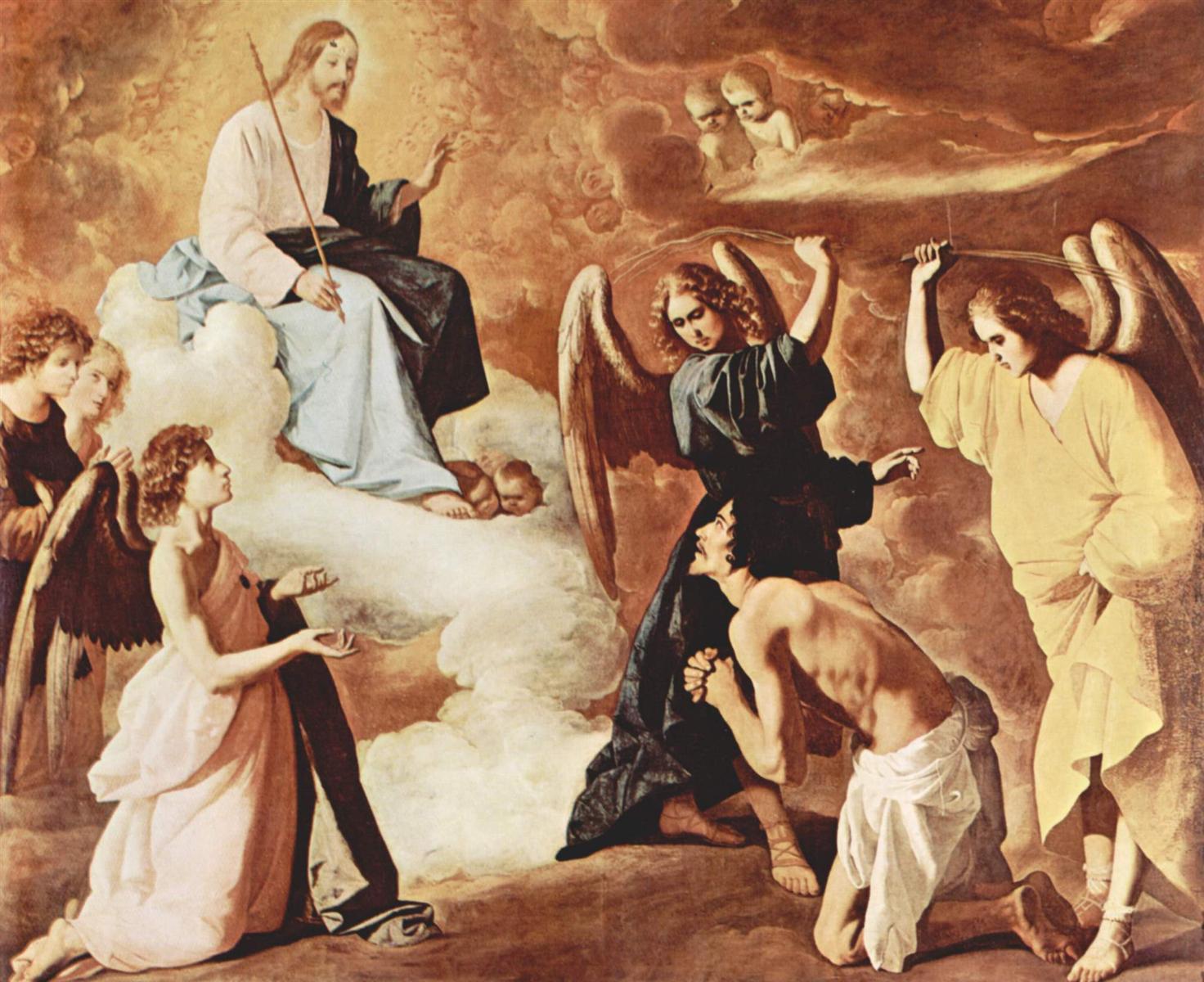
Francisco de Zurbaran’s “Flagellation of St Jerome by the Angels,” painted in 1639, transforms a subtle spiritual episode into a grand celestial drama. St Jerome, one of the four great Latin Doctors of the Church, appears half naked and kneeling at the lower right, his body tensed as angels raise a bundle of rods above him. Above and to the left, Christ sits on a throne of clouds, surrounded by a court of angels. The whole scene unfolds in a luminous atmosphere of golden clouds, where heaven seems to open like a stage for a visionary encounter.
This painting illustrates a famous episode from Jerome’s life. According to his own account, he once had a dream in which he appeared before the judgment seat of Christ. When asked who he was, Jerome replied that he was a Christian, but Christ accused him of being more devoted to the pagan writer Cicero than to the Gospel. As punishment, he commanded angels to scourge Jerome. The saint awoke covered in bruises and resolved to devote himself entirely to sacred scripture.
Zurbaran seizes on this interior experience and gives it monumental, visible form. His painting is not merely an illustration of bodily punishment. It explores questions of learning and faith, humility and pride, and the transformation that occurs when a soul submits to divine correction.
Historical and Spiritual Background
St Jerome lived in the fourth and early fifth centuries, known chiefly for translating the Bible into Latin and for his passionate commentaries on scripture. He was a man of fierce temperament and broad classical learning, equally at home in monastic solitude and theological controversy. The dream of his scourging encapsulated a tension felt by many Christian scholars who loved classical literature yet feared that such love might distract them from the Gospel.
In seventeenth century Spain, this story remained highly relevant. The Catholic Reformation placed great emphasis on scripture, orthodoxy, and the reform of personal habits. Scholars, monks, and clergy were encouraged to model themselves on saints like Jerome, whose intellectual vigor was tempered by deep penance and obedience.
Zurbaran, who painted numerous images for monasteries and religious houses, understood how powerful Jerome’s dream could be as a lesson in humility. By presenting the punishment not as something terrifying but as a mercy that leads to renewed dedication, he created a work that could speak to confessors, students, and devout laypeople alike.
Composition A Heavenly Court and a Penitent Scholar
The composition of “Flagellation of St Jerome by the Angels” is carefully divided between the serene authority of Christ and the dramatic action surrounding Jerome. On the left, Christ sits high on a cloud, slightly above the center of the canvas. His figure is calm and frontal, one hand raised in a gentle but commanding gesture, the other holding a slender staff that signifies his role as judge and king. The cloud on which he rests swells outward like a throne, partially hiding cherubic heads that peek from its edges.
Below Christ, a group of angels kneel on the same cloud bank, watching the scene or presenting small objects. Their arrangement creates a visual bridge between Christ and the earthly plane where Jerome kneels. Their lines of sight and gestures connect the two realms, directing our attention from the judge to the penitent.
On the right, Jerome dominates the lower portion of the painting. Stripped to a simple white cloth around his waist, he kneels on the cloud or heavenly floor, hands clasped in intense prayer. Two angels stand beside and behind him. One, dressed in a deep blue garment, points toward Christ, underlining the source of the punishment and the mercy. The other, in a pale golden robe, lifts a bundle of slender rods as if about to bring them down. Their wings and robes swirl with movement, contrasting with Jerome’s fixed posture and Christ’s stillness.
The background is filled with warm clouds that roll and twist, opening occasionally to reveal cherubs or more distant light. This backdrop unites the figures in a single celestial space and gives the entire scene an otherworldly glow.
The Figure of Christ Divine Judge and Gentle Teacher
Zurbaran’s Christ is both judge and teacher. Seated calmly on the billowing clouds, he appears youthful yet authoritative. His right hand is raised in a gesture that suggests both blessing and admonition. Unlike stern medieval depictions of the Last Judgment, this Christ does not glare or brandish thunderbolts. His expression is serious but compassionate, as if he grieves that Jerome had wandered too far into secular learning yet rejoices that he now returns with greater fervor.
The staff in Christ’s left hand acts as a symbol of rulership and judgment. It is not a heavy scepter but a light rod that resonates visually with the scourging rods held by the angel on the right. This subtle parallel reminds the viewer that the punishment is not arbitrary cruelty but proceeds from Christ’s sovereign decision for Jerome’s good.
Christ’s clothing offers another layer of meaning. He wears a pale tunic with a blue mantle, colors associated with divinity, wisdom, and heavenly peace. The soft modeling of the fabric and the warm light that bathes his figure emphasize his role as a source of light and truth. From this elevated throne, he presides over the drama below without losing his serenity.
St Jerome Between Pride and Repentance
At the heart of the painting is St Jerome, whose half naked body contrasts sharply with the robed and winged figures around him. His posture captures the paradox of humility and strength. He kneels, knees pressed to the ground, torso bent forward slightly, hands bound together in a tight clasp. The muscles of his back and arms are tense, visible beneath the thin skin. His head tilts upward, eyes fixed on Christ with a mixture of fear, sorrow, and trust.
By stripping Jerome to a simple white cloth, Zurbaran visualizes the saint’s spiritual vulnerability. The cloth acts like a loincloth of penance, reminiscent of Christ’s own garment during the Passion. It suggests that Jerome’s scholarly pride has been stripped away, leaving only the bare soul standing before its judge.
At the same time, Jerome’s physical strength is evident. His body is lean and muscular, demonstrating that he is not a frail victim but a vigorous man capable of accepting discipline. This depiction fits the historical Jerome, who embraced austere monastic practices in the desert. The painting suggests that true intellectual and spiritual power includes the capacity to submit to correction.
The Angels Agents of Correction and Mercy
The angels surrounding Jerome play distinct roles in the narrative. The angel in blue who stands close beside the saint acts almost like a mentor or guardian. With one hand he points toward Christ, as if explaining to Jerome the meaning of what is happening. His face is calm and focused, his curls illuminated by the warm light. He embodies divine clarity, helping the saint interpret the punishment as a loving call rather than sheer rejection.
The angel in golden yellow, positioned to the far right, holds a bundle of rods poised to strike. His expression is more intense, and his pose conveys readiness for action. Yet even in this role he does not appear malicious. The raised arm is firm but not wild, and his gaze seems to look beyond Jerome, toward Christ, awaiting the command. This dependence on Christ’s will underscores that the scourging is not an act of anger from the angels but a service they perform in obedience.
Other angels add nuances to the scene. Those kneeling near Christ appear in attitudes of prayer and attentive watching. Their presence indicates that heaven is not indifferent to the struggles of human souls. Even the punishment of one saint becomes an occasion for communal contemplation, as if they too learn from Jerome’s example.
Light, Color, and Atmosphere
Zurbaran employs a warm, almost monochromatic palette dominated by golden browns, creams, and soft blues. This choice envelops the entire scene in a unified glow, suggesting the light of dawn or the internal radiance of heaven. The clouds are painted in broad, soft masses that catch the light and create a sense of depth.
The bodies and garments are modeled with subtle transitions of tone. Jerome’s skin shows a delicate gradation from the highlighted shoulders to the shadowed back, emphasizing his physicality without harshness. The angels’ garments range from deep blue to bright yellow and soft pink, forming harmonies that guide the viewer’s eye across the composition.
Light also functions symbolically. Christ is the brightest figure, bathed in a clear, steady light. The angels near him share some of this brightness, while Jerome is lit more dramatically, with strong highlights on his shoulders and face contrasting with deeper shadows on his back. This chiaroscuro emphasizes his dramatic conversion in the making, a soul caught between old darkness and new illumination.
The upper clouds where cherubs peer out are slightly darker, adding layers to the space and suggesting that even within heaven there are depths beyond human understanding.
Theological Meaning Penance, Learning, and Conversion
The subject of Jerome’s flagellation addresses central themes of Christian spiritual life. It dramatizes the conviction that even good things, such as love of literature and eloquence, can become obstacles if they displace devotion to God. Jerome was not punished for reading in itself, but for valuing classical authors more than scripture.
In Zurbaran’s painting, the rods held by the angels symbolize divine pedagogy. The punishment is not retribution but correction. Jerome’s kneeling posture shows his willing acceptance. By submitting to the scourging, he consents to be purified of attachments that hinder his vocation.
For seventeenth century viewers steeped in monastic culture, this scene would serve as a powerful reminder that even intellectual pursuits must be ordered to spiritual ends. It also offered encouragement that lapses could be remedied through sincere repentance. If a great doctor of the Church like Jerome could be corrected and transformed, then ordinary scholars and believers could also hope for mercy and growth.
Zurbaran’s Artistic Language in a Visionary Scene
While Zurbaran is often associated with austere scenes of solitary monks, here he demonstrates his capacity for complex visionary compositions. He organizes numerous figures and swirling clouds without sacrificing clarity. Each figure is distinct and legible, yet the entire scene feels unified.
His experience painting altarpieces and celestial visions informs this work. The arrangement of Christ on a cloud throne, angels in attendance, and a kneeling saint below recalls other Spanish Baroque depictions of mystical experiences. What sets this painting apart is the specific narrative of disciplinary love. The emotional range is broader than mere adoration. There is tension, sorrow, and eventual consolation.
Zurbaran’s handling of anatomy, especially in Jerome’s lean body, shows his study of classical models and natural observation. Yet he avoids sensationalism. The saint’s suffering is serious but not grotesque. The viewer is invited to empathize spiritually rather than to recoil from physical brutality.
Emotional Tone and Viewer Experience
The emotional tone of “Flagellation of St Jerome by the Angels” is one of solemn gravity tempered by hope. Jerome’s posture and the raised rods create a sense of impending pain, but the warm light and the calm of Christ and many of the angels prevent the scene from feeling hopeless. The overall atmosphere suggests that this severe moment is the threshold to deeper peace.
For a viewer standing before the painting, the eye naturally moves between Jerome’s upturned face and Christ’s steady gaze, tracing the invisible line of communication between them. This dynamic encourages the viewer to imagine personal moments of examination, when conscience confronts the demands of the Gospel.
The painting can thus function as a mirror for the soul. It prompts questions: What attachments distract me from my true vocation? How willing am I to accept correction, whether through life events, spiritual counsel, or inner conviction? Zurbaran’s Jerome becomes an example of someone who confronts these questions with honesty and courage.
Legacy and Contemporary Relevance
Today, “Flagellation of St Jerome by the Angels” remains significant both for art history and for spiritual reflection. Art historians admire the way Zurbaran fuses a rare subject with a sophisticated composition, showing his range beyond his more familiar monastic scenes. The painting demonstrates how Spanish Baroque artists could handle complex theological themes with visual clarity and emotional depth.
For modern viewers, even those outside a religious context, the painting speaks to the challenge of ordering our intellectual and cultural loves. Jerome’s struggle between admiration for eloquent pagan authors and loyalty to Christian revelation can be paralleled by contemporary tensions between faith and culture, duty and pleasure, or principle and ambition.
The idea that growth sometimes requires painful self-critique remains relevant. Zurbaran’s work suggests that such moments, though difficult, are held within a larger framework of mercy and purpose. The warm clouds, the attentive angels, and the compassionate yet firm Christ all speak of a universe where correction is ultimately aimed at flourishing rather than destruction.
Conclusion A Vision of Severe Mercy
“Flagellation of St Jerome by the Angels” by Francisco de Zurbaran is a rich meditation on discipline, learning, and grace. Through a carefully balanced composition, radiant color, and expressive figures, the artist turns a private dream into a cosmic event. Christ, enthroned on clouds, presides as both judge and teacher. Angels serve as ministers of correction and witnesses of conversion. St Jerome, stripped of worldly prestige, kneels in humble acceptance, ready to let his love of literature be purified by love of God.
The painting invites viewers into this drama, not as distant observers but as potential participants. Each person, it suggests, must at some point stand before the truth and allow cherished habits to be weighed. Yet the scene reassures us that such moments occur under the gaze of a merciful Christ, in the company of angelic helpers, and in the hope of renewed dedication.
In capturing this “severe mercy,” Zurbaran created one of his most compelling works, a canvas where theology, psychology, and artistry converge among the golden clouds of a visionary sky.