Image source: wikiart.org
Introduction
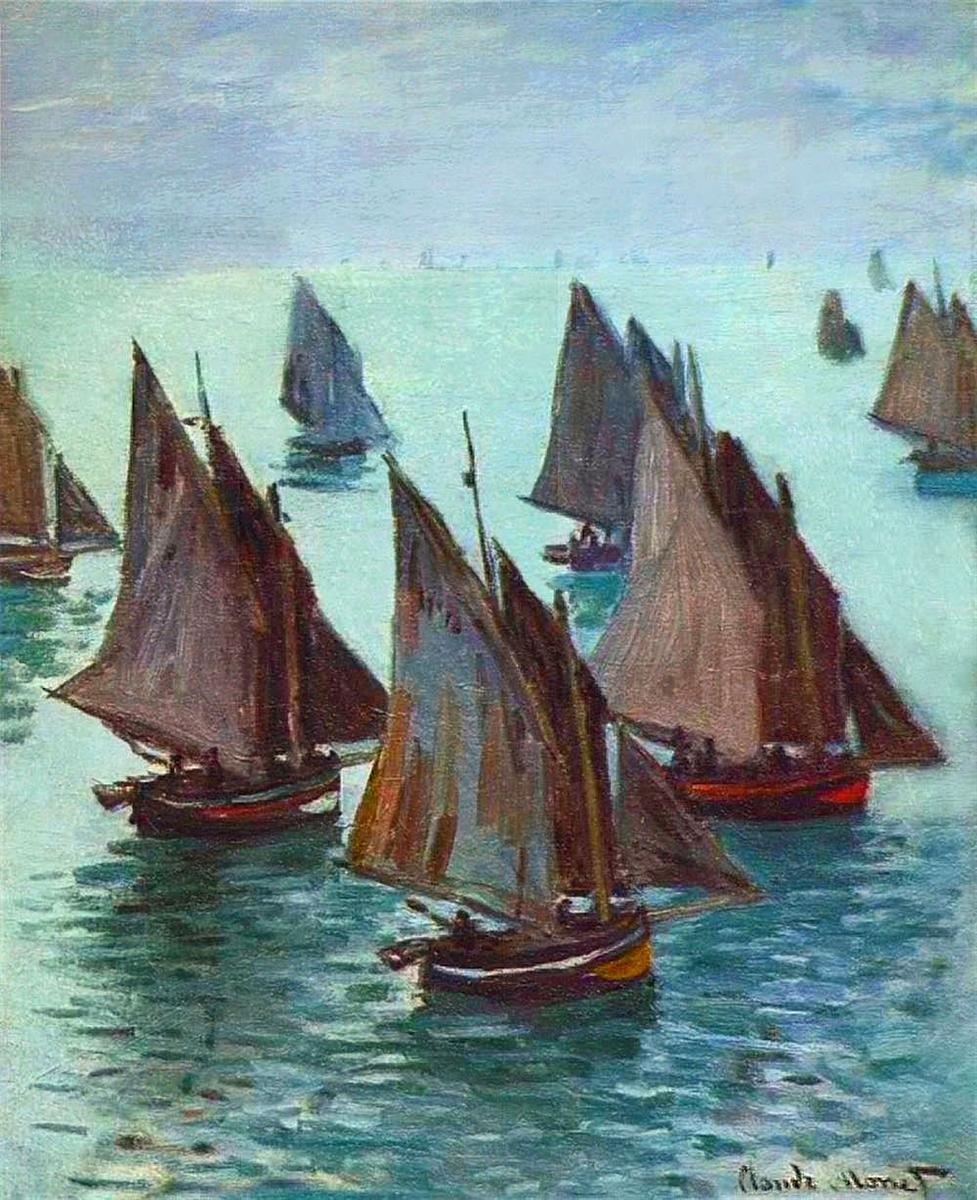
Claude Monet’s Fishing Boats, Calm Sea from 1868 is a marine scene that immediately reveals how much could be said with restraint. At first glance, the painting seems simple. A group of fishing boats drifts across still water under a pale, expansive sky. The sails are dark and triangular, the sea is quiet, and the atmosphere feels cool, hushed, and suspended. Yet this apparent simplicity is precisely what makes the work so compelling. Monet does not fill the canvas with dramatic action or theatrical incident. Instead, he builds the image through balance, atmosphere, and sensation. The painting becomes less about boats as objects and more about the visual experience of seeing them in soft light and calm weather.
This is one of the great strengths of Monet’s art, especially in his early marine paintings. He understood that the sea could be painted not only as a setting for narrative but also as a surface of changing color, shifting air, and subtle reflections. In this work, the boats are certainly important, but they are also vehicles for a larger investigation into tone, structure, and mood. Their sails interrupt the pale openness of the sea and sky, creating a rhythm of pointed forms against a misty background. Their dark silhouettes hold the composition together while the surrounding water dissolves into delicate passages of blue, green, gray, and silver.
The result is a painting that feels both solid and fleeting. It gives the viewer something definite to look at, yet it also preserves the instability of real vision. Nothing is overexplained. The distant horizon nearly disappears into haze. The reflections on the water shimmer rather than mirror exactly. The air seems to soften edges, and the boats appear at once present and slightly absorbed by their environment. This dual quality is central to Monet’s achievement. He does not force the world into hard clarity. He lets it remain alive, mobile, and atmospheric.
Claude Monet in 1868
In 1868, Monet was still a young painter, but he had already begun to develop the artistic instincts that would later define Impressionism. He was deeply engaged with outdoor painting, with the study of natural light, and with the challenge of translating transient visual effects into paint. Even in a work like Fishing Boats, Calm Sea, which predates the full public emergence of Impressionism, one can already see his commitment to direct observation and sensory immediacy.
This period of Monet’s career is especially fascinating because it stands at the threshold between tradition and innovation. He had inherited the lessons of landscape painting and marine painting from earlier generations, but he was moving toward something fresher and less formulaic. Instead of building a scene around polished academic finish, he was increasingly interested in perception itself. How does water appear under muted daylight? How do sails cut through mist? How does distance flatten and dissolve forms? These kinds of questions seem to animate this painting.
The late 1860s were also years in which Monet returned repeatedly to coastal motifs. Harbors, beaches, boats, and estuaries offered him an ideal subject because they united structure and change. Boats provided strong forms. Water and sky provided instability, reflection, and atmosphere. In Fishing Boats, Calm Sea, Monet takes advantage of that contrast. The rigid geometry of the sails stands against the softness of sea and air, and the entire image depends on that tension.
What is especially notable here is how mature Monet’s visual intelligence already appears. He is not simply recording a picturesque harbor scene. He is organizing the painting so that each formal choice contributes to an overall sensation. Even at this early stage, he shows a remarkable confidence in reducing narrative detail and trusting tonal relationships to carry the emotional force of the image.
The Subject and Its Quiet Power
The subject of the painting is modest: fishing boats resting or moving slowly on calm water. There is no storm, no crashing surf, no dramatic sky, and no spectacle of labor. The boats do not appear locked in struggle with nature. Instead, they inhabit the sea with calm assurance. This makes the scene feel deeply meditative. Monet has chosen not the exceptional moment but the ordinary one, and in doing so he reveals how rich ordinary perception can be.
Fishing boats had long appeared in European painting, often as symbols of livelihood, labor, trade, or coastal identity. Monet does not reject those associations, but he treats them indirectly. The boats are clearly working vessels, and one senses the economic life behind them, yet the painting does not become a genre scene in the conventional sense. Human activity is reduced to hints. The emphasis falls instead on presence, spacing, and atmosphere. The boats are seen as masses of color and form within a broader field of light.
This quietness is important. The title itself, Fishing Boats, Calm Sea, tells us almost everything in the plainest terms. There is no poetic embellishment. The painting offers a condition rather than a story. Calm sea is not just a description of weather. It becomes the governing emotional state of the entire canvas. The stillness of the water, the muted color range, and the softly veiled distance all contribute to a mood of composure and suspension.
Because the subject is so restrained, the viewer becomes more attentive to nuance. One begins to notice how each boat occupies its own pocket of space, how the sails differ slightly in angle and tone, how the reflections break apart across the water, and how the horizon remains barely there. The painting rewards slow looking. Its power lies not in immediate drama but in cumulative subtlety.
Composition and Structure
The composition is one of the most striking features of the painting. Monet arranges the boats so that they seem loosely clustered across the foreground and middle ground, while the distant vessels fade into the pale upper half of the canvas. This creates depth without relying on rigid perspective. Space opens gradually rather than mathematically. The boats nearest the viewer are substantial and dark, while those farther away become smaller, lighter, and more indistinct.
The triangular sails are the key structural elements. They rise vertically and diagonally across the composition, interrupting the horizontal spread of sea and sky. Without them, the picture might dissolve into atmospheric softness. With them, it gains tension, rhythm, and order. Each sail acts almost like a visual note in a measured sequence. Together they create a pattern of repetition and variation that guides the eye across the canvas.
Monet avoids excessive symmetry. The boats are balanced, but not evenly distributed. A large vessel on the left, a dense grouping toward the center and right, and several more distant shapes in the background keep the composition active. The central foreground boat, smaller than some of the others but clearly placed, helps anchor the lower part of the painting. Its position near the viewer gives the image intimacy. We are not observing the harbor from a remote panoramic distance. We feel close to the water.
Another subtle achievement is the way Monet prevents the sky from overpowering the boats, even though it occupies a large area of the canvas. The upper region is broad and pale, but it remains visually connected to the sea below through shared cool tones. This soft continuity prevents a hard division between sky and water. The boats, in turn, become the principal interruptions within a nearly unified atmospheric field. The composition therefore depends on contrast between openness and interruption, calm and form, expanse and cluster.
Color and Tonal Harmony
The painting’s color is restrained, but it is never dull. Monet uses a palette of cool blues, sea greens, grays, muted violets, and brownish reds, creating a harmony that feels both natural and carefully orchestrated. The dominant impression is one of cool freshness. The water has a pale green blue quality, while the sky shifts through soft grayish blue tones. These colors establish the calm temperature of the scene and give the painting its hushed emotional register.
Against this cool field, the darker sails become especially important. They are built from deep browns, muted purples, charcoal tones, and occasional warmer notes that keep them from appearing flat. Their darkness does not feel heavy in a dead or opaque way. Instead, it feels velvety and responsive to light. Monet makes them absorb and reflect atmosphere at the same time. They stand out strongly, yet they still belong to the weather and light of the painting.
The touches of red along some of the boats’ hulls are small but significant. They add moments of warmth that keep the composition from becoming too monochrome. These accents also increase the sense of material presence. The boats are not merely silhouettes. They have painted surfaces, weight, and individuality. Monet uses these warmer notes sparingly, which makes them all the more effective.
Tonal harmony matters as much here as color itself. The painting is organized through values, from the pale haze of the distance to the dense dark masses of the sails. Monet demonstrates a sophisticated understanding of how tonal contrast can generate structure without destroying atmosphere. The darks create focus, but they never feel pasted onto the picture. The lights create openness, but they never wash the image out. Everything is calibrated so that the eye moves gently rather than abruptly.
Water, Reflection, and the Impression of Stillness
The sea in this painting is calm, but it is not inert. Monet treats the water as a subtly active surface, alive with small shifts of light and broken reflections. This is one of the most beautiful aspects of the work. The sea holds the boats, echoes them, and disperses their presence into rippling color. Instead of crisp mirrored reflections, Monet gives us shimmering, interrupted versions of the boats and sails, as they would actually appear on slightly moving water.
This brokenness is essential to the painting’s realism. Monet understands that reflection is never a perfect duplication. Water receives the world, but it also transforms it. The dark sails descend into elongated, fractured shapes that merge with the cool tones of the sea. In some places, the reflection is only hinted at through a soft darkening or a streak of color. In others, it becomes more legible. This variation gives the surface life.
The calmness of the sea is conveyed through scale and rhythm rather than through absolute flatness. Small brushstrokes across the foreground create the suggestion of gentle movement. The water is placid enough to reflect, but active enough to prevent stillness from becoming rigidity. This is a very convincing balance. It lets the viewer feel the condition named in the title while still sensing the sea as a living element.
Monet also uses the water to deepen the mood of the painting. Because the sea is quiet, the entire scene feels contemplative. There is no sense of urgency. The viewer’s eye can linger on the subtle transitions of tone and the gentle interactions between hull, sail, and reflection. The painting invites patience. It seems to ask us to slow down and inhabit the same quiet duration that it depicts.
Brushwork and Surface
Although the painting appears soft from a distance, it is built through visible, active brushwork. Monet does not conceal the making of the image. The surface bears the marks of a painter responding directly to what he sees. This quality gives the work freshness and immediacy. The boats, sails, sky, and water are all shaped through strokes that remain alive rather than being smoothed into an academic finish.
In the sky, the brushwork is light and blended enough to suggest broad atmospheric continuity, yet one can still sense movement within it. The paint does not form a blank backdrop. It breathes. The same is true of the water, where shorter strokes and tonal variations create flicker and texture. Monet does not describe each ripple individually. He lets brushwork imply the surface condition.
The sails are handled somewhat more firmly, but even here the paint retains flexibility. Edges are often softened, and tonal shifts within the sails prevent them from reading as flat geometric cutouts. This is important because it keeps the forms atmospheric rather than merely graphic. The sails have shape and weight, but they also respond to surrounding light and air.
This kind of brushwork is central to Monet’s developing style. It reflects a move away from polished finish and toward a painting language that records perception in real time. The viewer becomes aware not only of boats on water but also of paint on canvas, of an artist translating fleeting visual relationships into strokes, patches, and tonal decisions. That liveliness of execution is part of the painting’s enduring charm.
Atmosphere and Distance
One of the most striking things about Fishing Boats, Calm Sea is the way distance is handled. The horizon is faint, and the farthest boats almost dissolve into the light. Monet does not insist on crisp clarity at every depth. Instead, he allows atmosphere to veil the background. This makes the painting feel spacious and true to lived vision. On a hazy day at sea, distance does not present itself with sharp certainty. It recedes through light.
The pale region of sea and sky in the upper half of the painting creates a sense of openness that is almost ethereal. Boats in the distance become mere signs, dark marks suspended in a luminous field. This is one of the ways Monet transforms a harbor scene into an atmospheric meditation. The farther the eye travels, the less material the world appears. The near boats are weighty and present, while the distant ones verge on disappearance.
This gradual loss of definition also enhances the emotional effect of the painting. It introduces a note of quiet mystery. The world does not end at the edge of clear vision. It continues beyond what can be firmly grasped. Monet captures that sensation beautifully. The painting feels grounded in observation, yet it also suggests the limits of observation.
Atmosphere in this work is not decorative. It is structural. It shapes how forms appear, how space recedes, and how mood is established. The haze, the soft distance, and the merging of sea and sky all contribute to a sense of serenity touched by remoteness. The scene is not empty, but it is spacious enough to feel inward and reflective.
Human Presence Without Portraiture
Although the painting centers on boats rather than figures, human presence is unmistakable. These vessels exist because of people. They are worked, inhabited, navigated, and maintained. In a few places, tiny figures can be detected, but Monet does not emphasize them. He allows the boats themselves to stand in for the labor and routines of coastal life.
This choice is significant. By not focusing on individual fishermen as characters, Monet avoids anecdote and sentimentality. He does not turn the scene into a moralized image of labor or a picturesque rustic narrative. Instead, he lets human activity remain embedded in the objects and rhythms of the harbor. The boats are enough to imply the lives connected to them.
There is something deeply modern in this restraint. The painting acknowledges work, but it does not dramatize it. It acknowledges livelihood, but it does not illustrate a story about it. What matters is the visual condition in which these working vessels appear. Human presence becomes part of the atmosphere of the place, woven into the relationship between craft, water, and light.
This also helps explain the painting’s emotional neutrality, which is one of its strengths. It is not sentimental, heroic, or tragic. It simply observes. That observational honesty allows the viewer to enter the scene without being told what to feel. Calmness becomes something discovered through looking rather than imposed by narrative convention.
A Marine Painting Reimagined
Marine painting has a long history, often associated with storms, naval power, grand coastlines, and dramatic weather. Monet takes a very different approach here. He strips away spectacle and replaces it with immediacy. The sea is not a stage for heroics. It is a field of light and tone. The boats are not emblems of conquest or danger. They are forms suspended in a calm visual moment.
This shift is important in understanding Monet’s originality. He inherits the subject of marine painting but reorients its priorities. Instead of narrative drama, he offers perceptual sensitivity. Instead of polished grandeur, he offers atmosphere. Instead of rhetorical effect, he offers visual truth as it appears in a specific moment under particular conditions.
That does not make the painting less ambitious. In some ways, it makes it more ambitious. It is easier to rely on dramatic incident than to hold attention through nuance alone. Monet succeeds because he trusts the subtle richness of the visible world. He knows that a calm harbor can be as visually profound as a storm if it is truly seen.
This is one of the reasons the painting still feels fresh. It is not burdened by overstatement. It feels open, direct, and attentive. Its beauty lies in its refusal to exaggerate.
Why the Painting Endures
Fishing Boats, Calm Sea endures because it captures something fundamental about Monet’s art and about painting itself. It shows how ordinary motifs can become extraordinary through perception. Boats on calm water are not rare or sensational, but in Monet’s hands they become a study in balance, silence, and luminous restraint.
The painting also endures because it invites slow attention. In an age that often favors instant impact, this work rewards patience. Its subtleties emerge gradually through looking. One begins with the sails, then notices the water, then the shifting atmosphere, then the way distance dissolves, then the careful color accents in the hulls. The painting unfolds rather than announces itself.
It is also an early demonstration of Monet’s lifelong gift for making light and air feel tangible. Even before his later series and more radical explorations of atmosphere, he was already showing how paint could translate transient visual experience into something lasting. The image preserves a moment, but it does not freeze it. It remains alive with movement, humidity, and quiet change.
Ultimately, the work endures because it is deeply honest. It does not pretend that the world is sharper, more dramatic, or more orderly than it is. It allows haze to be haze, reflection to be broken, calm to include slight movement, and distance to remain partially unknowable. That honesty gives the painting both beauty and authority.
Conclusion
Claude Monet’s Fishing Boats, Calm Sea is a masterful early marine painting that reveals how much emotional and visual depth can reside in a restrained scene. Through a carefully balanced composition, a cool and harmonious palette, sensitive brushwork, and an extraordinary feeling for atmosphere, Monet transforms a simple harbor view into an experience of stillness and perception.
The dark sails, pale sea, and softened horizon work together to create a world that feels both immediate and elusive. The painting is grounded in the material reality of fishing boats and coastal labor, yet it rises beyond description into something more contemplative. It becomes a meditation on calmness, distance, and the way light binds objects to their environment.
What makes the painting so memorable is its refusal to overstate. It trusts nuance. It trusts the viewer. It trusts that a quiet sea and a cluster of boats can hold the eye and mind if they are painted with enough sensitivity. Monet proves that they can. In doing so, he offers not only an image of boats on water, but also a lesson in how to see.
