Image source: wikiart.org
Introduction
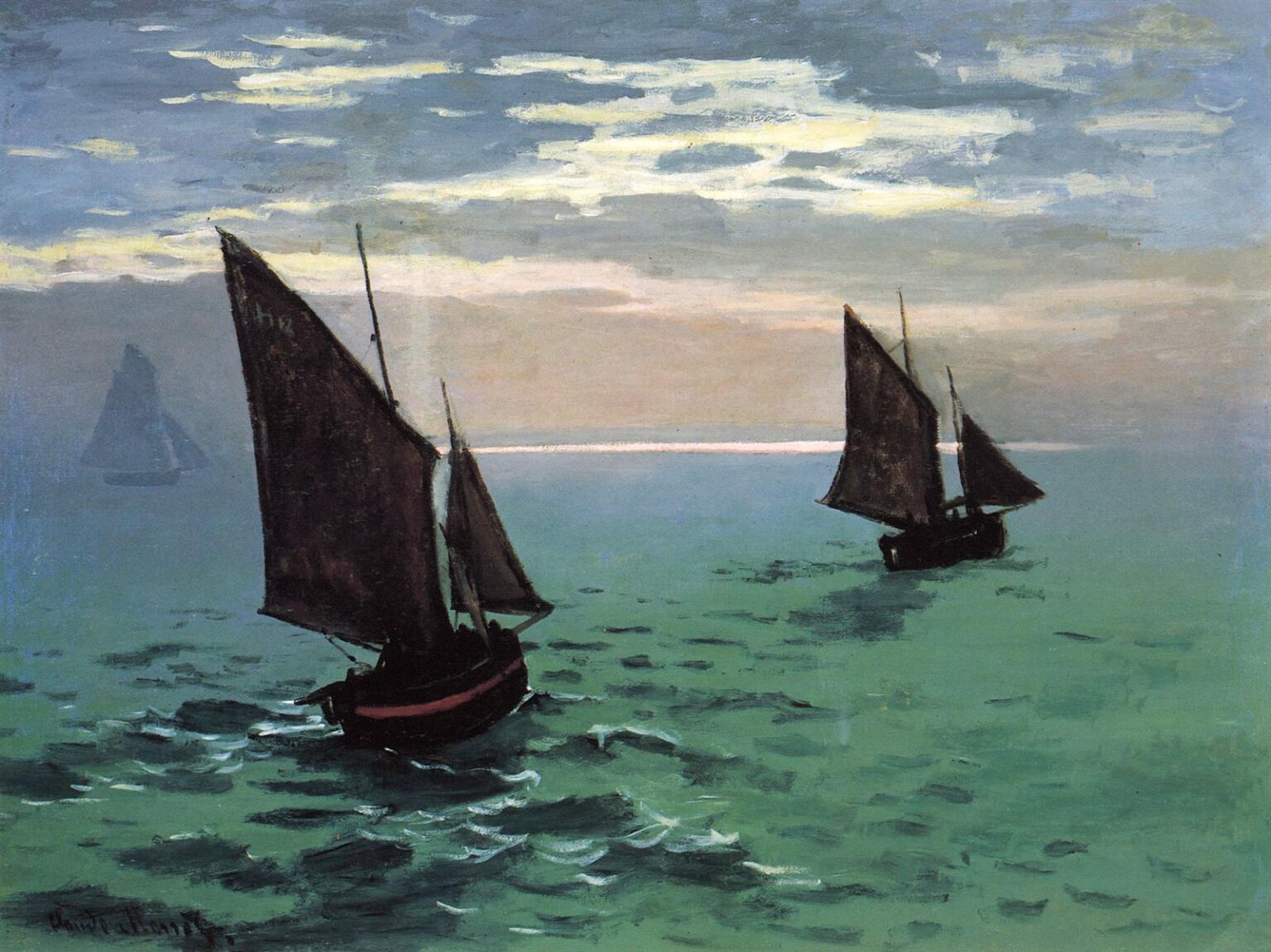
Claude Monet’s Fishing Boats at Sea from 1868 is a small but remarkably atmospheric painting that shows how much emotion can be carried by restraint. At first glance, the subject seems simple. A few dark fishing boats move across a pale green sea under a broad, clouded sky. There is very little narrative action, and yet the picture feels full of movement, weather, silence, and distance. Monet turns an ordinary coastal scene into something lyrical and immersive. The painting does not depend on spectacle. Instead, it works through tone, balance, and sensation.
What makes the image so compelling is the way Monet lets mood emerge from modest means. The boats are not grand vessels. The sea is not violent. The sky is not theatrical in the usual sense. Yet the picture holds the eye because every part of it contributes to a quiet tension between stillness and motion, light and shadow, nearness and remoteness. The horizon line glows faintly, the water shifts from cool blue to green, and the sails appear almost as silhouettes against a soft atmosphere. These contrasts give the scene its emotional charge.
This is one of those works that shows Monet’s gift for seeing beyond the object itself. He is not simply painting boats as things. He is painting the visual experience of boats seen at a certain time of day, at a certain distance, in a certain atmosphere, under a certain quality of light. That sensitivity would become central to his mature art, but it is already clearly present here. The painting belongs to the moment when Monet was developing the language that would help define modern landscape painting. Even in a relatively early work like this one, he is less interested in exact description than in the total impression made by air, light, water, and movement.
Monet in 1868
The year 1868 falls within an important phase of Monet’s development. He was still a young painter, but he had already begun moving away from academic finish and toward a more direct engagement with the visible world. Coastal subjects offered him an ideal setting for that exploration. The sea is never static, and neither is the sky above it. Reflections break apart, forms dissolve in haze, and light changes from minute to minute. For an artist interested in perception rather than rigid formula, the shoreline offered endless possibilities.
In Fishing Boats at Sea, Monet shows how deeply he had already understood the expressive power of transience. He chooses a moment that feels fleeting. The light is soft and unstable. The water surface is broken into shifting touches rather than smooth description. The boats seem to pass through a living atmosphere rather than occupy a fixed stage. This quality of impermanence is one of the defining strengths of the painting.
The work also reveals Monet’s growing confidence in reducing a scene to essentials. He does not fill the canvas with excessive detail. The composition is open and spacious. The image breathes. This economy is not a sign of incompleteness. It is a deliberate artistic choice. Monet is learning that suggestion can be more powerful than exhaustive finish. The viewer does not need every rope, plank, and wave to be carefully delineated. What matters is the overall sensation of being there, witnessing the boats moving across cool water beneath a changing sky.
Composition and Spatial Design
The composition is one of the painting’s greatest achievements. Monet arranges the boats in a way that guides the eye naturally through the space while preserving a feeling of openness. The largest boat occupies the left foreground, but it is placed off center rather than dominating the middle of the canvas. This decision creates dynamism immediately. The boat feels close to us, almost entering our space, while the other boats lead the gaze farther into the distance.
The second and third boats form a subtle diagonal movement toward the right side of the picture. This diagonal is essential because it prevents the image from becoming static. Even though the sea appears calm, the arrangement of the vessels gives the sense that they are moving steadily across the water. The smallest, faintest vessel on the far left background adds another layer of depth. It reminds us how large the sea is and how far the visible world extends beyond the immediate foreground.
The horizon line is set relatively high enough to establish distance but low enough to give the sky major importance. That balance matters because the painting is as much about atmosphere as it is about maritime life. The viewer’s eye moves between the dark triangular sails and the broad horizontal band of sky and sea. Vertical and diagonal shapes meet expansive horizontal fields. This contrast produces a rhythm that feels both stable and alive.
Monet also understands the power of negative space. Much of the canvas is occupied by open water and sky. These empty seeming areas are not empty at all. They hold the painting together. They create breathing room around the boats, emphasize isolation, and make the vessels appear fragile within the wider environment. The result is a composition that feels elegant, natural, and quietly dramatic.
The Role of Light
Light in this painting is subtle, but it is the true protagonist. Rather than flooding the scene with bright sunlight, Monet works with a diffused and delicate illumination. The brightest area is the narrow band near the horizon where light seems to gather and spread softly across the water. This glowing strip is small in proportion to the whole image, yet it organizes the entire scene. It separates sky from sea while also binding them together through reflection.
Because the light is muted, the darker sails become especially powerful. They are not just objects but visual accents that sharpen the mood of the picture. Their dark masses stand against the paler atmosphere, creating tension between opacity and luminosity. The eye repeatedly returns to this opposition. It is one of the reasons the painting feels so memorable.
Monet is also highly sensitive to how light changes color. The sea is not a single flat tone. It carries hints of blue, green, gray, and silver, all modified by the sky above. The clouds are similarly varied. Creamy whites, cool blues, soft grays, and pale rose tinges merge into one another. This complexity gives the painting a sense of living weather. The scene does not feel frozen. It feels like a brief visual event unfolding before us.
Importantly, Monet avoids making light merely decorative. It is structural and emotional at once. It establishes depth, defines mood, and shapes the painting’s sense of time. The day seems either early or late, a transitional hour when forms soften and the world appears less solid. That sense of transition adds poignancy to the image. We feel that this exact arrangement of sky, sea, and boats can only exist for a moment.
Color and Tonal Harmony
The color range of Fishing Boats at Sea is restrained, and that restraint is a major source of its beauty. Monet does not rely on brilliant hues. Instead, he builds the painting from a harmony of cool greens, marine blues, gray violets, muted creams, and deep browns. The result is rich without being loud. The colors feel observed rather than invented.
The sea is particularly striking. Its greenish tone gives the picture a distinctive character. This is not the dark heroic sea of romantic painting, nor the sparkling blue of postcard imagery. Monet’s water is luminous, shallow seeming, and full of tonal change. It reflects the sky without merely copying it. Near the foreground, darker patches suggest movement and depth, while lighter passages create the impression of ripples catching the light.
The sails are among the darkest elements in the composition, but even they are not simply black. They are built from layered browns, maroons, and shadowed purples. This richness prevents them from becoming flat silhouettes. At the same time, their darkness anchors the composition and keeps the paler tones from drifting into vagueness.
What Monet achieves through this palette is unity. Every color seems to belong to the same atmosphere. Nothing feels artificially isolated. Even the brightest notes are softened by surrounding tones. This tonal coherence is what gives the painting its calm authority. The image does not shout. It sustains a mood.
Brushwork and Surface
One of the most revealing aspects of the painting is Monet’s brushwork. The handling is free enough to convey immediacy, yet controlled enough to preserve structure. In the water, short and broken strokes suggest the restless surface of the sea. They are not literal descriptions of individual waves. Rather, they translate the flickering appearance of moving water into paint. This is an essential part of Monet’s modernity. He paints perception itself, not just the object perceived.
The sky is handled differently. There the brushwork becomes softer and more blended in places, especially around the luminous cloud forms. This change in touch helps separate atmosphere from solid form. The boats, by contrast, are given firmer contours, though even these are not rigidly drawn. Their edges breathe slightly into the surrounding air, which prevents them from feeling cut out and pasted onto the scene.
The foreground passages of foam and reflected movement are especially lively. A few quick, pale strokes are enough to indicate white disturbance on the water near the nearest boat. These marks give the image energy without overwhelming its serenity. They remind us that Monet can suggest a great deal with very little.
The surface of the painting therefore becomes part of its meaning. We are aware of paint as paint, but this awareness does not break the illusion. Instead, it deepens our appreciation of how the illusion is made. Monet invites the viewer to see the world and the act of seeing at the same time. That dual awareness would become central to Impressionism, and this painting offers an early, persuasive example of it.
Boats as Visual and Emotional Motifs
The boats are the obvious subject of the painting, yet Monet treats them as more than descriptive maritime details. They function as emotional motifs within the composition. Their dark sails rise like quiet signals across the sea, giving the scene both structure and feeling. Because they are simplified and partly silhouetted, they take on an almost emblematic quality. They seem both real and symbolic.
There is also something human about their presence. Even though the figures inside the nearest boat are only barely indicated, we sense labor, routine, and livelihood. These are working boats, not leisure craft. That fact gives the painting a subtle social grounding. Monet does not narrate the lives of the fishermen in detail, but he places their activity within a vast natural setting. The result is a poignant relationship between human effort and the larger world.
The boats also embody scale. Their modest size against the spacious sea and sky emphasizes vulnerability. Yet they are not overwhelmed. They move with steadiness and dignity. This balance between fragility and purpose contributes strongly to the painting’s mood. The scene is not tragic, but it is touched by seriousness.
The nearest boat, with its large sail, is especially important. It occupies enough space to feel immediate and present, yet it does not close off the composition. Its angled form draws us inward rather than blocking us. The other boats echo and vary its shape, creating repetition without monotony. Together they form a visual chorus across the water.
Atmosphere, Weather, and the Sea
Monet had an extraordinary ability to paint atmosphere, and this work is a fine example of that gift. The scene is not defined by dramatic weather, yet the air feels palpable. The clouds are layered and broken, and the light filters through them in a way that makes the entire image shimmer with humidity and distance. We feel that the weather is changing, or could change at any moment.
This atmospheric sensitivity is what gives the painting its emotional subtlety. The sea and sky are not backdrops. They are active presences. The open water carries reflections, patches of shadow, and traces of surface movement that make it feel alive. The sky, meanwhile, is expansive but not empty. Its soft cloud formations create visual movement overhead, echoing the drifting motion of the boats below.
There is an element of quiet suspense in this relationship between sea and sky. The painting is calm, but not placid in a dull sense. The sky’s grayness and the dark sails introduce seriousness. The faint brilliance at the horizon introduces hope or stillness. These different tones coexist without resolving into a single simple mood. That complexity is one reason the work continues to hold attention.
Monet’s sea is also modern in its refusal of theatrical convention. Earlier marine painting often emphasized dramatic wave action, heroic storms, or sharply defined nautical detail. Here, the sea is experiential rather than spectacular. It is painted as it appears to the eye in a certain moment of changing light. That choice aligns the painting with Monet’s lifelong interest in transient visual truth.
The Painting’s Quiet Drama
Although Fishing Boats at Sea appears understated, it contains a real sense of drama. This drama does not come from action in the narrative sense. It comes from the tension between darkness and light, solidity and atmosphere, closeness and distance. The boats are dark and weighty, yet they float on luminous water. The horizon glows, yet the sky above remains cool and veiled. Everything in the picture is balanced between clarity and uncertainty.
This kind of drama is inward rather than theatrical. It asks the viewer to slow down and attend to nuance. The more time one spends with the painting, the more its emotional complexity emerges. The nearest boat feels intimate and immediate, but the distant boats pull the eye away into a larger and lonelier space. The soft light feels peaceful, but the dark sails hint at endurance, labor, and exposure to the elements.
The painting also dramatizes perception itself. We are made aware of how vision behaves in open air. Forms lose sharpness at distance. Reflections blur boundaries. Light alters color. The horizon becomes a zone of radiance rather than a hard line. Monet transforms these optical facts into poetic experience. That is one of the great achievements of his art.
Relation to Monet’s Broader Career
Seen within Monet’s broader career, Fishing Boats at Sea reveals several qualities that would become central to his mature work. First is his dedication to painting outdoor light as something unstable and alive. Second is his preference for motif over narrative. The boats matter, but above all they matter as vehicles for studying atmosphere, tone, reflection, and spatial rhythm. Third is his confidence in allowing brushwork to remain visible and active.
At the same time, the painting retains a certain gravity that distinguishes many of Monet’s earlier works from some of his later, more radiant canvases. There is more tonal depth here, more emphasis on shadow, and a slightly stronger sense of human labor. The palette is cooler and more subdued than in many of the sunlit scenes people often associate with Monet. That makes the picture especially valuable because it broadens our understanding of him. He was not only a painter of bright gardens and sparkling leisure scenes. He was also a painter of weather, work, silence, and muted grandeur.
This work shows Monet before his art became fully identified with the serial investigations of haystacks, cathedrals, poplars, and water lilies. Yet the roots of those later achievements are already visible. The fascination with changing light, the reduction of subject to visual sensation, and the poetic use of repeated forms are all present here in concentrated form.
Why the Painting Endures
The enduring power of Fishing Boats at Sea lies in its balance. It is observational but poetic, simple but sophisticated, quiet but emotionally resonant. It does not depend on elaborate storytelling or extravagant effects. Instead, it invites contemplation. The viewer returns to the relationship between sea and sky, to the dark accents of the sails, to the faint light at the horizon, and to the subtle movement in the water.
The painting also endures because it captures something universally compelling about the sea. Coastal scenes often evoke freedom, uncertainty, labor, distance, and reflection all at once. Monet condenses these associations into an image that feels both specific and timeless. We recognize it as a particular maritime moment, but we also experience it as a meditation on atmosphere and passage.
Perhaps most importantly, the painting reminds us that greatness in art does not always announce itself through grandeur. Sometimes it appears in a measured arrangement of tones, in a narrow band of light, or in the silhouette of a working sail against an evening sky. Monet understands that painting can speak softly and still leave a lasting impression. In Fishing Boats at Sea, he gives us a world that seems almost hushed, yet full of sensation and depth. The result is a marine painting of remarkable delicacy and quiet strength.
