Image source: wikiart.org
First Encounter With Breath And Line
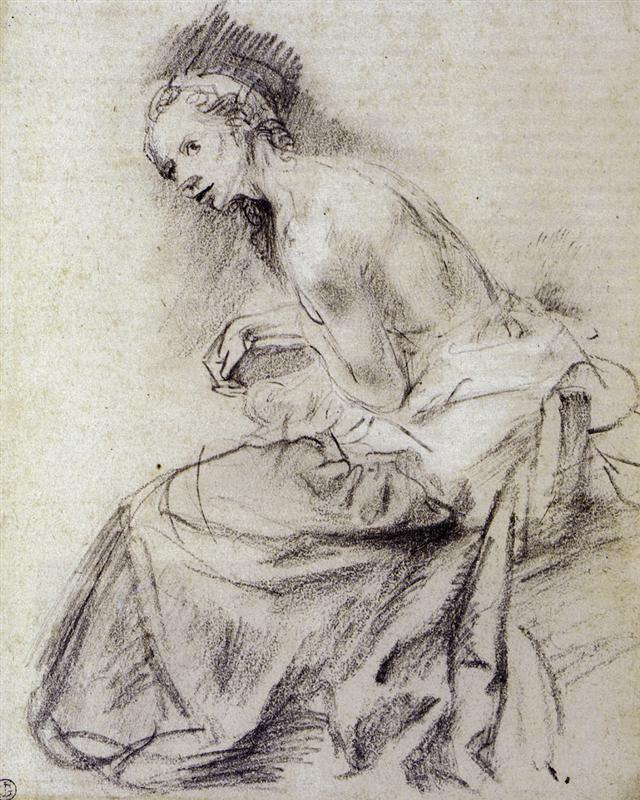
Rembrandt’s 1634 drawing “Female Nude Seated, Suzanne” greets the viewer with a human presence that feels immediate, unguarded, and alive. A young woman sits in three-quarter view, torso angled forward, head turned, mouth slightly open as if she has just spoken or is about to. The body is not posed for ideal display; it is caught mid-rest, mid-thought, mid-shift. What first reads as a quick sketch soon reveals a rigorous orchestration of weight, gravity, and light. With black chalk and touches of heightening, Rembrandt converts paper into atmosphere and the pressure of a hand into the stir of a living model.
A Studio Moment That Refuses Theatricality
The title identifies the model as Suzanne, a reminder that for Rembrandt the nude begins with a person rather than an allegory. This is not Venus on a cloud or Diana in a grove; it is a woman in the studio, hair roughly pinned, fabric pooled around her hips, arms relaxed but ready to move. That refusal of theatrical costume matters. By stripping away mythology, the artist gives the viewer a portrait of attention itself—his attention to her, her attention to something just out of frame. The result is intimacy without display, a vision of the human figure grounded in time and breath rather than myth.
Proportions, Pose, And The Architecture Of Weight
The seated pose reads with persuasive weight because the lines track the body’s engineering. The spine leans forward and twists, setting ribs and shoulder blades into a subtle, asymmetrical rhythm. The left forearm crosses the lap in a compact arc; the right hand gathers a fold of cloth. Hips widen into the cushion of drapery, and the knee projects slightly, creating a diagonal that carries the eye down and forward. The tilt of the head, small but decisive, is the counterweight to the torsional energy of the torso. Rembrandt’s drawing exposes what keeps the pose from tipping: the triangle between bent knee, grounded hip, and planted drapery. Because that triangle is stable, the restless head and ribcage can move inside it.
Chiaroscuro In Chalk
With a few tonal families—warm paper, deep charcoal marks, and faint highlights—Rembrandt builds a basin of light around the figure. The broad, velvety shadows under the skirt are laid with the side of the chalk; thinner, quicker strokes articulate the edges of fabric and the planes of the back. Across the shoulder and the top of the chest, soft halftones open the forms without hard contours. Where skin turns into shadow, the mark dissolves rather than stops, and the viewer’s eye completes the transition. That economy produces a truth photographs often miss: flesh reads as luminous, not because it is white, but because its edges are negotiated, breathing from light into dark.
The Face And The Ethics Of Specificity
The head is drawn with a different pressure than the drapery: more linear, more searching, lightly corrected in places. The open mouth and slightly lifted brows suggest speech or a response to the artist’s instruction. A few decisive lines articulate the cheekbone, the hollow around the eye, the subtle notch above the upper lip. This is not a generic “nude head.” It is Suzanne, present and engaged. The specificity keeps the nude from dissolving into type; it asserts that the study of the body is, finally, a study of a person.
Drapery As A Partner, Not A Prop
The skirt and the mantle wrapped around the hips are not distractions from the nude but partners in the pose. Rembrandt uses cloth to stage light, to anchor the figure on the page, and to reveal motion. Notice the sweeping, semicircular strokes that map the skirt’s volume—each long arc traces the path the model’s weight has pressed into the fabric. Sharp, dark accents at the hem and beneath the folds give the mass its base. Where the model’s hand gathers cloth at the lap, small zigzag marks describe compressed fabric and, by contrast, the softness of skin nearby. Cloth becomes a second anatomy, an exterior record of the interior distribution of weight.
Gesture Drawing That Thinks
The drawing’s intelligence shows in its revisions and apparent hesitations. A faint earlier contour behind the back, a lifted line near the shoulder, and ghost marks around the knee reveal a mind testing alternatives. These “errors” are points of thought. Rembrandt does not erase them into anonymity; he lets them live as a palimpsest of decision. The viewer receives not only a solution but the search that found it, a kind of time-lapse of understanding.
The Contour That Breathes
Rembrandt avoids the deadness of a single, unwavering outline. Along the spine and ribcage the contour thickens and thins, occasionally breaking to let light leak in. Around the shoulder, a short, darker segment presses a form forward; around the flank, a softer pass recedes into tone. This modulation makes the body feel round and permeable to air. You sense distance—not just left to right on the sheet, but forward and back into space.
The Hands As Fulcrums Of Feeling
Both hands are compressed little dramas. The right hand tenses just enough to pinch the cloth, its knuckles marked by quick angles, its fingertip indicated by a single hook of line. The left hand, nearer the lap, opens into a more relaxed curve, suggesting the casual readiness of someone who expects to shift again soon. Hands, more than faces here, carry mood. They argue that this is a break within a session, not a final, frozen pose—a human interval caught by a human witness.
Hair, Headband, And The Trace Of The Studio
The hair is handled with economy—short, scratchy strokes grouped into planes, with a darker sweep behind the head that may indicate a headband or a shadow cast on a studio screen. That dark “halo” is not religious; it is practical: a tonal device that pops the head forward, ensuring that the most psychologically charged part of the drawing is instantly legible at a distance. We feel the studio’s arrangement—the seat, the light falling from one side, the backdrop near enough to catch a shadow—without seeing any of it described explicitly.
The Model’s Gaze And The Viewer’s Role
Suzanne’s eyes angle outward past the artist. She is engaged with something or someone else just to our left. That outward attention brings the viewer into the circuit: we are placed slightly off-axis, aware that we are not the sole addressee of her look. This complicates the power dynamic that often haunts drawings of nudes. Instead of a one-way gaze—artist to model, viewer to body—Rembrandt proposes a triangle in which the model also looks and thinks. The result is dignity without self-conscious display.
Paper Tone And The Quiet Middle
The sheet’s mid-tone does as much work as the pigment. By letting large fields of paper remain unworked, Rembrandt keeps the drawing airy. Light seems to emanate from the sheet itself, so that the body feels bathed rather than spotlighted. The unshaded areas around the figure act like silence around a voice, amplifying what matters by not crowding it. This restraint also heightens the authority of the few white heightenings—on shoulder, breast, and knee—where a touch of chalk clarifies top planes.
1634 And The Young Master’s Commitment To The Human Figure
The date situates the drawing at a moment when Rembrandt, newly established in Amsterdam, is investigating the nude with both curiosity and empathy. Commissioned portraits brought him fame and income; drawings like this kept his eye honest. They practice the essentials: structure, light, motion, and the relation between fabric and flesh. The drawing announces a lifelong refusal to idealize bodies beyond recognition. Even at twenty-eight, he prefers the truth of a torso that twists in real time to a smooth, static emblem.
From Study To Language
Although this sheet was surely made as a study, it reads like completed speech. Every mark carries syntactic weight: long arcs describe volume, jittery hatching describes vibration, short darts of darkness nail down an edge. Rembrandt’s line is a language learned from looking; it conjugates forms rather than naming them. As in great prose, speed and pressure vary to match meaning: fast where motion is implied, slow where weight settles, soft where a contour slips into shadow.
The Nude Without Apology
Seventeenth-century Northern art often clothed the nude in allegory to grant it legitimacy. Here, the nude requires no excuse. Modesty is preserved by posture, not by myth. The torso turns away; the breast is indicated but not paraded; the pelvis is concealed by drapery arranged for comfort, not for tease. The drawing assumes a viewer who can attend to flesh as form and person, not merely as provocation. That trust in the viewer is part of its modernity.
Anatomy And Mercy
Rembrandt’s anatomical knowledge is fluent but never pedantic. The serration of the ribcage, the wedge of the scapula, the swell of the deltoid—each appears when needed and subsides when not. He chooses legibility over display, mercy over medicalization. The body is allowed to be itself, imperfect and credible. Where many draftsmen of the period polished away irregularity, Rembrandt lets asymmetry and the small accidents of posture remain.
The Sound Of The Drawing
Look long enough and the sheet acquires an acoustic. The broad, scuffed chords of tone under the skirt hum like a cello; the brisk, high marks around hair and fingers chatter like a flute; the measured midtones that roll across the shoulder land with the calm of a middle register. This imagined sound is not fanciful; it names the drawing’s rhythm. You can feel where the artist slowed, where he hurried, where he pressed, where he lifted. That rhythm is a form of honesty.
Teaching And Learning From The Page
For artists, the drawing is a concise tutorial. Block the big volumes with side-of-chalk planes. Establish torque by setting the relationship between shoulder line and pelvic tilt. Save the darkest accents for anchoring edges and shadow cores to keep the whole from floating. Place a decisive tonal “backboard” behind the head to bring the face forward. Reserve heightening for the top planes that sell light. Most of all, let the drawing describe weight before detail. The sheet proves that five well-placed value steps can persuade the eye more completely than fifty fussy lines.
Why This Sheet Still Feels New
It feels new because it is about encounter rather than display. The paper records the time two people shared in a room with light. It honors the model as participant and the viewer as a partner in completion. It trusts the viewer to accept incompletion as vitality. In an era saturated with high-resolution images, the drawing’s omissions and abbreviations are refreshing; they give the imagination room to join the work.
Closing Reflection On Presence Without Pose
“Female Nude Seated, Suzanne” is a compact manifesto for Rembrandt’s art. He chooses the human over the ideal, the immediate over the theatrical, the truth of weight over the polish of finish. The chalk behaves like breath, thickening and thinning as attention moves. Suzanne is not immobilized by the gaze that studies her; she remains present, thinking, about to speak. The drawing shows how a line, when laid by a hand that looks with respect, can do what paint and marble sometimes fail to do: make a viewer feel the living now of another person.