Image source: wikiart.org
Introduction
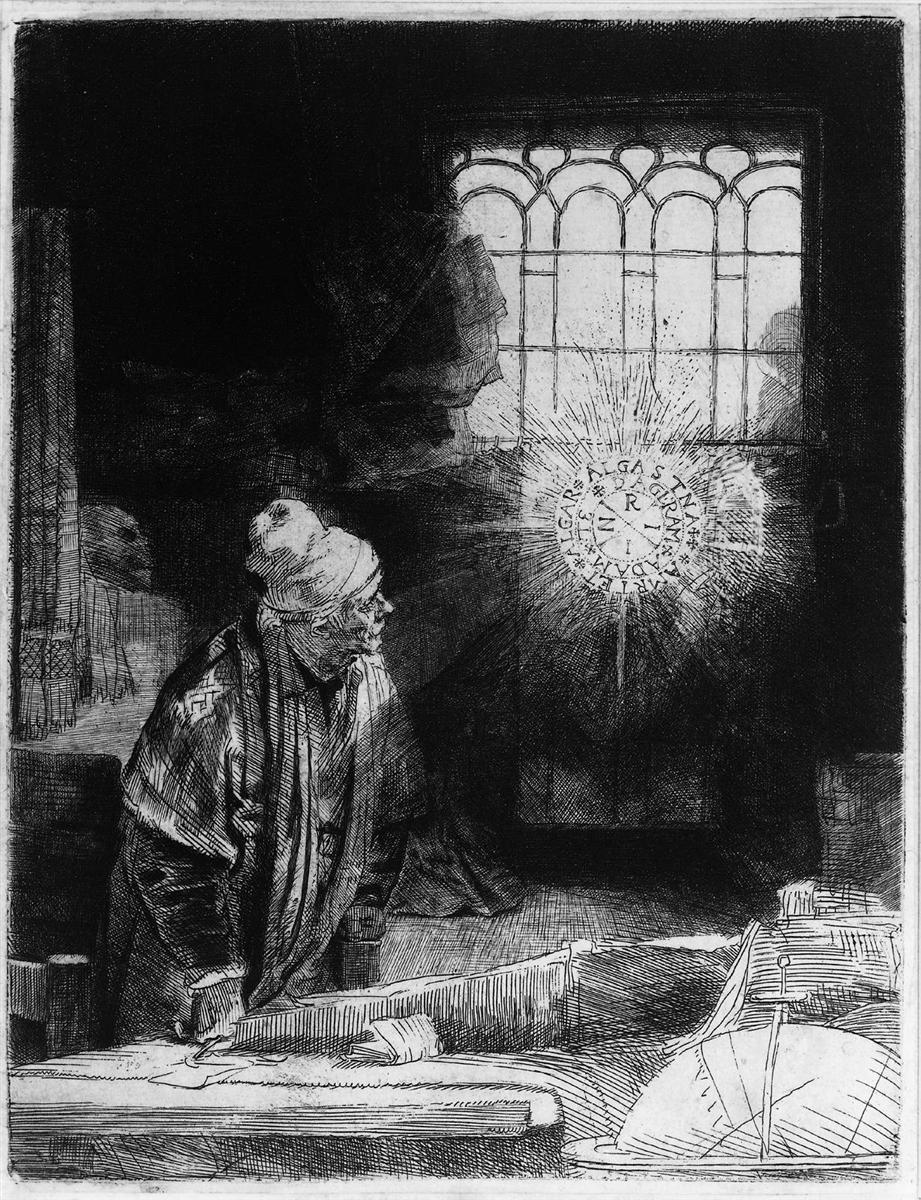
Rembrandt’s “Faust” (1652) is one of the most arresting images of a thinker in Western art. The print shows a solitary scholar in a shadowy room, leaning over a table crowded with books and instruments, his gaze caught by a sudden, radiant apparition: a circular device of letters and symbols that bursts like a star near a mullioned window. Neither fully natural nor fully supernatural, that strange disk turns a quiet study into a theatre of revelation. The sheet is small, the means modest—etched and drypoint lines knit together with plate tone—yet the drama it stages is sweeping. “Faust” is not just an illustration of a legend; it is a meditation on curiosity, risk, and the light by which human beings understand the world.
A Scholar Arrested By Light
Rembrandt constructs the scene around an interruption. The scholar (often called Faust by tradition) has been working—his sleeves are pushed back, a scarf falls loosely across his chest, and books sprawl in front of him like steps of thought. Suddenly, a bright circular blaze appears near the window, each of its concentric rings filled with tightly inscribed characters. The man does not recoil; he leans in. His face, tilted toward the flash, reacts with astonishment tempered by intellectual appetite—the look of a person who wants to know what a marvel means, not only that it exists. In that single posture, Rembrandt captures the mixture of fear, desire, and attention that propels discovery.
Composition As A Theatre Of Mind
The composition is a classic Rembrandt stage: deep shadow frames a pocket of illumination. Three geometric actors govern the space. First, the rectangle of the window with its Gothic tracery establishes a world of order and architecture. Second, the circular apparition cuts across that order with its radiating spokes and concentric rings, a sun within a room. Third, the diagonal of the scholar’s body, braced on the table, funnels the viewer’s eye from the grounded world of objects to the hovering sign. These elements triangulate the print’s meaning: reason (the room), revelation (the disk), and attention (the body) intersect in a single instant.
The Apparition And Its Ambiguities
Rembrandt keeps the glowing device recognizably textual and vigorously ambiguous. We see letters and sigils formed by short, cut lines, compressed into arcs that read like the compressed logic of a seal or prayer. The center contains a small monogram and a cross-like axis; around it, words spiral outward, then explode into rays that strike the room like silent lightning. Is the disk a magical diagram, an angelic message, a mnemonic wheel built by the scholar’s own hand? The artist refuses to say. That refusal is the print’s principal intelligence. By suspending certainty, Rembrandt invites the viewer into the same speculative space the scholar inhabits—between the blessed and the forbidden, the studied and the given.
Light, Shadow, And The Ethics Of Illumination
The print’s lighting has a moral architecture. There are two sources: dim daylight slipping through the leaded panes, and the intense, self-generated glow of the apparition. Daylight prepares the room—it outlines the window and faintly touches the stone—but it is the apparition that animates faces and objects, giving the scholar’s profile its living edge. Rembrandt’s light is not merely visual; it is ethical. It does not flatter; it clarifies. The things that deserve attention become visible, while the rest withdraw into a dignified obscurity. In this way, the print argues that genuine illumination does not wreck the darkness; it coexists with it, making room for mystery even as it exposes form.
The Scholar As Character, Not Caricature
Rembrandt’s man is no stock necromancer. He is elderly but vigorous, wrapped in a robe whose woven borders suggest both comfort and study. The headscarf is practical, the spectacles optional; the hands are large and trained to handle paper, instruments, and thought. Even the posture—leaning, braced, absorbed—feels exact. A lesser artist might exaggerate wicked cunning or naïve fear; Rembrandt chooses recognition. We have met this person in libraries and workshops, in laboratories and studios: someone prepared by long discipline to notice a rare event when it happens.
Instruments, Books, And The Material Culture Of Learning
The table holds a still life of knowledge: thick books, manuscript leaves, a folded cloth used to protect fragile bindings, and a small constellation of measuring tools. At the lower right a circular device lies tilted toward the viewer, engraved with radiating lines and needles—the profile of a sundial or an astrolabe-like instrument. Nearby we glimpse a straightedge, perhaps a compass leg, and a wedge of stacked papers. Rembrandt draws these with quick, persuasive strokes. He does not inventory them to brag about accuracy; he shows them as extensions of the scholar’s reach, the honest tools by which humans parse the world’s order. The apparition arrives not to replace those tools but to test and stretch them.
The Gothic Window And The Memory Of Tradition
The window’s tracery is not a neutral prop. Its architecture evokes older orders of learning—monastic rooms, scriptoria, long lines of inherited commentary. The apparition bursts exactly where that architecture meets the present moment. This placement matters. The print does not set the new against the old; it sets them into dialogue. Revelation, whether interpreted as divine or as the shock of new knowledge, enters through the very framework that tradition supplies. The old window lets in a new light.
Etching And Drypoint: A Language For Night
Technically, “Faust” is a brilliant essay in how etched and drypoint lines can simulate atmosphere. The room’s darkness is not an empty fill; it is a web of lines overlapping at varied densities, with plate tone left purposefully in place so the black breathes. The apparition’s halo is carved by bursts of short radiating strokes. Where the light strikes an edge—book corners, the scholar’s cheek, the cloth’s fold—Rembrandt lifts his hand, letting the paper’s whiteness speak. Drypoint burr, especially around contours in the robe and head, creates a soft fringe that makes the light look like it is sinking into fabric rather than riding its surface. The result is tactile: the eye feels the room.
The Scholar’s Gaze And The Psychology Of Seeing
The print is often read as an image of “Faustian” ambition—knowledge pursued at any cost. Yet Rembrandt’s gaze does not endorse arrogance. The man looks with wonder, not greed. His mouth is slightly open, his brow raised, his body’s weight forward but balanced. He does not clutch at the light; he receives it. This difference is crucial. The print’s drama is not about a bargain with darkness but about the discipline required to meet an unexpected illumination without panic. In Rembrandt’s humanist ethic, the mind’s first duty is attention.
The Table’s Edge As Threshold
Across the foreground runs the thick edge of the table, etched with hatches that bring the wood into relief. That edge is more than furniture; it is a threshold. On this side: the viewer, accustomed to daylight and familiar tools. Beyond it: a room where a strange text has appeared and a man is deciding what to do with it. The heavy lip of the table keeps us participants rather than intruders. We stand exactly where awe belongs—close enough to see, far enough to respect.
Words, Signs, And The Limits Of Language
The radiant disk is filled with legible characters arranged into illegible meaning. Letters promise language even as they deny comprehension. That paradox is the engine of the picture. Rembrandt suggests that revelation often arrives in the shape of language but at a speed or density our training cannot immediately parse. The scholar’s task—and ours—is to remain with the sign long enough for sense to form. The print becomes, in this reading, a parable of interpretation itself: art, science, and faith all begin in the gap between sign and understanding.
A Room Of Silence
Despite the burst of light, the impression remains hushed. No assistants crowd the scene, no curtains flutter, no dog barks. The quiet is necessary; it protects the moment from spectacle. Rembrandt always understood that thought requires a certain acoustics. The stillness around the scholar is not empty; it is charged, like the pause before a verdict or the breath one takes before naming a discovery. By respecting that silence, the print models the interior discipline curiosity needs.
Kinship With Rembrandt’s Other Nocturnes
This sheet converses with Rembrandt’s night pieces of the same decade. In the “Hundred Guilder Print,” light organizes a crowd into zones of listening; in “The Star of the Kings,” it gathers neighbors under a festive spark; in “The Adoration of the Shepherds,” it reverently cradles a newborn. In “Faust,” light does something different: it isolates an inward event. It is not theatrical or communal; it is intensely private. The same techniques—plate tone, scratching rays, controlled highlights—serve a different end: the registration of thought in the very moment it meets the unexpected.
The Moral Of Curiosity
What lesson does the print teach? Not that curiosity is dangerous, nor that revelation nullifies study, but that genuine inquiry sits at the crossing of both. The presence of books and instruments insists that patience and craft are honorable. The arrival of the disk insists that meaning sometimes exceeds method. The scholar’s poised astonishment is the synthesis: be prepared, and be ready to be surprised. Few artworks describe that double duty—discipline and openness—with such economy.
Close Reading Of Key Passages
Look at the scholar’s hand nearest the light. The fingers curl lightly over the cloth, feeling rather than gripping, as if touch could help the mind interpret. Study the starburst itself: at its center a tiny dark cross-axis grounds the blaze, and the rays are not uniform but irregular, flickering where light meets dust. Note the window: each leaded arch is drawn with two lines that swell and thin, making hard glass seem malleable under light. Follow the robe’s border: Rembrandt interrupts the hatching to inscribe a small geometric pattern, a modest display that translates texture into thoughtfulness. Finally, scan the lower right instrument: its clean radial lines rhyme with the apparition’s rays, echoing the idea that human measuring and sudden illumination share a geometry.
Why This Image Still Feels Contemporary
Modern viewers recognize the scene’s central tension: screens flicker with data; theories flash into public view; instruments proliferate; language multiplies faster than understanding. Rembrandt’s “Faust” offers a stance rather than a solution. It tells us to cultivate a room—literal or mental—where surprise can be met with steadiness, where tradition frames and does not foreclose new perception, where hands that know tools also know when to rest on wood and listen. The print is four centuries old and yet it describes, precisely, the felt experience of encountering the unknown today.
Conclusion
“Faust” is a printed poem about illumination. A scholar bends over the work of his hands; a blazing circle interrupts; a room of shadow yields just enough form to trust what we see. With etched lines and drypoint burr, with plate tone left to thicken the dark, Rembrandt composes an ethics of knowing: attend, measure, remember, receive. The legend of Faust hovers at the edges, but the heart of the image is larger and more generous. It is the story of how humans stand when light—of whatever kind—finally arrives.