Image source: wikiart.org
Introduction
Claude Monet’s Farm near Honfleur from 1864 belongs to a crucial moment in the artist’s early development, when he was still shaping the visual language that would later transform modern painting. Although this work predates the mature Impressionist style for which Monet became internationally celebrated, it already reveals many of the qualities that made him exceptional. The painting is modest in subject, direct in mood, and deeply attentive to the shifting character of place. Rather than presenting a grand historical theme or a carefully staged narrative, Monet turns to a quiet rural scene and treats it with seriousness, sensitivity, and pictorial intelligence.
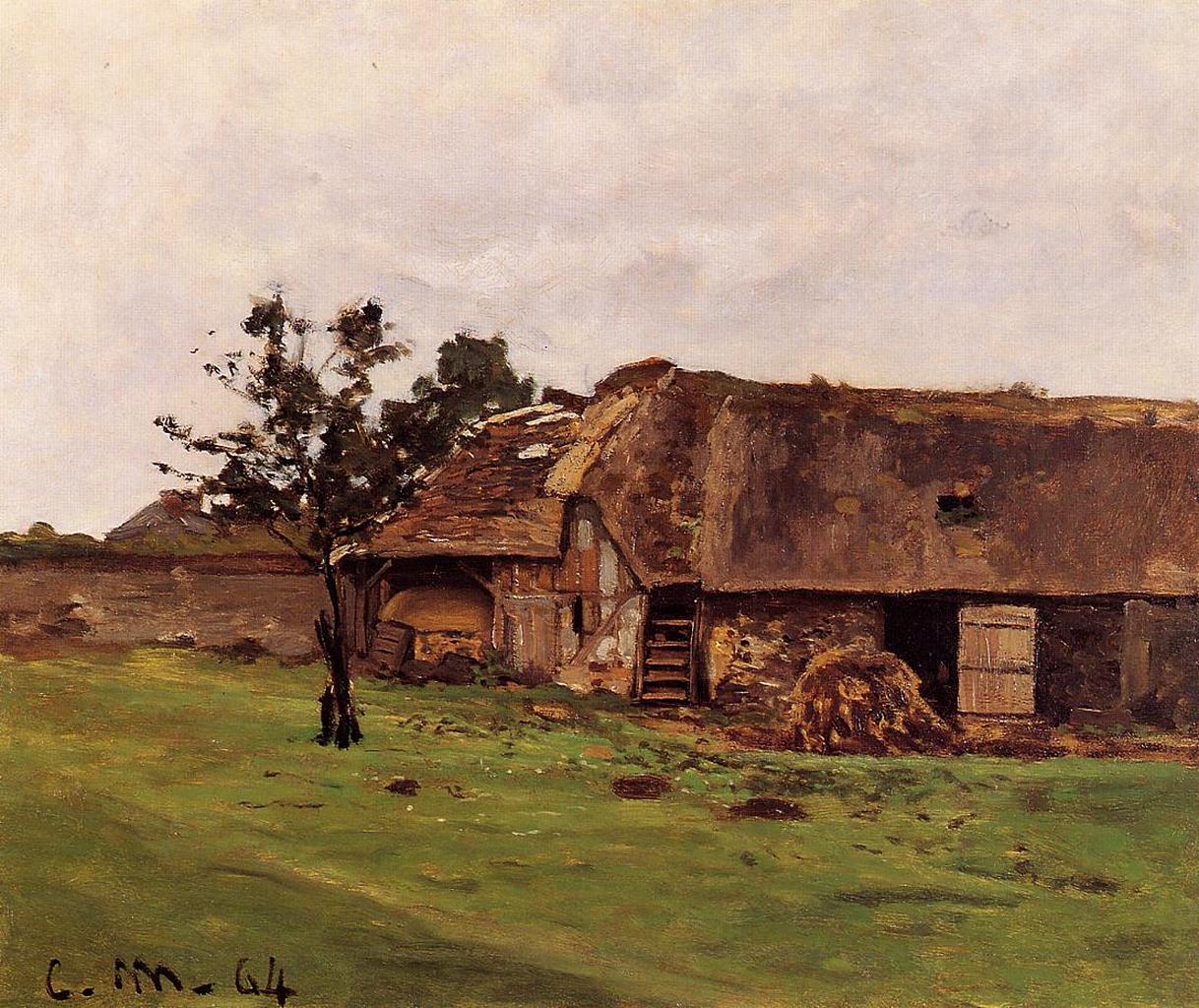
The painting shows a simple farm building set within an open grassy area under a pale, expansive sky. A lone tree stands in front of the structure, breaking the horizontal movement of the composition and giving the scene a subtle emotional center. The buildings appear weathered and solid, their rustic forms merging into the land rather than dominating it. Nothing dramatic seems to happen here, and that is precisely what makes the work so compelling. Monet finds visual meaning in stillness, in modest architecture, in subdued light, and in the ordinary textures of rural life.
This painting is especially important because it demonstrates how Monet’s eye was already moving away from academic idealization and toward direct observation. He was interested in what a place felt like, not just what it looked like in a descriptive sense. The result is a painting that conveys atmosphere as much as structure. It does not simply record a farm near Honfleur. It translates a lived impression of that site into painterly form.
Monet in 1864
In 1864, Monet was still a young artist searching for direction, recognition, and financial stability. He had not yet become the central figure associated with Impressionism, but he was already engaged with many of the ideas that would define that movement. During these early years, Monet absorbed lessons from landscape painters who encouraged direct work from nature, especially Eugène Boudin and Johan Barthold Jongkind. Their example helped him see that the natural world, with its changing weather and fleeting light, could serve as a worthy and modern subject.
Honfleur and the surrounding Norman coast played an important role in Monet’s formation. This region offered a rich variety of visual material, including harbors, farm buildings, estuaries, skies, and open fields. It was a place where land and atmosphere interacted constantly, and Monet responded strongly to that environment. In Farm near Honfleur, one can sense his growing confidence in the rural landscape as a serious artistic subject. The painting does not rely on anecdote or decorative charm. Instead, it is built on close observation and a desire to evoke the character of a real place.
What makes the year 1864 especially interesting is that Monet was still balancing different influences. He had not fully broken from more traditional forms of construction, and this painting reflects that transitional moment. The composition remains structured and stable, yet the handling of light and surface suggests a painter increasingly concerned with immediacy. The work stands at the intersection of realism and the beginnings of Impressionism.
The Subject and Setting
At first glance, the subject of Farm near Honfleur may seem extremely simple. It depicts a rural property with thatched and weathered buildings, a patch of green ground, a sparse tree, and a broad sky. Yet simplicity in Monet is rarely empty. The scene carries visual depth because every element contributes to a sense of place. The farm buildings do not appear newly built or idealized. They are worn, practical, and integrated into the earth around them. Their low forms and rough textures suggest long use and an existence shaped by labor and seasons.
The setting is unmistakably rural, but it is not romanticized into a picturesque fantasy. There are no brightly dressed peasants, no decorative animals placed for charm, and no sentimental storytelling. Instead, Monet presents the farm as a working environment. The haystack near the building, the open doors, and the rough surfaces all point to daily agricultural life. Even if no figures are visible, human presence is implied everywhere through the structures and their functional arrangement.
Honfleur itself, a port town in Normandy, was known for its maritime and rural surroundings. This painting emphasizes the inland, agricultural side of that region. That matters because it shows Monet’s range. Even early on, he was not limited to coastal sparkle or urban activity. He could find pictorial richness in a muted farmyard and in the relationship between buildings, sky, and grass. The subject becomes a meditation on environment, material, and atmosphere.
Composition and Spatial Design
The composition of Farm near Honfleur is one of its quiet strengths. Monet organizes the painting around broad horizontal zones: the field in the foreground, the band of buildings across the middle, and the open sky above. This layered arrangement creates clarity and stability. At the same time, it would risk becoming too static if not for the vertical interruption of the tree, which serves as a pivot between the grounded and the atmospheric elements of the scene.
The tree is placed slightly left of center, which gives the composition a natural asymmetry. It prevents the farm buildings from appearing too heavy or too linear. Its dark trunk and branching silhouette draw the eye upward and create a subtle sense of movement against the pale sky. Because the tree stands alone, it also carries emotional weight. It introduces a note of solitude that deepens the mood of the scene.
The buildings themselves are arranged in a way that feels both practical and painterly. Their irregular rooflines and openings create small variations within the broader horizontal mass. Monet pays attention to how these structures occupy space without turning them into rigid architectural studies. The forms are solid enough to anchor the painting, but loose enough to remain alive as painted shapes. The farm does not sit in space as a sharply outlined object. It emerges from the land through color, tone, and texture.
The foreground field is equally important. It opens the painting toward the viewer and creates a sense of entry into the scene. Rather than filling this area with detailed vegetation, Monet keeps it broad and relatively open. This choice gives the painting air and allows the eye to travel naturally toward the buildings. The field is not empty, however. Subtle shifts in tone and scattered darker accents suggest uneven ground and traces of rural use. These small marks enrich the surface without disturbing the overall calm.
Color and Tonal Harmony
One of the most striking features of Farm near Honfleur is its restrained palette. Monet relies heavily on earthy browns, muted greens, soft grays, and warm ochres. This limited range gives the work unity and seriousness. It also reflects the natural character of the subject. A working farm in Normandy under subdued light would not demand brilliant color. Monet understands that truth and uses it to his advantage.
The greens of the field are especially notable because they are not bright or decorative. They are broken, varied, and grounded by brown and olive notes. This gives the grass a believable density and prevents the landscape from appearing artificially fresh. The building roofs and walls are treated with rich browns and warm neutral tones, suggesting age, weather, and rough organic material. These colors make the structures feel embedded in the environment rather than placed on top of it.
The sky is pale and soft, occupying a large portion of the canvas with understated authority. Its light grayish tone does more than provide background. It establishes the emotional climate of the painting. The scene feels overcast or gently diffused by cloud cover, which softens contrasts and brings the entire composition into tonal balance. Because the sky is so broad and quiet, the darker accents of the tree and building openings become more expressive.
Monet’s sensitivity to tonal relationships is already impressive here. He does not seek dramatic contrast for its own sake. Instead, he builds the painting through close harmonies. Browns lean into greens, grays soften the atmosphere, and darker touches are used sparingly to structure the image. This tonal coherence gives the work a meditative quality. It feels observed rather than invented, and felt rather than performed.
Light and Atmosphere
Even in this early painting, Monet shows an unusual ability to translate atmosphere into paint. Light in Farm near Honfleur is not theatrical. It does not spotlight the buildings or create sharp, decorative effects. Instead, it is diffused across the whole scene, binding everything together. The result is a painting that feels humid, quiet, and specific to a certain kind of weather.
This attention to atmospheric light is one of the clearest signs of Monet’s future path. Rather than using light simply to model forms, he uses it to define the mood of the entire environment. The farm, tree, and field are all seen through the same veil of air. That unity matters. It transforms the painting from a straightforward rural description into an experience of place.
The sky plays a central role in this effect. Its pale expanse suggests a day without harsh sun, perhaps cloudy or softly illuminated. Because the light is even and subdued, the painting avoids strong shadows. This creates gentleness and helps emphasize the tactile quality of surfaces. The farm roofs, the walls, the haystack, and the grass all seem touched by the same quiet illumination.
Atmosphere here is not merely meteorological. It is emotional as well. The softness of the light encourages contemplation. There is no urgency in the scene, no sense of spectacle. Instead, there is patience. Monet asks the viewer to notice the ordinary and to remain with it long enough to feel its depth.
Brushwork and Surface
The brushwork in Farm near Honfleur reveals Monet as a painter in transition. It is not as broken or flickering as the brushwork of his mature Impressionist canvases, yet it already resists academic smoothness. The surface remains visibly painted, with strokes that describe form while also preserving a sense of immediacy.
In the field, the paint appears handled with freedom, using uneven marks to suggest grass and ground without laborious detail. This gives the foreground life and avoids stiffness. The buildings are more compactly worked, but even there Monet does not disappear into polish. The roof textures, wall planes, and dark openings are constructed through painterly decisions that remain visible to the eye.
This matters because visible brushwork changes how we experience the painting. It reminds us that the scene is not just a window onto a farm, but a crafted response to perception. Monet is already thinking in terms of painted sensation. He simplifies, suppresses, and emphasizes according to what will best convey the scene’s character. That selective approach would become central to Impressionism.
The tree is an especially good example of expressive economy. It is not rendered leaf by leaf or branch by branch with botanical precision. Instead, Monet captures its overall structure and presence with dark, active strokes. It reads immediately as a living form, yet it remains unmistakably paint. This balance between recognition and painterly shorthand is one of the work’s most appealing qualities.
Rural Realism and Emotional Tone
Although Farm near Honfleur is not a social realist manifesto, it carries a strong sense of rural truth. Monet does not beautify the farm into a polished emblem of country life. The structures look worn, the tree somewhat sparse, and the sky subdued. This honesty gives the painting integrity. It respects its subject by refusing false grandeur.
At the same time, the painting is not bleak. Its emotional tone is quiet rather than harsh. The muted greens of the field bring a feeling of life, and the broad sky opens the composition rather than pressing down on it. There is a modest dignity in the scene. The farm seems weathered but enduring, plain but rooted.
This tone reflects Monet’s gift for finding beauty in ordinary things without sentimentalizing them. He does not need dramatic ruin, picturesque peasant costumes, or sunset brilliance to make the scene meaningful. The very plainness of the subject becomes a source of depth. The viewer is invited to appreciate texture, balance, light, and atmosphere as worthy in themselves.
The emotional effect is one of calm attentiveness. The painting feels like the product of someone standing before the landscape and allowing its simplicity to reveal itself slowly. That patience is a major strength. It teaches the viewer to look beyond spectacle and to discover the poetry of the everyday.
The Influence of Normandy
Normandy was essential to Monet’s artistic imagination, and Farm near Honfleur helps explain why. The region offered changing skies, moist air, open fields, coastal light, and a visual rhythm shaped by both nature and labor. Its landscapes were not static backdrops. They were dynamic environments in which weather and light constantly altered appearance.
In this painting, Normandy is present not through famous landmarks but through atmosphere and material character. The low farm structures, thatched surfaces, open terrain, and muted palette all reflect a specific local reality. Monet does not need to announce the region through obvious symbols. He conveys it through how things look and feel under its climate.
Honfleur was also a place connected to artistic exchange. Monet’s time there linked him to painters who valued direct outdoor observation. That context deepens the significance of this work. It is not merely a rural picture made in passing. It is part of an emerging vision in which landscape becomes modern because it is seen honestly, in real time, and with full attention to changing conditions.
Why This Painting Matters in Monet’s Career
Farm near Honfleur may not be as famous as Monet’s later views of water lilies, haystacks, or Rouen Cathedral, but it matters greatly because it reveals the foundation of his art. Here we see a young painter learning how to build a picture out of observation, tone, and atmosphere rather than convention. The subject is small in scale, but the artistic ambition is large.
This work shows Monet moving toward a new understanding of landscape. He is no longer treating nature as a stage for narrative or as an idealized decorative setting. Instead, landscape becomes the central event. The farm, sky, and field are enough. Their relation under a specific light is the true subject. That shift would become one of the defining achievements of modern painting.
The painting also shows that Monet’s later innovations did not emerge from nowhere. They grew from years of disciplined looking. Before the bright shimmer of mature Impressionism came works like this one, where he tested how much atmosphere, structure, and feeling could be conveyed through a restrained rural motif. In that sense, Farm near Honfleur is not a minor early work to be overlooked. It is a key chapter in the story of how Monet became Monet.
Conclusion
Claude Monet’s Farm near Honfleur is a remarkable early landscape because it transforms an ordinary rural subject into a deeply felt visual experience. Through restrained color, careful composition, visible brushwork, and an extraordinary sensitivity to atmosphere, Monet gives the scene both solidity and mood. The farm buildings feel real and used, the tree stands as a quiet emotional anchor, and the pale sky spreads a unifying light across the whole canvas.
What makes the painting memorable is its refusal of excess. It does not depend on drama, ornament, or narrative incident. Its power comes from close observation and painterly sincerity. Monet sees the farm not as a quaint object, but as part of a living environment shaped by weather, labor, and time. That approach gives the work honesty and depth.
Seen within the context of Monet’s early career, the painting becomes even more significant. It shows a young artist already drawn to the fleeting, atmospheric qualities of the natural world, yet still grounded in a strong sense of structure and form. It bridges realism and Impressionism, discipline and freedom, description and sensation.
In the end, Farm near Honfleur reminds us that Monet’s greatness was never limited to bright gardens or glittering water. From the beginning, he possessed the rare ability to look at a simple place and discover within it a complete world of tone, light, material, and feeling. That gift is fully present here, in this humble farm under a quiet Norman sky.
