Image source: wikiart.org
First Impressions of a Family Painted as a Living Conversation
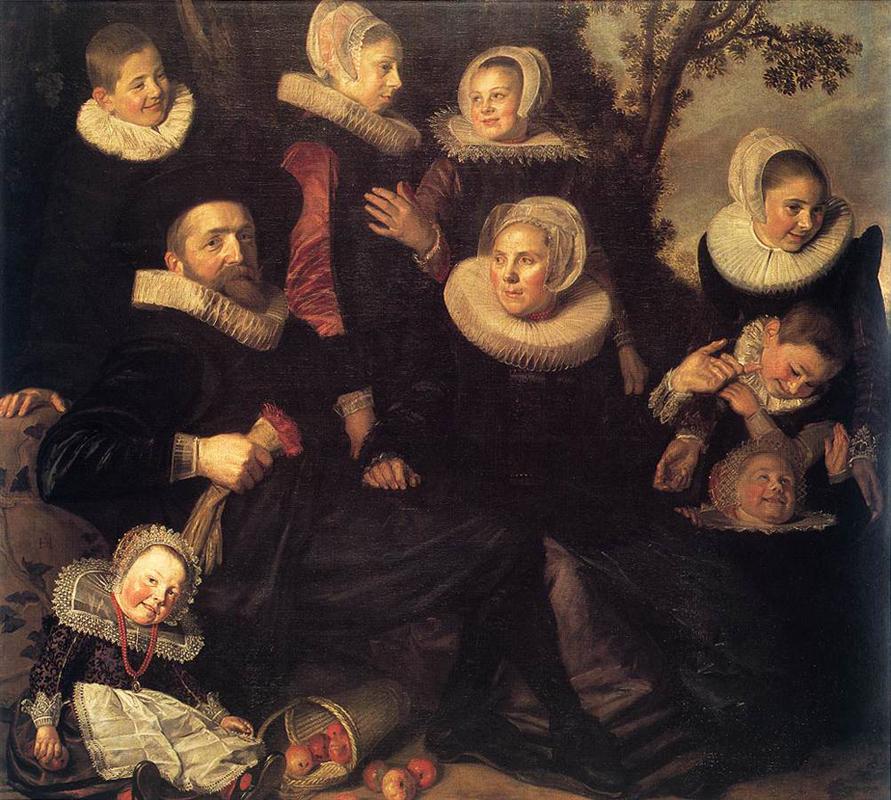
Frans Hals’ “Family Group in a Landscape” (1620) immediately feels less like a posed arrangement and more like a moment caught mid-sentence. Instead of lining his sitters into a rigid hierarchy, Hals builds the painting around glances, gestures, and the soft chaos of a household temporarily gathered in one place. Faces turn toward one another rather than outward toward the viewer. Hands rise as if explaining something. A child leans, another smiles, another appears absorbed in their own small world. The result is a portrait that behaves like life, full of slight overlaps, interruptions, and sudden tenderness.
The title signals an outdoor setting, yet the landscape functions more like a breathable backdrop than a dominant subject. The true environment is social. Hals paints a family as an atmosphere, something created by attention and proximity. You can sense relationships through posture: the calm authority of adults, the lively unpredictability of children, and the shared space that binds them into one image. This is not simply a record of who belonged to whom. It is a demonstration of how a family feels when it is together.
A Group Portrait That Refuses to Become a Statue
Group portraits can easily become stiff, with each sitter isolated into a formal unit. Hals avoids that trap by allowing the composition to remain slightly unsettled, as if the group has only just paused and could resume motion at any second. He does not erase the awkwardness of gathering people. He uses it. The painting contains small disruptions: heads at different heights, bodies angled in different directions, expressions that do not match perfectly. Those disruptions are precisely what make it convincing.
The adults appear composed, but not frozen. Their collars and dark clothing signal status and restraint, yet Hals introduces softness through facial warmth and the subtle play of expressions. The children, meanwhile, are allowed to be children. They do not perform adult calm. They grin, squirm, and drift into their own rhythms. This contrast between adult composure and childhood spontaneity animates the entire scene. The viewer senses the effort of adulthood to keep order and the effortless refusal of childhood to be fully contained.
By embracing this dynamic, Hals creates a group portrait that feels like a real social scene rather than a decorative lineup. It becomes an image of family life, not merely family identity.
Clothing, Ruff Collars, and the Language of Social Respectability
The most striking formal element in the painting is the repeated presence of white ruff collars against dark clothing. These collars create a visual pattern across the group, like punctuation marks of status and propriety. The ruff is not merely fashion. It is a social statement. It signals discipline, expense, and a public-facing respectability. In a family portrait, that matters because the painting itself is part of public identity. It is a declaration of belonging to a certain class and culture.
Hals paints these ruffs with care, but not with sterile precision. They appear crisp and structured, yet they still feel worn by human bodies rather than displayed like objects. The collars frame faces and pull attention upward, ensuring that the viewer reads the sitters through expression and presence rather than through decorative luxury. The black clothing deepens this effect. Black in Dutch portraiture often communicates both sobriety and wealth, since achieving deep black fabric could be costly and carefully maintained.
The children’s clothing, while still elegant, introduces a different register. Their smaller collars and softer facial features create a sense of delicate scale. The contrast between adult heaviness and child lightness strengthens the painting’s emotional range. Hals uses clothing to show hierarchy, but he also uses it to show intimacy, the way the family shares a visual code of respectability while still containing many different personalities.
The Composition as a Web of Glances and Interruptions
What makes “Family Group in a Landscape” so persuasive is how Hals organizes attention. The figures are connected through lines of sight. Some look across the group, others toward a speaker, others outward. This variety creates the sensation of conversation. The painting does not give the viewer one single focal point. It gives multiple centers of interest, like a real gathering where your attention shifts from face to face.
The central adults function as anchors, but the composition is constantly pulled outward by children at the edges. This is emotionally accurate. In families, children often disrupt the neatness of adult arrangements. Hals allows them to do so visually. A child appears low in the foreground, more playful and vivid, creating a diagonal that counters the adults’ more stable mass. Another child at the right becomes part of a small domestic drama, leaning and reacting, suggesting affection mixed with the mild chaos of childcare.
The group’s arrangement also suggests different kinds of closeness. Some figures are physically near but psychologically separate, absorbed in their own thoughts. Others seem emotionally linked through shared gaze. Hals captures these subtle variations without spelling them out. The viewer is invited to infer relationships from small details, which gives the painting an enduring sense of mystery.
Children as the Portrait’s Emotional Spark
The children are not decorative additions. They are essential to the painting’s sense of life. Hals paints them with an emphasis on expression and individuality. Their faces carry blush and brightness that stand out against the restrained adult palette. This brightness is not merely aesthetic. It signals youth as energy, youth as unpredictability, youth as the element that keeps a family from becoming purely formal.
One child in the lower left, dressed with striking detail, seems to acknowledge the viewer more directly. The child’s presence near the foreground brings the image closer, as if the family’s world has spilled toward the viewer’s space. The basket of fruit nearby intensifies this feeling of domestic abundance and everyday life. The fruit is not arranged like a still life trophy. It feels like something that belongs to the family’s outing or gathering, casually included, part of the shared moment.
On the right, another child’s posture suggests playfulness and fatigue, the bodily truth of being young in adult spaces. Hals does not idealize childhood into pure sweetness. He paints it as lively and inconvenient, which is exactly what makes it believable. The children give the portrait its narrative pulse, turning a social statement into a scene.
The Landscape as a Breath of Space and Status
Although the figures dominate, the landscape background matters. It provides a sense of open air and gentle expansion, preventing the group from feeling trapped inside darkness. The tree and foliage at the upper right function as a classical portrait convention, offering a natural frame and suggesting a controlled, respectable environment. This is not wild nature. It is a portrait landscape, a cultivated idea of outdoors that complements the family’s cultivated image.
Outdoor settings in portraits often carry symbolic weight. They can suggest land, stability, and a sense of belonging to a place. Even if the sitters are not literally outside, the idea of the landscape implies that the family has space around them, social space as much as physical. The open background also softens the severity of the black clothing. It introduces a gentler atmosphere, allowing the portrait to feel warmer and less purely formal.
Hals keeps the landscape subordinate. He does not compete with faces. Instead, he uses the background to create contrast and depth. The figures feel closer because the background recedes. That recession gives the family a kind of stage, making their conversation-like arrangement feel even more immediate.
Light, Warmth, and the Painting’s Quiet Unity
The lighting in the painting is not dramatic in a theatrical sense, but it is carefully organized. Faces and collars receive the most light, which makes sense because they are the sites of identity and social signal. The black clothing absorbs light, creating a stable base that allows the whites to glow. Hals uses this classic contrast to unify the group. Even when faces turn in different directions, the repeated rhythm of white ruffs creates a visual cohesion.
Flesh tones add warmth. Subtle reds appear in cheeks and lips, especially in children, giving the painting a gentle vitality. The warmth is moderated rather than flamboyant, which fits the tone of a respectable family portrait. Hals finds a balance between animation and restraint. He makes the group feel alive without making them feel unruly.
This balance is a major achievement. Group portraits can become either too stiff or too chaotic. Hals threads the needle. The family feels like a real unit with real movement, yet the overall impression remains dignified. The viewer senses that this is a family that wants to be seen as stable and honorable, even as the painting quietly admits the reality of different temperaments within the group.
Brushwork and the Sense of Informal Truth
Hals’ brushwork plays a crucial role in preserving the portrait’s liveliness. He does not smooth everything into a polished surface. Instead, he allows paint to retain energy, especially in faces and fabric transitions. The ruffs have crisp edges, but they also show painterly handling. The children’s features are modeled with a touch that feels quick and responsive, as if Hals is capturing expressions before they change.
This painterly approach is part of what makes Hals distinctive within Dutch portraiture. He is not interested in turning people into statues. He is interested in presence. Presence requires slight irregularities, the sense that the painter responded to what he saw rather than forcing it into a rigid template. In “Family Group in a Landscape,” that responsiveness creates the impression that the family is temporarily gathered, temporarily still, and about to shift again.
The brushwork also communicates hierarchy without blunt symbolism. The adult clothing is painted with broad, controlled handling, emphasizing weight and stability. The children’s clothing and faces often have lighter, more flickering touches, emphasizing movement and youth. This difference in handling becomes a subtle narrative device.
Family, Status, and the Portrait as a Public Statement
A family portrait in early seventeenth-century Dutch culture is not simply a private keepsake. It is also a public declaration. It announces lineage, respectability, and social coherence. Hals paints that declaration through dress, posture, and the general impression of calm prosperity. The family appears well-dressed, organized, and capable of presenting itself as a unified group.
Yet Hals refuses to flatten unity into sameness. He allows individuality to remain visible. This is where the portrait becomes psychologically interesting. The painting suggests that a family is both a social unit and a collection of separate minds. Adults carry authority differently. Children express themselves differently. Some figures feel engaged, others distracted. That range does not weaken the portrait’s statement. It strengthens it by making it believable.
The presence of fruit, the outdoor setting, and the relaxed grouping all suggest a family that possesses comfort without needing to prove it through excessive display. The painting’s luxury is quiet. It resides in the ability to commission a portrait, in the refined clothing, and in the painterly intelligence with which Hals renders each face.
The Subtle Drama of Attention and Care
Beyond status, the painting contains a quieter emotional theme: attention. Who watches whom, who listens, who leans in, who is being managed. Family life is often structured around the distribution of attention, especially where children are present. Hals captures this through small gestures and postures that imply care, supervision, and affection.
On the right side, the interaction involving a child suggests a moment of playful handling or mild restraint, the kind of everyday negotiation between adult and child. This is not an idealized Madonna-and-child tenderness. It is more ordinary and therefore more touching. The viewer recognizes the physical reality of family closeness, where affection includes holding, guiding, and sometimes gently controlling a child’s movements.
Even the adults’ expressions imply different forms of attention. One seems more outward-facing, aware of the portrait’s public function. Another seems inward, more absorbed in the group’s internal dynamic. Hals allows these differences to exist, which gives the painting emotional credibility.
Frans Hals in 1620 and the Evolution of Group Portraiture
By 1620, Hals was already demonstrating a powerful ability to animate portraits with a sense of immediacy. While he is often celebrated for later militia group portraits and vivid character studies, works like “Family Group in a Landscape” show how early he was exploring the problem of painting multiple people without turning them into a stiff arrangement.
Hals’ solution is to treat the group like a social event. Rather than making everyone face forward in equal clarity, he allows the group to behave naturally. Some figures turn, some speak, some react. The painting becomes an orchestrated spontaneity. It looks casual, but it is carefully designed. Hals is choreographing a scene that feels unchoreographed.
This approach would become influential because it makes portraiture feel more modern. It implies that identity is not only in a face, but also in interaction. A family is not just a set of individuals. It is a network of relationships, and Hals paints that network into visibility.
Why the Painting Still Matters Today
“Family Group in a Landscape” remains compelling because it captures a timeless truth: families are not static. They are conversations. They are constant negotiations of attention, affection, and individuality. Hals expresses that truth through painterly means rather than sentimental storytelling. He shows it in glances, in the slight disorder of grouping, in the way children disrupt the composition, in the way adults attempt to maintain calm.
The painting also matters because it demonstrates a broadening of what portraiture can do. It can record faces, but it can also record the feeling of shared life. Hals makes the viewer sense not only who these people are, but how they coexist. That is a rarer achievement than simple likeness.
Even across centuries, the scene feels familiar. The children’s expressions, the adults’ composed gravity, the soft background of landscape, the sense of being gathered for a moment that is both ordinary and significant. Hals transforms that kind of moment into an image that still feels alive, still feels like a group about to move, speak, and laugh again as soon as the painter’s brush is lifted away.