Image source: wikiart.org
Introduction
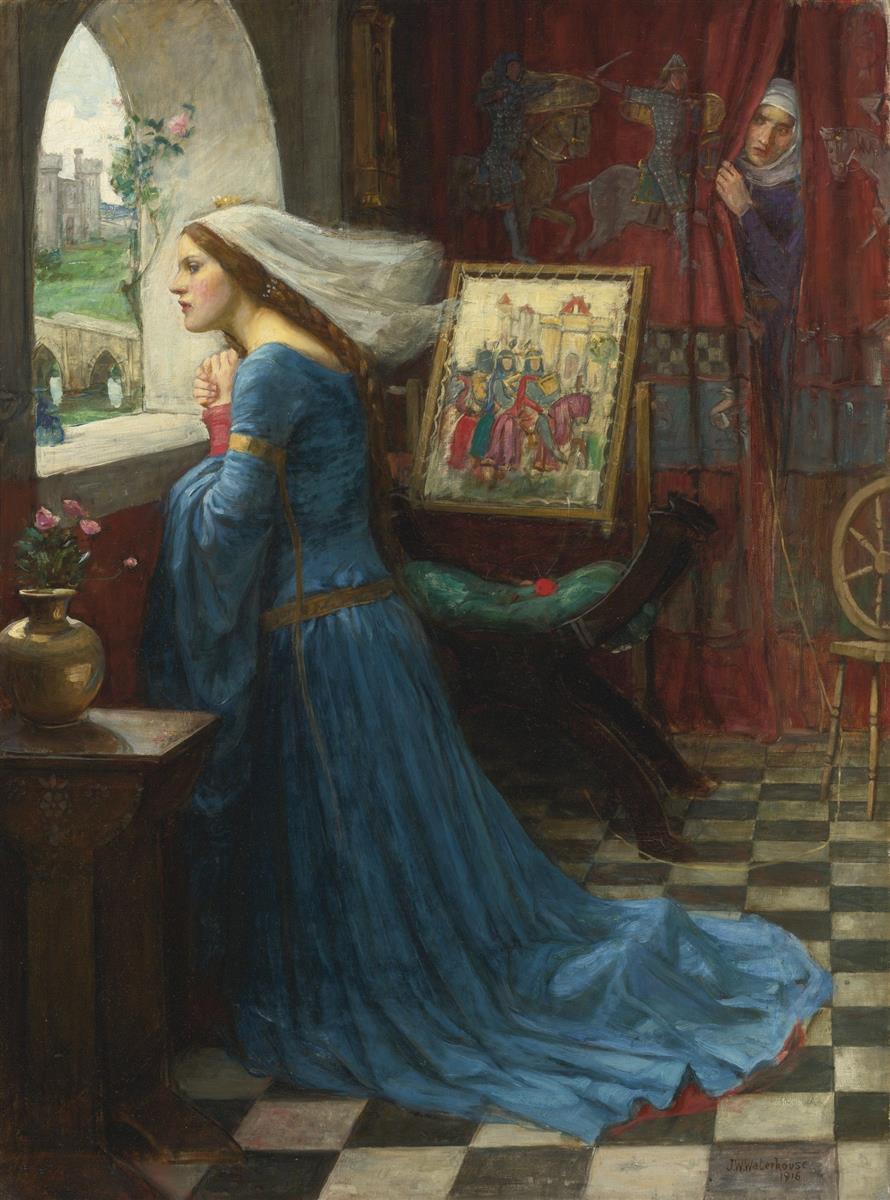
John William Waterhouse’s Fair Rosamund (1916) belongs to the artist’s late period, when his imagination returned again and again to women poised between story and symbol. Waterhouse paints Rosamund not as a distant historical curiosity, but as a living presence caught in a charged moment of waiting. The scene feels private, yet it is saturated with public consequence. A young woman in a blue dress leans at a stone window embrasure, her head turned outward toward light and air. Behind her, the room deepens into shadow and theatrical fabric. Figures half seen, half staged hover in the background like memories or omens. The painting becomes a drama of thresholds: inside and outside, safety and exposure, innocence and knowledge, desire and danger.
Waterhouse’s gift here is not simply to illustrate a legend, but to make the psychological temperature of the legend visible. The image reads as a single instant, but it carries the weight of a longer story. Even if a viewer does not know the tale of Rosamund Clifford, the painting communicates what matters: a fragile calm shadowed by surveillance, the tenderness of a life lived under someone else’s plot, and the tension of a woman whose future is being decided in spaces she cannot fully control.
The Legend and Why Waterhouse Returns to It
Rosamund Clifford, often called “Fair Rosamund,” is wrapped in medieval romance and later literary embellishment. She is remembered as the beloved of King Henry II, secluded from courtly scrutiny and, in some versions, discovered by Queen Eleanor. The legend is less a stable historical account than a cultural mirror, repeated and reshaped to express anxieties about love, power, and punishment. Rosamund becomes a figure through which storytellers explore the costs of being desired by a king and the vulnerability of women when affection is entangled with sovereignty.
Waterhouse, who repeatedly painted heroines from myth, poetry, and medievalized romance, found in such stories a perfect structure for his own sensibility. His women are rarely pure allegories; they are emotional centers whose inner lives are rendered through posture, light, and surrounding objects. In Fair Rosamund, the legend supplies suspense, but the painting’s true subject is the state of being hidden. Rosamund is protected and imprisoned at once. The viewer senses both the sweetness of retreat and the dread of being found.
Composition as a Stage of Secrets
The composition is organized around a strong diagonal that runs from the bright window on the left into the dim interior on the right. Rosamund’s body anchors that diagonal. She leans toward the opening, drawing the eye outward, yet her trailing dress pulls the viewer back into the room, where the story’s threat accumulates. The space is divided into two emotional climates. The window area is cool, pale, and breathable. The interior is red, brown, and heavy with fabric. Waterhouse uses this division to turn architecture into psychology. The window is hope, the room is consequence.
Rosamund is placed slightly left of center, giving her presence dominance without making her confrontational. She is not a heroine on a pedestal; she is someone caught mid thought. The room behind her is not simply background but a second narrative plane. A curtain is drawn aside, revealing an older, watchful figure. The curtain behaves like a theater prop, suggesting that Rosamund’s life is a performance she did not choose, observed by forces that remain partly concealed. At the same time, the picture within the picture, the framed scene of armored riders and a castle, turns the room into a chamber of stories and warnings. Rosamund’s world is being narrated around her.
Rosamund’s Pose and the Language of Waiting
Waterhouse paints Rosamund in profile, a choice that heightens the feeling of withdrawal. Profile is intimate but not reciprocal. We cannot meet her eyes, and she does not acknowledge ours. This creates a poignant distance: she is present to herself, not to the viewer. Her hands gather near her chest, an inward gesture that reads as anxiety, prayer, or self protection. Her posture is not relaxed. It is the posture of someone listening for footsteps, someone measuring time.
Her veil streams back as if stirred by a breeze from the window, giving the scene movement without action. That movement is crucial. The veil is a whisper of the outside world entering the room, and also a visual metaphor for the fragility of concealment. A veil can be lifted. A secret can be uncovered. Waterhouse lets the veil do narrative work: it connects Rosamund to the light beyond, while reminding us that what separates her from danger is thin.
Color and Mood: Blue Against Red
The dominant color contrast is between Rosamund’s deep blue dress and the surrounding reds and browns of the interior. Blue, traditionally associated with calm, fidelity, or spiritual purity, becomes in Waterhouse’s hands a color of quiet endurance. It gives Rosamund dignity. It also makes her stand out like a singular note against a darker chord. The interior reds feel velvety, warm, and suffocating at once. They suggest passion, power, and bloodline politics. Even without explicit violence, the color red carries a sense of stakes.
This palette turns the painting into a psychological map. Blue belongs to Rosamund’s interior self: private, reflective, yearning. Red belongs to the external world of court intrigue and possession: public, controlling, predatory. Waterhouse does not need to show confrontation. He lets color carry the conflict.
The smaller accents reinforce this. The pale stone of the window and the soft greens outside create a corridor of relief. The dark furniture and shadowed floor create gravity. The few floral notes, the pinks and greens in the vase, read as domestic tenderness. They are modest, almost fragile, as if beauty has been permitted only in small doses.
Light as Narrative Pressure
Light enters from the left, washing Rosamund’s face and veil and catching the folds of her dress. It is a light that caresses rather than blasts. Waterhouse avoids harsh illumination, keeping the atmosphere dreamlike. Yet the light has a narrative edge. It pulls Rosamund outward, toward openness and visibility. At the same time, it makes her easier to see. In stories of hidden lovers, light is double edged: it is freedom, and it is exposure.
The interior is lit more sparingly. Forms emerge from shadow, especially the watchful figure by the curtain and the dramatic elements near the back wall. This selective darkness suggests secrecy and surveillance. Waterhouse treats shadow not as emptiness, but as a medium for threat. What is concealed in the dark is not necessarily absent; it is simply waiting.
Objects That Tell the Story Without Words
Waterhouse populates the room with objects that function like quiet narrators. The chessboard floor is one of the most important. Its pattern immediately implies strategy, calculation, and power games. Rosamund stands on a surface that turns her life into a contest between players who might not be her. Even her seclusion feels planned, like a move made to protect a king’s desire or to outmaneuver a queen’s suspicion.
The framed image of knights and a castle acts as a miniature epic inside the intimate scene. It suggests chivalric ideals and the machinery of medieval authority. Knights are supposed to guard and honor, yet they also enforce. The castle is home and fortress. By placing that image behind Rosamund, Waterhouse implies that the romance is never only romance. It is upheld by a whole structure of force and hierarchy.
The vase of flowers near the window adds another layer. Flowers are a common sign of youth, beauty, and transience. They are also domestic, implying a life arranged to please and to soothe. In a secluded chamber, flowers can feel like a gesture of care or a decorative substitute for freedom. Waterhouse allows both readings to coexist.
The Curtain and the Act of Being Watched
The curtain is a masterstroke. It makes the interior feel like a stage, but it also makes the idea of privacy unstable. Curtains are meant to separate, to protect, to hide. Here, the curtain is being pulled back. The act of revealing is happening inside the painting. That means the viewer is not the only observer. Someone within the story is observing too.
The older figure peering from behind the curtain complicates the scene’s emotional balance. The figure may be interpreted as a guardian, a spy, a servant, or a symbolic stand in for judgment. Waterhouse does not spell it out. He leaves ambiguity, which intensifies unease. Rosamund seems unaware, or unwilling to look back. The tension comes from that asymmetry: a watched subject who is turned toward a different horizon.
This is one of Waterhouse’s most modern psychological moves. Rather than painting a climactic encounter, he paints the quiet dread that precedes it. The moment before discovery can be more haunting than discovery itself, because it is filled with imagined outcomes.
Waterhouse’s Late Style and the Softening of Drama
By 1916, Waterhouse’s approach had shifted from the crisp theatricality of some earlier works toward a softer, more atmospheric handling. The brushwork in Fair Rosamund supports mood over spectacle. Fabrics dissolve into painterly passages. Shadows are layered rather than sharply defined. The result is a scene that feels remembered as much as witnessed, like a story resurfacing in the mind.
This softness does not weaken the drama. It changes its register. The painting becomes less about historical reconstruction and more about emotional truth. Waterhouse’s medieval world is not a museum diorama. It is a dream space where human vulnerability is amplified.
The figure of Rosamund exemplifies this. Her face is modeled with tenderness, her skin warmed by light, her expression suspended between longing and apprehension. The painting does not demand that we admire her as an ideal. It invites us to feel the pressure around her.
Themes of Agency, Captivity, and Romantic Myth
The legend of Fair Rosamund often risks turning a woman into a decorative tragedy. Waterhouse partly resists this by giving Rosamund interiority. She is not shown pleading or collapsing. She is upright, composed, and thoughtful. Yet her circumstances remain constrained, and the painting does not pretend otherwise. That tension between dignity and confinement is central to the work’s emotional power.
The room itself is a metaphor of romantic myth. In tales of secret love, the hidden bower is presented as paradise. Waterhouse shows its cost. It is beautiful, but it is also controlled. It contains art, flowers, and luxurious textiles, but it also contains surveillance, strategy, and the looming apparatus of power. Rosamund is surrounded by markers of romance, but those markers feel like staging. The painting asks whether love inside such a structure can ever be free.
The chessboard floor and the curtain together suggest that Rosamund’s life is not simply a private affair. It is a contest of wills, reputations, and political stakes. Her vulnerability is not merely personal. It is systemic.
Why the Painting Still Grips Modern Viewers
Even when stripped of its medieval setting, Fair Rosamund speaks to a recognizable emotional situation: being placed in a secret, being told it is for your protection, and sensing that protection can vanish at any moment. The painting is about the precariousness of safety when safety depends on someone else’s power.
It also resonates because it portrays a woman at the edge of a decision, even if that decision is not fully hers. The window symbolizes possibility. The interior symbolizes consequence. The viewer stands in the position of witness, but Waterhouse cleverly makes witnessing feel complicit. We, too, are looking at Rosamund in a space meant to hide her. The painting becomes a meditation on the gaze: who looks, who is looked at, and what looking can do.
Finally, the work endures because it is both story and atmosphere. It allows multiple levels of entry. A viewer can enjoy the color harmony and the texture of fabric. Another can read the narrative clues and sense the approach of tragedy. Another can focus on Rosamund’s psychology and see a portrait of contained fear. Waterhouse builds a painting that holds all these readings together without forcing a single interpretation.